Bible Crafts for Catholic Kids That Teach Real Truths
Turn simple Bible crafts into memorable Catholic lessons about God’s promises, mercy, vocation, and service. Each hands-on activity begins with Scripture and gives children a concrete way to see, disc
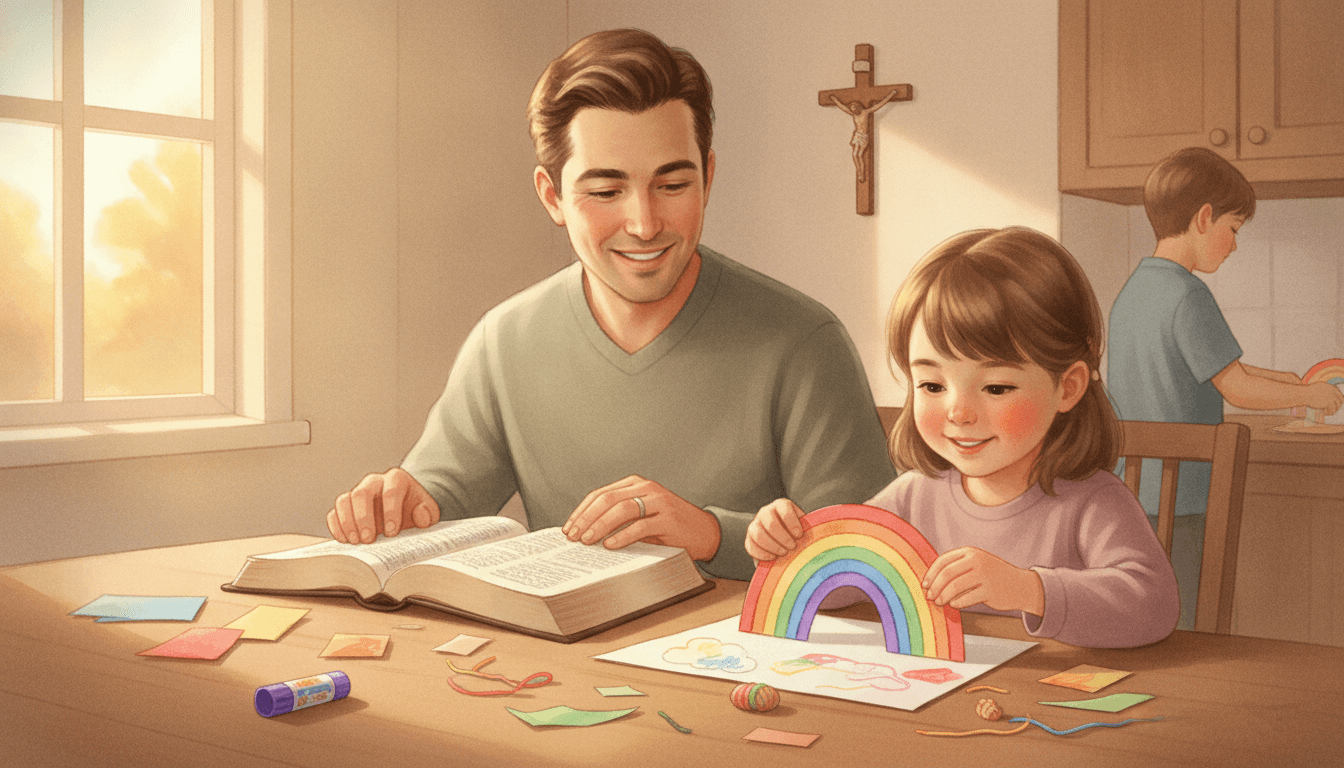
The glue stick is open, the crayons are rolling under the table, and your child is ready to make something. That ordinary moment can become real catechesis when Scripture comes first and the craft helps a child remember one truth about God: his faithful promise, his mercy, his call, and his way of serving.
Begin With the Bible, Not the Craft
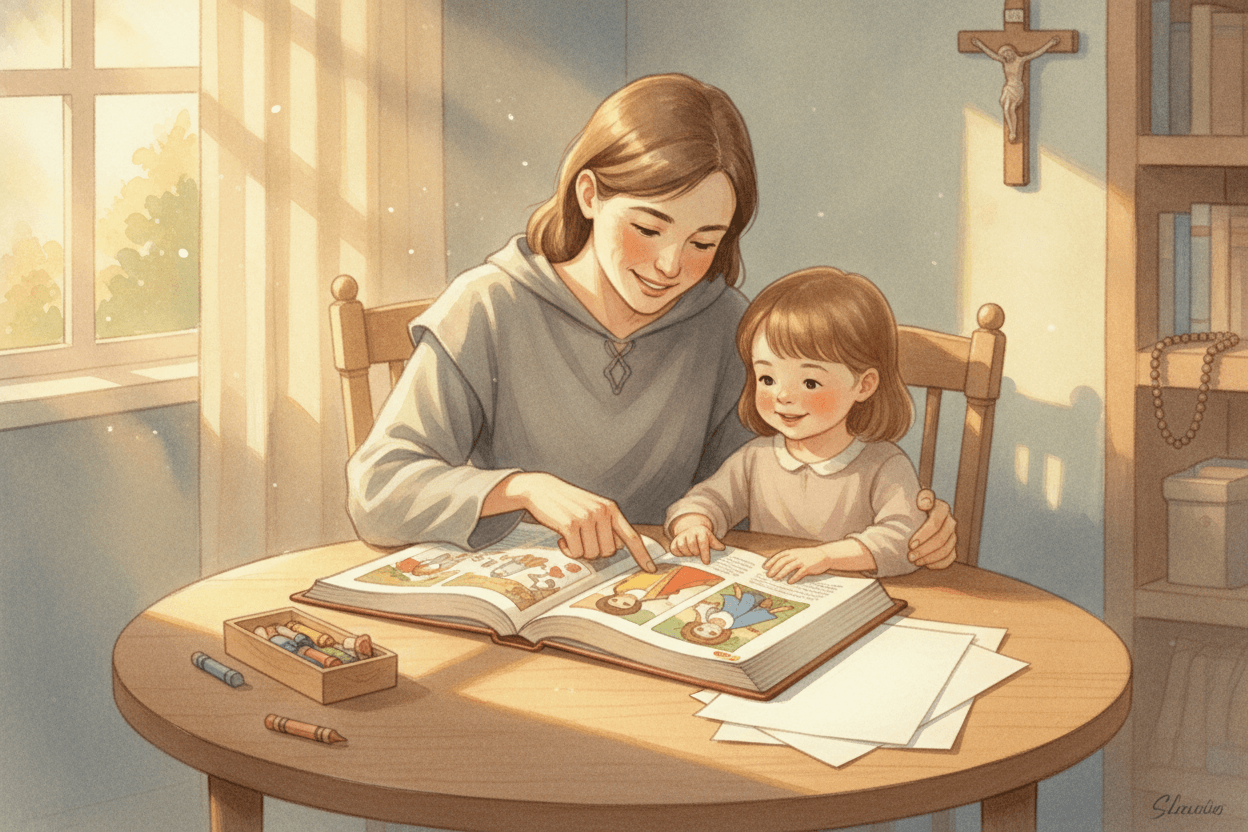
A child may spend ten careful minutes choosing the right color for a rainbow, then be unable to tell you why Noah saw one in the sky. That is not a reason to abandon the craft; it is a reason to put the Bible first. Paper, crayons, glue, and stickers can give little hands a way to remember, but they are not the lesson itself. Read a short passage aloud from a Catholic Bible before opening the supply box. Let the child hear God’s Word, even if he or she wiggles, interrupts, or asks an unexpected question.
For ages three to five, I recommend a simple rhythm that can be repeated almost every time: read, name one truth, make, ask, pray, and respond. Read only a few verses. Name one clear truth: God keeps his promises; Jesus teaches us mercy; Jesus calls us to follow him; Jesus serves. Then make something that points back to that truth, rather than trying to recreate every detail of the story. A paper rainbow after Genesis 9, a heart with bandage shapes after the Good Samaritan, or paper hands marked with helpful acts can all serve this purpose.
As the Catechism reminds us, “Family catechesis precedes, accompanies, and enriches other forms of instruction in the faith” (CCC 2226). The home is not a miniature classroom, and parents need not deliver a lecture. Still, a craft time can become real catechesis when an adult calmly returns to the source: “What did God promise?” “Who needed mercy?” “Whom can we serve today?” One open-ended question invites a child to listen, think, and speak without turning the activity into a test.
Here’s how I’d teach this in a parish class or at the kitchen table: after the child makes the craft, offer a one-sentence prayer and choose one small response for the day. After a mercy craft, perhaps the child brings a tissue to someone who is sad, helps put away toys, or speaks kindly to a sibling. After a covenant rainbow, name one promise your family keeps, such as telling the truth or praying before bed. The response should be concrete and possible, not impressive.
Do not measure the hour by whether the rainbow looks neat or the footprints are evenly cut. Young children learn through repetition, imitation, prayer, and loving conversation. They are learning that Scripture is heard with attention, that God speaks truthfully, and that Christians answer him with love. Jesus welcomes them without demanding a polished performance: “Let the children come to me, and do not prevent them, for the kingdom of heaven belongs to such as these.”
Jesus said, 'Let the children come to me, and do not prevent them, for the kingdom of heaven belongs to such as these.'
A Rainbow Covenant Craft: God Keeps His Promises
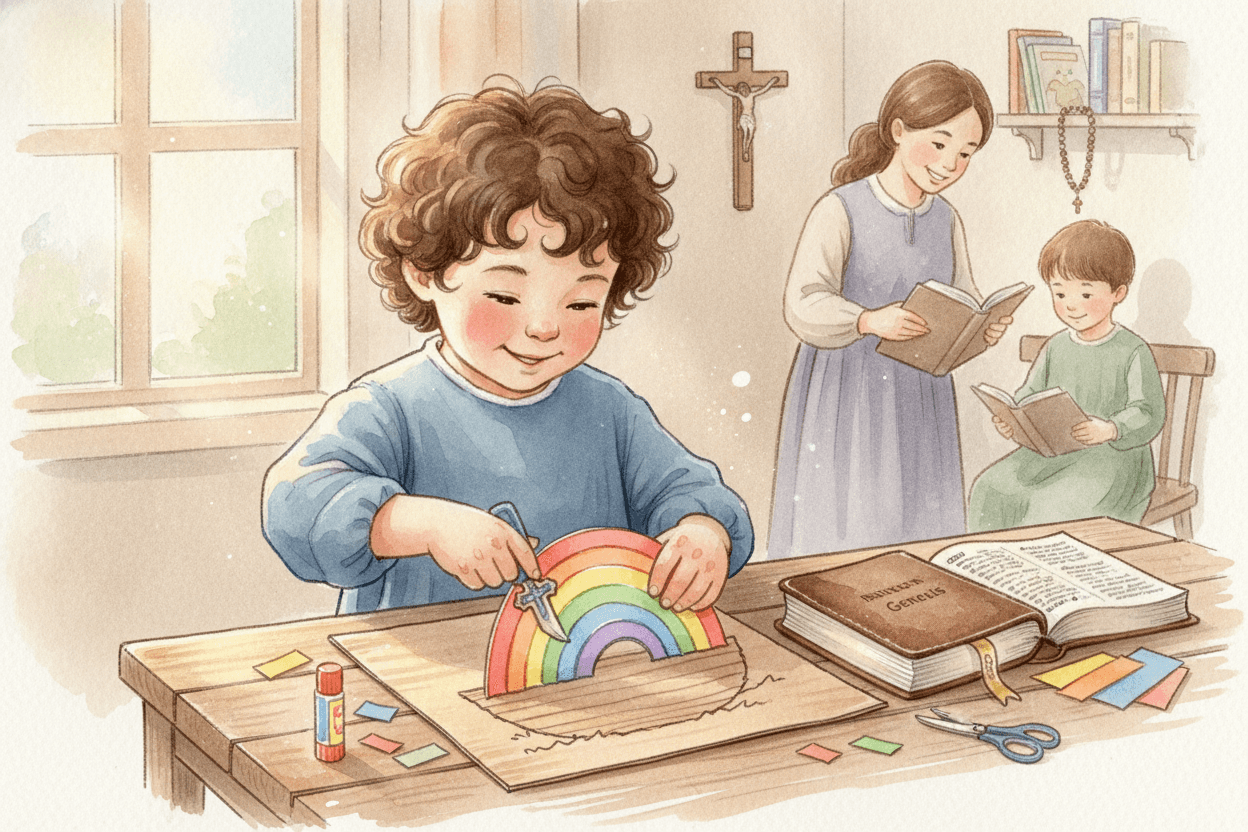
Set a few strips of red, orange, yellow, green, blue, and purple paper on the table, but leave the glue closed for a moment. First, open a Catholic Bible and read Genesis 9:8–17 aloud. Children often recognize a rainbow immediately, yet they need the larger story: after the flood, God spoke to Noah and made a covenant with Noah, his descendants, and every living creature. The rainbow was not given as a decoration or a lucky sign. It was the sign of God’s own faithful promise.
Here’s how I’d teach this: say, “A covenant is a serious promise that God makes and keeps. God promised that the flood would not again destroy all life on earth.” For younger children, that one sentence is enough to repeat together. Older children can notice that God’s promise includes the whole earth and its creatures. Scripture invites us to see God as faithful before we ask children to make any response of their own. The rainbow points beyond itself to the God who speaks, remembers, and remains true to his word.
For the craft, draw a large curved rainbow line on recycled cardboard or a sheet of paper. Let each child glue colored paper strips along the curve, color broad bands with crayons, or cut strips from old magazines. Add cotton-ball clouds only if they do not distract from the central truth. On the back, help the child write: “God keeps his promises.” Then ask, “What did God promise Noah?” and “What is one loving promise our family tries to keep?” A child might name praying together before bed, telling the truth even when it is hard, forgiving after an argument, or helping with a younger sibling. These family practices do not equal God’s covenant; rather, they give children a small, concrete way to practice faithful love at home.
Do not correct every uneven stripe or turn the activity into a quiz. As the Catechism reminds us, family catechesis “precedes, accompanies, and enriches other forms of instruction in the faith” (CCC 2226). Keep the finished rainbow where the family will see it, and return to the promise during the week: “God is faithful; how can we be faithful today?” Close simply: Faithful God, thank you for keeping your promises; help our family to love you and one another faithfully.
I set my bow in the clouds to serve as a sign of the covenant between me and the earth.
A Mercy Heart Craft: Love Moves Toward Hurt
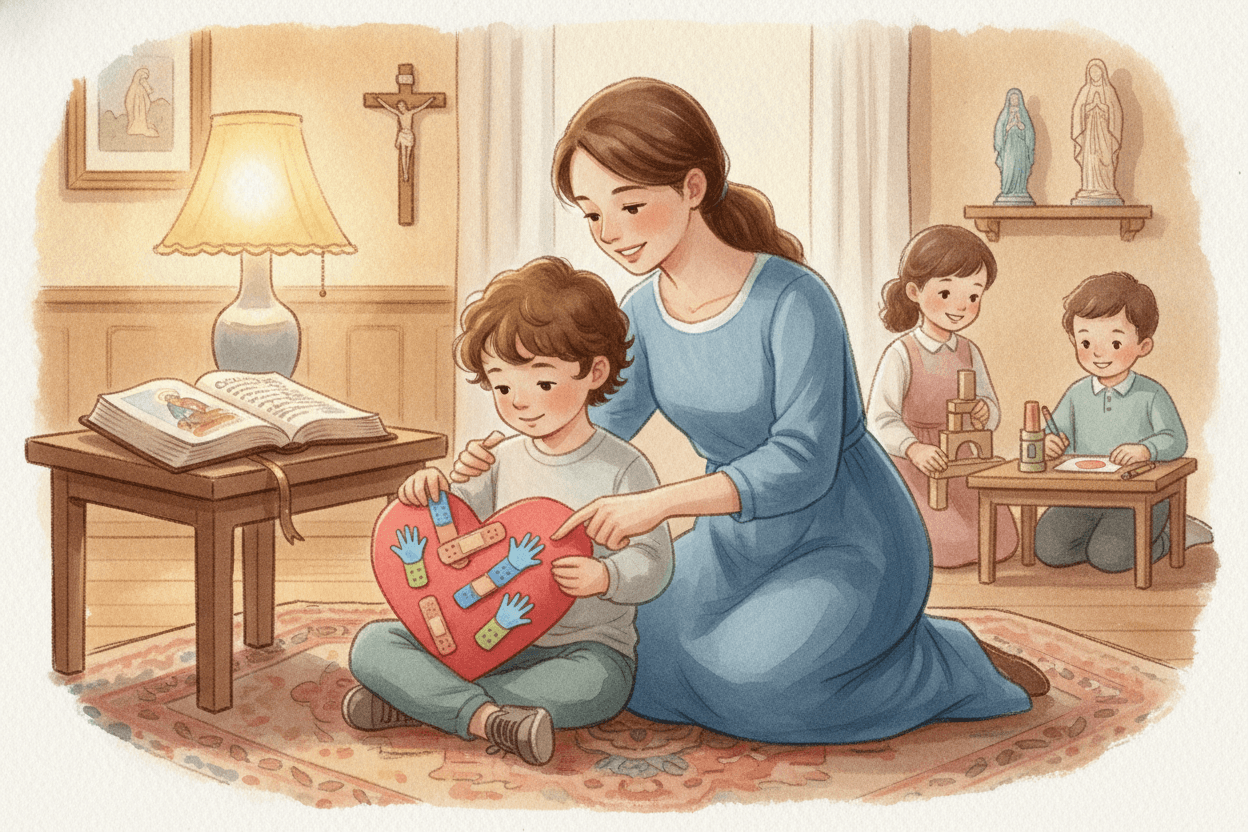
A child can usually spot a scraped knee across the room. The more important lesson is helping that child notice the quieter hurts too: the classmate left out of a game, the sibling crying after a mistake, the parent carrying too many things. Before bringing out paper and glue, read Luke 10:25–37 aloud from a Catholic Bible. Pause at the moment when the Samaritan sees the wounded man and chooses to stop. Mercy is not merely being nice. Mercy notices another person’s need and responds with care, even when helping costs us time, attention, or comfort.
Then make a large heart from red paper or recycled cardboard. Give each child paper bandages cut from cream paper, or use small adhesive-shaped paper strips. On each bandage, let the child draw or dictate one way a person can care for someone who is hurting: bring a tissue, share a toy, sit beside someone who is lonely, help set the table, or speak gently to a brother or sister. Younger children may simply add bandages and name their ideas aloud; older children can write the actions themselves. The finished heart should not suggest that we can fix every hurt. It helps children remember that love does not look away.
Here’s how I’d teach this in a parish classroom: after the reading, ask, “Who needed mercy?” Let the children identify the wounded man, then ask, “Who saw him and helped?” A child may say, “The good man,” which opens the door to explain that the Samaritan was the neighbor who acted with compassion. Next ask, “Whom can we help today?” Keep the question concrete. Children learn mercy through small, real choices much more readily than through vague promises to be kind.
Jesus does not leave the lesson at admiration for the Samaritan. He tells the listener to follow that example. Choose one bandage action from the heart and do it that day. Perhaps a child brings a tissue to someone who is upset, shares a favorite toy without being pressured, or helps prepare supper before being asked. At home, this fits the Church’s understanding of parents as first teachers of faith: “Family catechesis precedes, accompanies, and enriches other forms of instruction in the faith” (CCC 2226). The craft becomes a prompt for Christian practice, not a test of whether a child knows the right answer.
Close by placing the heart where the family will see it during the week. Pray simply: “Jesus, give us eyes to notice people who need help and hearts ready to serve them. Amen.” When a child later points to a bandage and recalls an act of care, the paper heart has done its modest but worthwhile work: it has joined the Lord’s words to an ordinary act of mercy.
He replied, 'The one who treated him with mercy.' Jesus said to him, 'Go and do likewise.'
Footprints of Discipleship: Jesus Calls Us to Follow
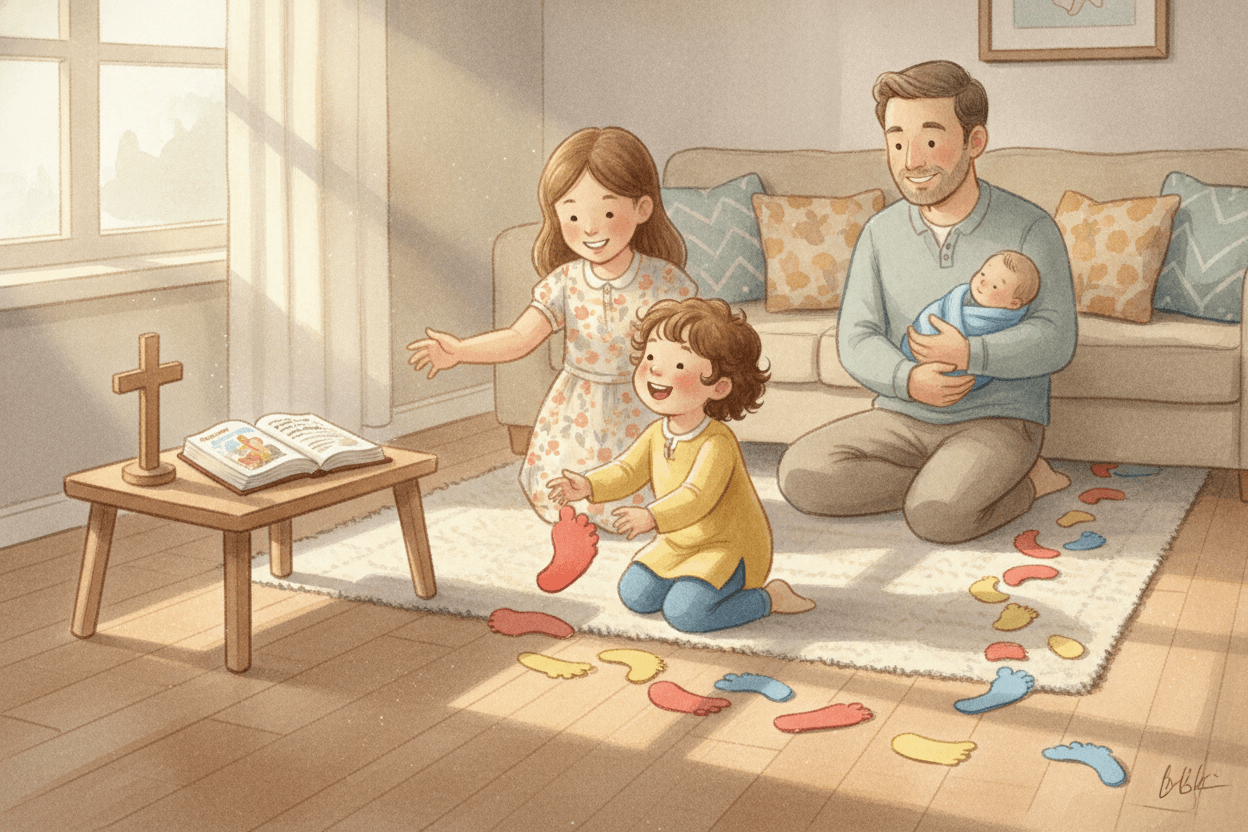
Set five paper footprints across the kitchen floor, leading from the Bible to a small crucifix or prayer corner. Children immediately understand that footprints are for going somewhere. Before anyone picks up a crayon, read Mark 1:16–20 aloud from a Catholic Bible. Let the room be quiet for a moment after Jesus calls Simon and Andrew. Then ask, “What did Jesus ask these men to do?” Their answer need not be polished. The central truth is clear: Jesus calls people to follow him.
On each footprint, write one concrete response: pray, listen, forgive, help, and go to Mass. Children can color the prints, add stickers, or trace their own feet on recycled cardboard. Place them in a short path and invite each child to step from one response to the next. Here’s how I’d teach this: following Jesus is not only something we say with our voices. We follow him in the small choices we make at home, at school, and at church. “Listen” may mean paying attention when a parent speaks or hearing God’s Word at Mass. “Forgive” may mean choosing not to keep replaying a sibling’s mistake.
Be careful not to turn this activity into a quiz about a child’s future. When children hear the word vocation, they may think they must already know whether they will be married, ordained, or enter religious life. Those are real and important ways God calls people, but they are not a decision children must make now. Every baptized person has a first vocation: discipleship. Jesus calls each of us to belong to him and to live as his follower today. A child who prays honestly, receives the faith, serves at home, and learns to forgive is already taking real steps in that calling.
As the Catechism reminds us, parents have a particular role here: “Parents have the mission of teaching their children to pray and to discover their vocation as children of God” (CCC 2226). Family catechesis does not require a formal lesson every evening. It often grows through repetition, imitation, and a loving conversation after the craft is finished. Ask, “Which footprint feels easiest for you today?” and “Which one do you think Jesus is asking you to practice?” Receive their answers without correcting every detail; guide them gently toward one action they can actually do.
Finish by choosing one footprint for the family to practice before bedtime or before the next Sunday Mass. Perhaps everyone helps set the table without being asked, offers forgiveness after an argument, or pauses for a brief prayer. Then pray simply: “Jesus, help us to follow you today. Teach us to pray, listen, forgive, help, and worship you at Mass. Amen.” The paper path may end at the prayer corner, but its lesson belongs in the ordinary steps of family life.
Jesus said to them, 'Come after me, and I will make you into fishers of men.'
Helping Hands: Jesus Teaches Service, Not Attention
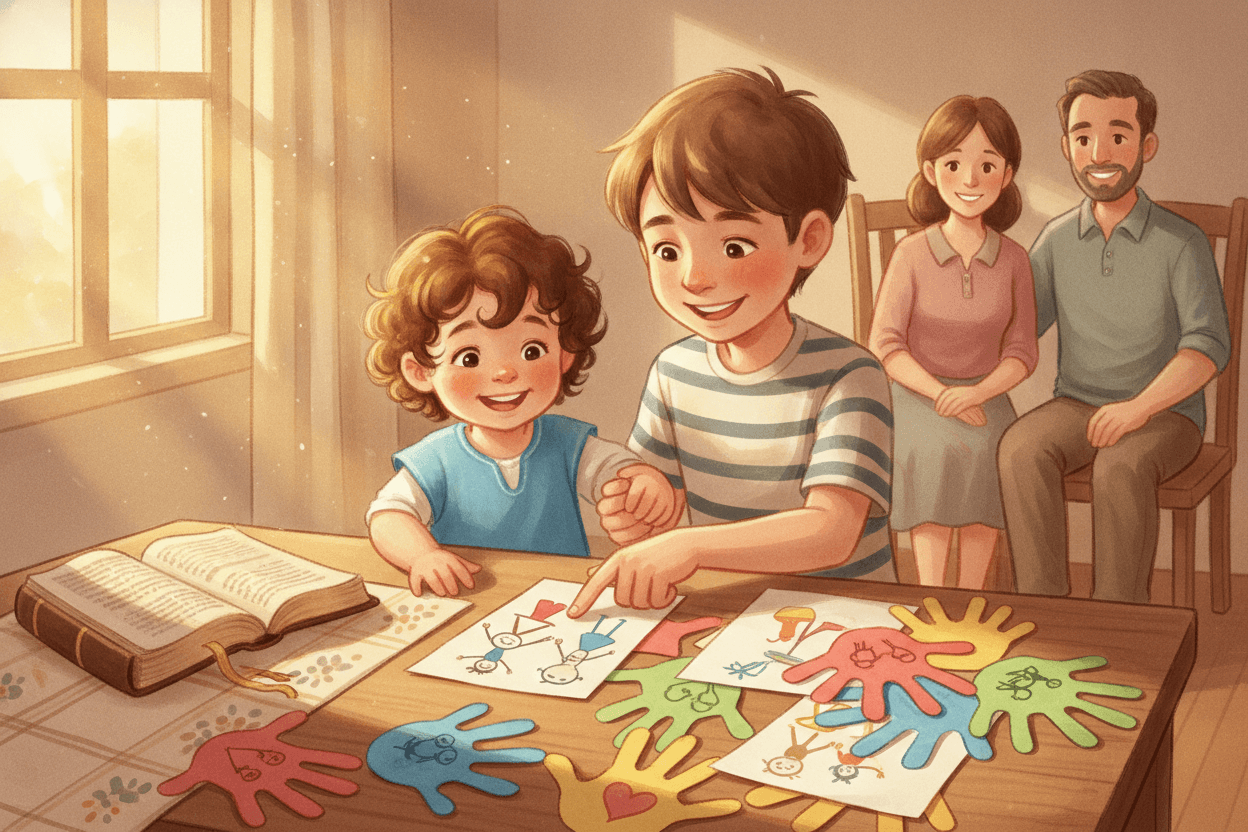
A child who carries napkins to the table and immediately looks around for applause is not being difficult; he is learning something every Christian must learn. We all want to be noticed. Yet after reading Mark 10:42–45 aloud, I would tell children plainly: Jesus teaches us that helping is not a way to become the most important person in the room. We serve because he first served us.
Set out paper, crayons, child-safe scissors, and glue sticks. Trace each child’s hand, or cut hand shapes from recycled cardboard. On each finger, let the child draw or write one concrete act: put toys away, make a card for someone who is sick or lonely, carry napkins to the table, pray for someone, or let another person go first. For younger children, draw simple pictures beside the words. Here’s how I’d teach this: each finger is not a scorecard of good deeds. It is a small prompt to notice where love can take action today.
Then ask, “Whom can we serve today?” and “Would this still be loving if no one thanked us?” Children usually understand the distinction when it is put in ordinary terms. We do not put away toys so everyone says, “What a wonderful helper!” We put them away because shared spaces belong to the whole family. We do not make a card merely to receive praise; we make it because another person may need encouragement. Scripture invites us to look to Christ’s own pattern: “For the Son of Man did not come to be served but to serve and to give his life as a ransom for many.”
Before the day moves on, choose one hidden act of service as a family. It might be straightening the shoes by the door, refilling the pet’s water bowl, wiping the table, or praying quietly for a person who is having a hard week. Do not announce it afterward. This is not secrecy for its own sake; it is practice in loving without demanding attention. If a child does tell someone, receive it gently rather than scolding. Simply say, “I am glad you helped. Next time, let’s try offering it quietly to Jesus.”
This kind of repeated family practice belongs to real Catholic formation, not an extra activity for especially organized homes. As the Catechism reminds us, “Family catechesis precedes, accompanies, and enriches other forms of instruction in the faith” (CCC 2226). End by placing the paper hands where the family will see them and praying, “Jesus, thank you for serving us. Give us willing hands and humble hearts. Help us to love others today, even when no one notices. Amen.”
For the Son of Man did not come to be served but to serve and to give his life as a ransom for many.
Try One Scripture Craft This Week
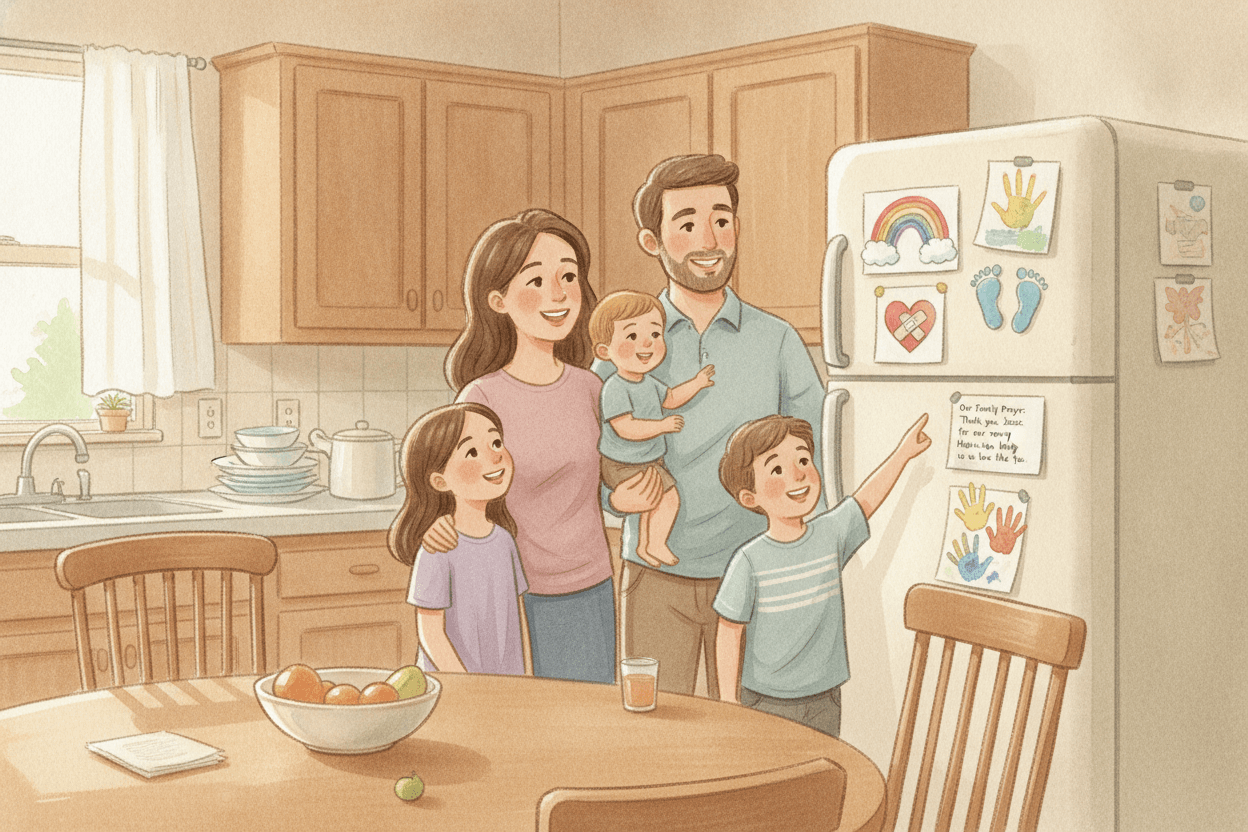
The most fruitful craft time may begin with four ordinary supplies on the table: paper, crayons, glue, and child-safe scissors. Choose one passage for this week—Genesis 9:8–17, Luke 10:25–37, Mark 1:16–20, or Mark 10:42–45—and reserve only ten to fifteen minutes. That small boundary helps everyone begin gladly and finish before a child’s attention, or a parent’s patience, is spent.
Keep the pattern simple: read, tell one truth, craft, ask, pray. Read the passage aloud from a Catholic Bible, even if your child is young. Then state one clear truth in a sentence: God keeps his promises; Jesus calls us to mercy; Jesus calls us to follow him; Jesus teaches us to serve. Make the related paper craft, ask one open question, and close in prayer. Here’s how I’d teach this: the craft is not the lesson’s reward. It is a child-sized way to hold onto what God has said.
For the mercy passage, Scripture gives us the center of the lesson: “He said in reply, 'You shall love the Lord, your God, with all your heart, with all your being, with all your strength, and with all your mind, and your neighbor as yourself.'” A heart with paper bandages can help a child remember that love of neighbor includes practical care. Ask, “Who needed mercy in this story?” or “Whom can we care for today?” Listen without rushing to improve the answer.
There is no need to quiz children afterward or correct every crooked rainbow, uneven footprint, or misspelled word. A child may remember the glue, the conversation, and the prayer long before he can retell every detail of the passage. That is not wasted formation. As the Catechism reminds us, “Family catechesis precedes, accompanies, and enriches other forms of instruction in the faith” (CCC 2226). Repetition, imitation, and a peaceful adult presence teach far more than a polished page.
Match your closing prayer to the passage: for God’s covenant, “Faithful God, thank you for keeping your promises. Help our family keep ours.” For mercy, “Jesus, give us hearts that notice and help people who are hurt.” For discipleship, “Jesus, show us how to follow you today.” For service, “Lord, give us joyful hands to serve without needing attention.” Place the finished craft somewhere visible, then let its truth return naturally at dinner, bedtime, or the next moment your family has an opportunity to love.
He said in reply, 'You shall love the Lord, your God, with all your heart, with all your being, with all your strength, and with all your mind, and your neighbor as yourself.'
Frequently asked questions
How do I use a Bible craft to teach my preschooler about God?
Begin by reading a short passage from a Catholic Bible before bringing out the supplies. Choose one truth for the child to remember, make a simple craft that points to it, then ask one open-ended question, pray briefly, and choose a small loving action for the day.
What does the rainbow mean in the story of Noah?
In Genesis 9:8–17, the rainbow is the sign of God’s covenant with Noah, his descendants, and every living creature. It reminds us that God is faithful and keeps his promise that a flood will not again destroy all life on earth; it is not simply a decoration or lucky symbol.
What Bible craft can teach children about God keeping his promises?
Make a paper or recycled-cardboard rainbow after reading Genesis 9:8–17. Write “God keeps his promises” on the back, then talk about one faithful practice in your family, such as telling the truth, forgiving, or praying together before bed.
How can I teach my child the Good Samaritan story with a craft?
Read Luke 10:25–37, focusing on how the Samaritan saw a wounded man and stopped to help. Let your child add paper bandages to a heart and draw or name acts of mercy, such as comforting someone who is sad, sharing, or helping at home.
What does mercy mean for young children?
Mercy means noticing that someone is hurt, lonely, or in need and responding with care. Help children practice it through small actions they can really do, such as bringing a tissue, speaking gently to a sibling, or sitting with someone left out.
Do Bible crafts need to look neat to be meaningful?
No. The purpose is not a polished project but helping a child hear Scripture, remember God’s truth, pray, and respond with love. Repetition, conversation, and a simple family prayer matter more than straight lines or perfectly glued pieces.
Sources: vatican.va · vatican.va · vatican.va · vatican.va · vatican.va · vatican.va
Scripture quotations in this article use the NABRE translation.