How to Read the Bible With Kids Without Losing Them
Family Bible reading does not require perfect attention or lengthy lessons. Discover practical ways to choose age-appropriate passages, welcome interruptions, and turn restless moments into meaningful
The moment a child starts swinging his legs, interrupting every other sentence, or declaring a Bible story “boring,” many parents assume family Scripture time has failed. It has not. Scripture invites us to begin smaller, choose wisely, and make room for real conversation—because children are not passive listeners but young disciples learning to hear God’s Word.
The Goal Is Encounter, Not a Perfect Bible Lesson
Your seven-year-old is upside down on the sofa, your teenager asks why God allowed something hard in the passage, and someone remembers a missing homework assignment just as you open the Bible. It is easy to read those moments as proof that family Scripture time has failed. They are not. Children are learning that God’s Word belongs in an ordinary home inhabited by real people, with questions, restlessness, and unfinished thoughts. The aim is not to deliver a polished mini religion class. It is to form the habit of coming before the Lord’s Word together.
The Catechism gives parents a steady starting point: “The Christian family is the first place of education in prayer. Based on the sacrament of marriage, the family is the ‘domestic church’ where God’s children learn to pray ‘as the Church’ and to persevere in prayer” (CCC 2685). A domestic church does teach, certainly, but it also listens, receives, repents, gives thanks, and returns week after week. When a parent opens the Sunday Gospel, reads five or ten verses slowly, and asks, “What did you notice?” the family is practicing that listening.
CCC 2688 adds an important detail: the home is a place where children learn to meditate on the Word of God. Meditation is not a test of who can find the correct answer fastest. It begins with attention. A child may notice that the disciples seem afraid; another may wonder why Jesus asks a question when he already knows the answer. Rather than correcting every imperfect observation, receive it and ask one more question: “What makes you say that?” Here’s how I’d teach this after years of parish formation: let the text speak first, then help children connect it to the Church’s faith and to their own lives.
St. Paul describes Timothy’s formation in a way that should encourage tired parents: “But you, remain faithful to what you have learned and believed, because you know from whom you learned it, and that from infancy you have known the sacred scriptures, which are capable of giving you wisdom for salvation through faith in Christ Jesus.” Timothy did not receive Scripture as a one-time achievement. He knew it from infancy, through faithful people who taught him over time. Your family’s brief, repeated return to the Bible has that same patient character.
Keep the first practices small enough to continue: a quiet corner, one short passage, a simple prayer for the Holy Spirit’s help, a few seconds of silence, and one question each person may answer—or pass on. If a child’s question takes the conversation in an unexpected direction, do not panic. Say, “That is worth thinking about,” and promise to return to it if needed. Scripture invites us to trust that the Lord is at work even when the lesson feels untidy. Faithful attention, more than parental performance, is what children will remember.
But you, remain faithful to what you have learned and believed, because you know from whom you learned it, and that from infancy you have known the sacred scriptures, which are capable of giving you wisdom for salvation through faith in Christ Jesus.
Make It Short Enough That Everyone Can Return Next Week
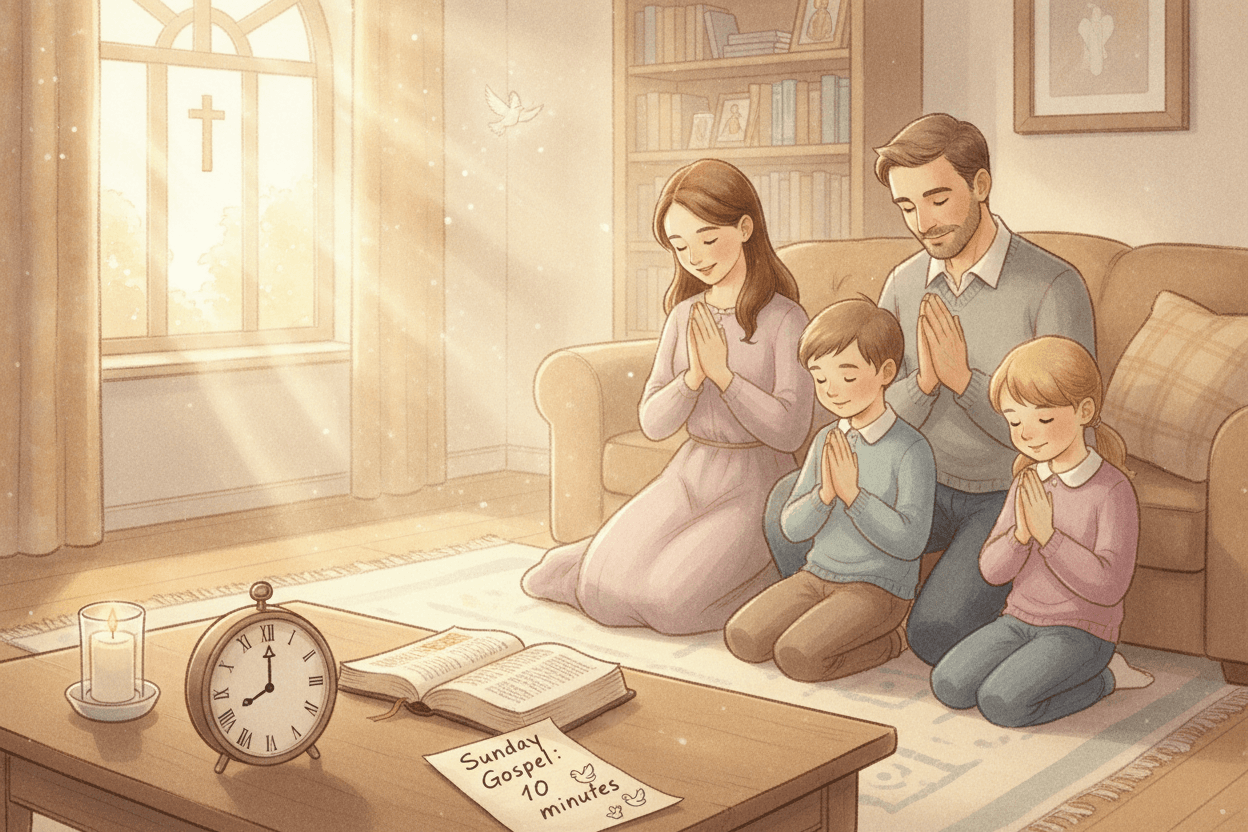
At 7:42 on a Tuesday evening, when one child is looking for a missing shoe and another is halfway through a story about recess, no family needs a forty-five-minute Bible lesson. They need a practice that can survive ordinary life. In parish classrooms, I have seen children return eagerly to a familiar ten-minute pattern; I have also seen their attention disappear when adults try to cover too much at once. End while everyone can still remember that Scripture is a place where the family listens together.
Begin with ten to fifteen minutes, once a week. Choose a quiet corner, put phones aside, and read five to ten verses—perhaps the coming Sunday Gospel, a parable, a healing story, or a passage that meets something your children are carrying that week. Open with one sentence: “Holy Spirit, help us hear God’s Word.” Read aloud slowly. Keep a brief silence, then invite each person to name one word, action, or image they noticed. Two honest questions are enough: “What do you like or wonder about?” and “Where do we see something like this in our week?” Here’s how I’d teach this: do not rush to supply the correct answer. Let children speak, and gently return to the actual words of the passage.
The USCCB gives parents similarly modest counsel: dedicate family time each week to a brief Scripture reading, perhaps the Sunday Gospel, then allow time to reflect and share together. This is not lowering the standard; it is respecting both the Word of God and the limits of young listeners. The Catechism calls the family the first place of education in prayer (CCC 2685), and it notes that children learn to meditate on Scripture first at home (CCC 2688). A short weekly reading says, week after week, “God speaks here too”—at the kitchen table, on the sofa, and in a home where not everyone is equally calm or equally interested.
Do not add more simply because you feel you should. Keep the weekly rhythm for several weeks. If it is becoming familiar rather than burdensome, add a second, even shorter session: five minutes after dinner, or a rereading of Sunday’s Gospel before bed. Barna reported that 81% of engaged Christian parents say their child reads or engages with the Bible independently at least weekly. That figure cannot promise an outcome for any one child, but it rightly encourages us: regular exposure within family life is connected with personal Bible habits. The aim is not to finish a plan. It is to form children who know they can return to the Scriptures—and to Christ—again next week.
Choose Stories Children Can Enter—and Read the Sunday Gospel First
A child who has just listened to the multiplication of the loaves at Mass is already carrying questions home: Why did that boy share? Why were there baskets left over? That is a much better starting point than opening at Genesis 1 with the private goal of reading every page in order. Children ages six through nine need the great sweep of salvation history, certainly, but they receive it first through scenes they can picture, people whose choices they can discuss, and words they can remember.
Choose a small passage—usually five to ten verses—and let the story do its work. Jesus welcoming children, a parable, a healing, a miracle, or a major Old Testament narrative gives children something concrete to enter. Ask, “Which person in this story would you want to talk to?” or “What do you notice about Jesus?” These questions respect a child’s intelligence and leave room for a real answer. Avoid turning every reading into a lecture with one approved moral. Scripture invites us to listen before we explain.
Make the Sunday Gospel your first source of material. Read the Gospel for the coming Sunday at one family gathering, or return to the Gospel your children heard at Mass and ask what they recall. This joins the domestic church to the Church’s public prayer rather than creating a separate family curriculum. The Catechism calls the Christian family the first place of education in prayer (CCC 2685), and it notes that the Word of God has a particular place in family prayer (CCC 2688). A familiar Gospel at home gives children another hearing, which is often where attention and understanding begin.
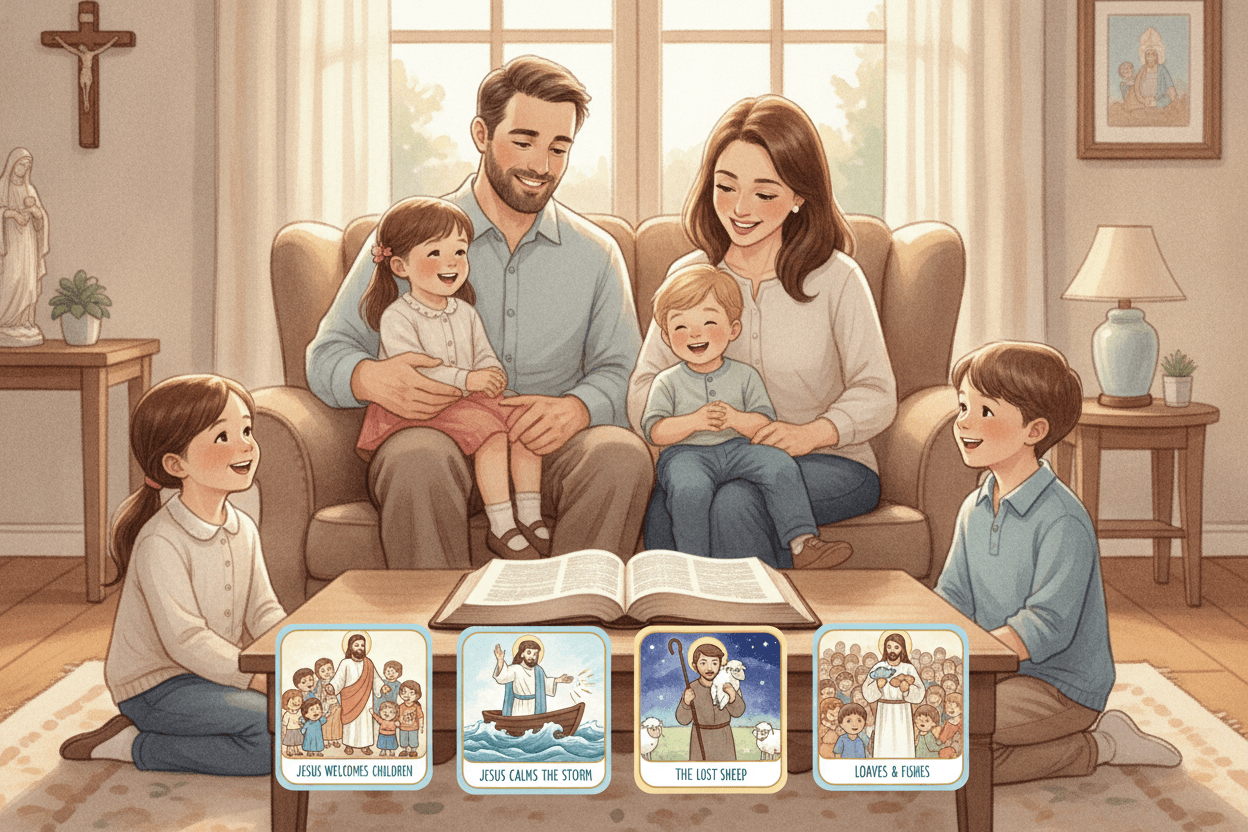
Here is how I’d teach this as a four-week beginning: week one, Matthew 19:13–15, Jesus receives the children; week two, Mark 4:35–41, Jesus calms the storm; week three, Luke 15:1–7, the lost sheep; week four, John 6:1–14, the feeding of the five thousand. Read the biblical passage aloud first, even if a younger child is following from a story Bible. Then pause. For the longer reading in John, you may read it in two short portions or retell only after everyone has heard the words of the Gospel.
After the reading and conversation, a BibleHeroes comic episode connected with that week’s passage can help children picture the setting or retell the action. It is a support, not the lesson itself and never a replacement for Scripture. The order matters: hear God’s Word, sit with it, speak about it, then enjoy a resource that reinforces what was heard. Jesus’ own welcome sets the tone: “Let the children come to me, and do not prevent them; for the kingdom of heaven belongs to such as these.”
But Jesus said, “Let the children come to me, and do not prevent them; for the kingdom of heaven belongs to such as these.”
Use a Children’s Bible as a Bridge, Not a Substitute
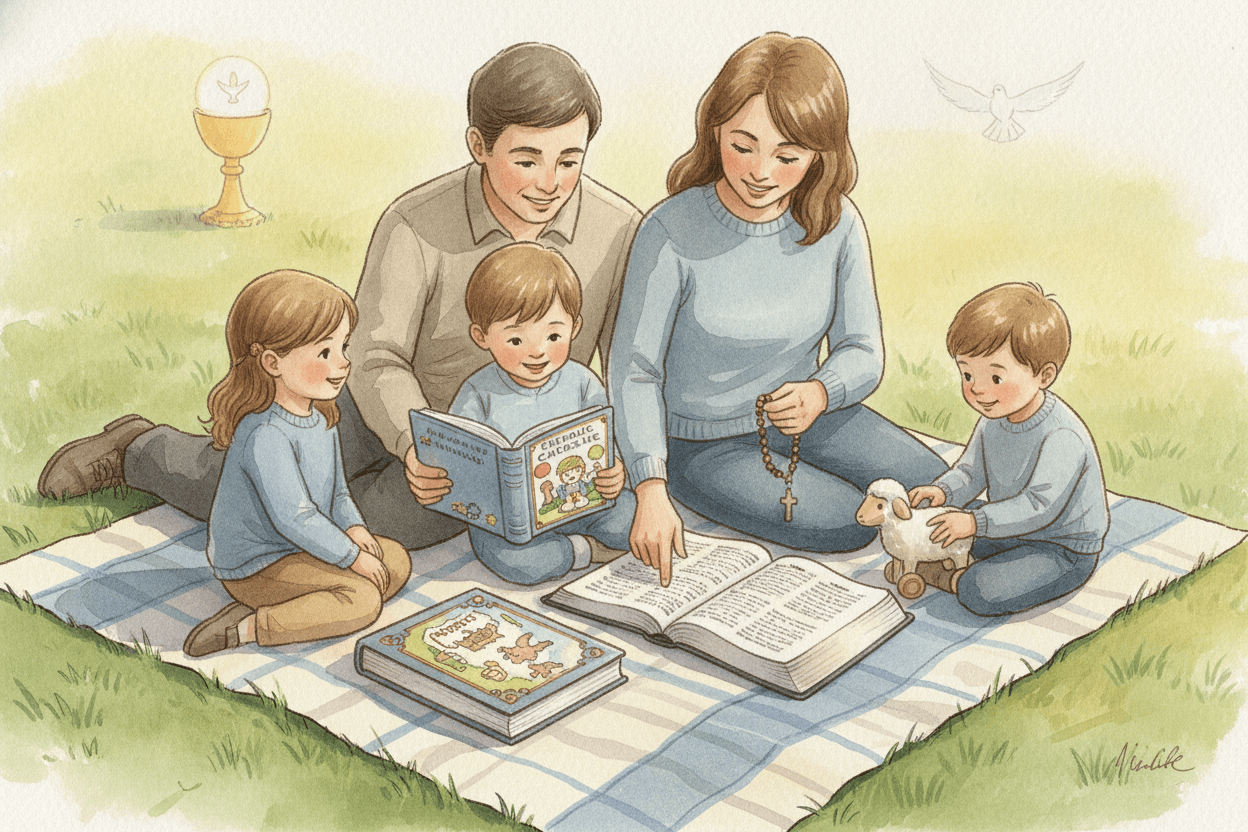
A seven-year-old can follow David facing Goliath in a picture-rich Bible long before he can explain why Israel needed a king. That is not a failure of formation; it is how vocabulary, memory, and reverence begin to grow. A faithful Catholic children’s Bible or storybook gives young children faces, places, and a sequence of events they can hold onto. For ages six to nine, I would gladly place such a book in their hands, especially for the Gospels, parables, miracles, Exodus, and the lives of the patriarchs. But I would keep the NABRE open beside it. The child’s book is a bridge into God’s word, not the destination.
Here is the order I would teach: Scripture first, then a brief explanation shaped by the Church’s teaching, then the picture, retelling, comic, or activity that helps the child remember. Read five to ten verses from the NABRE aloud, even if the language is not yet fully familiar. Then offer one or two sentences of context: “Jesus is showing that he notices a person others tried to ignore,” or “God made a covenant with Abraham, a promise that would bless all nations.” Only after that might you turn to the storybook illustration or retelling. This keeps the inspired biblical text at the center while giving children the support they need to understand it.
Around First Communion, begin reading more directly from the NABRE with regularity. You need not retire the children’s Bible on a child’s seventh birthday, nor should you demand that a new reader master every phrase. Let the two books work together. Read the passage in the NABRE; ask what word, action, or image the child noticed; then consult the age-appropriate aid for a map, a definition, or a visual retelling. If a storybook compresses a passage, say so plainly: “This helps us remember the story, but now let us listen again to what the Gospel actually says.” Children are capable of learning that illustrations serve the text, rather than replace it.
This patient approach is also thoroughly Catholic. The Catechism calls the Christian family the first place of education in prayer (CCC 2685) and teaches that children learn to meditate on the Word of God within the home (CCC 2688). St. Paul recalls Timothy’s formation with gratitude: Scripture invites us to trust that repeated, ordinary exposure bears fruit over time. A parent does not need to become a Bible scholar before opening the NABRE. Read carefully, explain modestly from the faith of the Church, and let a well-chosen children’s aid make the passage memorable. That is substantial formation, not a watered-down version of it.
But you, remain faithful to what you have learned and believed, because you know from whom you learned it, and that from infancy you have known the sacred scriptures, which are capable of giving you wisdom for salvation through faith in Christ Jesus.
Ask Questions That Invite Children to Think, Not Perform
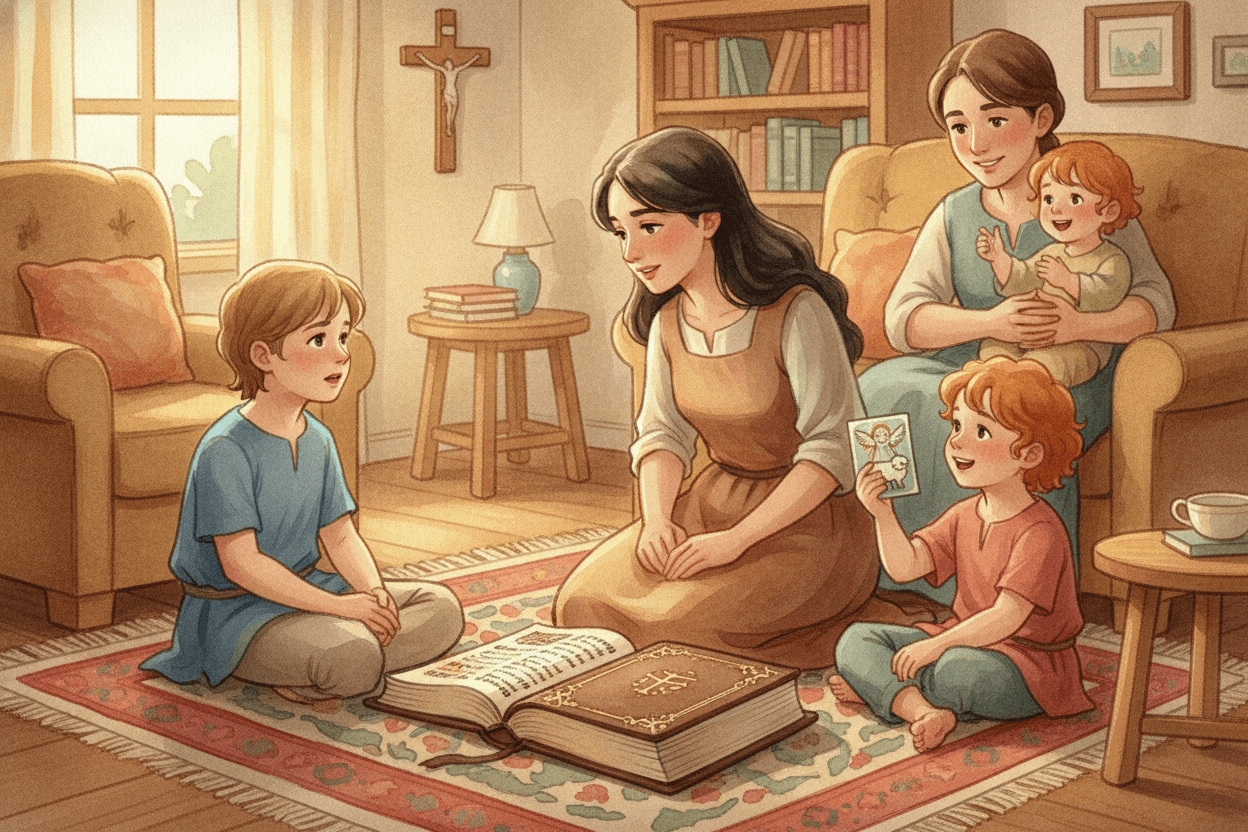
A child has just heard Jesus calm the storm, and the first question she receives is, “What does this teach us?” She looks down, trying to locate the answer she thinks the adult wants. That small moment can turn the Bible from God speaking to us into another subject where children must perform. Catholic children are capable of real reflection, but they need room to notice, wonder, and speak before they are asked to explain a lesson.
Here is a repeatable pattern I have used in parish classrooms and would bring into a family home. Read five to ten verses aloud. Pause for a few seconds—long enough for everyone to hear the passage settle, not so long that younger children become restless. Then go around and ask, “What is one word, action, or picture you noticed?” Receive every sincere answer without correcting it immediately. A child may say, “The boat,” “Jesus sleeping,” or “They were scared.” Those are not incomplete answers; they are doors into the text. Scripture invites us to attend before we interpret.
Next, choose one or two open questions rather than trying to cover every possible point. Ask, “What do you like or wonder about this story?” “Which person would you want to talk to?” “How do you think that person felt?” or “What might this look like at school tomorrow?” With the calming of the storm, a child might connect the frightened disciples to a hard test, a friendship problem, or bedtime fears. A parent can then gently return to the passage: “What do you notice Jesus does when they wake him?” This keeps Scripture first. Your own story and the Church’s teaching can follow, but neither should replace the child’s actual encounter with the words that were read.
Avoid questions that make Bible time feel like a quiz: “Who can tell me the correct answer?” “What is the moral?” or “Why were the disciples wrong?” Also resist the long lecture that arrives after a child shares one thought. Those habits can discourage participation, particularly for children who need time to form their ideas. St. Paul gives parents a sober instruction: “Fathers, do not provoke your children, so they may not become discouraged” (Colossians 3:21, NABRE). In this setting, not discouraging them means refusing to shame a wrong answer, demand adult language, or force a personal application every time.
If no one speaks at first, offer your own brief response: “I noticed that Jesus was asleep. I wonder why that detail is here.” Then let the silence do some work. As the Catechism reminds us, children learn to meditate on the Word of God in the home (CCC 2688). The aim is not to extract polished insights. It is to teach your children, week after week, that they may listen carefully to Scripture, ask honest questions, and bring their ordinary lives before Christ.
Children, obey your parents in everything, for this is pleasing to the Lord. Fathers, do not provoke your children, so they may not become discouraged.
What to Do When the Room Gets Wiggly, Loud, or Quiet
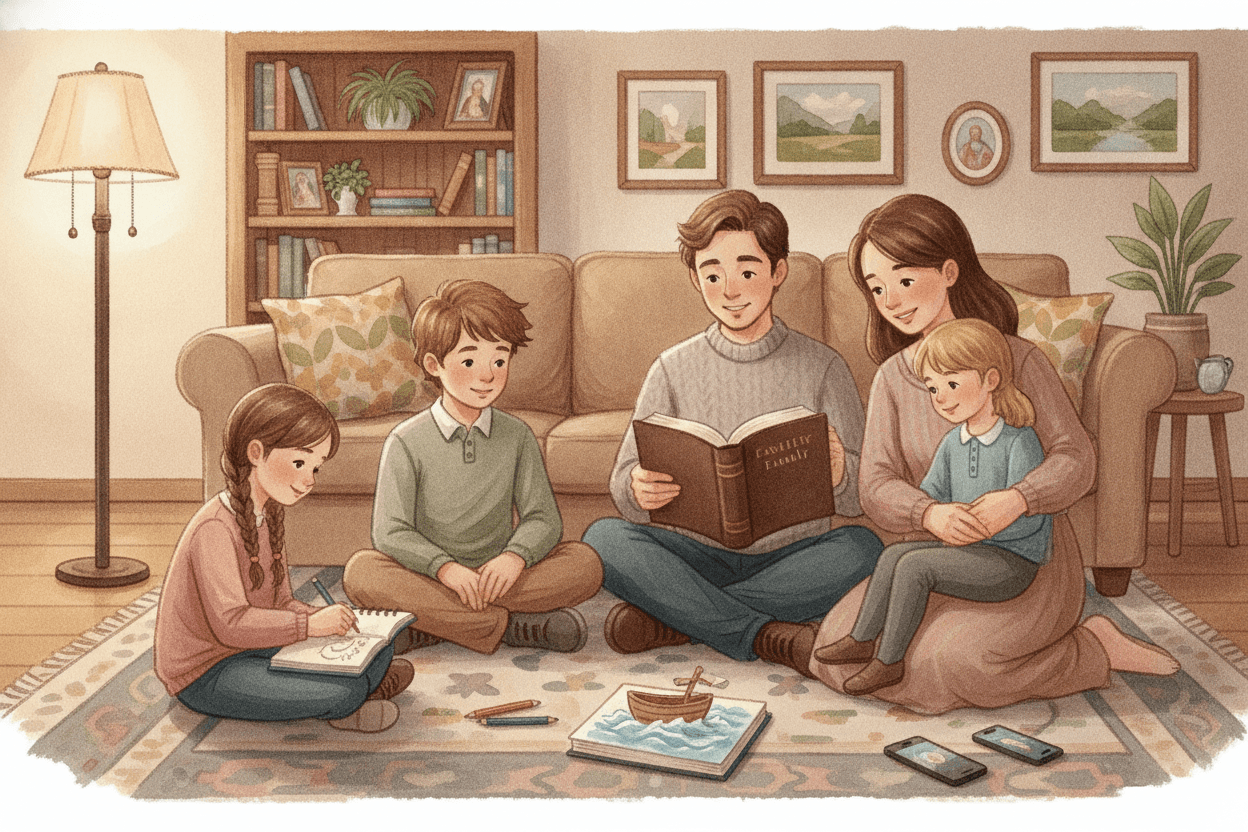
Halfway through the Gospel, someone drops a crayon, one child is lying under the table, and another suddenly asks why God allowed something frightening to happen. This is not evidence that family Scripture time has failed. It is ordinary family life meeting the living Word of God. Reverence does not require everyone to sit motionless or speak in hushed voices. It asks us to treat God’s Word as worth returning to, even amid the noise.
For the child who needs to move, give the movement a purpose. Let her hold the Bible while you read, turn the page, or draw one scene from the passage afterward. A younger child may listen better while coloring Jesus calming the storm or the shepherd seeking the sheep. This is not a distraction from Scripture when the drawing follows the text; it can be a child’s way of attending to it. Catholic children do best when we respect both their intelligence and their actual stage of development.
When a child asks a hard question, resist the temptation to supply a quick answer or redirect the conversation. Try saying, “Let’s look at that together.” Then return to the words on the page: What does this passage say? What does it not say? If the question needs more than a few minutes, tell your child that you will bring it to prayer, consult a trusted Catholic resource, or ask your priest or catechist. That response teaches something essential: Scripture can bear honest questions, and the Church does not ask us to pretend that difficult things are simple.
Quiet children deserve room, too. Invite each person to name a word or image that stood out, but do not require an answer from every child. A child who says nothing may still be listening closely. Keep screens and phones out of reach, choose a comfortable corner, and end while attention remains rather than pressing forward until everyone is frustrated. Ten attentive minutes, or even five, forms a better habit than a long session that leaves children discouraged. As the Catechism reminds us, the family is the first place where God’s children learn to pray as the Church (CCC 2685).
Deuteronomy places God’s Word not only in a formal lesson but in the ordinary rhythms of home: “Recite them when you are at home and when you are away, when you lie down and when you get up.” A bedtime question, a car-ride retelling of Sunday’s Gospel, or a brief prayer after a school disappointment can continue what began around the table. The room may be wiggly, loud, or unexpectedly quiet. Keep the Bible open anyway. Over time, children learn that God speaks not only when family life is perfectly arranged, but right in the middle of the life they actually have.
These words that I command you today shall be in your heart. Take to heart these words which I command you today. Keep repeating them to your children. Recite them when you are at home and when you are away, when you lie down and when you get up.
Try This 15-Minute Family Scripture Habit This Week
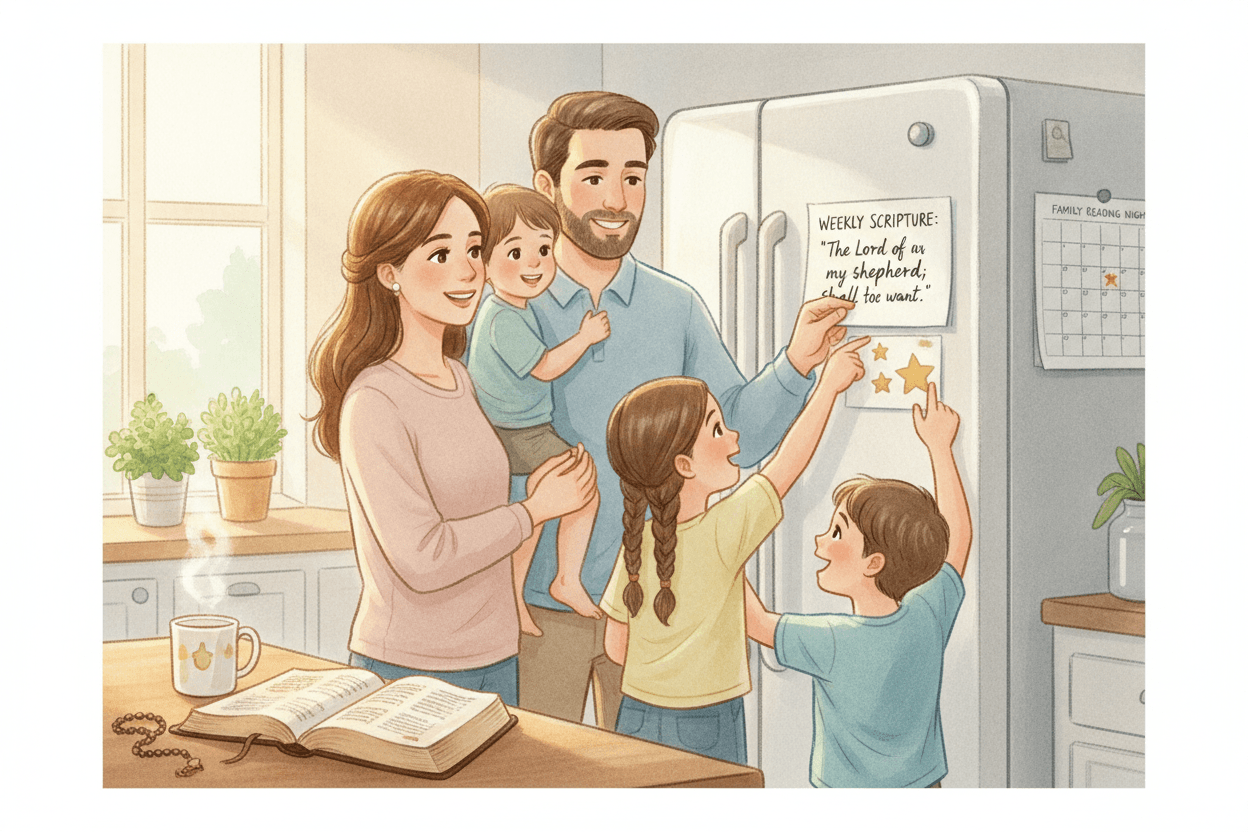
Pick one ordinary moment this week: Sunday afternoon before anyone reaches for a screen, Tuesday after dinner, or Saturday morning while the house is still relatively calm. Choose a place where everyone can sit close enough to hear—a couch, kitchen table, or the edge of a child’s bed—and make it the family’s Scripture place for fifteen minutes. Do not wait for a peaceful week. A recurring time and a screen-free corner will serve your family better than an elaborate plan that never quite begins.
Start simply: “Holy Spirit, help us hear your Word.” Then open the coming Sunday Gospel and read only five to ten verses aloud. If younger children need help following, point to a picture Bible afterward or briefly explain an unfamiliar word, but let the biblical text be the center. The Catechism calls the family the first school of prayer (CCC 2685), and it notes that children learn meditation on the Word of God in the home (CCC 2688). This is not a task reserved for parents who feel like experts; it belongs in the ordinary life of the domestic church.
After reading, keep one full minute of silence. It may feel long at first. A child may wiggle, whisper, or announce that nothing came to mind. Hold the minute anyway, gently and without correction. Then invite every person to name one word, action, or image they noticed. “Boat.” “Afraid.” “Jesus slept.” “The crowd.” Receive each answer before explaining it. Here’s how I’d teach this: thank the child, repeat the observation clearly, and ask one open question such as, “What do you like about this part?” or “How do you think that person felt?” One good question is enough.
End by giving each person the option to offer a one-sentence prayer: “Jesus, help me when I am scared,” or “Thank you for being with us.” A parent can close if the children prefer to listen. Psalm 78 gives parents the purpose without making the moment heavy: “We will not hide them from their children; we will recount to the next generation the praiseworthy deeds of the LORD and his strength, the wonders that he performed.” Your family is not merely covering a religious topic. You are recounting what God has done and making room for your children to answer him.
Before you clear the table, write down one thing a child said in a note on your phone or a small notebook. Their insight may be tender, funny, or surprisingly perceptive; all of it tells you how they are hearing the Word. Return to the same place next week and read the next Sunday Gospel. Measure success by faithful return, not flawless attention, sophisticated answers, or a perfectly quiet room. Short, regular listening teaches children that Scripture has a dependable place in family life—and that they have a real place within its conversation.
We will not hide them from their children; we will recount to the next generation the praiseworthy deeds of the LORD and his strength, the wonders that he performed.
Frequently asked questions
How long should family Bible reading take with young kids?
Start with 10 to 15 minutes once a week, using only five to ten verses. A short practice that your family can repeat is more valuable than a long lesson that leaves everyone discouraged. End while children can still associate Scripture with listening together rather than pressure.
What Bible passages are best for family Scripture time?
The coming Sunday Gospel is an especially helpful choice because children may have already heard it at Mass. Parables, healing stories, and passages connected to something your family is facing that week also work well. You do not need to read the Bible straight through for family prayer to be fruitful.
What should I ask my children after we read the Bible?
Keep the questions simple: ask what word, action, or image they noticed, what they like or wonder about, and where they see something similar in their week. Let each person answer or pass. Instead of rushing to correct an observation, ask what in the passage led them to think that.
What do I do when my child says a Bible story is boring or asks a hard question?
Treat it as an opening for conversation, not a failure. Acknowledge the question, return gently to the words of the passage, and say you will come back to a question that needs more thought. Children learn that Scripture belongs in real life when they can bring honest reactions to it.
How can I make family Bible reading a Catholic prayer habit?
Begin with a brief prayer such as, “Holy Spirit, help us hear God’s Word,” read slowly, and allow a few moments of silence before sharing. This reflects the family’s role as the domestic church, where children learn to pray and meditate on Scripture. Consistent, humble attention matters more than giving a polished lesson.
Should we add Bible reading every day as a family?
Establish one manageable weekly session first and keep it for several weeks. If it becomes familiar rather than burdensome, add a very short second time, such as rereading Sunday’s Gospel after dinner or before bed. The goal is a durable rhythm that helps children return to Christ and Scripture over time.
Sources: usccb.org · usccb.org · vatican.va · access.barna.com · access.barna.com · aleteia.org · aleteia.org · catholic.com
Scripture quotations in this article use the NABRE translation.