A 15-Minute Sunday Gospel Time for Catholic Families
Turn the Sunday Gospel into a manageable family rhythm with a snack, one focused question, and a simple prayer. These 15 minutes help children—and tired parents—remember what they heard at Mass and ca
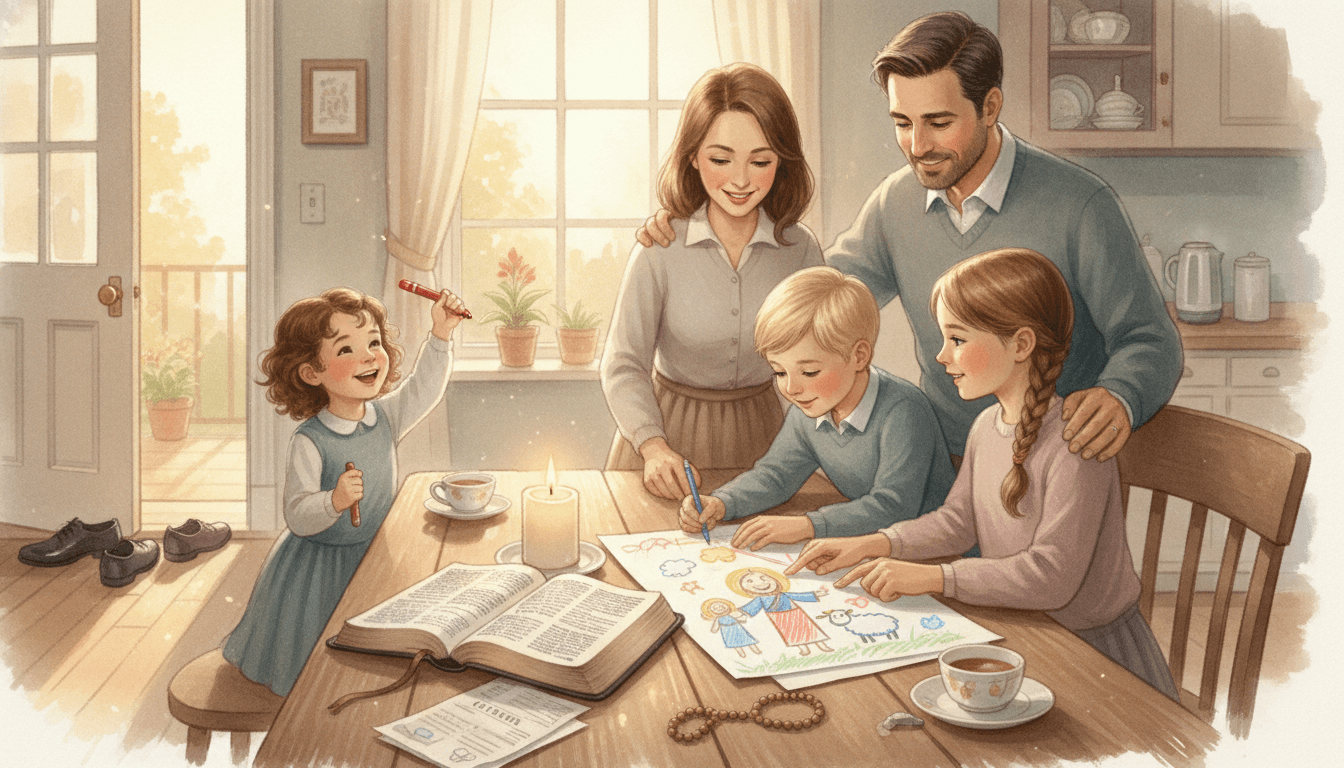
The shoes are kicked off, someone is asking for a snack, and the homily is already getting fuzzy. At our table, we have learned that 15 quiet-ish minutes with the Sunday Gospel can help the Word heard at Mass land in the kid sitting right in front of us.
When the Homily Gets Lost Between Mass and Lunch
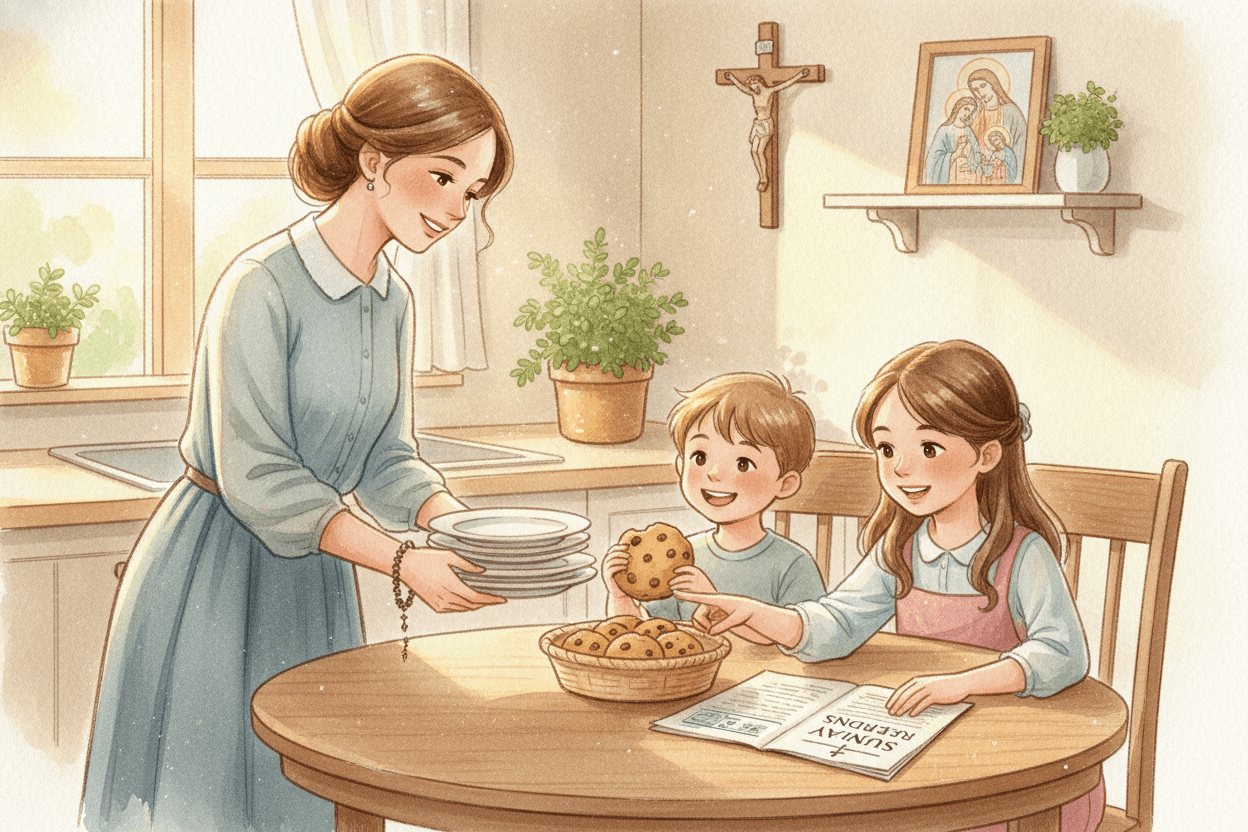
By the time we get to the car after Sunday Mass, somebody needs the bathroom, somebody is asking about donuts, and somebody has found the one church bulletin that must be folded into a paper airplane immediately. The homily may have been good. The Gospel may have hit home. But lunch, laundry, and a missing shoe can swallow it whole before noon.
That is why a 15-minute family Bible time can help. Not because parents need to turn the dining table into a second church service. And not because every child needs to offer a polished answer about the meaning of the Gospel. Sunday Mass is the center. This little pause simply carries one piece of what we heard into the noisy, ordinary hours that follow.
In our house, we have learned that short beats ambitious. Pull up the current Sunday Gospel on the USCCB Daily Readings page. Read it slowly. Then ask three questions you can use every week: What happened? What does this show us about Jesus or God? What is one way we can live this this week? A preschooler may retell one tiny part. An older child may notice a detail nobody else caught. Both count.
If the answers wander a bit, that is normal. Kids are experts at making connections that seem unrelated until they are not. You can gently bring them back by asking, “What makes you think that?” You do not have to correct every imperfect sentence. Let the passage sit with them. Let them draw the scene, act out a moment, or point to the person they would most want to meet. The kid in front of you matters more than getting through every question.
One small thing we tried was ending with a challenge small enough to remember before bedtime. If the Gospel is about mercy, choose one person to forgive. If it is about welcome, include the sibling who is usually left out. If it is about trust, pray when someone feels scared. Then close with one sentence each: “Jesus, help us to do this.” That is enough. Fifteen minutes, a few crumbs on the table, and the Sunday Word has made it past lunch.
Jesus said, “Let the children come to me, and do not prevent them; for the kingdom of heaven belongs to such as these.”
Start With the Sunday Gospel, Not a Big Lesson Plan
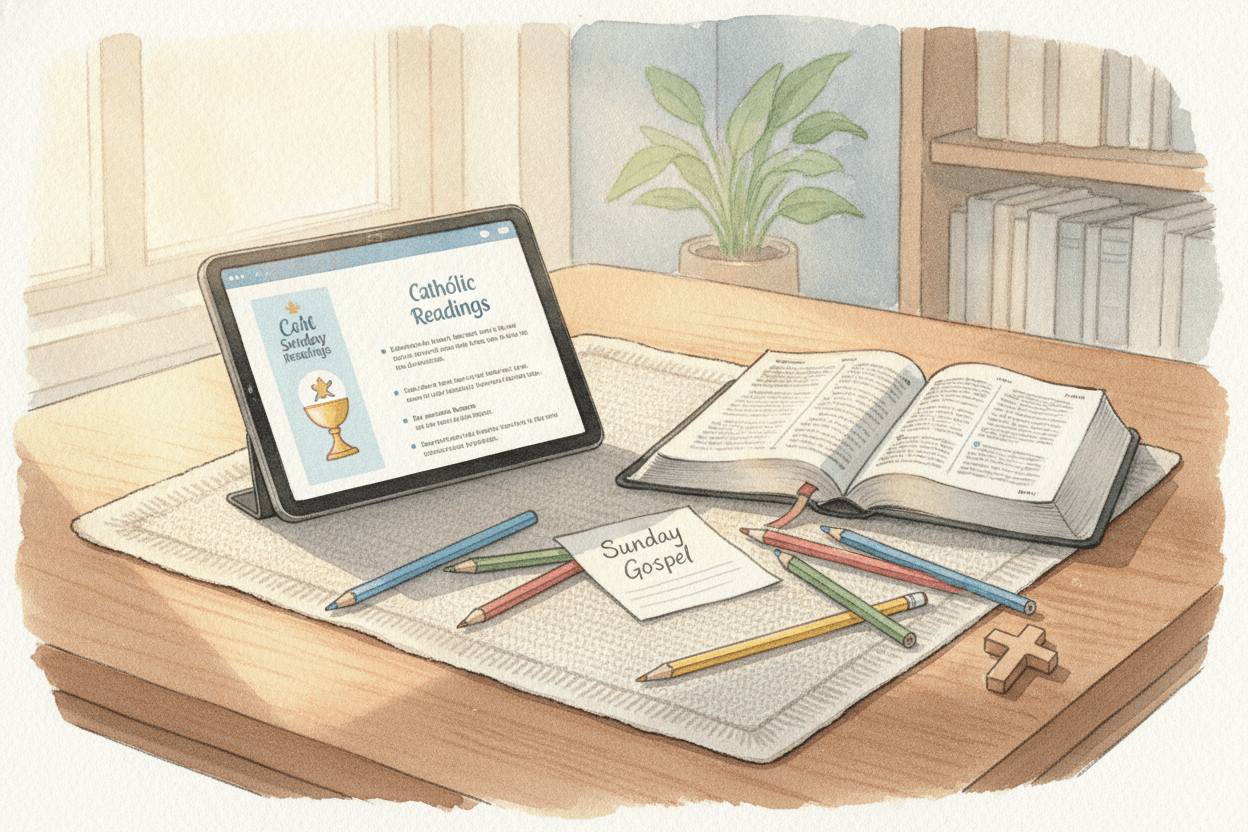
By the time we get home from Mass, somebody is looking for a snack, somebody else has lost one shoe, and the Gospel we just heard can disappear fast. I used to think family Bible time needed a neat plan, colored printouts, and everyone sitting still. That plan lasted about as long as a bowl of grapes at our table. What helped was much simpler: start with the same Gospel our children just heard at Mass.
Each week, pull up the USCCB Daily Readings page and choose the current Sunday. It gives you the full readings and makes it easy to find the Gospel without hunting through a Bible while a toddler is standing on a chair. Read that Gospel first. Jesus is speaking, acting, healing, calling, forgiving, or telling a story. Children can enter there. They may not remember the homily, but they can remember that Jesus welcomed a person everyone else ignored, calmed frightened friends, or told someone to forgive again.
Keep the opening small. Say, “Jesus, help us hear your word,” and read the passage slowly. Then ask three questions you can use every week: What happened? What does this show us about Jesus or God? What is one way we can live this this week? If your child answers, “Jesus was nice,” do not rush to fix it. Ask, “What did Jesus do that makes you say that?” Often the best part comes after a long pause, or after someone retells the story with a few wildly creative details. Let them draw a scene or act out one short moment if talking stalls. The point is not a tiny theology exam. The point is helping the Gospel land in the kid in front of you.
The first reading can wait. Add it when the children have the attention for it and when it clearly sets up the Gospel’s theme. Some Sundays that connection is easy to see; other Sundays, the Gospel alone is plenty. One small thing we tried was ending with one measurable choice: help a sibling without being asked, tell the truth the first time, pray for a worried friend, or forgive someone before bedtime. Then close with one sentence of prayer. Fifteen minutes is enough. Not because the readings are small, but because God can meet a family right in the middle of the ordinary noise.
“I give praise to you, Father, Lord of heaven and earth, for although you have hidden these things from the wise and the learned you have revealed them to the childlike.”
The 15-Minute Rhythm That Works in a Noisy House
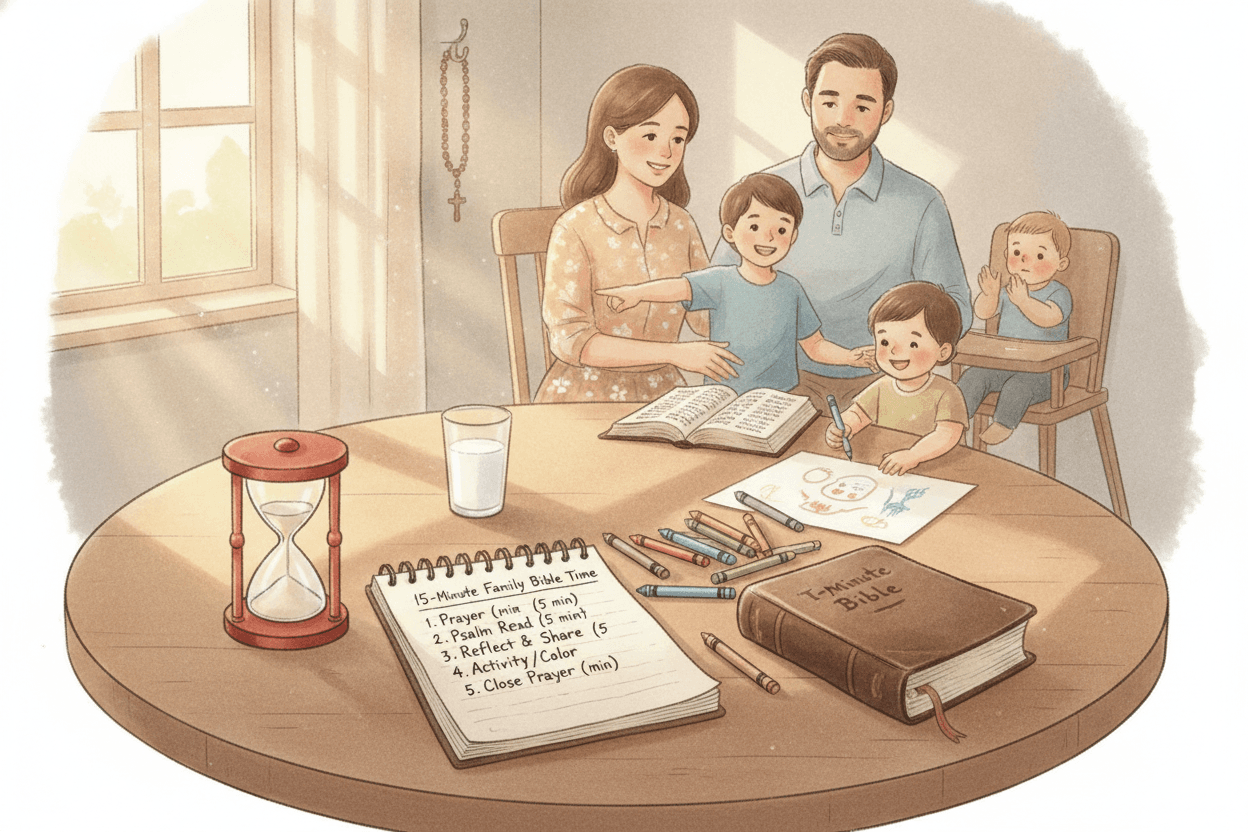
The timer on the microwave had barely started when somebody needed water, somebody else remembered a missing stuffed animal, and our youngest decided the chair was a mountain. That is not a failed family Bible time. That is family Bible time. In a noisy house, the goal is not fifteen minutes of perfect stillness. The goal is fifteen minutes in which God’s word gets a place at our table.
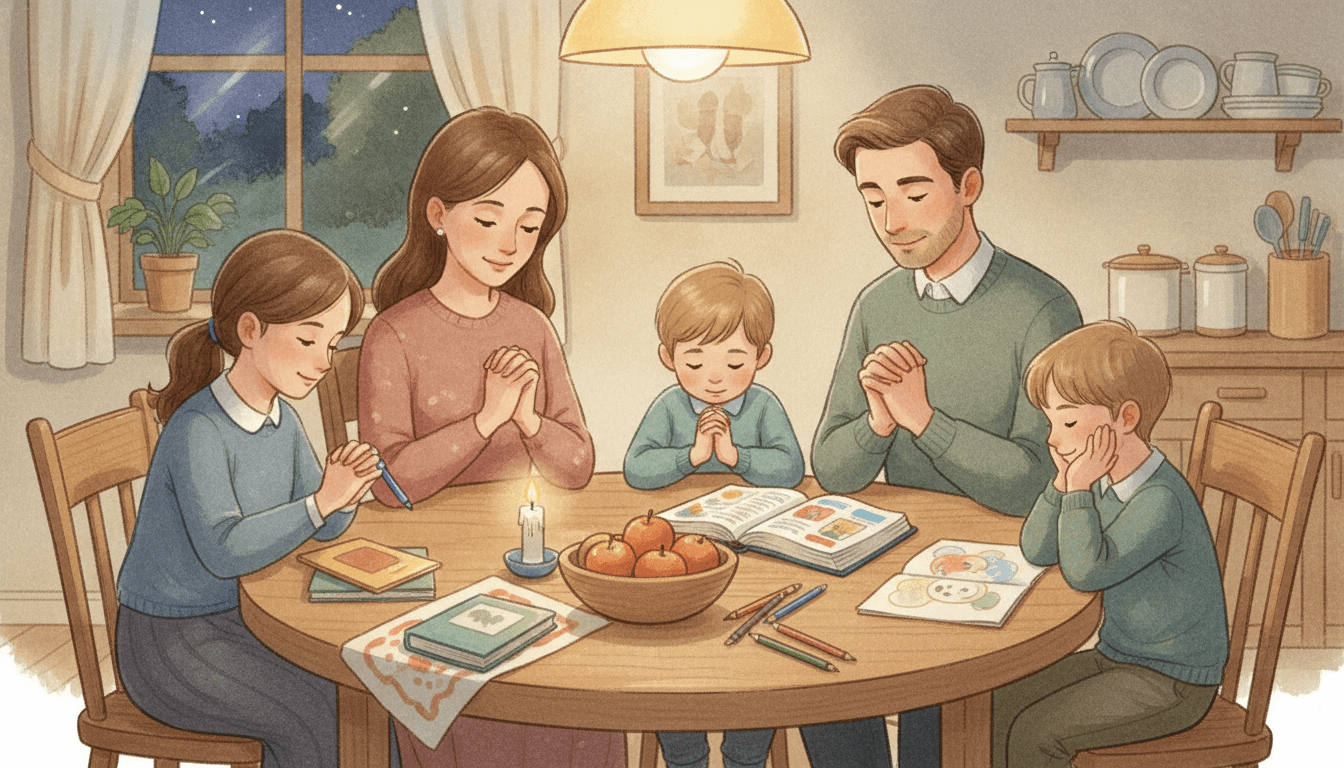
We use a rhythm simple enough to remember when everyone is hungry. Take one minute to gather. Light a candle if that helps, make the Sign of the Cross, and say something brief: “Jesus, help us hear your word.” Then read the Sunday Gospel aloud for three to five minutes. Find it on the USCCB Daily Readings page, which gives you the whole text for that Sunday. Read slowly, but do not worry about reader-theater voices unless your kids request them. They may, and they will be very serious about casting themselves as Jesus.
Next comes five minutes to talk. We come back to the same three questions: What happened in this Gospel? What does it show us about Jesus or God? What is one way we can live this teaching this week? A child who can retell one part has listened. A child who notices that someone was afraid, hungry, or left out has noticed something important. If an answer seems off, resist the urge to fix it like a spelling test. Try, “What makes you think that?” Then look back at the words together.
For children who are still wiggly—and that includes some adults in our house—give their hands something to do. Let a toddler sit on a lap. Let an older child draw the scene while you read. Ask the kids to act out a short moment or retell it with toys after the reading. One small thing we tried was asking each child for the most surprising detail. Here’s what landed: they often caught the detail I rushed past. The Gospel is not only for the child who can sit straight with folded hands.
Use the next three or four minutes to pick one challenge for the week. Make it small and measurable. “I will help clear the table without being asked.” “I will pray for Grandma tonight.” “I will share one thing willingly.” If the Gospel is about forgiveness, name a person or a situation where that will be hard. A vague promise to “be better” disappears by Monday morning; one clear action has a fighting chance.
Finish with one minute of prayer. Each person can name a need, or you can keep it as simple as, “Jesus, help us live your words this week. Amen.” That is enough. If you have time and attention, read the first reading before the Gospel another week. But do not make the extra reading the price of beginning. Fifteen faithful minutes, even with crayons on the floor and a child upside down on the couch, can help Sunday stay with your family long after Mass ends.
And he spoke to them at length in parables, saying: “A sower went out to sow.”
Ask These Three Questions Every Single Week
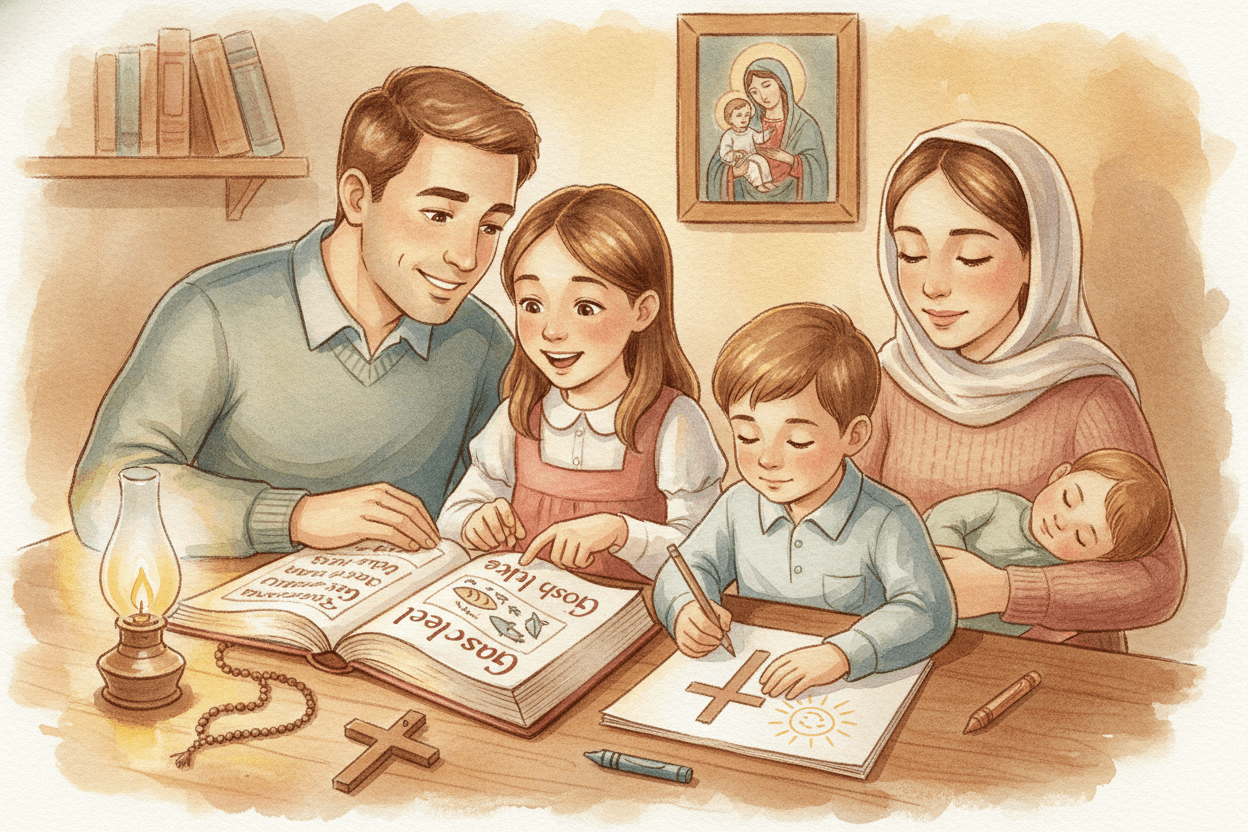
By the time we got to the question part, one child was upside down on the dining-room bench and another had announced that the Gospel story was “kind of like when Dad forgot the groceries.” He was not entirely wrong. The point was not to get a polished answer. The point was that the words from Sunday had made it all the way to our table, where real life was already waiting for them.
We come back to the same first question every week: What happened in this Gospel? Keep it that plain. Let the children retell it in their own words. Who was there? What did Jesus do? What surprised you? A younger child may draw the boat, the bread, the crowd, or the storm. An older child may act out one short scene with a sibling who is very eager to play the dramatic role. Either way, they are paying attention to the passage before anyone asks them to explain it.
Then ask: What does it show us about Jesus or God? This question moves the story from “what happened” to “why it matters.” Perhaps Jesus notices people others miss. Perhaps he tells the truth, forgives someone, calms frightened friends, or asks people to trust him. Do not rush to supply the answer. If a child says something a little sideways, try, “What makes you think that?” Then look back at the reading together. You can say, “Let’s find the part that gave you that idea.” That is gentler, and usually more helpful, than correcting every imperfect answer on the spot.
The third question is where the Gospel puts its shoes on: What is one way we can live this teaching this week? Make the answer small enough to recognize by Tuesday. If the passage is about forgiveness, the challenge might be to forgive one person without bringing the offense back up at dinner. If it is about generosity, share a treat willingly. If it is about prayer, pray for a worried friend before bed. At our table, we try to choose one thing each person can actually do, not a grand promise that disappears before the dishes are cleared.
These three questions work because they are repeatable. Children do not have to wonder what the “right kind” of Bible answer sounds like. They listen, they notice Jesus, and they choose one next step. That is a good pattern for any age. As Jesus says, “But what was sown on rich soil is the one who hears the word and understands it, who indeed bears fruit and yields a hundred or sixty or thirtyfold.” We may not see much fruit during fifteen noisy minutes. But one small act of mercy at school or one honest apology at home is a real beginning.
But what was sown on rich soil is the one who hears the word and understands it, who indeed bears fruit and yields a hundred or sixty or thirtyfold.
Let Kids Enter the Story With Their Hands and Imagination
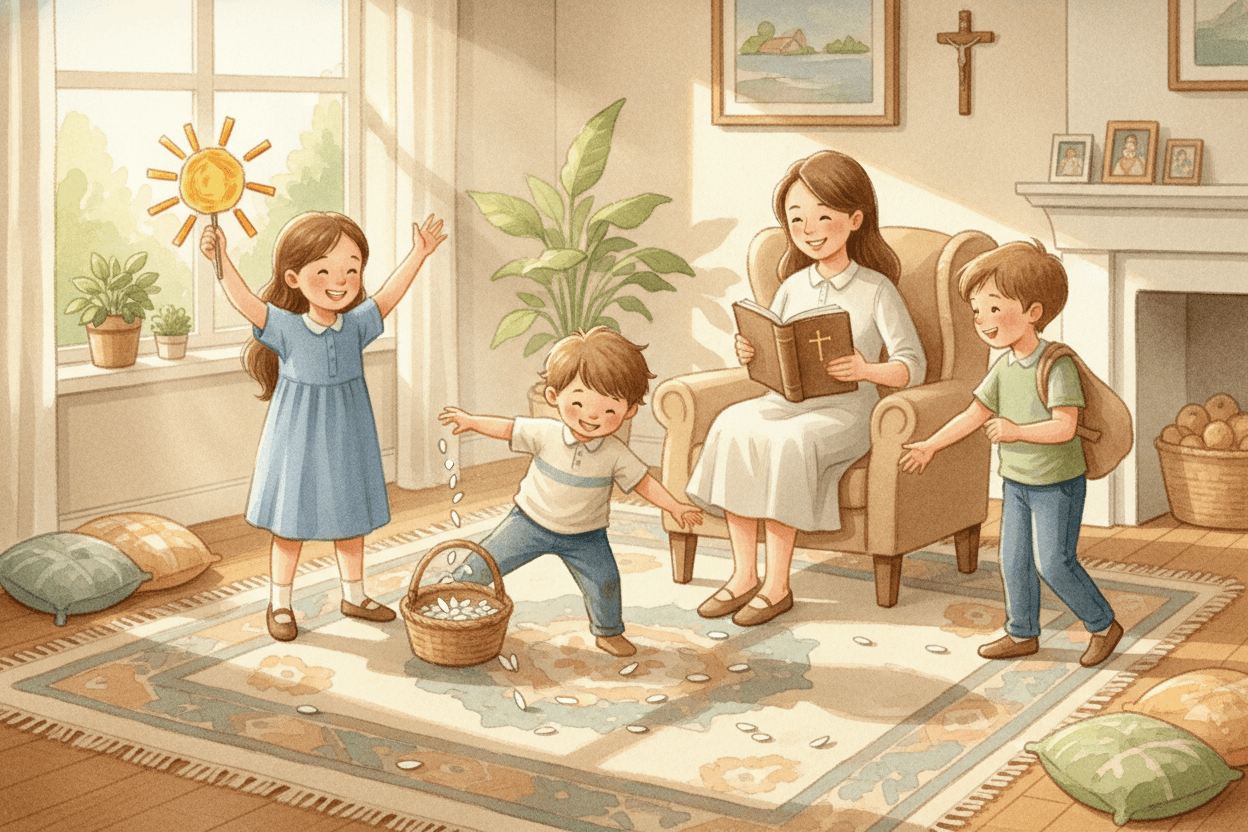
Last Sunday, one child at our table turned the Gospel into a sword fight before we had finished the second sentence. Another was coloring a purple sun. For a minute, I wondered if we should call the whole thing off. But then the sword fighter said, “Wait, why did that man run away?” He had heard the story after all. Kids do not always enter Scripture by sitting still and giving polished answers. Often they enter with crayons, questions, sound effects, and a very serious need to play the part with the important sandals.
So give them a doorway that fits their age. After reading the Gospel, ask a young child to tell it back in his own words. Do not worry if a few details get rearranged. Ask an older child, “What surprised you?” Let another child listen for a repeated word and raise a hand when she hears it. Put paper on the table and invite them to draw one scene: the boat, the crowd, the dinner, the road, Jesus’ face. One small thing we tried was acting out only thirty seconds of the passage. Nobody needs a costume. A dish towel can do a lot of work in a family Bible time.
These little responses keep the Bible close to the kid in front of you. If the Gospel includes fear, bring up bedtime: “What helps when you feel scared after the lights go out?” If Jesus speaks about forgiveness, connect it to the argument over the blue cup that somehow became a federal case. If the story involves sharing, ask what it looks like when someone wants the last cookie. Welcoming can mean noticing the new child at school. Truthfulness can mean telling Mom who spilled the cereal instead of blaming the dog. Prayer can begin with one person each child wants Jesus to help.
Sometimes the simplest connection is the one that lands. When a Gospel touches on fear, Jesus’ words can stay with a child long after the discussion ends: “So do not be afraid; you are worth more than many sparrows.” You might ask, “When could we remember that this week?” A child may say, “At bedtime,” or “Before my soccer game.” That is enough. You are not looking for a tiny theology professor. You are helping your child notice that Jesus speaks into an ordinary Tuesday.
When an answer is offbeat, resist the urge to correct it at once. Try, “What makes you think that?” or “Where did you hear that in the story?” Then gently return to the words you just read. End by choosing one action that can be seen: apologize to a sibling, share without being asked, pray for a worried friend, tell the truth the first time. The drawing may stay on the fridge for two days. The acted-out scene may be loud. But the Word has found its way into your house—and perhaps into the next squabble, too.
So do not be afraid; you are worth more than many sparrows.
Choose One Small Gospel Challenge for the Week
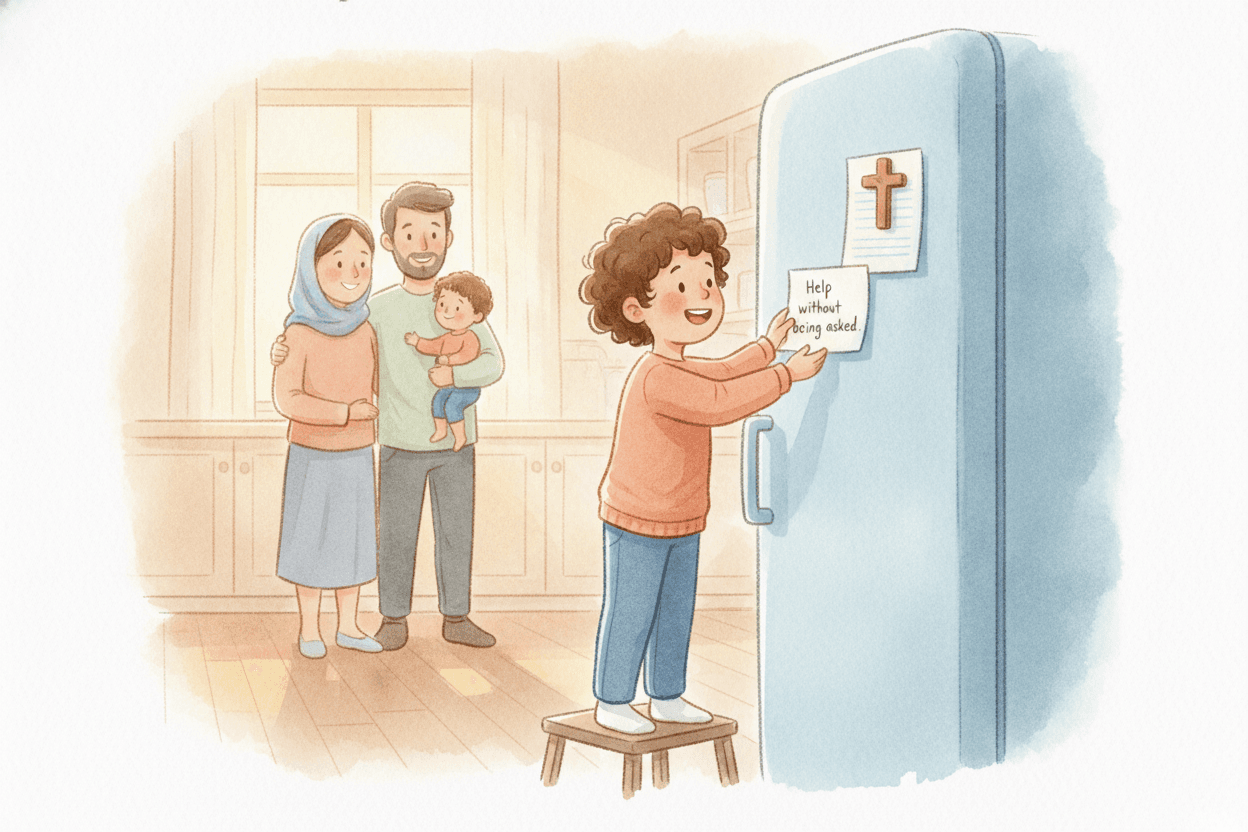
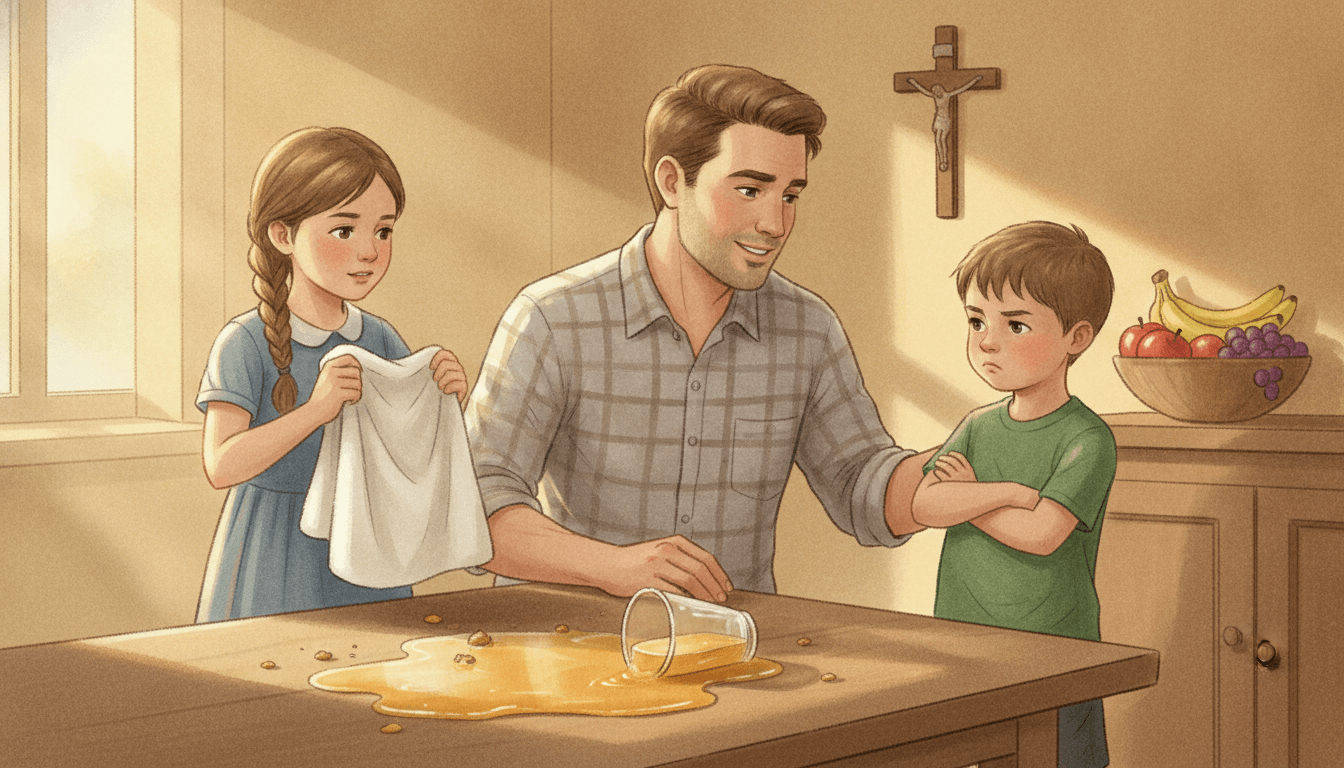
The real test usually arrives before Sunday dinner. One child takes the good marker. Another child shouts, “He always does that!” Someone is suddenly injured in a way that requires a full investigation. That is where the Gospel leaves the page and enters our house. If we only talk about forgiveness at the table, it can stay safely tucked between the salt shaker and the napkins. A small challenge gives it somewhere to go.
After you have talked through the Sunday Gospel, choose one thing your family will do this week. Make it clear enough that a six-year-old can tell whether he did it. “Let’s be better” sounds nice, but nobody knows what to do with it on Tuesday morning. Try: “This week, when someone in our family hurts us, we will forgive once before bedtime.” Or: “We will each help with one job without being asked.” Or: “At bedtime, each of us will pray for one person who is worried.”
Keep the challenge tied to the reading when you can. If the Gospel brings up mercy, make forgiveness the family practice. If Jesus welcomes someone others ignore, look for one person at school, work, or church whom you can greet and include. If the reading speaks about trust when people are afraid, pray together for a fear your child actually has: the spelling test, the dark hallway, the first day of practice. Here’s what landed for us: the smaller the challenge, the more likely it was to survive contact with a busy week.
For a Gospel about forgiveness, you do not need to predict the next sibling conflict. It is already on the calendar, probably before lunch. When it comes, resist the urge to deliver a long speech while everybody is crying. You can simply say, “Remember our Gospel challenge?” Then help the child name what happened, offer an apology if needed, and choose forgiveness. That is not a perfect family moment. It is a real one. And real is where children begin to see that Jesus’ words are for them.
Write the challenge on a scrap of paper and put it where people will see it: the fridge, the bathroom mirror, or beside the pile of shoes by the door. Mention it once at dinner. At the end of the week, ask, “When was this hard?” and “When did we remember?” Celebrate any honest effort. The goal is not to earn a gold star for holiness. It is to give your children one concrete way to carry Sunday into Monday.
Then Peter approaching said to him, “Lord, if my brother sins against me, how often must I forgive him? As many as seven times?” Jesus answered, “I say to you, not seven times but seventy-seven times.”
Try This at Your Table This Sunday
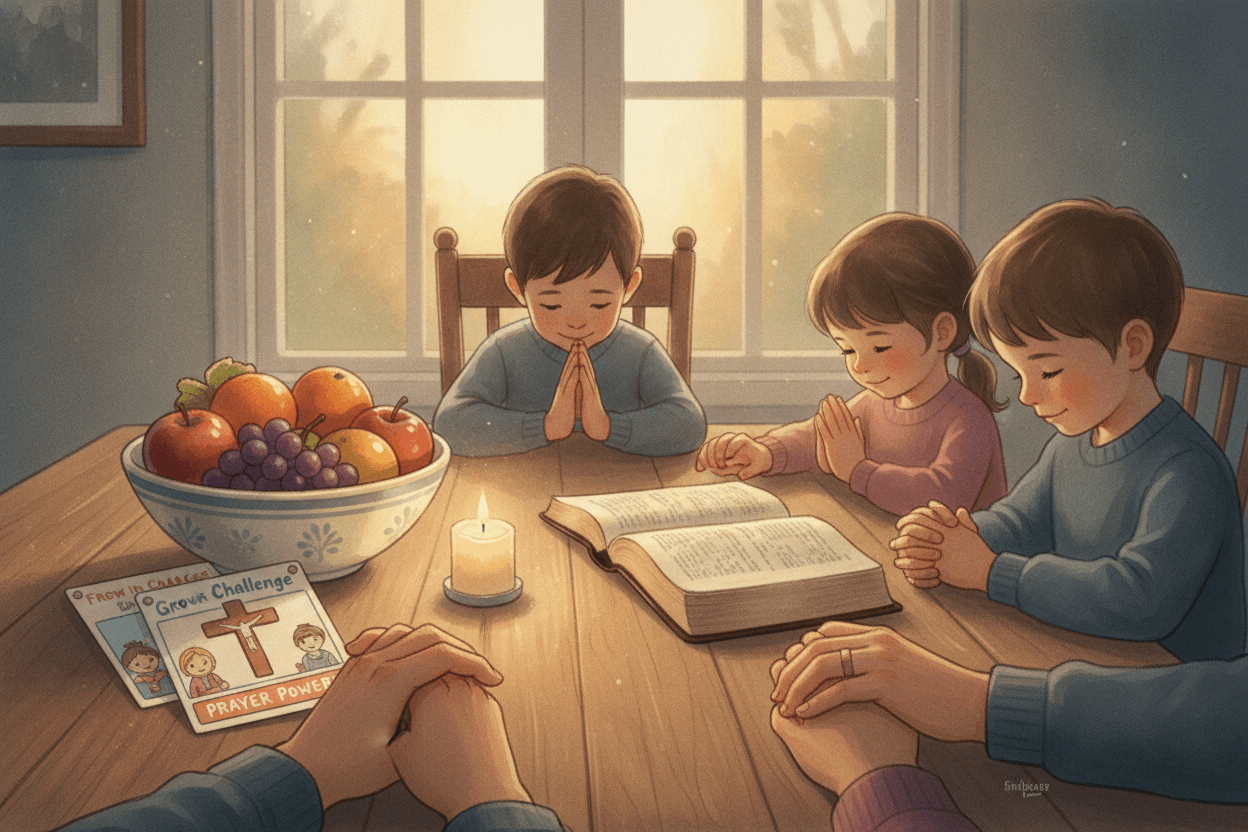
Sunday afternoon can disappear fast. Shoes come off by the door. Someone asks for a snack five minutes after lunch. A child remembers a missing library book at the exact moment you sit down. So do not wait for a calm, candlelit family Bible hour that may never arrive. This Sunday, try a small version at your table. Pull up the current Sunday Gospel on the USCCB Daily Readings page. Read it after Mass, before dinner, or whenever your family is most likely to be in the same room for a few minutes.
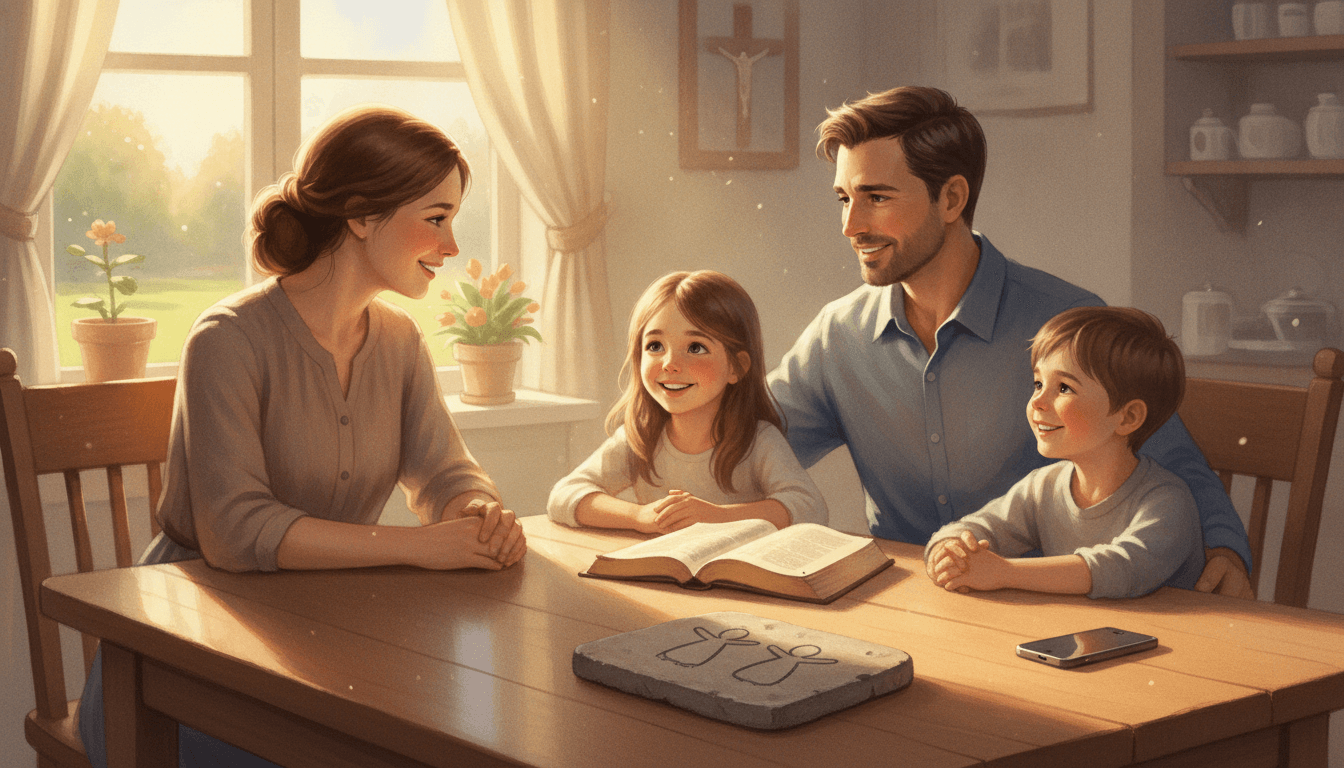
Keep the plan plain. Begin with the sign of the cross and a simple, “Jesus, help us hear your word.” Read the Gospel aloud. Then ask the same three questions: What happened in this Gospel? What does it show us about Jesus or God? What is one way we can live this teaching this week? Let the kids answer in kid language. If somebody says, “Jesus was mad because those guys were being mean,” you do not need to turn it into a lecture. Ask, “What in the story makes you think that?” Often, the next answer gets closer to the text.
Then choose one small family challenge. Make it specific enough that everyone knows what it looks like by Tuesday. Maybe each person helps once without being asked. Maybe nobody gets left out at recess. Maybe when siblings fight, they try again with kinder words. Maybe the family prays for one person who is having a hard week. At our table, the challenge works best when it is small enough for the youngest child and real enough for the grown-ups. Children notice quickly when Mom and Dad are also trying.
Close with one sentence: “Jesus, help us to do what you showed us today.” That is enough. Jesus said, “Let the children come to me, and do not prevent them; for the kingdom of heaven belongs to such as these.” Your children do not need a polished lesson before they can come to him. If your first attempt lasts seven minutes, includes spilled juice, and ends because someone has to use the bathroom, it still counts. One small thing we tried can become a weekly habit. Consistency matters more than polish.
Jesus said, “Let the children come to me, and do not prevent them; for the kingdom of heaven belongs to such as these.”
Frequently asked questions
How do I do a short family Bible study after Sunday Mass?
Use the Sunday Gospel your family just heard at Mass, available on the USCCB Daily Readings page. Begin with a brief prayer, read the Gospel slowly, and discuss it with three questions: What happened? What does this show us about Jesus or God? How can we live this this week?
How long should family Bible time with young children last?
Aim for about 15 minutes, but do not treat the timer as a test of success. A simple rhythm is one minute to gather and pray, three to five minutes to read, five minutes to talk, and a few minutes to choose an action and pray.
What should I do if my child gives a wrong or silly answer about the Gospel?
You do not need to correct every imperfect answer immediately. Ask, “What makes you think that?” and return to the Gospel text together; children often notice meaningful details after they have time to explain their thinking.
Which Sunday reading should we use for family Bible time?
Start with the Gospel, since it is often the easiest entry point for children: they can picture Jesus healing, teaching, forgiving, or welcoming someone. The first reading can be added later when your children have the attention for it or when its connection to the Gospel is clear.
How can I keep toddlers and wiggly kids engaged during family Bible time?
Let them participate with their bodies and hands instead of expecting perfect stillness. They can sit on a lap, draw a scene, act out a short moment, point to a person in the story, or retell one part of what happened.
How do we help children live the Sunday Gospel during the week?
End by choosing one small, specific action connected to the Gospel's message. For example, forgive someone before bedtime, help a sibling without being asked, welcome someone left out, or pray for a worried friend, then close with a simple prayer asking Jesus for help.
Sources: bible.usccb.org · bible.usccb.org · bible.usccb.org · bible.usccb.org · bible.usccb.org · bible.usccb.org
Scripture quotations in this article use the NABRE translation.