Preparing Kids for Confession With Truth and Mercy
Help children approach Confession without fear by explaining sin honestly, separating shame from responsibility, and emphasizing God’s unfailing mercy. With Scripture, simple language, and reassurance
A child who whispers, “What if Father is mad at me?” is not asking only about the steps of Confession. She is asking whether telling the truth about sin will cost her love. Scripture invites us to prepare children with both clarity and confidence: sin is real, repentance matters, and Jesus’ mercy is greater still.
Start Here: Sin Is Something We Do, Not Who We Are
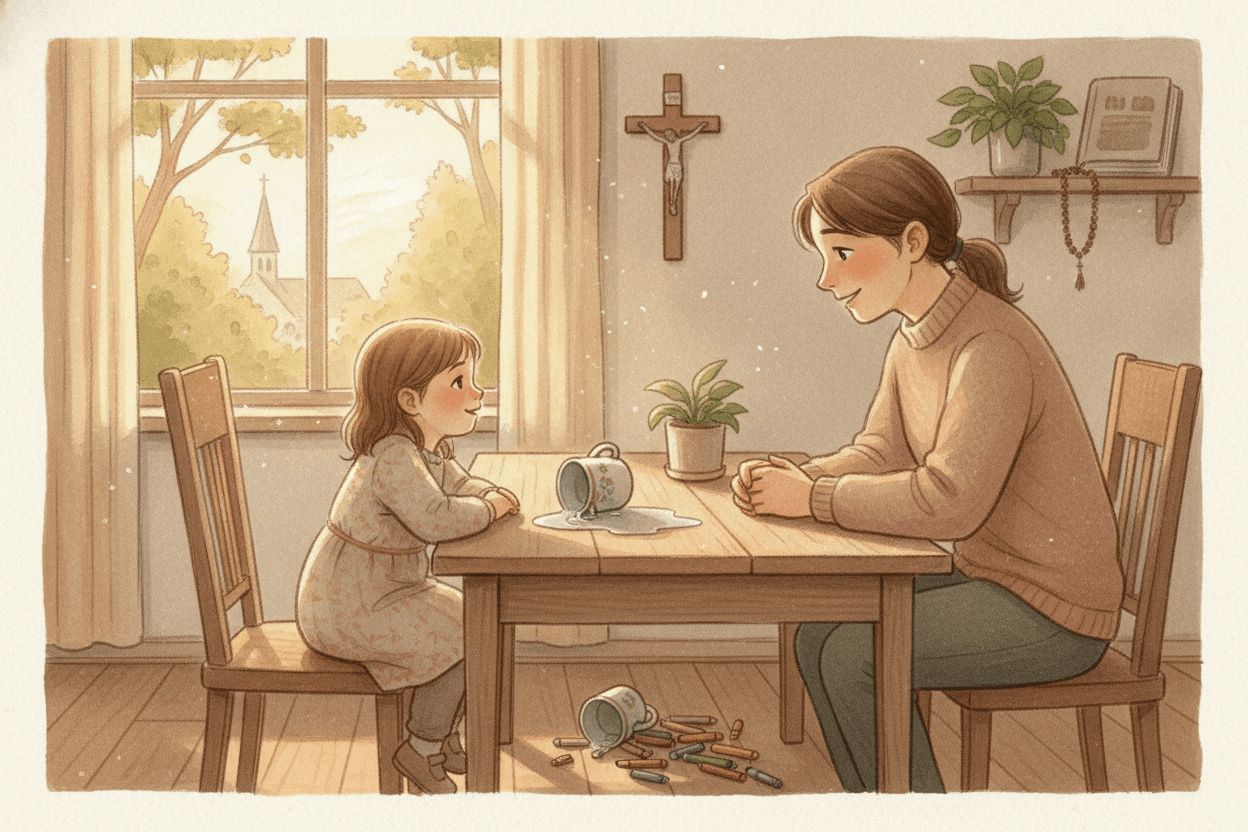
A child knocks over a sibling’s carefully built tower, sees the tears, and then says, “I didn’t mean to!” That moment is a better starting point than a long list of rules. We can help a child notice both the harm done and the next truthful step: “You were angry, and you chose to knock it down. That was not loving. What can you say and do now?” The child is not the sin. He or she is a beloved son or daughter of God who has made a wrong choice and needs mercy, repair, and practice in choosing the good.
Here’s how I’d teach this: sin is something we deliberately choose when we act against God’s love and against the good of another person. A child can understand this in ordinary life: refusing to tell the truth to avoid trouble, speaking cruelly to a brother or sister, ignoring a parent’s reasonable direction, or choosing not to pray because “I don’t feel like it.” Keep the focus on choices the child actually understands. Do not introduce adult concerns beyond his or her experience, and do not treat every accident, mistake, or childish limitation as sin. Deliberate choice matters.
This distinction protects children from a damaging confusion between guilt and shame. Healthy guilt says, “I did something wrong.” It can lead to sorrow, an apology, and a better choice next time. Shame says, “I am wrong. I am bad.” Shame makes children hide, defend themselves, or despair. Scripture invites us to tell the truth without fear of being discarded: “If we acknowledge our sins, he is faithful and just and will forgive our sins and cleanse us from every wrongdoing” (1 John 1:9). God’s forgiveness does not deny the wrong; it cleanses and restores the person who admits it.
Parents can practice language that is both honest and tender. Try: “What you did was wrong, but you are not a bad child.” “Jesus loves you now, and he will help you make this right.” “You do not need excuses; just tell the truth.” “I forgive you. Let’s think about how you can repair the hurt.” When a child admits a sin, resist turning that brave admission into a lecture or a record of past failures. A calm response teaches that truth is safe, even when choices have consequences.
As the Catechism reminds us, contrition includes sorrow for sin and the resolve not to sin again (CCC 1451). For children, that resolve can be concrete: return what was taken, apologize without adding “but,” help rebuild the tower, or speak respectfully at the next hard moment. This is not pretending they can fix everything alone. It is teaching them to bring a real wrong to Jesus, receive his mercy, and take the first small step of love afterward.
If we acknowledge our sins, he is faithful and just and will forgive our sins and cleanse us from every wrongdoing.
Let the Prodigal Son Set the Tone for Mercy

A child who has hidden a broken rule, a harsh word, or a lie often expects anger before he expects help. That is why the father in Jesus’ parable gives us the right starting place. The younger son has made real choices that wounded his family, and he does not return by pretending nothing happened. He gets up and goes home. Repentance means this turning back: telling the truth about what we have done and returning to the Father who loves us.
Notice what happens before the son can make his full speech. “While he was still a long way off,” the father sees him, is filled with compassion, runs to him, embraces him, and kisses him. Mercy is not God saying that sin does not matter. Sin does matter because it harms our love for God and neighbor. Yet mercy means that our wrong choices are never the final word about us. Here’s how I’d teach this: “You may have done something wrong, but you are not a bad child. You belong to God, and Jesus is glad when you come back to him.”
This distinction helps children separate guilt from shame. Guilt says, “I lied to my sister,” or “I refused to obey when I understood what Mom asked.” Those are concrete actions for which a child can be sorry. Shame says, “I am a liar,” or “God must be disappointed in me all the time.” Do not let shame supply the vocabulary for Confession. Invite children to name deliberate choices plainly, receive forgiveness gratefully, and ask Jesus for help to make a different choice next time. As the Catechism reminds us, contrition includes sorrow for sin and the resolve not to sin again (CCC 1451).
Julianne Stanz describes Reconciliation this way: “This sacrament brings us into intimate contact with Jesus, where we are liberated from the sins that trouble our hearts and minds and experience God’s unconditional forgiveness and mercy.” That language is worth repeating at home. The child meets Jesus’ mercy through the priest; he is not appearing before a judge who is waiting to embarrass him. The priest helps him tell the truth, offers counsel, assigns a small penance, and speaks Christ’s absolution.
Parents set this tone long before the child enters the confessional. Let children hear you say, “I was wrong; will you forgive me?” Let them see that forgiveness does not erase responsibility but restores communion. After Confession, resist asking for a report of every sin. Ask instead, “How are you feeling?” or “Would you like to pray your penance together?” A child who knows the Father runs toward the repentant son can approach the sacrament honestly—not careless about sin, but confident that coming home is always possible.
So he got up and went back to his father. While he was still a long way off, his father caught sight of him, and was filled with compassion. He ran to his son, embraced him and kissed him.
Use a Prayerful Examination, Not an Interrogation
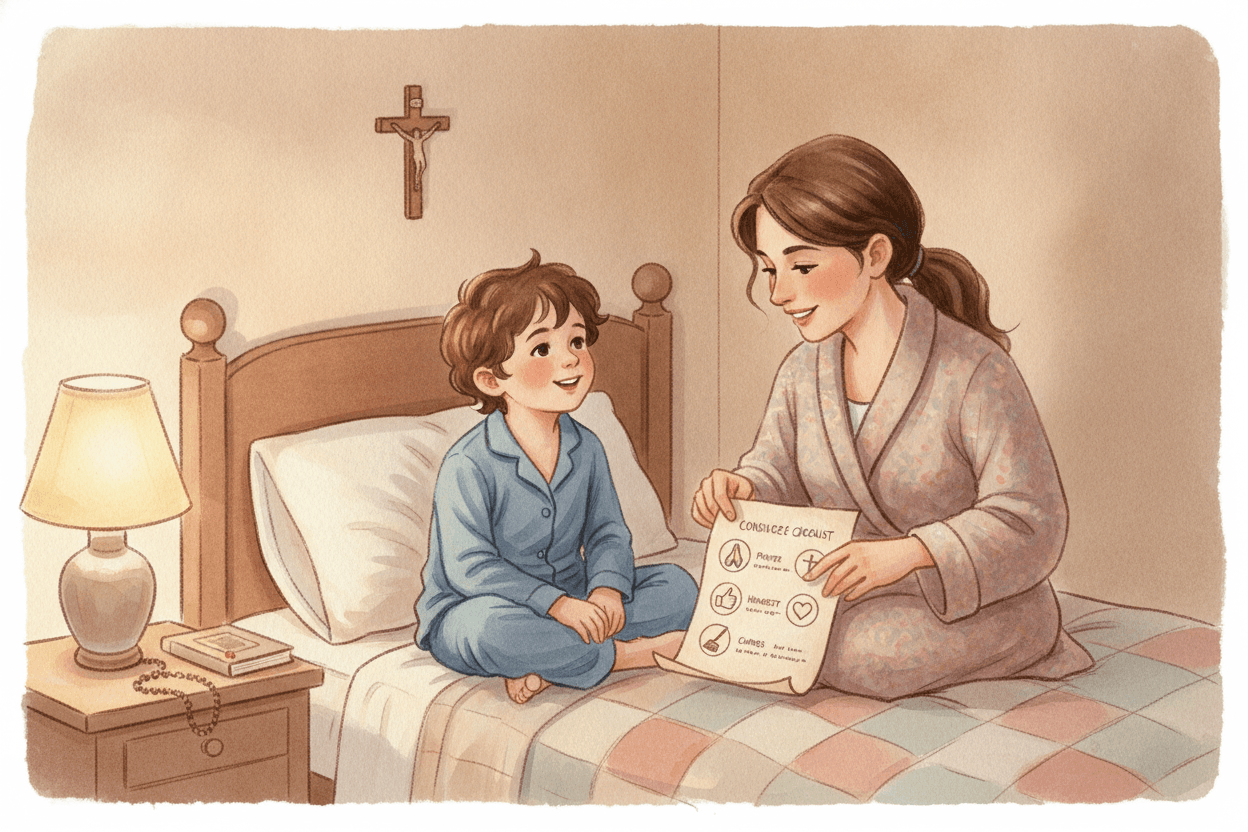
A child sitting silently at the kitchen table, eyes fixed on a worksheet, may be trying to guess which answer will make an adult happy. That is not the purpose of an examination of conscience. Before reviewing any choices, begin by saying plainly: “God loves you. We are not looking for proof that you are bad. We are asking Jesus to help us see what is true, so that we can receive his forgiveness.” This keeps the conversation rooted in mercy rather than fear or embarrassment.
Start with a short prayer to the Holy Spirit: “Holy Spirit, help me remember my choices honestly. Help me be sorry for what was wrong, and help me trust that Jesus forgives me.” Psalm 51 gives children words they can return to: “A clean heart create for me, God; renew within me a steadfast spirit.” An examination of conscience is not a hunt for every imperfect thought. As Fr. Timothy Hedrick explains, “An examination of conscience is a prayerful reflection on our thoughts, words, and actions in the light of the Gospel to determine how we may have sinned against God and others.”
Here’s how I’d teach this at home: move slowly through three ordinary categories—thoughts, words, and actions—and offer concrete questions. For thoughts, ask: “Did I hold on to angry thoughts or refuse to forgive someone?” For words: “Did I lie, use unkind words, blame someone else, or speak disrespectfully to a parent, teacher, sibling, or friend?” For actions: “Did I choose not to pray? Did I disobey when I understood what was being asked? Did I hurt someone, refuse a responsibility, damage something, or fail to care for my belongings?” Give your child time to think; silence is often more helpful than a stream of questions.
Keep the focus on choices your child can understand and made freely. A young child who forgot a chore once, knocked over a cup by accident, or felt angry has not necessarily committed a sin. Help them distinguish feelings and accidents from deliberate acts: “Feeling angry is not wrong. What did you choose to do with your anger?” Likewise, do not introduce adult concerns beyond a child’s experience or press for vague admissions such as “I was bad.” Specific, age-appropriate honesty forms the conscience without burdening it.
Parents can make this a calm, regular practice for a few minutes before First Confession and afterward as well. Do not demand to know what a child says to the priest; the sacrament is confidential, and your role is preparation, not interrogation. If a child cannot remember a sin or feels nervous, reassure them that they may simply tell the priest, “I am sorry for the sins I cannot remember,” or ask for help. As the Catechism reminds us, contrition includes sorrow for sin and a resolve not to sin again (CCC 1451). The goal is a child who can tell the truth with confidence: “I did something wrong, I am sorry, and Jesus is ready to help me begin again.”
A clean heart create for me, God; renew within me a steadfast spirit.
Explain What Happens in Confession Before They Enter
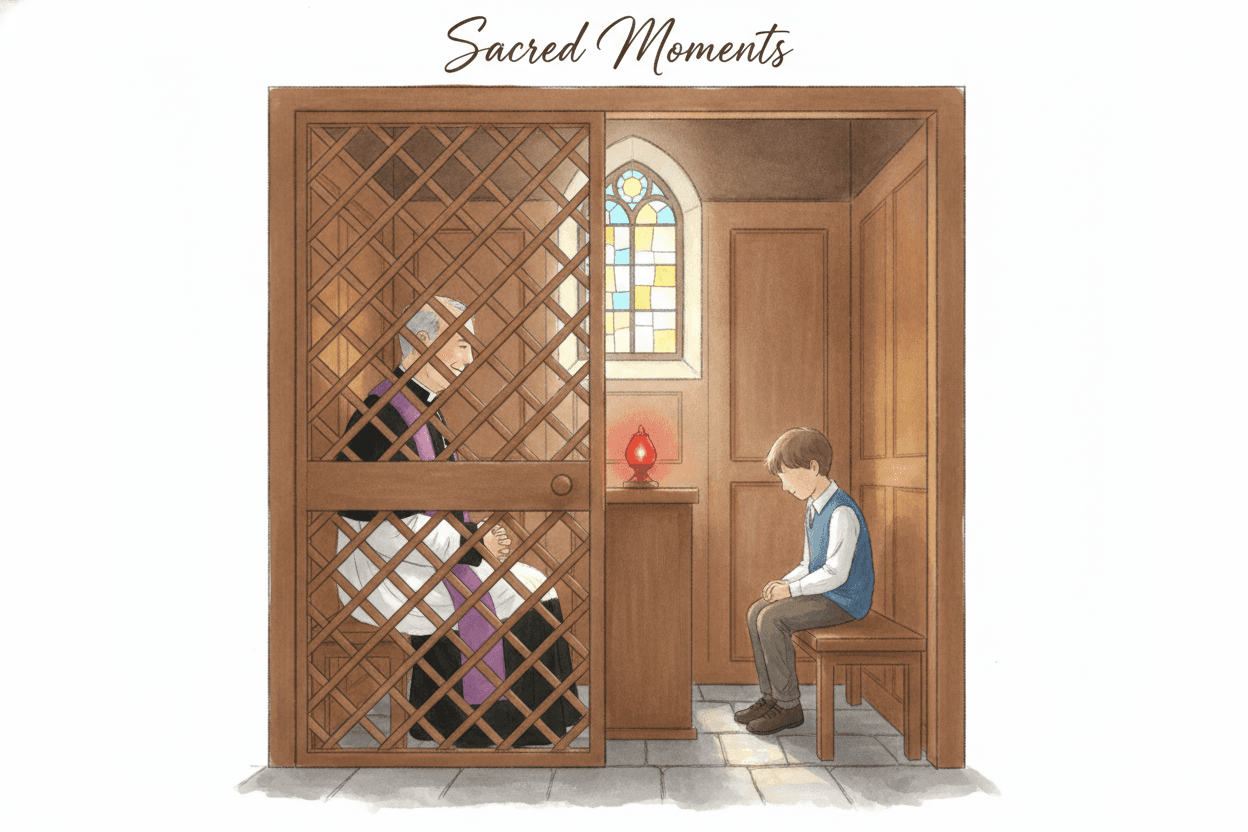
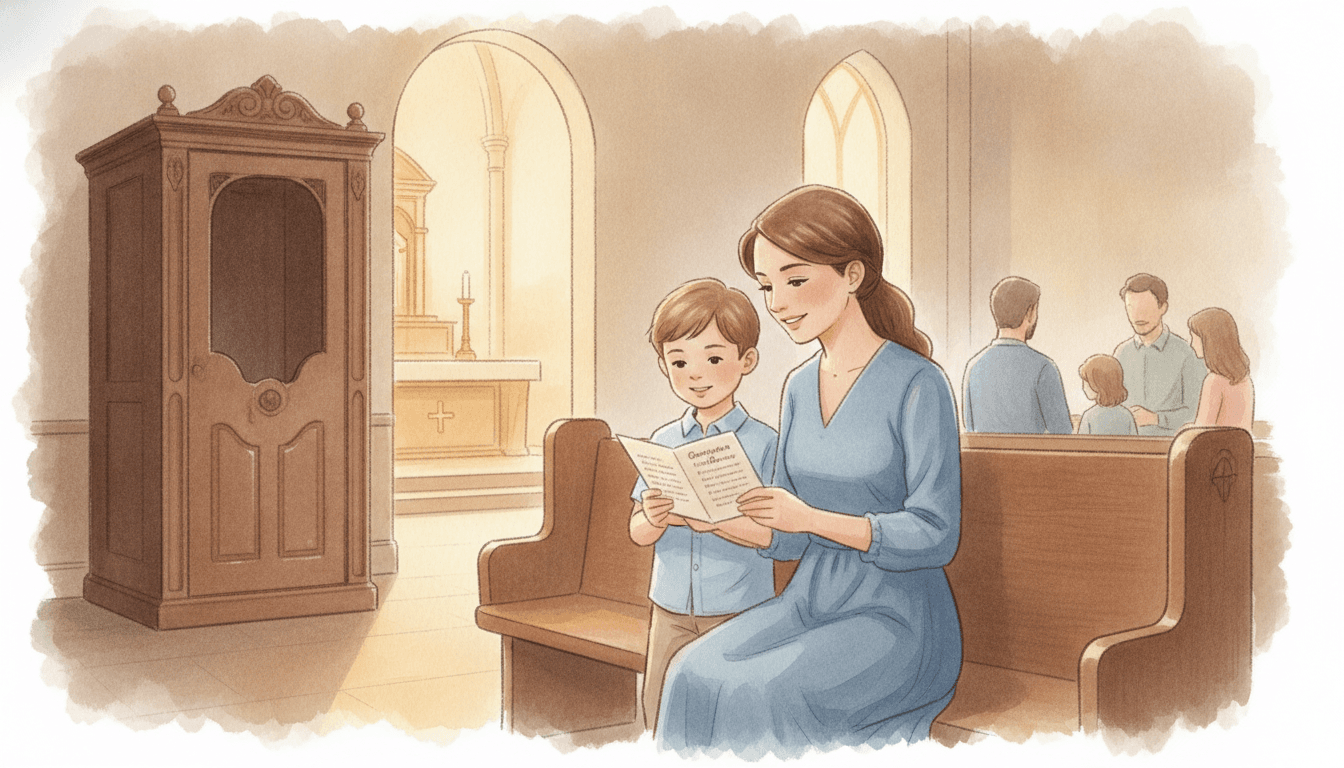
The worry often appears at the church door: a child suddenly asks, “What do I say?” A calm answer is far more helpful than a last-minute rehearsal of every possible sin. Tell your child that Confession has a simple, dependable pattern. The priest will guide them if they lose their place, and they need only speak honestly, briefly, and in words they understand. No child needs to give a long story, defend a choice, or guess at sins they cannot name.
Here’s how I’d teach this in a parish classroom: first, we prepare our hearts with an examination of conscience. This is a prayerful look at concrete choices—whether we prayed, told the truth, obeyed parents, used angry words, acted unkindly, forgave, or cared for what belongs to others. Then comes the welcome and blessing. The child greets the priest, makes the Sign of the Cross, and may say, “Bless me, Father, for I have sinned. This is my first Confession.” The priest is not waiting to catch a child in a mistake; he is there as a fatherly minister of Christ’s mercy.
Next comes confession itself: the child simply names the sins he or she remembers. This honesty is part of contrition, sorrow for having chosen against God’s love, together with a real desire to turn away from sin. The priest may offer counsel, then assign a penance. Explain that penance is not a payment that earns forgiveness. It is a small response of love and repair—perhaps a prayer or kind action—given after a child has confessed. The child then prays an Act of Contrition, using the version taught by the parish or asking the priest for help.
Finally, the priest gives absolution. This is the moment when God forgives sins through the ministry Christ entrusted to his Church. Jesus said to the apostles, “Receive the holy Spirit. Whose sins you forgive are forgiven them, and whose sins you retain are retained.” The sacrament therefore includes our actions—contrition, confession, and satisfaction through penance—and God’s action in absolution. Afterward, the child completes the penance with gratitude, not anxiety.
Parents can practice the order at home as a walk-through: greet the priest, make the Sign of the Cross, confess simply, listen, receive a penance, pray the Act of Contrition, and receive absolution. Do not role-play absolution itself; reserve that clearly for the priest in the sacrament. As the Catechism reminds us, children are to receive Penance before First Communion, and Catholics who have reached the age of discretion must confess serious sins at least once a year (CCC 1457). Once the sacrament is complete, resist asking for a report. A simple “I’m glad you went to Jesus” protects both the child’s privacy and the grace of the moment.
And when he had said this, he breathed on them and said to them, “Receive the holy Spirit. Whose sins you forgive are forgiven them, and whose sins you retain are retained.”
Practice the Words at Home Without Rehearsing Shame

The first time I invite a class to practice the words of Confession, a few children whisper so softly that no one can hear them, while others launch into a long defense of what happened with a sibling. Both responses are understandable. A calm rehearsal at home gives a child something much better than a polished performance: familiar words for telling the truth and receiving mercy. The goal is not to make children anxious about getting every phrase right. It is to help them enter the confessional knowing that Jesus welcomes them there.
Here’s how I’d teach this at home. Let one parent stand in for the priest only for the purpose of practicing the conversation; do not imitate sacramental absolution. The child can walk in, greet Father, and make the Sign of the Cross. If appropriate, the child may say, “Bless me, Father, for I have sinned. It has been ___ since my last Confession.” For a first confession, simply saying that it is their first Confession is enough. Then invite the child to name one or two concrete sins in plain words: “I disobeyed my mom,” “I was mean to my brother,” or “I lied about finishing my homework.” Practice a normal speaking voice, not a dramatic one.
Children should learn that Confession is not the place for a courtroom case. They do not need to supply a long story, blame someone else, or explain why the sin seemed reasonable at the time. Honest and brief is usually best. If a child freezes, forgets the words, or feels unsure whether something should be confessed, teach this simple sentence: “Father, I need help.” A priest is prepared to guide them. This protects a child from thinking that Confession depends on their verbal skill. God’s mercy does not wait for a perfectly delivered script.
Continue the practice by having the child listen quietly as “Father” offers counsel and assigns a small penance. Explain that penance is a response of love and repair, not a punishment that purchases forgiveness. Then practice the Act of Contrition your parish teaches. End by saying, “Then Father gives absolution, and you answer, ‘Amen.’” At that point, stop the role-play. The words of absolution belong to the sacrament itself, given by a priest; they should not become a family rehearsal line. As the Catechism reminds us, confession of sins, contrition, and satisfaction are human acts, while forgiveness is God’s action in the sacrament (CCC 1448).
Afterward, parents should resist asking, “What did you confess?” The sacrament is confidential, and a child deserves to know that home is not a place for a post-Confession report. You may ask instead, “Did you feel comfortable?” or “Was there anything you want help remembering for next time?” Jesus’ own welcome gives the right tone: “Let the children come to me, and do not prevent them, for the kingdom of heaven belongs to such as these.” A practiced child can approach the priest not as someone being put on trial, but as a beloved child coming to Christ for forgiveness and help.
“Let the children come to me, and do not prevent them, for the kingdom of heaven belongs to such as these.”
This Week: Make Mercy the Family’s Normal Language

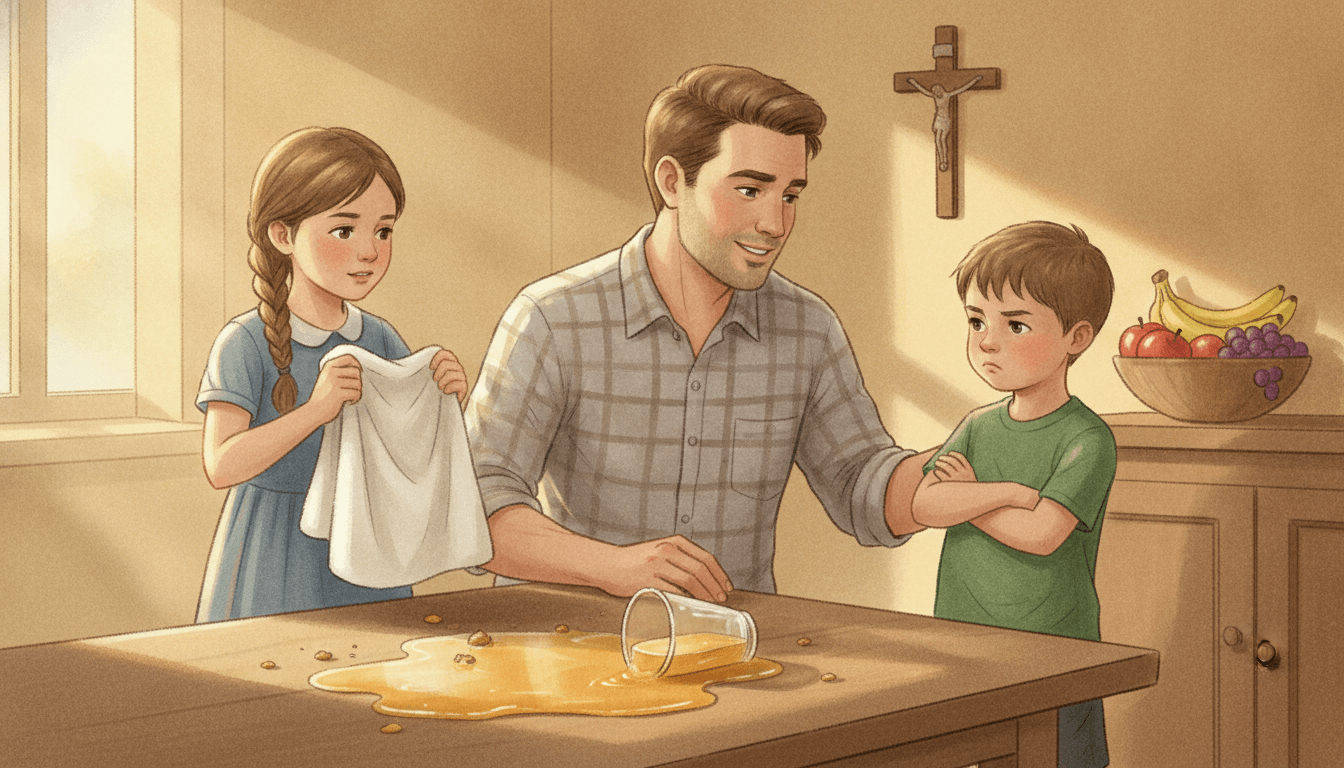
A child spills juice after being told not to carry it into the living room, then waits for the adult reaction. That small pause is one of the places where a family learns its language about sin and mercy. If our first words are labels—careless, bad, impossible—the child may hear shame. If our words name the choice, the harm, and the next faithful step, the child learns something truer: “That was not a good choice. Let’s clean it up. You are still loved, and we can make this right.”
This is not lowering the moral standard. It is teaching it clearly. Scripture invites us to acknowledge sin honestly while trusting the One who receives us: “If we acknowledge our sins, he is faithful and just and will forgive our sins and cleanse us from every wrongdoing” (1 John 1:9, NABRE). A child preparing for Confession needs to hear both parts repeatedly: my choices matter, and Jesus’ mercy is greater than my failure. As the Catechism reminds us, contrition includes sorrow for sin and the resolve not to sin again (CCC 1451). It does not require a child to carry the weight of self-contempt.
Parents teach this most convincingly by practicing repentance themselves. Let your child hear a specific apology: “I spoke sharply when you asked me a question. That was wrong. Please forgive me.” Then follow through with a calmer response. When a child apologizes, resist making him earn his way back into your affection. Receive the apology, name any needed repair, and offer forgiveness. This is the ordinary household grammar that makes the sacrament intelligible. Penance, too, can be explained in these terms: it is a loving response and a small act of repair, not a payment that purchases forgiveness. In Confession, God’s absolution is given before the assigned penance is completed.
Here is how I’d teach this over the next seven days. On day one, model that specific apology aloud. On day two, invite one concrete act of forgiveness in the family—perhaps releasing a sibling from a small offense without bringing it up again. On day three, spend five minutes at bedtime with a simple examen: thank God, ask for light, notice one loving choice and one unloving choice, ask forgiveness, and ask for help tomorrow. On day four, review the Act of Contrition slowly, explaining unfamiliar words rather than demanding perfect memorization. On day five, visit the church together, or point out where the confessional is and describe it as a place where Jesus meets us through the priest. On day six, let your child ask practical questions about Confession. On day seven, say plainly: “Confession is not what we threaten when you are in trouble. It is where Jesus forgives, strengthens, and helps us begin again.”
Keep the tone calm and matter-of-fact. Do not ask for a report afterward or press a child to disclose what was confessed; the priest is there to help, and the sacrament is confidential. What children need from us is not anxiety about getting every word right. They need a home where truth is spoken, forgiveness is practiced, repair is possible, and mercy is normal.
If we acknowledge our sins, he is faithful and just and will forgive our sins and cleanse us from every wrongdoing.
Frequently asked questions
How do I explain sin to my child before Confession?
Use ordinary situations your child understands, such as lying to avoid trouble, speaking cruelly to a sibling, or deliberately refusing a reasonable instruction. Explain that sin is a choice against love of God and neighbor, not an accident, mistake, or limitation. Keep the focus on concrete choices rather than adult concerns they do not yet understand.
How can I help my child understand the difference between guilt and shame?
Teach your child to say, “I did something wrong,” rather than, “I am bad.” Healthy guilt leads to sorrow, an apology, repair, and a better choice; shame makes a child want to hide or despair. Remind them that they remain God’s beloved child even when they need forgiveness.
What should I say if my child is afraid the priest will be angry in Confession?
Tell your child that the priest is there to help them meet Jesus’ mercy, not to embarrass or reject them. He helps them tell the truth, may offer simple counsel and a penance, and gives absolution in Christ’s name. Emphasize that Jesus is glad when we turn back to him.
How do I prepare my child for an examination of conscience without making them anxious?
Begin with reassurance: God loves them, and the goal is not to prove they are bad but to see the truth and receive forgiveness. Ask about deliberate choices that affected God or other people, using simple examples from family life. Avoid treating accidents or every childish weakness as sin.
What does contrition look like for a child?
Contrition means being sorry for a real wrong and wanting to choose differently next time. Help your child take one concrete step, such as apologizing without excuses, returning something taken, or repairing harm done to a sibling. This teaches that forgiveness restores love while still inviting responsibility.
Should I ask my child what they confessed afterward?
No. Respect your child’s privacy and avoid asking for a report of their sins. Instead, ask how they are feeling or offer to pray their penance with them. This helps Confession remain a safe place for honest repentance and confidence in God’s mercy.
Sources: usccb.org · usccb.org · usccb.org · vatican.va · usccb.org · usccb.org · usccb.org · usccb.org
Scripture quotations in this article use the NABRE translation.