A Simple Heavenly Friends Routine for Young Children
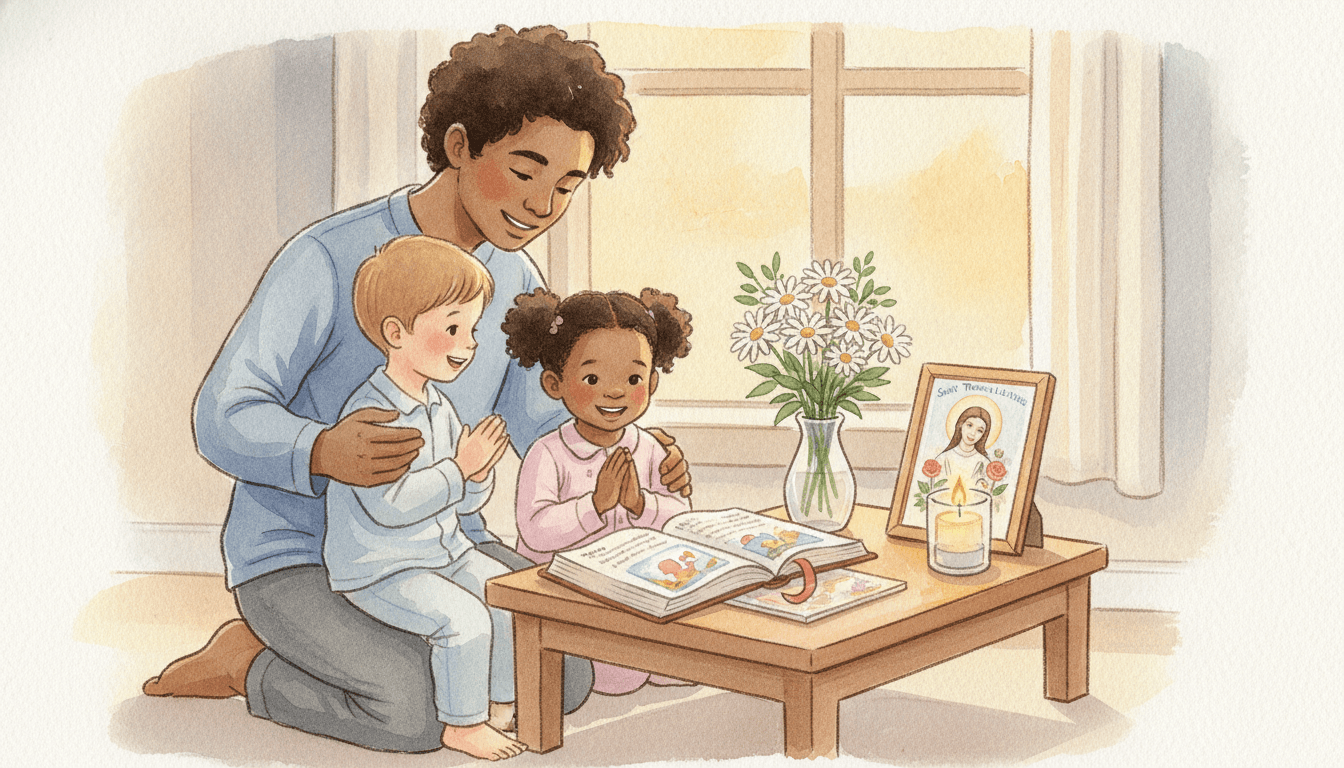
When your preschooler is waiting impatiently for a turn, worried at bedtime, or reluctant to share, a saint’s story can give faith a familiar face. Teaching Catholic saints to kids need not mean adding another long lesson; it can become a brief, steady family rhythm that shows them holiness grows in ordinary life.
Saints Are Heavenly Friends, Not Distant Heroes
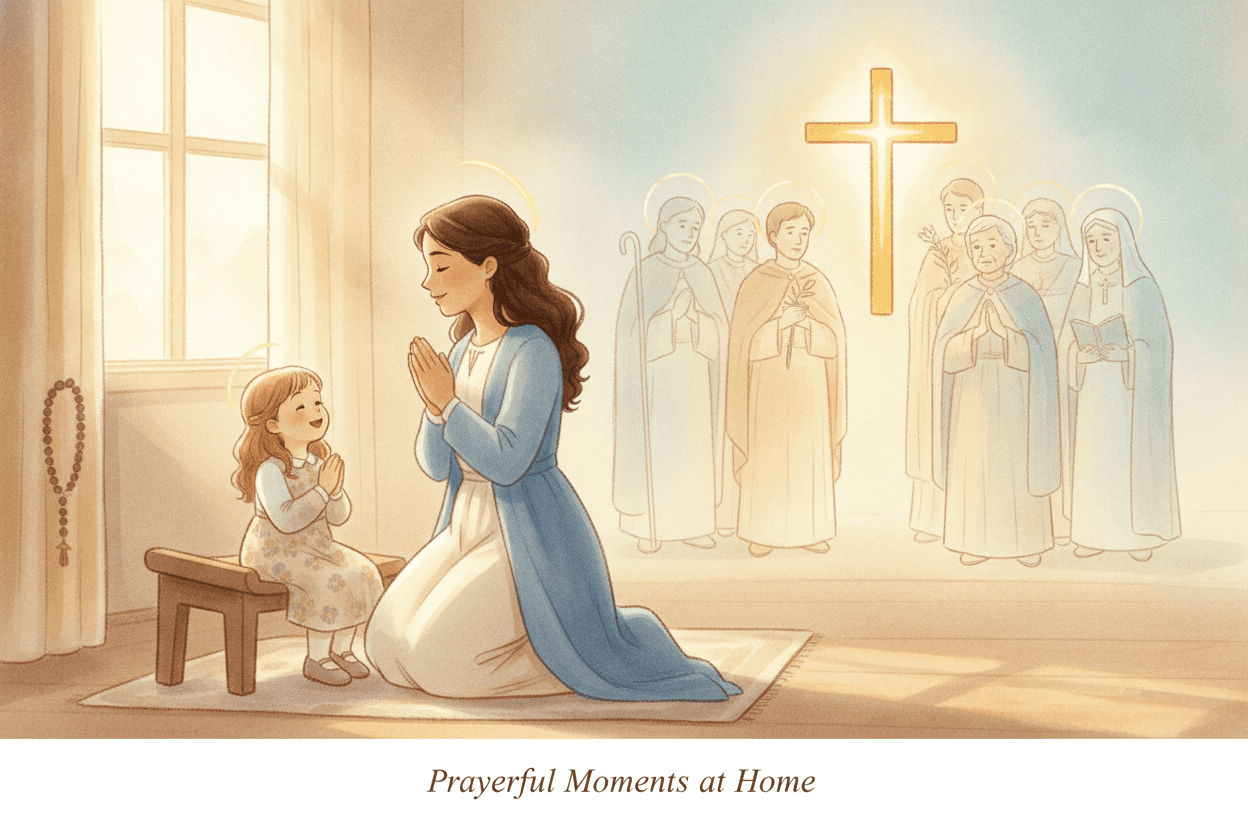
A child may hold up a holy card and ask, “Is she really listening?” That honest question is a good place to begin. The saints are not fictional characters, distant celebrities, or flawless people placed behind glass. They were real men, women, and children who received God’s grace and answered him in the circumstances of their own lives: at work, in family duties, in sickness, in friendship, in service to the poor, and sometimes after serious sin and repentance. Their lives show children that loving Jesus takes shape in ordinary choices.
Scripture gives us a family image for this truth: “Therefore, since we are surrounded by so great a cloud of witnesses, let us rid ourselves of every burden and sin that clings to us and persevere in running the race that lies before us.” The Church is one Body of Christ, united in him even though some members live on earth, some are being purified, and some are already in heaven. The Catechism calls this shared life the communion of saints (CCC 946–959). For a child, I would say: Jesus gathers his whole family together, and no one who belongs to him is forgotten.
This also helps parents explain prayer to the saints without confusion. We worship God alone: Father, Son, and Holy Spirit. When we ask a saint to pray for us, we are not treating that saint as God or asking for magic. We are asking a fellow member of Christ’s family to pray with us, much as we might ask Grandma, a godparent, or a friend at church to pray. The saints are alive in Christ, and their love for him is complete. Their prayers point us toward Jesus, never away from him.
Here’s how I’d teach this at home: choose one saint and offer a single concrete sentence about his or her life. “Saint Monica kept praying for her family.” Then connect it to what your child knows: “When we are worried about someone we love, we can keep praying too.” Pray, “Saint Monica, pray for us to trust Jesus and keep praying.” Follow it with a direct prayer to the Lord: “Jesus, please care for our family.” That small distinction quietly forms children in Catholic faith.
Over time, children learn that holiness is not a prize for people who never struggle. Saint Peter failed and returned to the Lord. Saint Thérèse practiced small acts of love. Saint Joseph cared faithfully for Jesus and Mary. Name the virtue, notice a chance to practice it, and let your child try again after a hard moment. As the Catechism reminds us, the communion of saints means that the gifts and love God gives one member of his Church are meant for the good of all. Our children need not admire the saints from afar; they can learn from them, ask their prayers, and follow their shared Lord today.
Therefore, since we are surrounded by so great a cloud of witnesses, let us rid ourselves of every burden and sin that clings to us and persevere in running the race that lies before us
Start Small: One Story, One Virtue, One Prayer
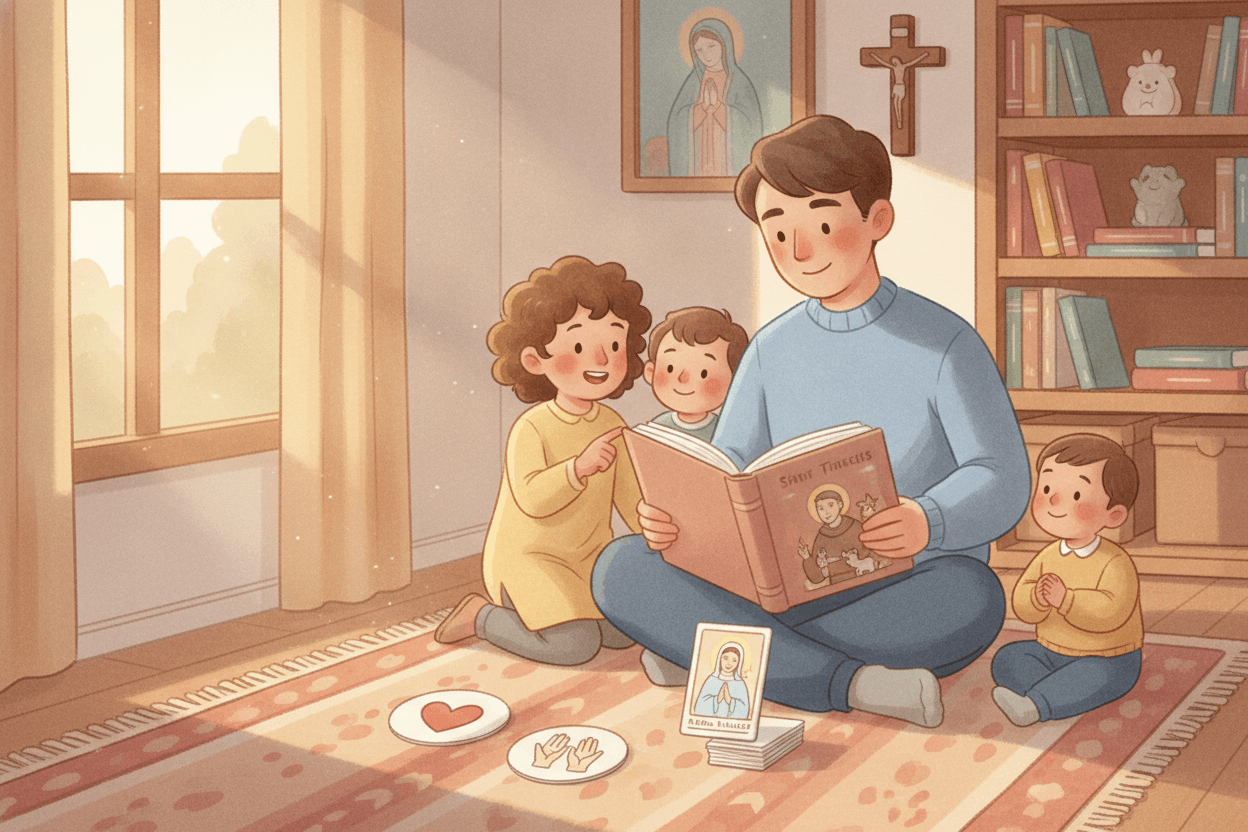
At bedtime, a four-year-old is rarely asking for a timeline, a list of miracles, or a lesson in Church history. She is asking, often without words, “What do I do when I am cross with my brother? Who helps when I am afraid?” That is why I encourage parents to begin with one saint at a time and keep the introduction small enough for a young child to carry into the next day.
Here’s how I’d teach this to ages three through five: choose one memorable fact, one virtue, and one short prayer. For Saint Thérèse of Lisieux, the fact might be that she wanted to do small things with great love. The virtue is kindness in little moments: putting away blocks, sharing a snack, or speaking gently. The prayer can be, “Saint Thérèse, pray for me to love Jesus in small things.” Then let your child add a simple prayer directly to Jesus: “Jesus, help me be kind to my sister.” This teaches the right order naturally: we ask the saint to pray with us, and we bring our needs to the Lord.
A weekly pattern makes this manageable. On one day, show a holy card or picture and tell a two-minute story. Name the virtue in words your child recognizes: patient waiting, helpful hands, brave truth-telling, generous sharing. During the week, notice one opportunity to practice it. At dinner or bedtime, ask, “Did we have a Saint Thérèse small-love moment today?” End with the same brief intercession. Repetition is not empty for young children; it is how the language of faith becomes familiar and trustworthy. As the Catechism reminds us, “The Christian family is the first place of education in prayer” (CCC 2685).
Be careful not to make the saint sound like a child who never cried, argued, disobeyed, or needed forgiveness. Children know that description is not true of them, and they may conclude holiness is not for them either. Speak instead of people who kept turning back to Jesus: Saint Monica persevered in prayer; Saint Joseph cared faithfully for his family; Saint Francis learned to treat God’s creation with kindness. Holiness includes repentance, courage, mercy, perseverance, and a life that keeps growing in love. A child can understand this: “When we make a wrong choice, we say sorry, ask Jesus to help us, and try again.”
Scripture invites us to welcome children into this life of faith without burdening them with more than they can receive at once. Keep a saint’s image where your child can see it, connect the virtue to one ordinary moment, and pray together rather than merely assigning the prayer. A parent who quietly says, “Saint Monica, pray for our family to keep trusting Jesus,” is teaching more than a fact. That parent is showing a child that the Church’s friends in heaven belong in the family’s real life, including its messes, apologies, and small acts of love.
Let the children come to me, and do not prevent them, for the kingdom of heaven belongs to such as these.
The Five-Minute Saint of the Week Rhythm
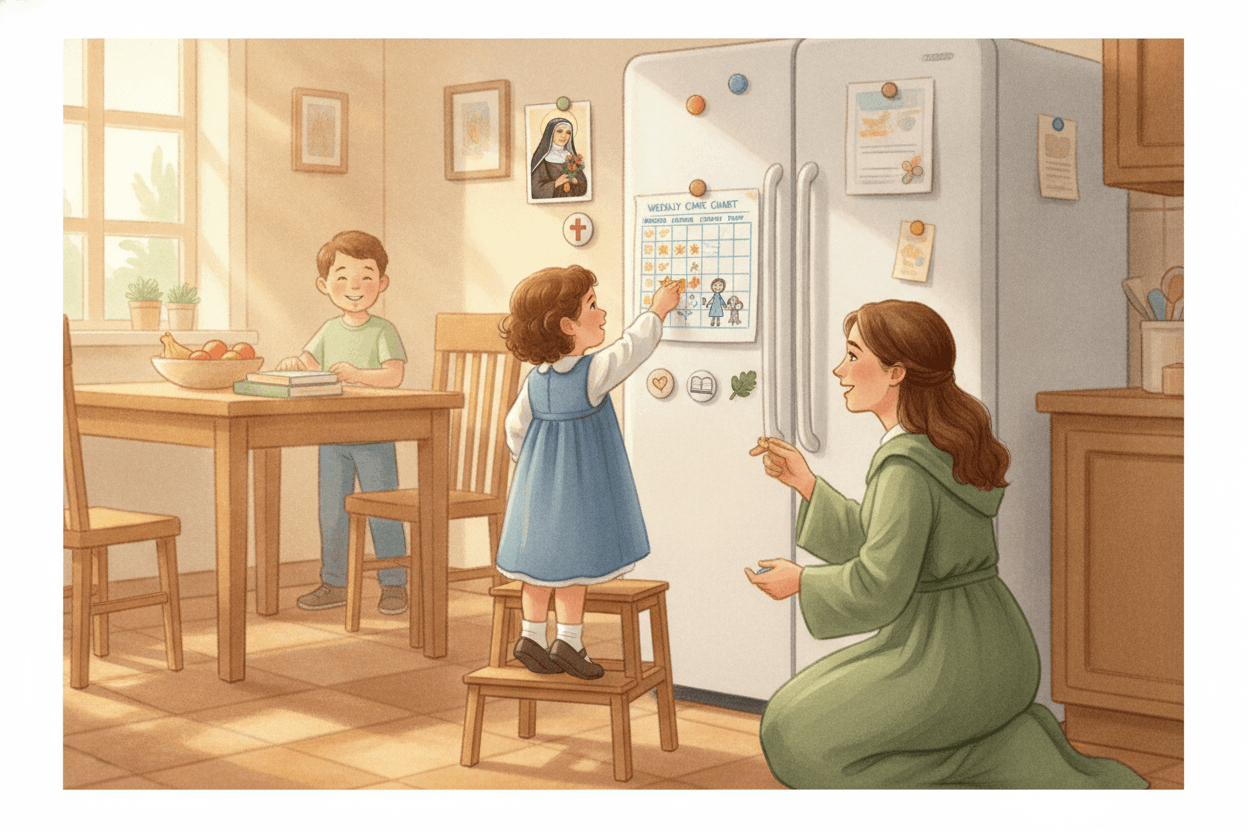
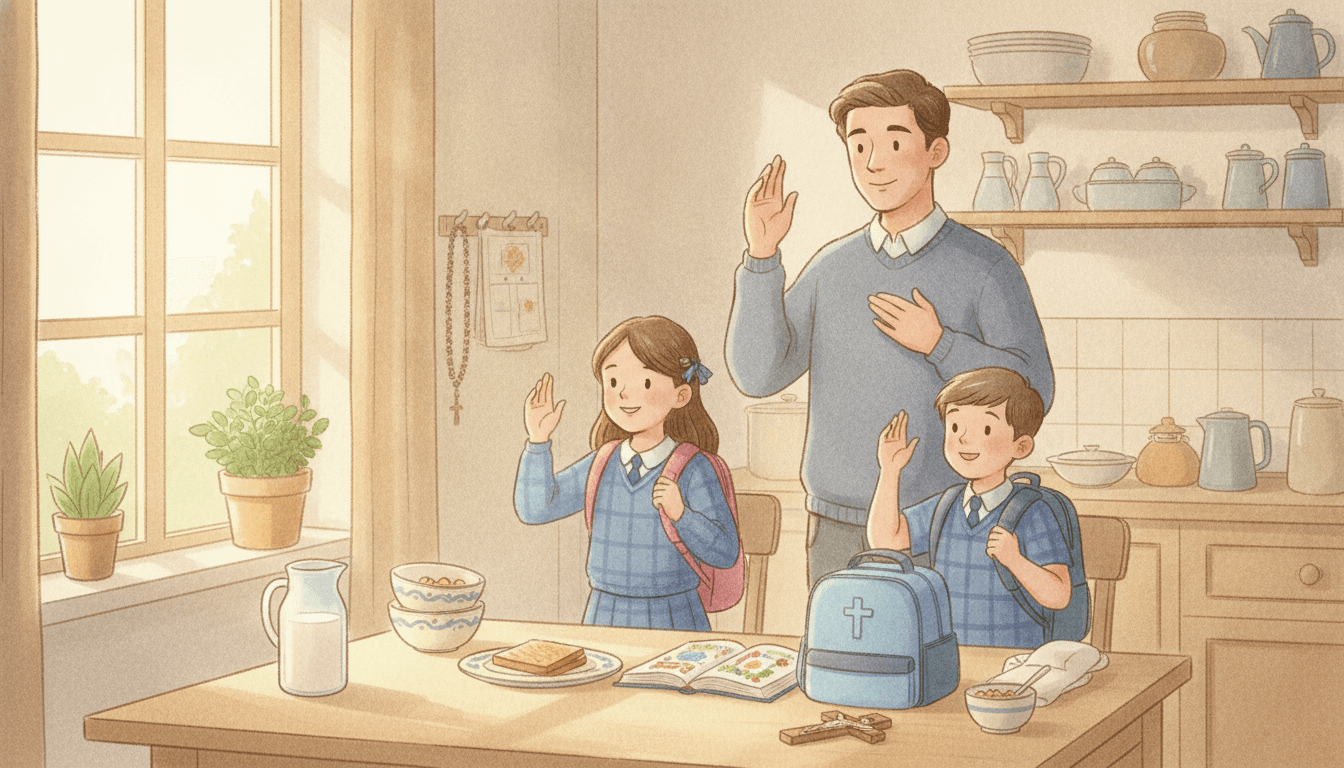
Monday morning can begin with a saint card propped beside the cereal bowl. Before anyone reaches for a biography or a craft, simply say the saint’s name, show the image, and offer one concrete detail: “This is Saint Joseph. He cared for Jesus and Mary by working faithfully.” Children do not need a lecture to begin recognizing that the saints were real people who loved Christ in ordinary circumstances. Let them notice the tools in Joseph’s hand, Saint Francis with the animals, or Saint Thérèse holding roses. An image gives the week a face and helps even a preschooler remember whom the family is talking about.
Then tell a two-minute story. Keep only what serves the child’s understanding: one choice the saint made, one difficulty he or she faced, and one way God was loved. Here’s how I’d teach this in a parish classroom: “Saint Monica kept praying for her son for many years, even when she felt sad. She did not stop asking God to help him.” Follow with one question: “When is it hard for us to keep praying?” A child may answer, “When my brother is mean,” or “When I want something now.” Receive the answer seriously. Catholic children are capable of connecting a saint’s perseverance with their own real lives.
Next, name one virtue for the week and practice it in the moments that already arise. With Saint Thérèse, choose small acts of love: putting away blocks without being asked, sharing the preferred cup, or speaking gently after disappointment. With Saint Joseph, practice helpful work. With Saint Nicholas, choose generosity. Do not make a chart that turns virtue into a scorecard. Instead, quietly point out a genuine attempt: “You waited while I finished helping your sister. That was patience.” The goal is not flawless behavior; it is learning, over time, that grace strengthens us to choose love again after we fail.
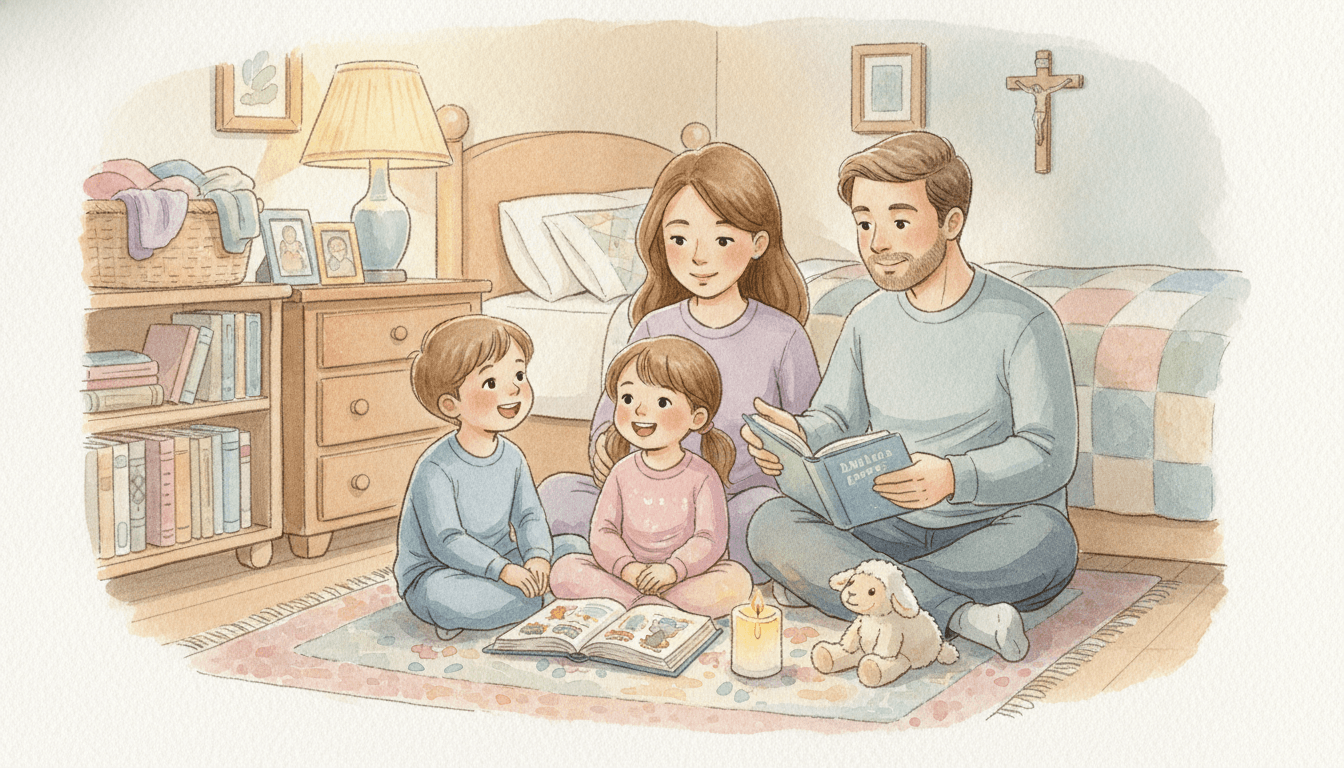
At bedtime, keep the prayer short enough that everyone can participate. “Saint Monica, pray for me to keep praying when something is hard.” Then invite each child to speak directly to Jesus in his or her own words. This teaches the proper order of Catholic prayer: we worship God alone, and we ask the saints, who are united to Christ, to pray with and for us. Scripture invites us to pray for one another, and the saints are not removed from the Church’s care for us. As the Catechism reminds us, “The Christian family is the first place of education in prayer” (CCC 2685). A parent’s steady, unhurried participation matters more than a polished explanation.
At the end of the week, perhaps on Sunday afternoon, take one minute to thank God: “Thank you, Jesus, for helping us try to be generous like Saint Nicholas.” Let each person name one attempt, including the parent. If no one can think of a success, thank God for another chance tomorrow. Then choose the next saint together from a small basket of holy cards or a children’s saint book. This gentle closing keeps the routine rooted in gratitude rather than performance, while giving children the repeated experience of belonging to a family that remembers and asks for the prayers of its heavenly friends.
Therefore, confess your sins to one another and pray for one another, that you may be healed. The fervent prayer of a righteous person is very powerful.
Match a Saint’s Virtue to the Moments Kids Actually Face
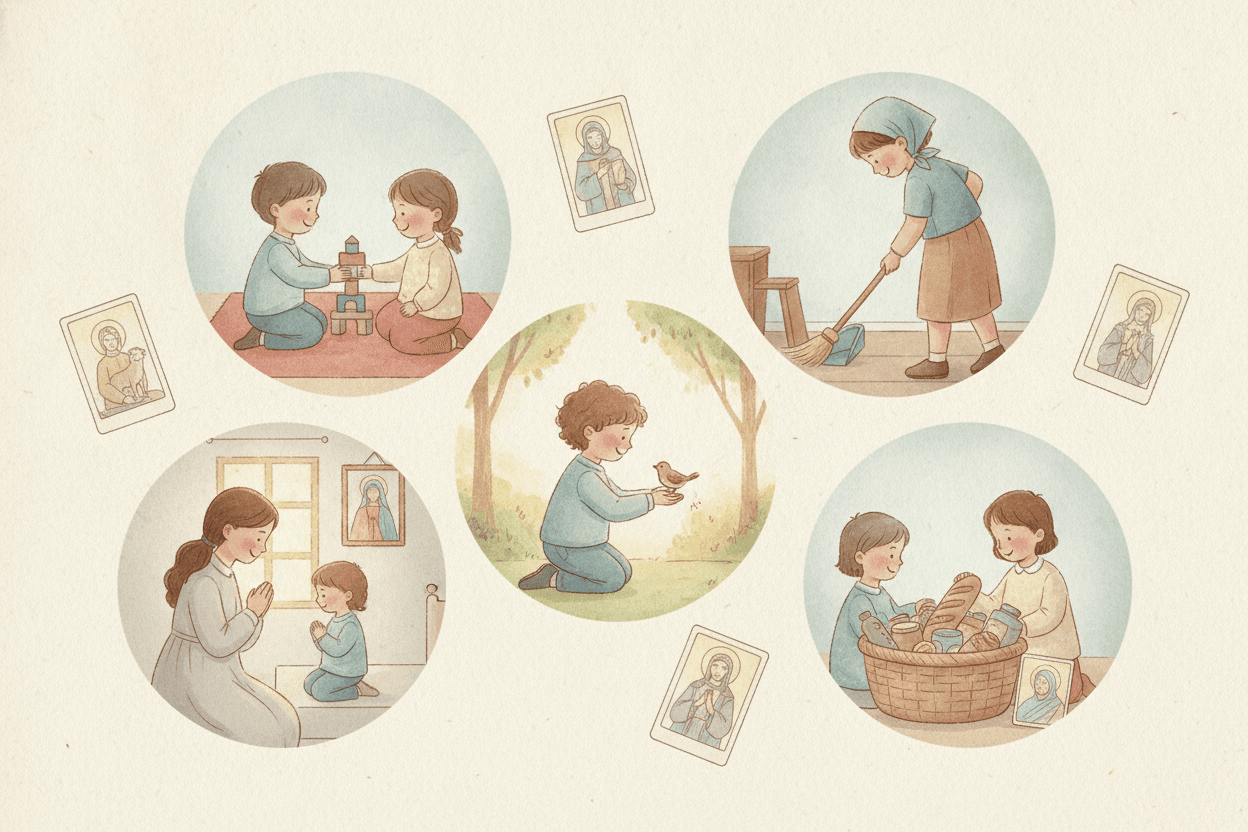
The argument over the blue cup has begun before breakfast is even cleared away. One child grips it; another cries; a parent is already tired. This is precisely where a saint belongs—not as a decoration on a holy card, but as an older friend in Christ whose way of loving God gives a child one faithful next step. We should resist turning saints into mascots with one catchy trait. Their lives were fuller than that. Still, a particular virtue can help children recognize that holiness reaches into the moments they know well.
For sharing, introduce Saint Nicholas as a man who gave generously because he loved Christ. Ask, “What is one thing you could share today, even if you still want it?” Then make the practice small and visible: let the child choose one snack, toy, or turn to offer freely. For waiting—at the doctor’s office, for a turn, or for a parent’s attention—turn to Saint Thérèse of Lisieux. Her “little way” teaches that small acts of love matter to God. Say, “While we wait, what small loving thing can we do?” The practice might be holding hands quietly, saying one Hail Mary, or letting a sibling go first without complaint.
Fear calls for more than telling a child, “Don’t be scared.” Saint Monica knew the long work of bringing worries to God in persevering prayer. When a child fears the dark, a new classroom, or being apart from you, ask, “What do you want Saint Monica to pray with you about?” Practice naming the fear plainly, then pray: “Saint Monica, pray for me to trust Jesus when I feel afraid.” Add a spontaneous prayer directly to Jesus. This keeps the teaching clear: we ask saints to pray with us and for us; worship belongs to God alone.
Chores are a natural place to remember Saint Joseph. He cared for Jesus and Mary through steady, ordinary work. Before putting toys away or setting the table, ask, “How can we help our family like Saint Joseph did?” Set a two-minute timer and work alongside your child rather than assigning the task from across the room. For kindness toward people and creation, Saint Francis of Assisi is a fitting companion. Ask, “What has God made that we can treat gently today?” The practice may be refilling a bird feeder, picking up litter with an adult, speaking gently to a pet, or choosing kind words when a sibling is frustrating.
The point is not to produce children who can recite saint facts while avoiding the work of love. It is to help them see that Christ strengthens them in concrete choices. Scripture invites us to say with Saint Paul, “I have the strength for everything through him who strengthens me.” A simple saint prompt at the hard moment, followed by a simple act, gives children a pattern they can carry into prayer. As the Catechism reminds us, “The Christian family is the first place of education in prayer” (CCC 2685). Parents who pray these brief prayers with their children teach far more than parents who merely explain them.
I have the strength for everything through him who strengthens me.
Let Children See That Prayer Is a Family Habit
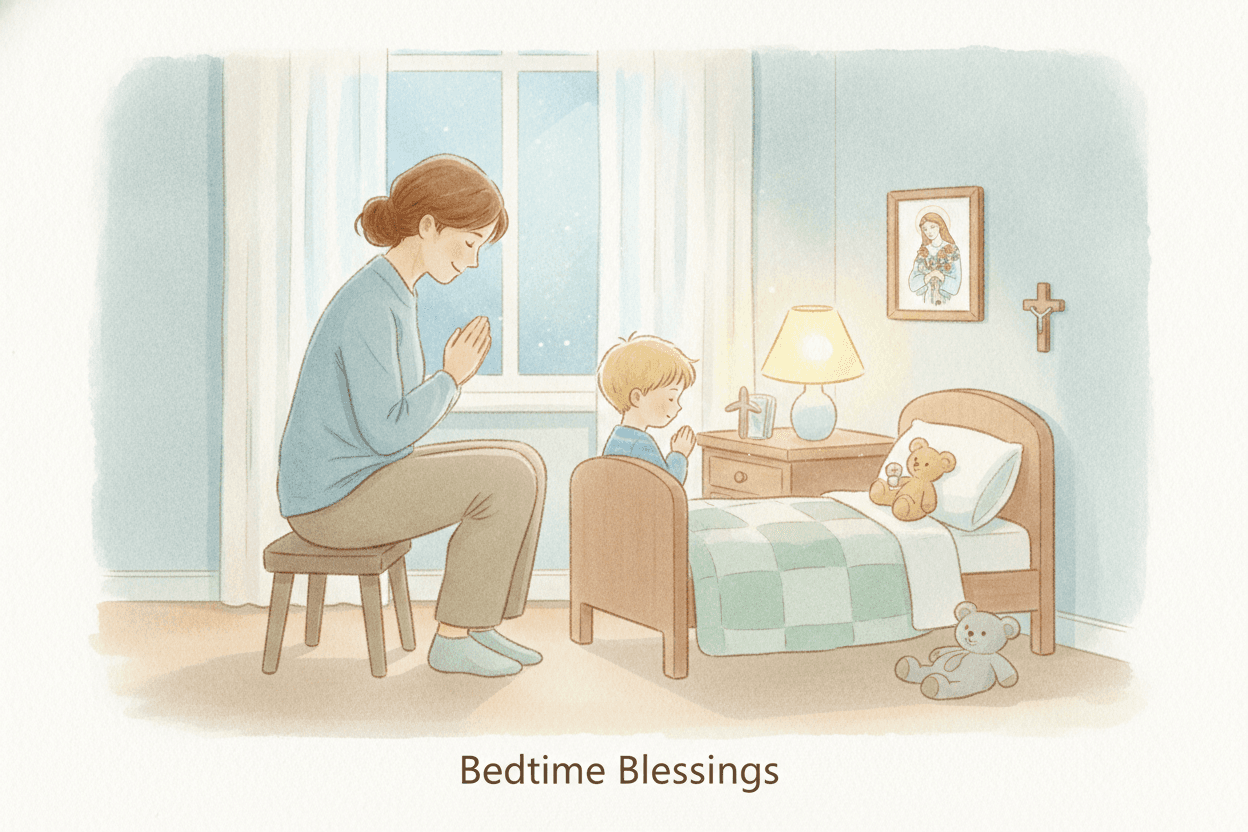
The spilled cereal is still on the floor, one child is upset about the wrong cup, and everyone needs to leave in seven minutes. That is precisely the kind of moment when children learn what prayer means in a Catholic home. A parent can pause, make the Sign of the Cross, and say, “Saint Thérèse, pray for us to be loving. Jesus, help us begin again.” The prayer need not make the morning instantly peaceful. Its purpose is more lasting: children see that their family turns to God in ordinary trouble, not only when the house is quiet.
The Catechism states plainly, “The Christian family is the first place of education in prayer” (CCC 2685). Children learn the words of prayer, certainly, but they also learn its posture from us: we stop, we thank God, we ask for help, and we trust him with what is unfinished. As the Catechism reminds us, parents have the mission of teaching their children to pray and to discover their vocation as children of God (CCC 2226). Information about saints matters; a child should know who Saint Joseph or Saint Monica was. Yet a parent’s regular, unhurried prayer teaches that these holy friends belong in real family life.
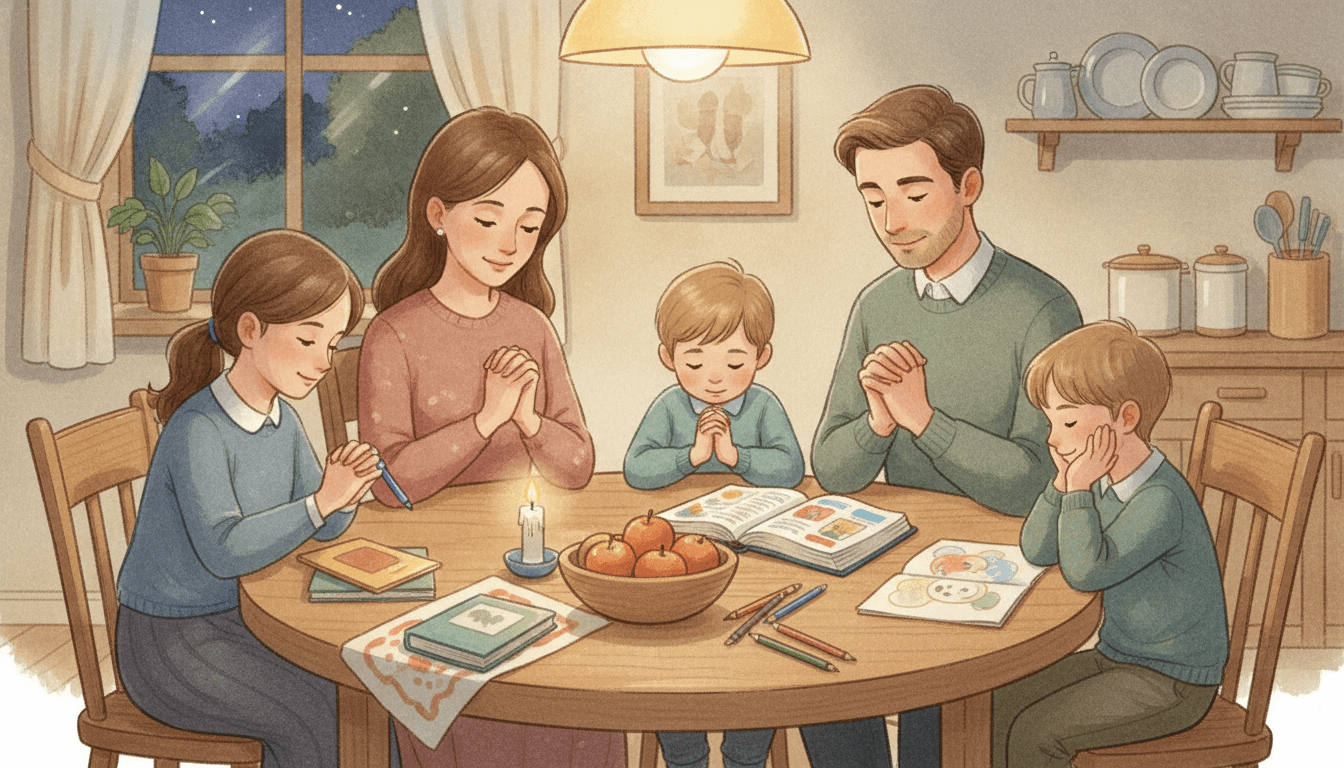
Keep the pattern brief enough to survive a normal week. At breakfast, name one gift: “Jesus, thank you for this food and for our family.” In the car, add one intention: “Saint Joseph, pray for Dad as he works today. Jesus, keep us safe.” After a hard moment—a sibling argument, a frightening doctor visit, a disappointed child—help the child put the feeling into a simple request: “Saint Monica, pray for me while I wait. Jesus, help me be patient.” At bedtime, thank God for one good thing, ask a saint’s intercession, and finish by speaking directly to Christ: “Jesus, forgive us, stay with us, and help us love you tomorrow.”
This order quietly teaches sound Catholic faith. We honor the saints and ask them to pray with us; worship belongs to God alone. The saints are not substitutes for Jesus, nor are they magical helpers who guarantee the outcome we want. They are members of Christ’s body who have persevered in love and now pray for the Church. Scripture invites us to remember that “Now you are Christ’s body, and individually parts of it” (1 Corinthians 12:27). A family’s saint routine can help children recognize that they are never praying alone.
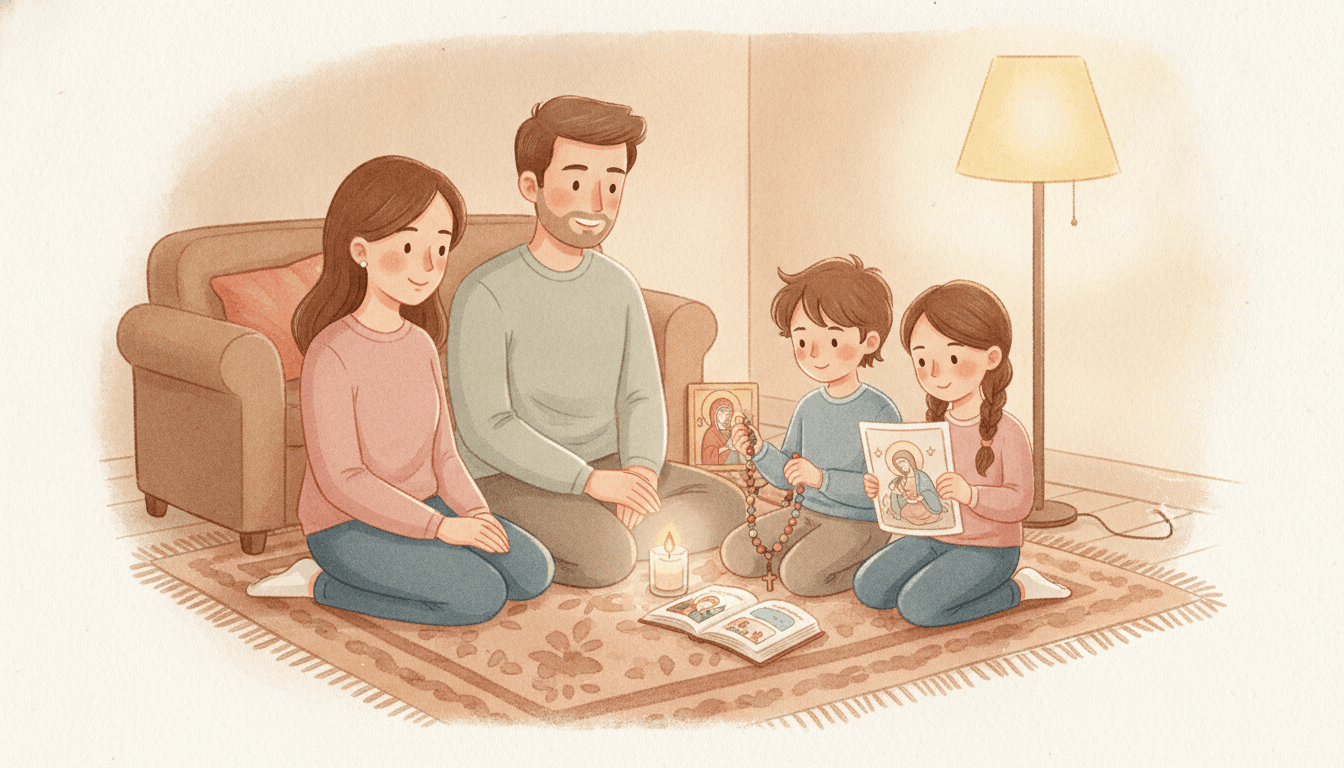
Here’s how I’d teach this to parents: choose two dependable prayer stops before adding more. Perhaps breakfast and bedtime work now; perhaps the car ride and the moment after an argument are more realistic. Put a holy card near the table or keep one in the car, but do not make the image carry the routine. Let the children hear you pray, including when you are tired or have made a mistake. A calm, repeatable return to Jesus will form them more steadily than a long lesson delivered once a week.
Now you are Christ’s body, and individually parts of it.
Try This Heavenly Friends Routine This Week
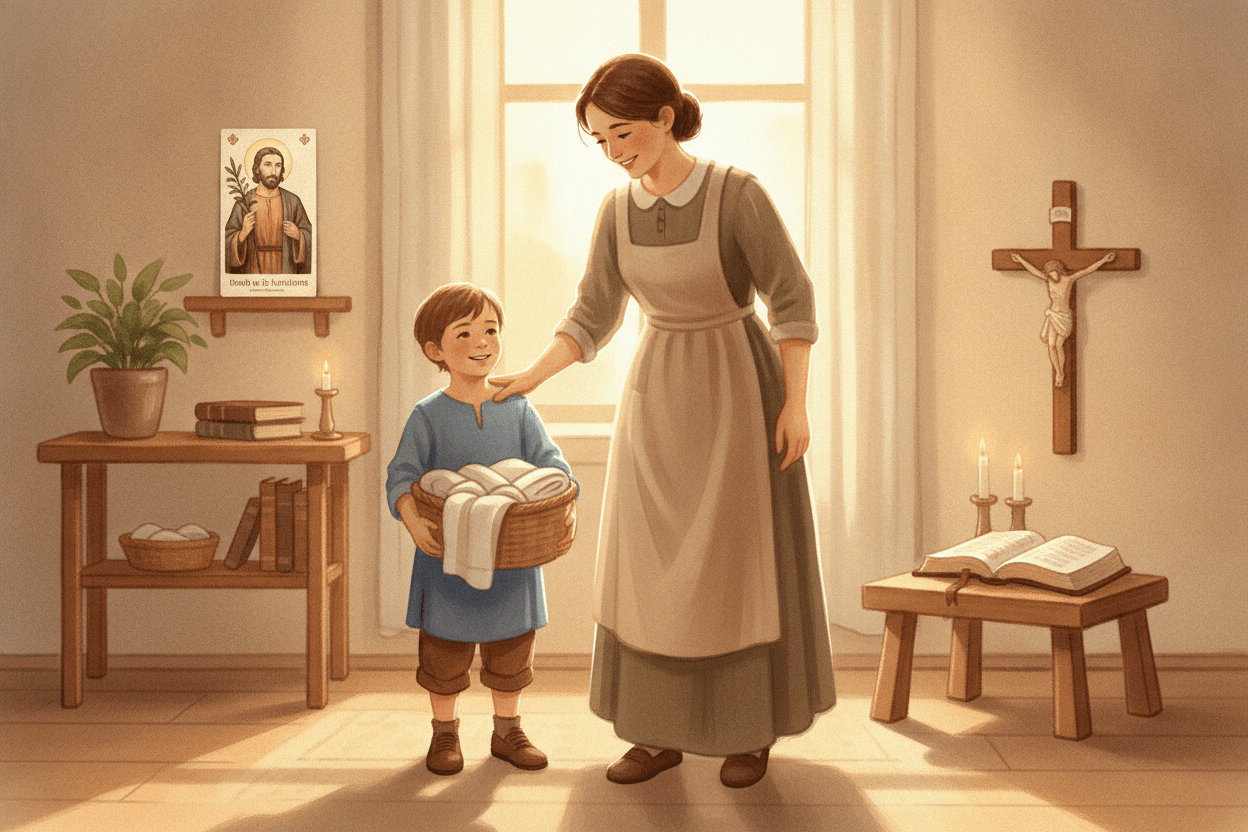
On Monday morning, place a simple image of Saint Joseph on the refrigerator or beside the spot where backpacks gather. Do not begin with a long lesson. Let a child notice the picture and ask who he is. Then say, “This is Saint Joseph. He cared for Jesus and Mary, and he worked faithfully for his family.” That is enough to begin. Children do not need every detail before they can recognize a virtue worth imitating.
For this seven-day starter plan, choose just one saint and one virtue. Saint Joseph is an especially practical choice for a busy family because his example points to helpfulness, steady work, and care for those entrusted to him. On Tuesday, tell a two-minute story: Joseph listened to God, protected Mary and Jesus, and did the ordinary work a family needed. On Wednesday, name the virtue plainly: “This week we are practicing helping our family with love.” Here’s how I’d teach this: give the virtue a child-sized action—putting shoes away, carrying napkins to the table, or helping a younger sibling without being asked twice.
From Thursday through Saturday, look for one opportunity each day to practice that virtue. Be specific rather than general. At breakfast, ask, “How can we help our family with love today?” At cleanup time, notice the effort: “You put the blocks away even when you wanted to keep playing. That was a helpful choice.” If the child refuses or forgets, resist turning the saint into a standard of impossible perfection. Simply begin again. Saints grew in holiness through grace, repentance, and perseverance; our children are learning that same pattern in small daily choices.
End each day with one sentence before bedtime or at the dinner table: “Saint Joseph, pray for me to help my family with love.” Then add a brief prayer directly to Jesus: “Jesus, help us love one another tomorrow.” This distinction matters. We ask Saint Joseph to pray with us and for us; worship belongs to God alone. The communion of saints is not a collection of spiritual superheroes but the family of Christ, united in him. As the Catechism reminds us, “The Christian family is the first place of education in prayer” (CCC 2685).
On Sunday, take thirty seconds to look again at the image and ask one easy question: “When did you help our family this week?” Thank God for one concrete answer, even if it is small. Then either repeat Saint Joseph for another week or choose another heavenly friend whose virtue meets a current family need. Keep the pattern brief enough to survive an ordinary week: one image, one story, one virtue, one daily action, and one prayer. Scripture invites us to welcome children to Christ with confidence, not pressure; this little routine gives them a recognizable way to do so together.
Let the children come to me, and do not prevent them, for the kingdom of heaven belongs to such as these.
Frequently asked questions
How do I teach my preschooler about Catholic saints?
Start with one saint at a time and keep it simple: share one memorable detail, name one virtue, and say one short prayer. Connect the virtue to something your child faces, such as sharing, waiting, being kind, or feeling afraid. A picture or holy card can help make the saint familiar.
How do I explain praying to saints without confusing my child?
Tell your child that we worship God alone and ask saints to pray for us, like asking a trusted family member or friend to pray. After asking the saint’s intercession, pray directly to Jesus together. For example: “Saint Monica, pray for us,” followed by, “Jesus, help our family trust you.”
What is the communion of saints in words a young child can understand?
You can say that Jesus has one big family, and everyone who belongs to him is connected in love. Some members of that family are on earth, and the saints are already with Jesus in heaven. They remember us and pray with us as we follow the same Lord.
What saint virtues are easiest to teach young children?
Choose virtues children can practice in everyday moments: patient waiting, helpfulness, gentle words, sharing, courage, and saying sorry. Saint Thérèse can inspire small acts of love, Saint Monica can model persevering prayer, and Saint Joseph can show faithful care for family. Keep the focus on one attainable choice rather than a long biography.
How can we make saints part of our family routine?
Try a simple weekly rhythm: introduce a saint with a two-minute story and image, then watch for one chance to practice that saint’s virtue during the week. At dinner or bedtime, ask about a “small-love moment” or another concrete example. End with the same brief prayer so the saint becomes a familiar heavenly friend.
How do I talk about saints without making my child think they were perfect?
Explain that saints were real people who needed God’s mercy and kept returning to Jesus. Emphasize repentance and trying again after wrong choices, not flawless behavior. This helps children see that holiness is growing in love with God’s help, even when life is messy.
Sources: vatican.va · vatican.va · vatican.va · vatican.va · usccb.org · vatican.va · vatican.va · vatican.va
Scripture quotations in this article use the NABRE translation.