Catholic Morning Routines That Help Kids Start With God
Discover simple Catholic morning routines that fit real family chaos, from a brief offering prayer to blessing foreheads before school. These small habits help children place their homework, friendshi
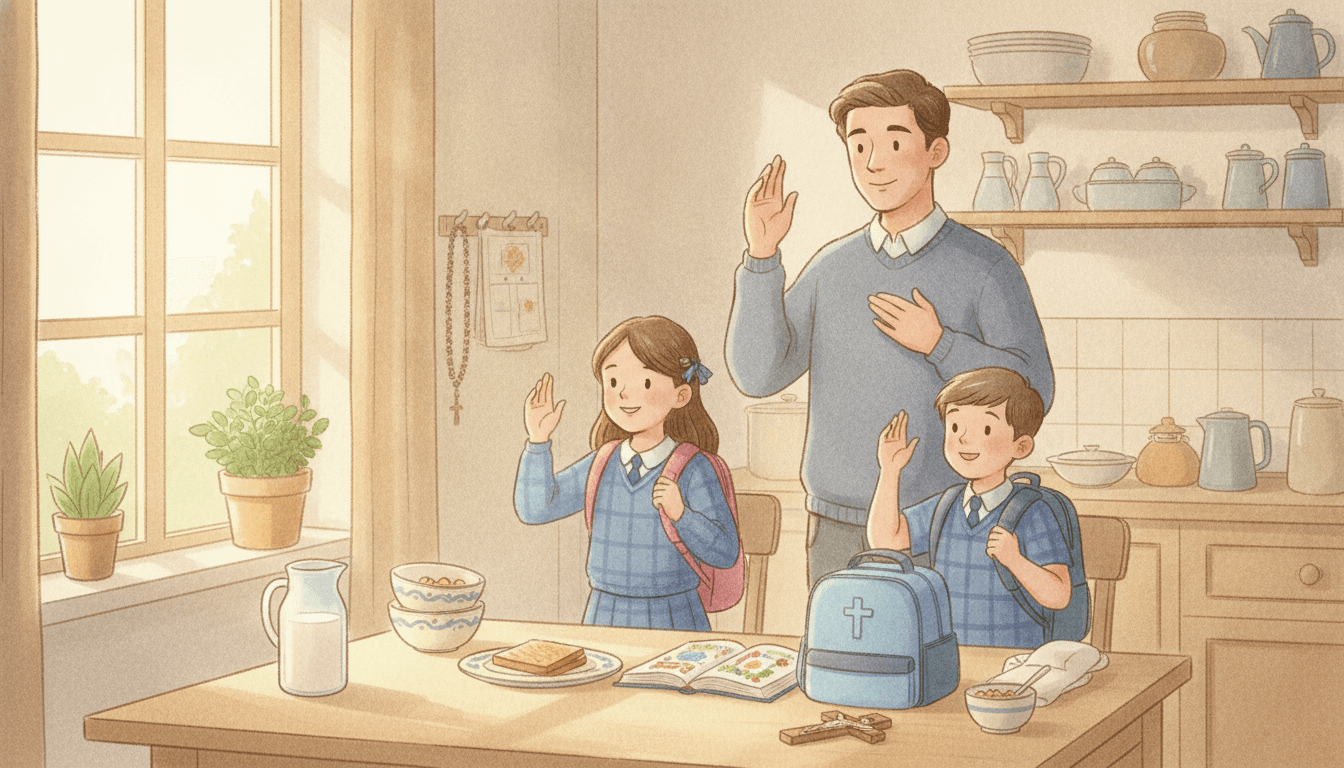
The lunchbox is open, one shoe has disappeared, and the carpool clock is not forgiving. Yet even a two-minute pause can teach a child that schoolwork, friendships, worries, and joys belong to Jesus. Scripture invites us to make the ordinary school morning a small, steady school of prayer.
Why Two Minutes in the Morning Can Shape a Child’s Faith
Sixty-three percent of U.S. parents say their children regularly take part in a religious activity at home, such as prayer, Scripture reading, or conversation about faith. Many families are already doing something meaningful. The next helpful step is not adding a lengthy devotional to an already crowded school morning; it is giving those few minutes a dependable shape. A child who begins the day with the Sign of the Cross, a brief offering, and one intention learns that prayer belongs before the backpack is zipped, not only after something goes wrong.
Two minutes can teach a large truth: the day is received from God and returned to him. This is the logic of a morning offering. Children are capable of understanding that their math work, a hard spelling test, recess friendships, chores, and disappointments are not outside their life with Christ. Scripture invites us to make that connection: “And whatever you do, in word or in deed, do everything in the name of the Lord Jesus, giving thanks to God the Father through him.” A morning prayer gives children language for living this verse in ordinary places.
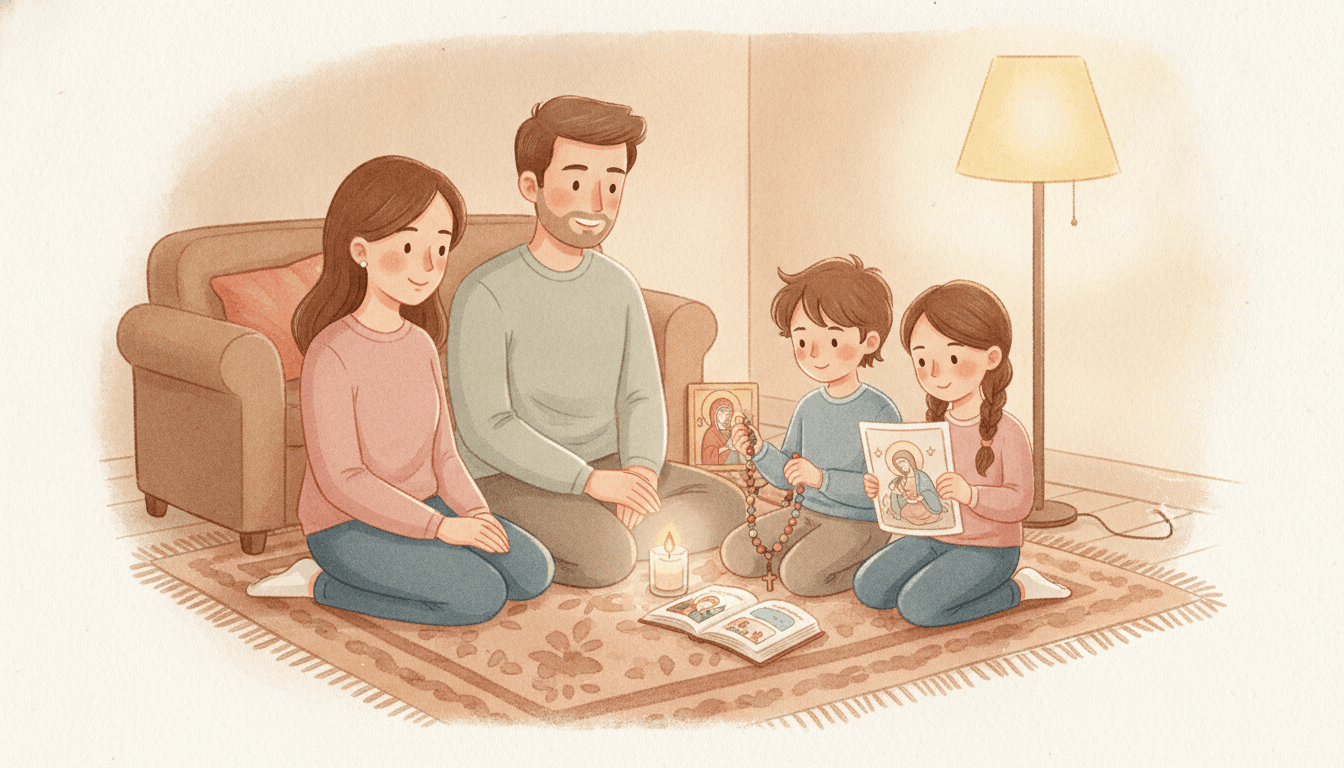
Here is how I’d teach this in a parish classroom and encourage it at home: keep the pattern steady enough that children can lead it. Begin together: “In the name of the Father, and of the Son, and of the Holy Spirit. Amen.” Then pray, “Jesus, I give you my work, my play, my words, and my worries today. Help me to love as you love. Amen.” Let each child name one particular intention—a friend who is sick, courage for a presentation, patience with a sibling. The prayer need not be polished. It needs to be real and repeated.
This small practice is formation in the domestic church. The Catechism calls the Christian family a place where children first learn prayer and Christian life (CCC 1657). Parents are not required to deliver a daily lesson before breakfast. They are showing, through a simple habit, that God is present in the actual material of family life: rushed mornings, lost shoes, eager plans, and difficult days. Over time, children learn that prayer is not an interruption to the day’s work. Their work can become an offering.
The Catechism also reminds us that the baptized person begins the day with the Sign of the Cross, dedicating the day to God’s glory and asking for the Savior’s grace. That is a serious lesson expressed in a child-sized practice. When the routine is brief and predictable, it respects children’s attention while giving them a sturdy spiritual reflex: before I face the day, I turn to God. The lasting fruit may not be visible at breakfast. Yet the words they learn there can return years later—in a classroom, on a bus, before a decision—as a remembered way to begin again with God.
And whatever you do, in word or in deed, do everything in the name of the Lord Jesus, giving thanks to God the Father through him.
The Biblical Pattern: Speak of God When You Get Up
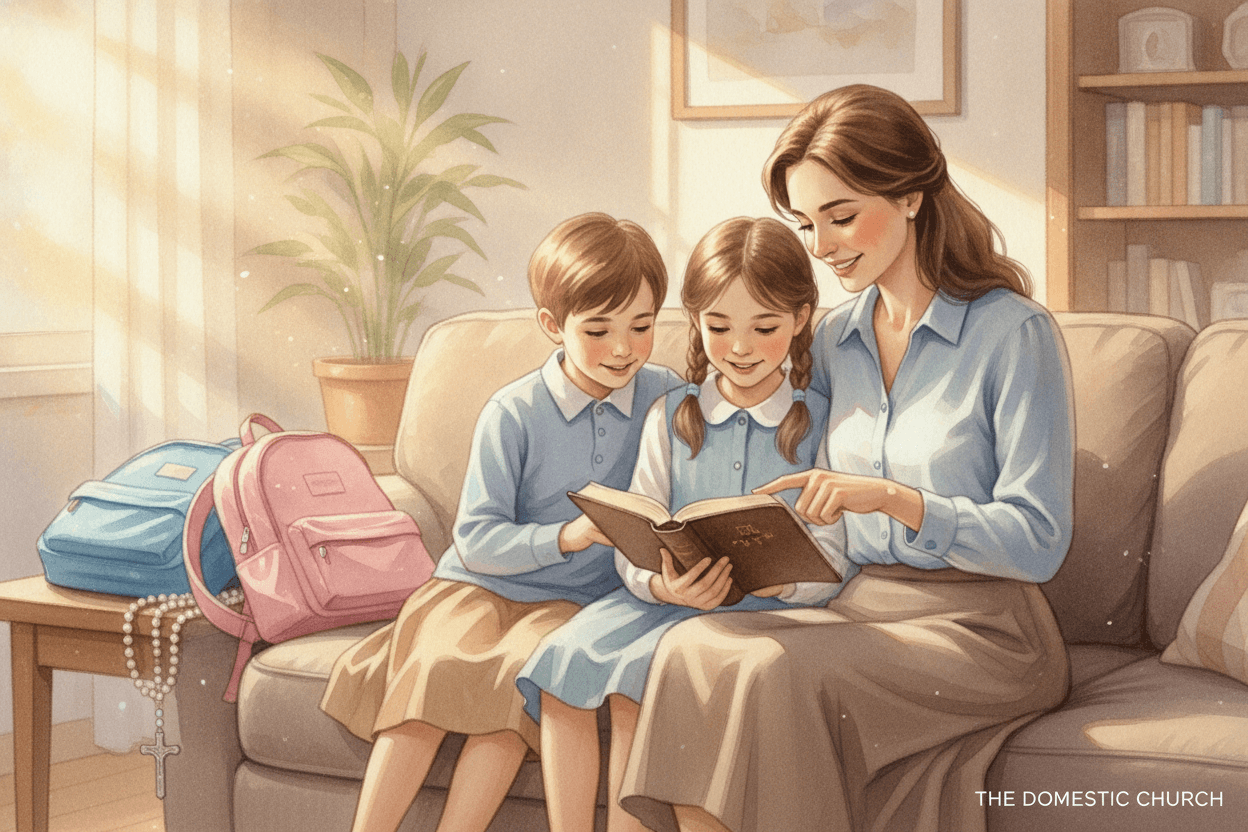
The backpack is by the door, someone cannot find a shoe, and the school-day clock is moving faster than anyone wants. That small threshold is not too ordinary for faith formation. It is precisely the kind of moment Scripture names. Moses does not place the teaching of God’s words only in formal lessons; he places it in the repeated rhythms of home life, including the moment children get up.
Scripture invites us to see morning prayer not as one more task to complete, but as a brief act of remembrance. A parent might gather the children for thirty seconds at the breakfast table or before they step into the car: make the Sign of the Cross, say a short Morning Offering, and name one intention for the day. “Jesus, I give you my work, my friendships, and anything hard that happens today. Help me love you.” Children are capable of understanding that their spelling test, recess disagreement, music practice, and acts of kindness all belong to God.
Psalm 5 gives this habit its proper direction: “In the morning you will hear my voice; in the morning I will plead before you and wait” (Psalm 5:4, NABRE). Notice that the psalmist speaks and waits. Children can learn both actions. Let them supply their own words: a thank-you for breakfast, a plea for help with a worried feeling, or a prayer for a classmate. Here’s how I’d teach this in a parish classroom: adults go first, but children should soon have a real part to pray aloud. They are not an audience for family prayer.
That matters because Jesus says, “Let the children come to me; do not prevent them” (Mark 10:14, NABRE). A hurried morning does not prevent a child from coming to Christ when the prayer is simple, consistent, and shared. The Catechism teaches that Christians begin the day with the Sign of the Cross, dedicating their actions to God and asking for the Savior’s grace. A parent’s steady invitation—rather than a long explanation—forms this instinct over time: when I rise, I turn first toward God.
Keep repeating them to your children. Recite them when you are at home and when you are away, when you lie down and when you get up.
Build a Catholic Morning Prayer With Three Simple Parts
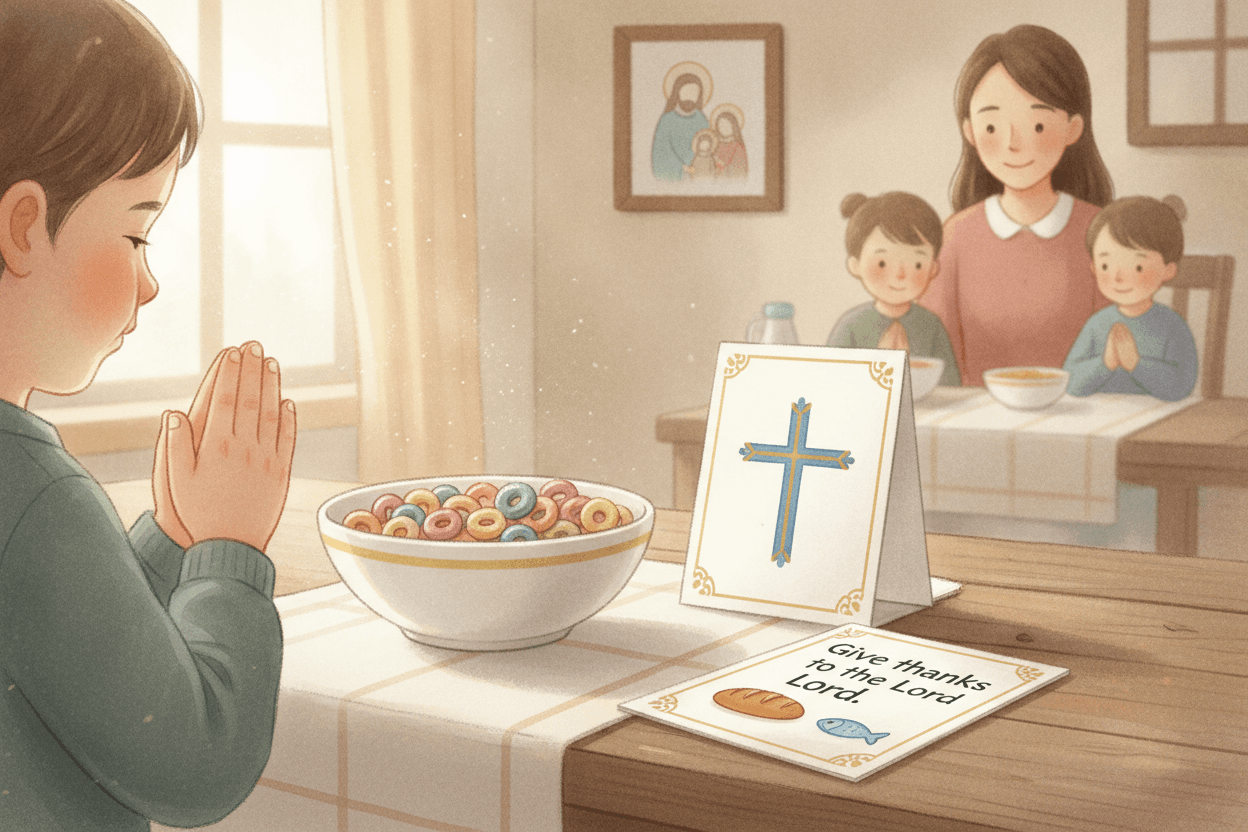
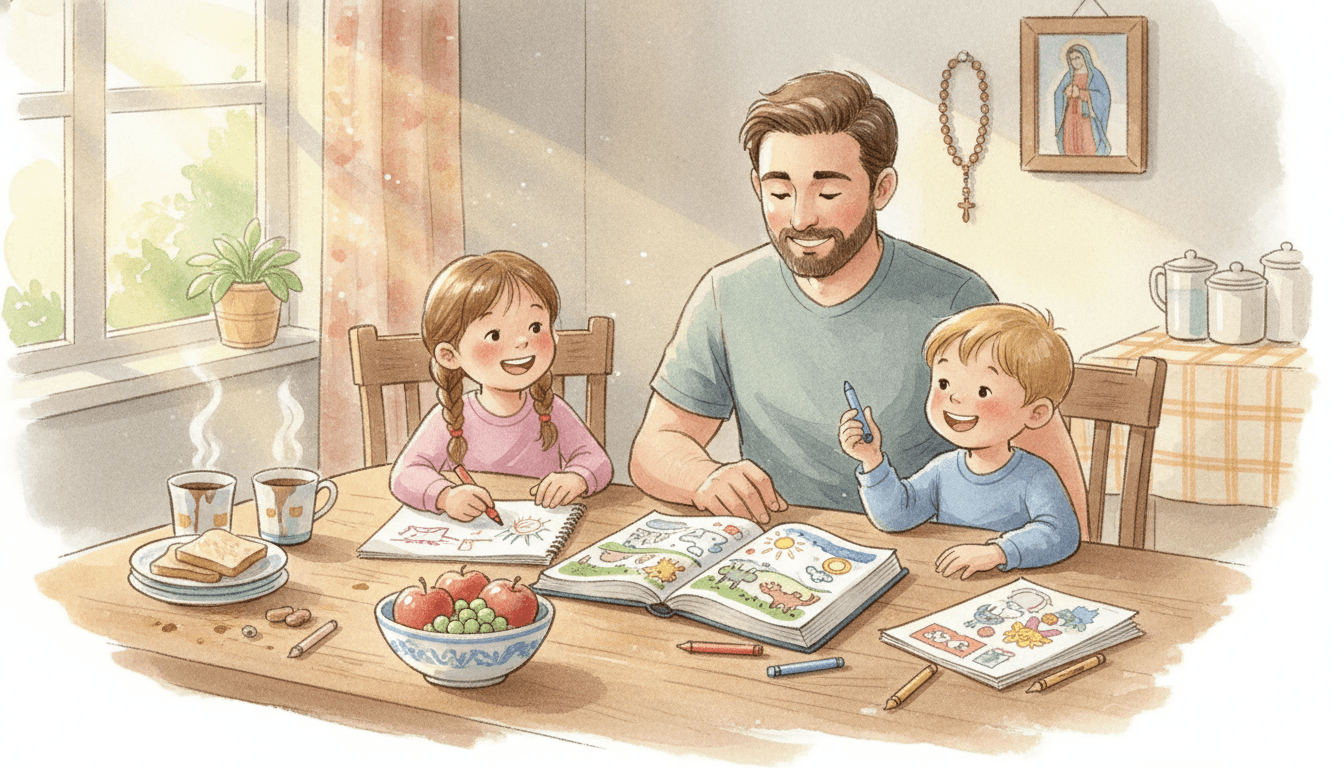
The backpacks are zipped, someone cannot find a shoe, and breakfast is disappearing faster than expected. That is precisely why a family morning prayer needs a small, steady shape rather than a long list of good intentions. Choose one place—the breakfast table, the front door, or the car before it moves—and return to it at roughly the same point each morning. Consistency of time and place matters more than length. Two attentive minutes can teach children that God belongs in an ordinary school day, not only at Mass or before bed.
Begin with the Sign of the Cross. This is not merely a signal that prayer has started; it names the God into whose life we were baptized. As the Catechism reminds us, “The Christian begins his day, his prayers, and his activities with the Sign of the Cross” (CCC 2157). Invite children to make it deliberately: “In the name of the Father, and of the Son, and of the Holy Spirit. Amen.” Even a preschooler can learn the gesture, while older children can begin to understand its meaning: today’s work, words, choices, and difficulties are offered to the Triune God.
Second, pray a short Morning Offering that children can memorize and eventually lead. The traditional form is a worthy prayer, but young children need words they can say with understanding. Here is how I’d teach this: “Thank you, God, for this day. Help us to be like Jesus in all we think, do, and say. Amen.” A child who prays those words before spelling practice, a friendship problem, recess, or a test is learning that nothing in the day sits outside God’s care. As children grow, add specific words: “Jesus, I offer you my work, my joys, and my hard moments today.”
Third, add one short Scripture verse or one concrete intention. Do not turn this into another lesson before everyone leaves the house. Read a single sentence, then ask a simple question: “What can we give Jesus today?” The answer may be, “My math test,” “being kind to my brother,” or “Grandma’s doctor visit.” On especially hurried mornings, skip the verse and name the intention. On calmer days, let one child repeat the words of Psalm 5:4: “In the morning you will hear my voice; in the morning I will plead before you and wait.”
Keep the pattern stable: Sign of the Cross, offering, Scripture or intention. Let children take turns leading, even when their words are imperfect. Their participation is not a performance for adults; it is their own response to God. Over time, this brief practice forms a Catholic instinct: before the day asks something of us, we first turn toward the Lord and give Him what the day will contain.
In the morning you will hear my voice; in the morning I will plead before you and wait.
Use Words Children Can Understand—and Let Them Lead
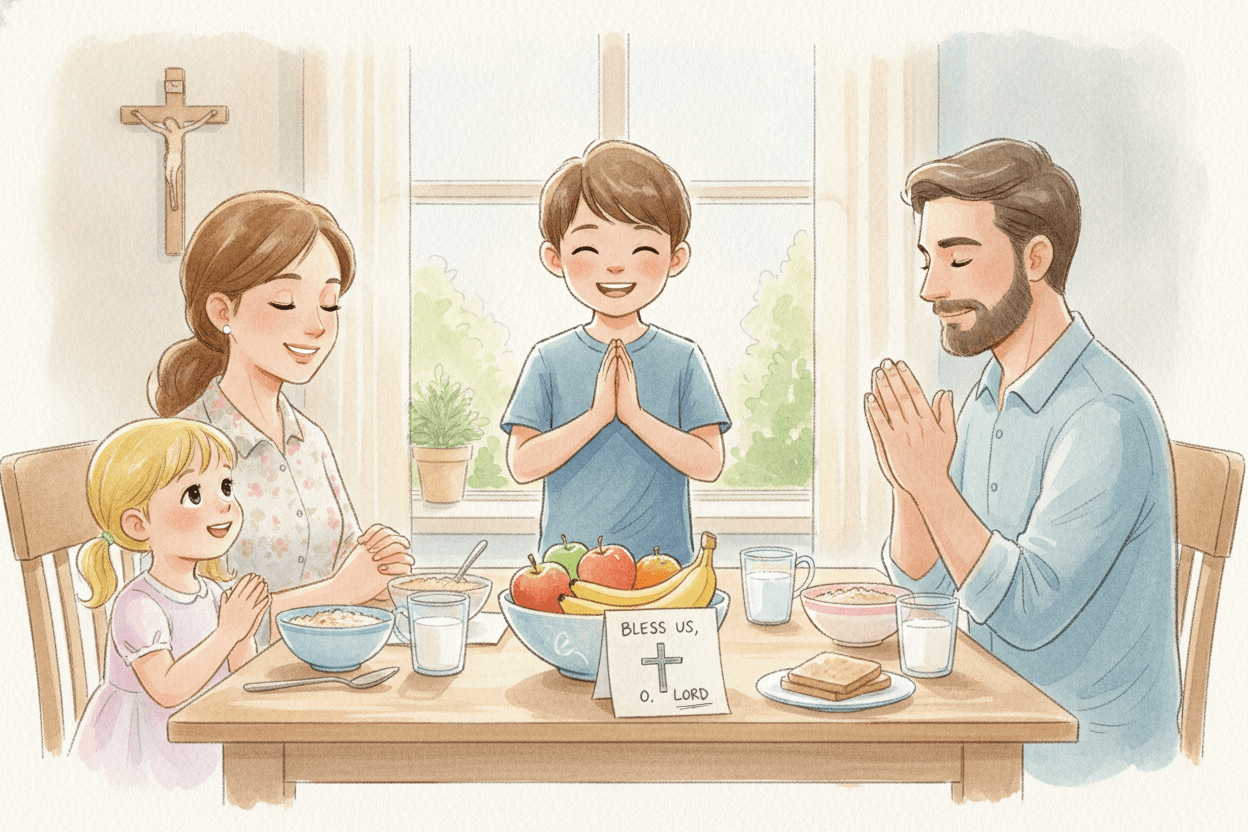
A seven-year-old who can button a coat and remember a library book can also lead the family in prayer. The key is not giving children adult-sized language and hoping they will absorb it. Give them words they can understand, repeat, and mean. Before breakfast or at the door with backpacks on, begin with the Sign of the Cross and pray: “Thank you, God, for giving us this day; help us to be like Jesus in all we think, do, and say. Amen.” This is short enough to memorize, yet it teaches gratitude, discipleship, and the offering of the whole day.
As the Catechism reminds us, the Christian begins the day with the Sign of the Cross, dedicating the day to God’s glory and asking for the Savior’s grace. A child’s prayer need not say everything at once. It should say something true. Once this first prayer is familiar, a family can add a fuller version: “Jesus, I give you my schoolwork, my friends, my play, my joys, and the hard things that happen today. Help me to choose what is good and kind. Be with me, and help me to be like you. Amen.” Notice that this names the places children actually live: a spelling test, recess, a disagreement, a success, and a worry.
For children ages six through nine, shared leadership matters. Let one child make the Sign of the Cross aloud, another name an intention, and another choose the day’s verse. A child might pray, “Please help Dad at work,” or, “Help me be patient with my brother.” These are not interruptions to the real prayer; they are the child’s real prayer. Here’s how I’d teach this in a parish classroom: offer two or three simple choices, allow a few seconds of silence, and receive the child’s words without correcting every phrase. Parents are forming both confidence and reverence.
Some families will be ready for the traditional Morning Offering: “O Jesus, through the Immaculate Heart of Mary, I offer you my prayers, works, joys, and sufferings of this day…” It is a worthy prayer to learn gradually, perhaps one line at a time. But memorization is not a test of holiness. The aim is that children understand they can give Jesus their entire day—what they do, what they enjoy, and what they find difficult. Saint Paul’s instruction gives this small practice its proper horizon: prayer and thanksgiving belong in every circumstance, including an ordinary Tuesday before school.
Rejoice always. Pray without ceasing. In all circumstances give thanks, for this is the will of God for you in Christ Jesus.
Choose the Routine That Fits Your Actual School Morning
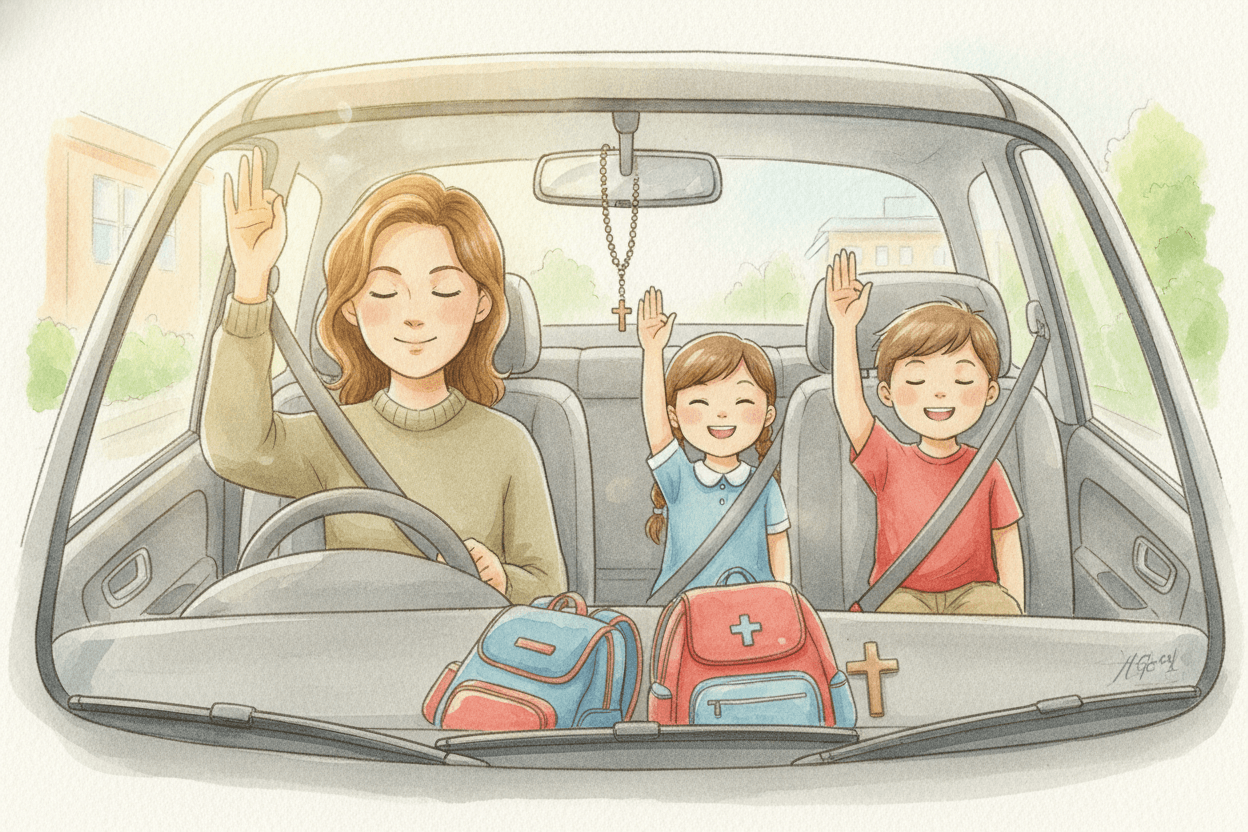
At 7:42 a.m., when someone cannot find a shoe and breakfast is still on the counter, a family does not need an ideal prayer plan. It needs one small practice that can survive a real school morning. Choose the length by the morning you actually have, not by the routine you wish you had. Children learn that prayer belongs to ordinary life when they see that God is welcomed both on calm days and on hurried ones. Jesus said, “Let the children come to me; do not prevent them, for the kingdom of God belongs to such as these.” A child’s brief, honest prayer at the doorway is a real coming to Christ.
For the rushed day, use a 60-second doorway prayer. As backpacks go on, make the Sign of the Cross together. A parent can say, “Jesus, we give you this day.” Each child may add one word or phrase: “my test,” “soccer,” “my friend,” or “help me be kind.” Then pray, “Guardian angel, watch over us. Amen.” This is not a lesser form of prayer because it is short. It teaches children to offer the concrete events already on their minds, and it gives them words they can eventually lead themselves.
On a morning with three minutes at the breakfast table, follow the same order each time: Sign of the Cross, offering, Scripture. Pray: “Thank you, God, for giving us this day; help us to be like Jesus in all we think, do, and say. Amen.” Then read one verse aloud, perhaps Psalm 5:4 or Colossians 3:17, and ask one question: “What can we offer Jesus today?” A child might answer, “My spelling work,” “being patient with my brother,” or “recess.” Here’s how I’d teach this: do not explain every verse at length before school. Read it clearly, name one connection to the day ahead, and let the child think.
If the car gives you five minutes, begin with, “Come, Holy Spirit, guide our minds, words, and choices today.” Invoke a saint connected to a child’s need: “St. Thomas Aquinas, pray for us as we learn,” or “St. Elizabeth Ann Seton, pray for our teachers and students.” Then let each person name one intention, including the driver. End with an Our Father or a simple response such as, “Jesus, stay with us today.” Keep a small list of verses or saints in the visor compartment so the prayer has variety without requiring a parent to invent something while driving.
A decade of the Rosary can be a good occasional car practice, especially during Advent, Lent, a family need, or a month devoted to Mary. It need not become the daily minimum for every household. The point is not to create a morning scorecard; it is to form a dependable reflex of turning toward God. Keep one routine for rushed days and one for calmer days, use the same place when possible, and begin again without drama after missed mornings. Scripture invites parents to speak of God “when you lie down and when you get up” (Deuteronomy 6:7). School mornings give that instruction a very practical home.
When Jesus saw this he became indignant and said to them, “Let the children come to me; do not prevent them, for the kingdom of God belongs to such as these.”
Send Children Out With a Blessing, Not Just a Reminder
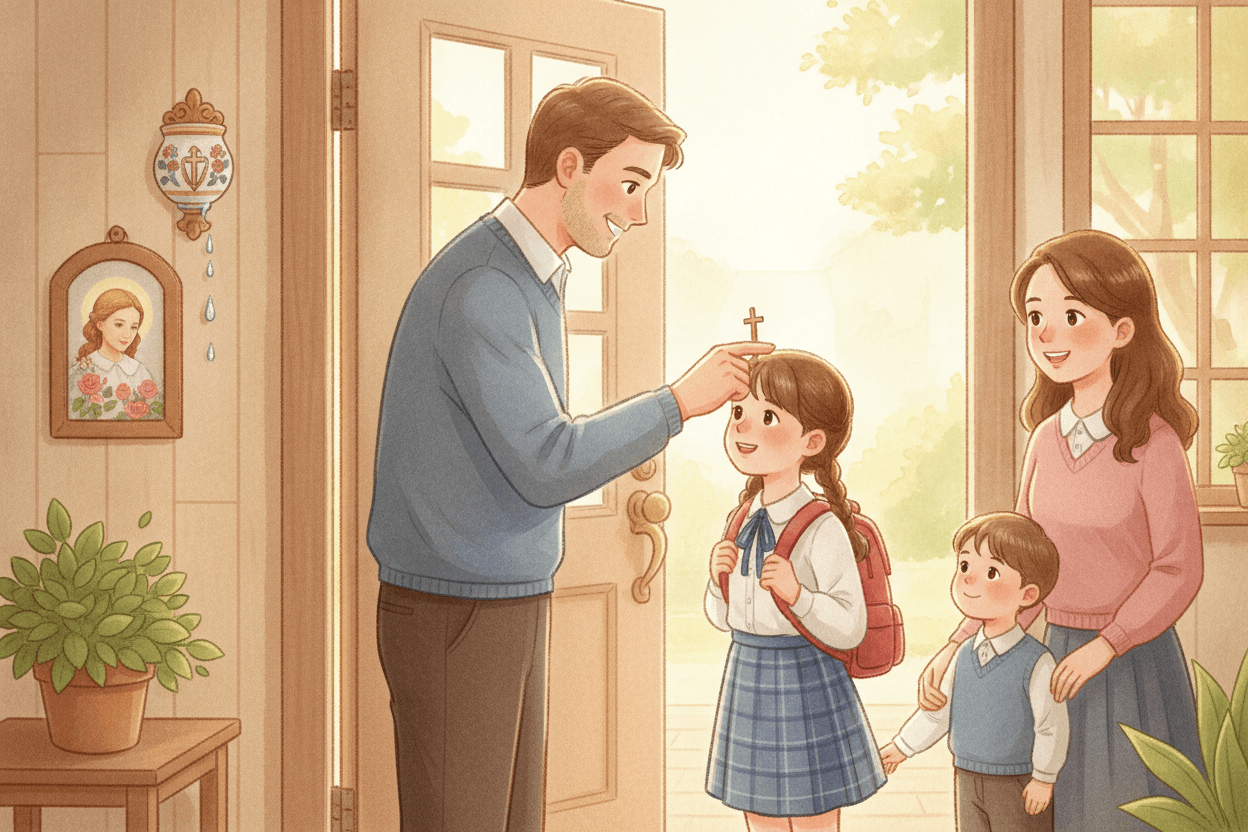
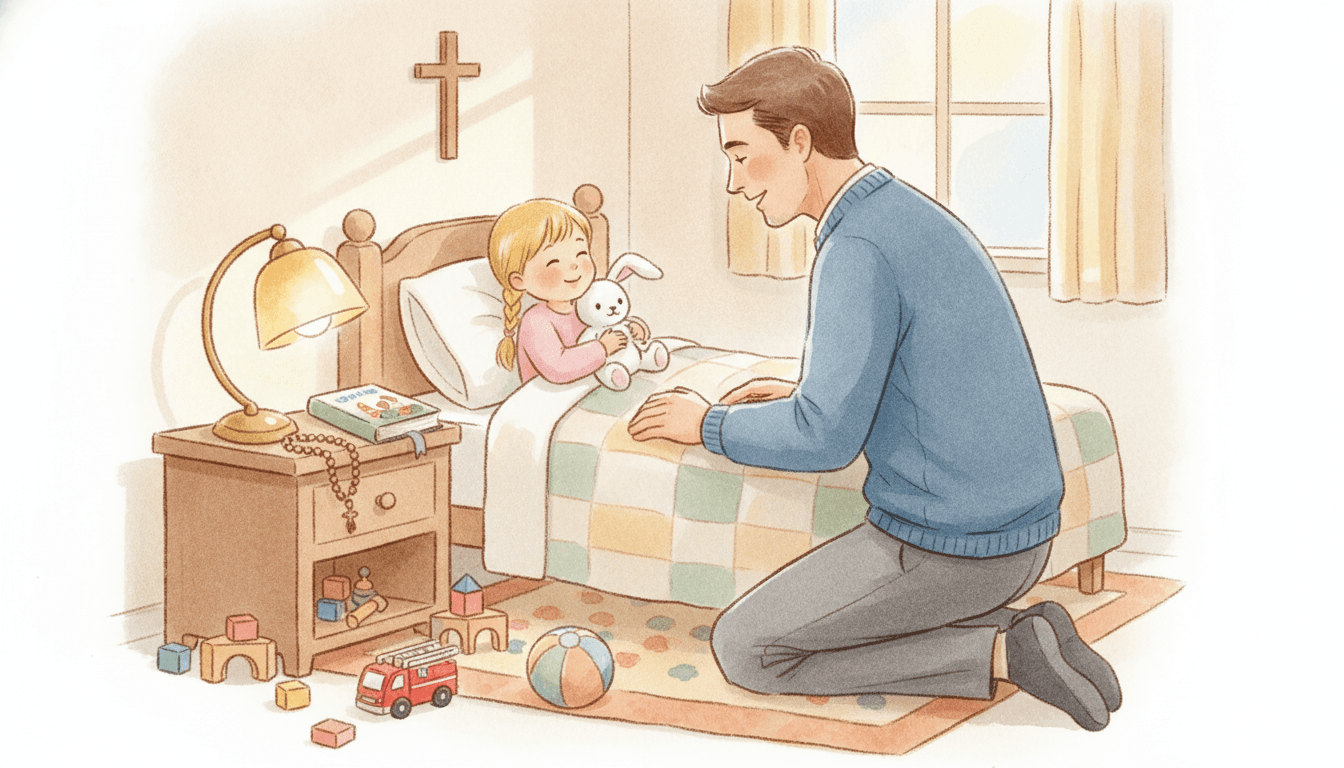
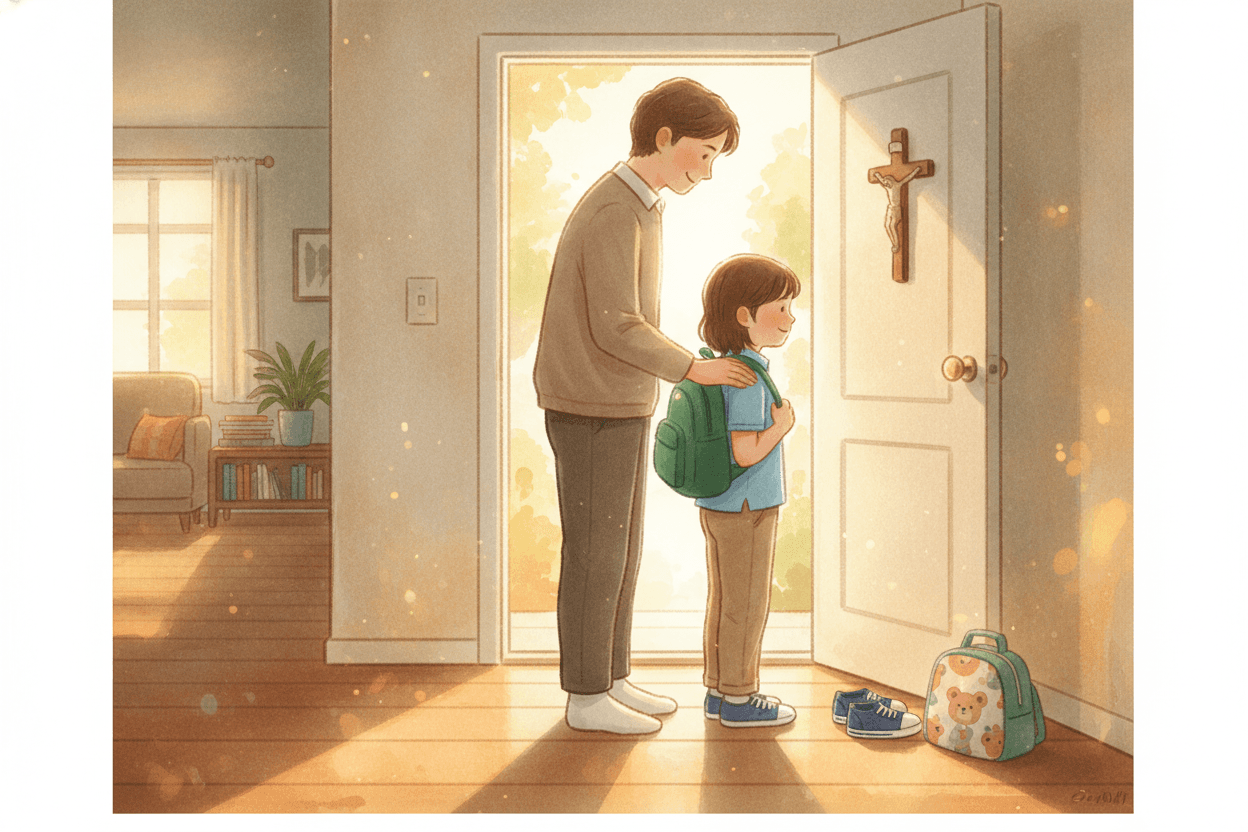
The backpacks are zipped, someone cannot find a shoe, and the last instruction at the door is often, “Don’t forget your lunch.” Before the children step outside, add one more small action: place your hand gently on a child’s head or shoulder, trace the Sign of the Cross, and speak a blessing. It takes less than half a minute, yet it tells a child something important: this school day belongs to God, including the spelling test, the noisy lunchroom, the hard conversation, and the ride home.
A parent might say, “May God protect you today, give you wisdom to make good choices, kindness toward others, and courage when something is hard. In the name of the Father, and of the Son, and of the Holy Spirit. Amen.” Keep the words steady enough that children come to know them, but leave room for a particular need. “Give Anna peace for her presentation.” “Help Marcus be patient with his brother.” Children are capable of understanding that God cares about the concrete duties and struggles waiting for them, not only the broad idea of having a good day.
The USCCB’s Daily Blessing of a Child offers parents a trustworthy pattern for this practice. Its value is not in finding a flawless formula; it gives a family words shaped by Christian faith when the morning is moving quickly. Here’s how I’d teach this to parents in formation: choose one place—the front door, the driveway, or the school drop-off line—and make the blessing the final family action before separation. If mornings are especially crowded, bless each child while fastening a seat belt or as they climb from the car. Consistency matters more than length.
This is not a priestly liturgical blessing, and parents need not imitate one. A priest blesses in the Church’s liturgical ministry; a mother or father prays over a child within the ordinary, baptismal life of the family. The Catechism teaches that the baptized begin the day with the Sign of the Cross, dedicating their actions to God and calling on the Savior’s grace. A parent’s blessing expresses that same faith-filled care: God is Father, Christ goes before this child, and the Holy Spirit can guide every word and choice. Send the reminder about lunch if needed—but let the final word be prayer.
This Week: Start With One Prayer at One Predictable Moment
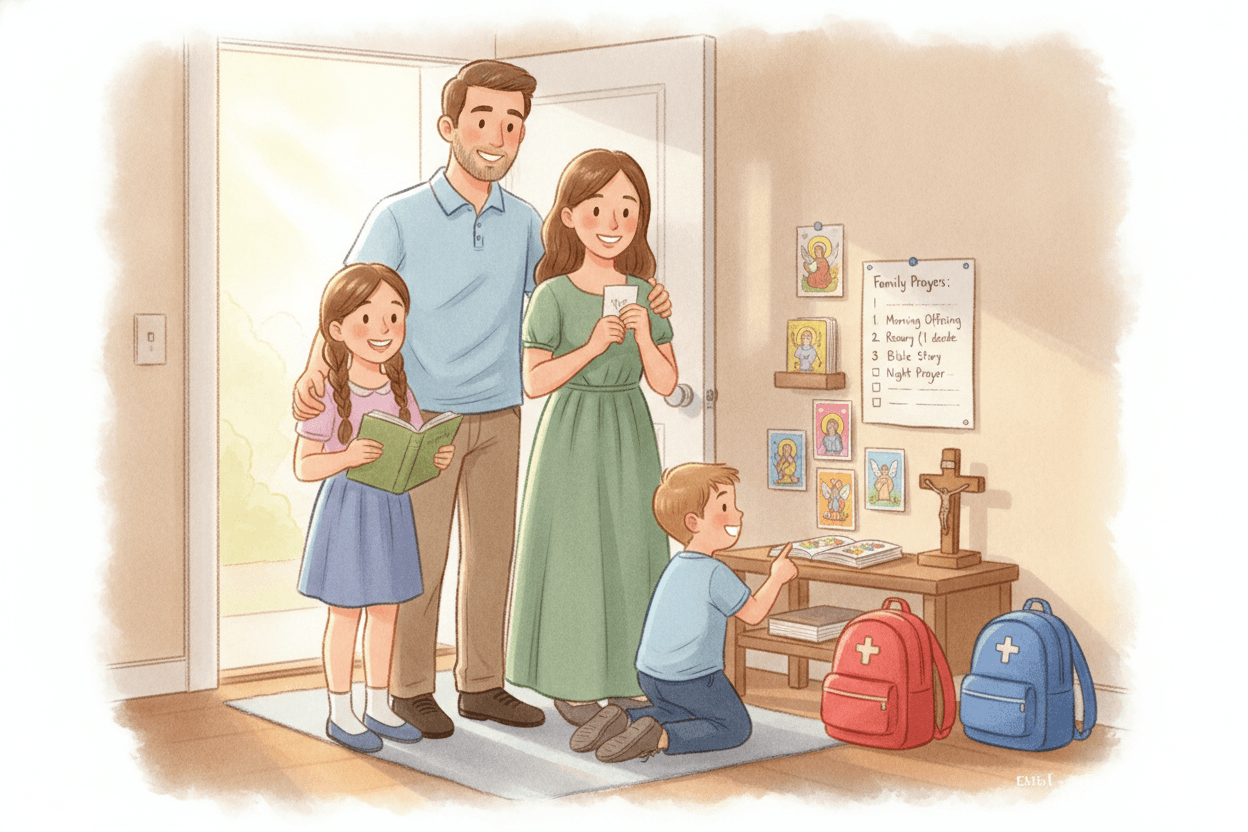
Monday morning can unravel before anyone reaches the kitchen: a missing shoe, a lunchbox left open, a child suddenly remembering a project due today. That is precisely why the family prayer should be attached to something already happening, not added as one more task to manage. Choose one location—the breakfast table, the car before it moves, or the spot by the front door—and one reliable cue, such as after backpacks are zipped or before the first bite of breakfast. Consistency teaches more effectively than a long prayer attempted only on unusually calm days.
For the next seven days, keep the pattern to sixty seconds. Begin with the Sign of the Cross. Then pray: “Thank you, God, for giving us this day; help us to be like Jesus in all we think, do, and say. Amen.” Add one brief intention: “Jesus, help me with my test,” or “Help me be patient with my brother.” On Monday through Friday, use these same words at the same moment. Children do not need novelty in order to pray attentively; they need words solid enough to become their own.
Scripture invites us to see ordinary transitions as places of formation: “Keep repeating them to your children. Recite them when you are at home and when you are away, when you lie down and when you get up.” The command in Deuteronomy is not a demand for elaborate family devotions. It is a call to speak God’s word within the actual rhythm of home life. As the Catechism reminds us, the Christian begins the day with the Sign of the Cross, dedicating the day’s actions to God and asking for grace to act as a child of the Father (CCC 2157).
Give each child one turn to lead during the week. A younger child may simply make the Sign of the Cross and say the opening line; an older child can choose the intention or read the verse card. At dinner, ask one concrete question: “Where did you notice God helping you today?” Accept small answers without correcting them: “I calmed down,” “My friend shared,” or “I remembered to study.” This helps children connect prayer with schoolwork, friendships, disappointments, and ordinary acts of kindness.
Keep the practical pieces visible: a prayer card where you gather, a Bible verse card beside it, and a brief blessing at the door—a hand on the shoulder with, “May God bless you and keep you today.” If a morning is missed, do not turn it into evidence that your family cannot keep a routine. Pray in the car, at pickup, or at bedtime, then begin again at the next cue. Faithful family prayer grows through return: one place, one minute, one offered day at a time.
Keep repeating them to your children. Recite them when you are at home and when you are away, when you lie down and when you get up.
Frequently asked questions
How can I fit Catholic morning prayer into a rushed school morning?
Keep it to one or two minutes and attach it to a reliable moment, such as breakfast, the front door, or the car before leaving. Use the same simple pattern each day: the Sign of the Cross, a short offering, and one intention.
What is a simple morning offering my child can pray?
Try: “Jesus, I give you my work, my play, my words, and my worries today. Help me to love as you love. Amen.” You can also name school-specific concerns, such as friendships, a test, or something difficult that may happen.
Why do Catholic families begin the day with the Sign of the Cross?
The Sign of the Cross dedicates the day and its activities to God and recalls that we were baptized into the life of the Trinity. CCC 2157 notes that Christians begin their day, prayers, and activities this way, making it a meaningful practice even for young children.
How can I get my children to participate in family prayer instead of just listening?
After the opening prayer, invite each child to name one intention in his or her own words: a sick friend, help with a presentation, patience with a sibling, or gratitude for breakfast. Adults can model first, but children should gradually take a real speaking role.
What should we pray about before school?
Help children offer ordinary parts of the day to Jesus: classwork, recess, friendships, chores, worries, and acts of kindness. A brief prayer teaches them that nothing in their school day is too small or too ordinary to bring to God.
Do we need a long devotional for our family morning routine to count?
No. A brief, repeated prayer is more sustainable than a long routine that creates stress or is rarely completed. The goal is to form the habit of turning toward God at the start of the day, not to add another task to a busy morning.
Sources: pewforum.org · pewresearch.org · usccb.org · usccb.org · teachingcatholickids.com · gracewatch.org · hallow.com · en.wikipedia.org · biblegateway.com · biblegateway.com
Scripture quotations in this article use the NABRE translation.