Teaching Kids to Pray the Rosary Without Tears or Boredom
Make the Rosary inviting with shorter sessions, Scripture-rich mysteries, movement, and age-appropriate roles. Discover how small habits, patient guidance, and Mary’s companionship can help children p
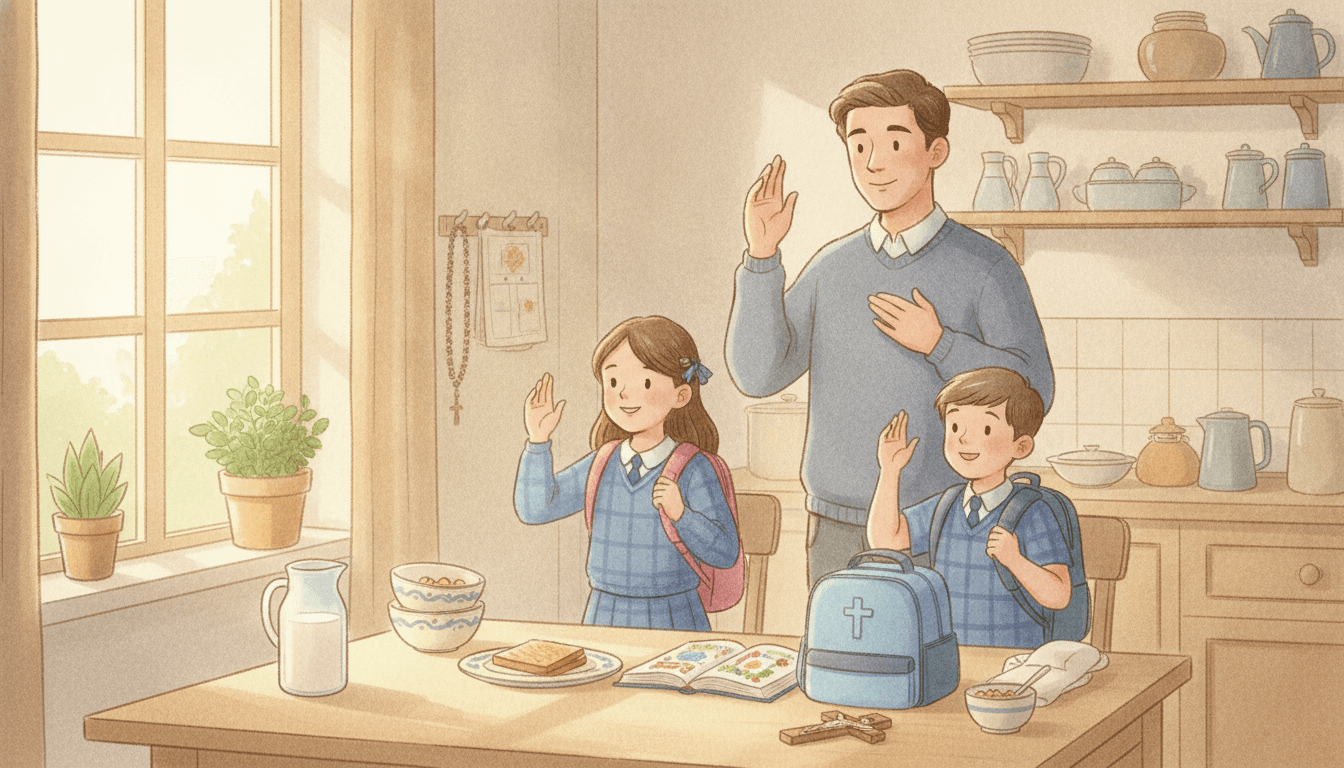
The beads are slipping off the couch, one child is whispering “How many more?”, and you are wondering whether family Rosary time is helping anyone pray. The answer is not to lower the dignity of the Rosary, but to teach it as the Church gives it: a way of looking at Jesus with Mary, one small and Scripture-filled step at a time.
Begin With Jesus, Not With a Long List of Prayers
A child picks up the beads, looks at the long string, and asks, “Do I have to say all of those prayers?” That question deserves a better answer than, “Yes, because this is what Catholics do.” Before teaching children where to place their fingers or how many Hail Marys belong in a decade, tell them whom the Rosary is about: Jesus Christ. The beads give our bodies a steady rhythm so that our minds and hearts can stay with the events of his life.
St. John Paul II called the Rosary a “compendium of the Gospel.” That is a helpful phrase for parents and children alike. In the mysteries, we remember Jesus conceived and born, teaching and healing, suffering and dying, rising from the dead, and bringing his mother into heavenly glory. Mary is present because she was present in the Gospel story, but she does not replace her Son. She helps us look at him carefully, as she herself did: “And Mary kept all these things, reflecting on them in her heart” (Luke 2:19).
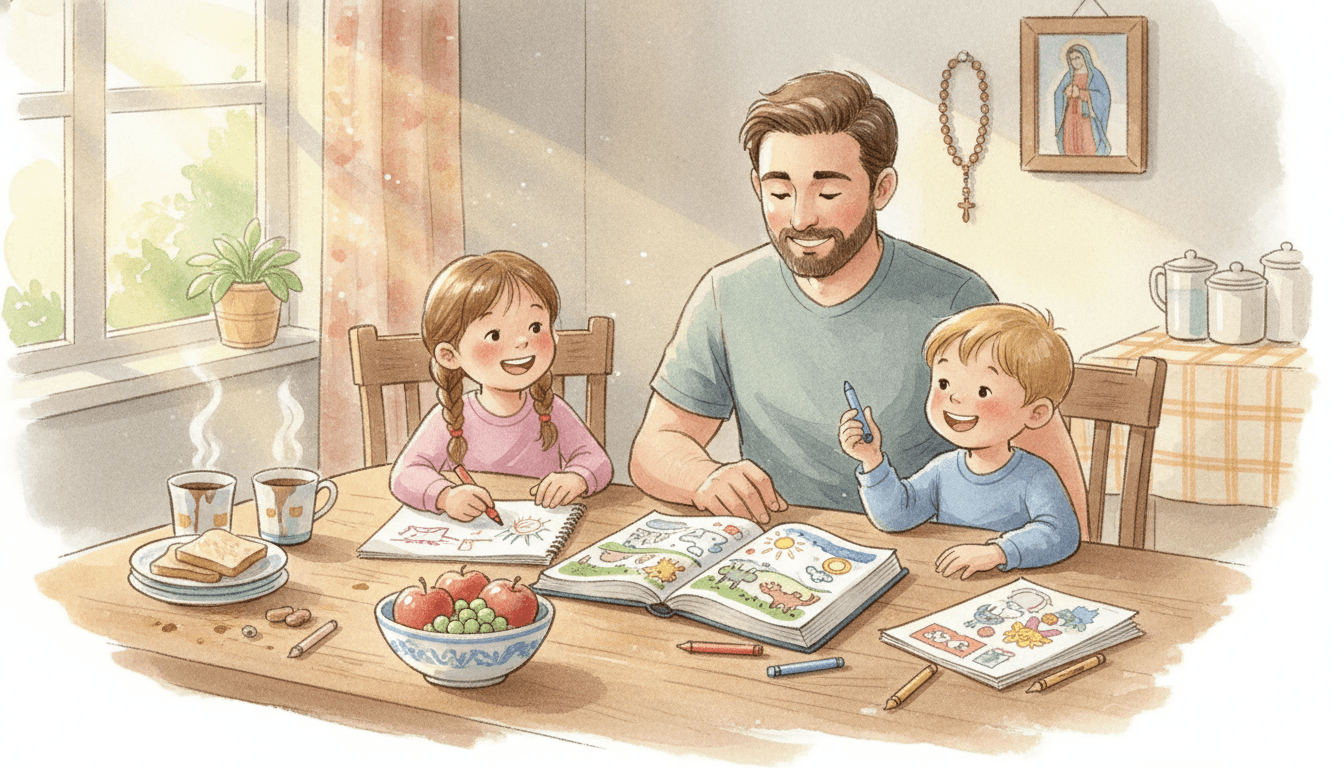
Here’s how I’d teach this to a child: “When we pray a decade, we are not trying to finish ten Hail Marys. We are thinking about one part of Jesus’ life. The words help us pay attention.” Then name a mystery in plain language and ask one concrete question: “What do you notice about Jesus?” or “What might this teach us about trusting God today?” A picture Bible, a holy card, or a simple image placed in the center of the table gives younger children something specific to contemplate.
The Hail Mary itself gives us an early Scripture lesson. Its opening words come from the angel Gabriel’s greeting to Mary: “And coming to her, he said, ‘Hail, favored one! The Lord is with you.’” Elizabeth then praises Mary and Jesus in Luke 1:42. Children should know that these are not random religious phrases. We repeat the words of Scripture, honoring the mother Jesus gave us while keeping our attention on “the fruit of your womb,” Jesus. As the Catechism reminds us, Christian prayer is centered on Christ (CCC 2675).
This beginning changes the tone of family prayer. Rather than presenting the Rosary as a test of endurance, present it as ten small moments spent noticing Jesus with Mary. Start with one mystery and one decade if that is what your children can pray attentively. Let the goal be reverence, understanding, and a growing familiarity with the Gospel—not speed, perfect stillness, or completing a full set of beads. When children grasp the “why,” the prayers gradually become less like a list and more like a way of entering the story of Christ.
And coming to her, he said, “Hail, favored one! The Lord is with you.”
Why a Full Rosary Can Feel Too Long for Ages 6–9
The third Hail Mary has barely begun, and a six-year-old is rolling a bead between his fingers, a sibling is whispering, and someone suddenly needs water. Many parents read that moment as failure. It is not. A full five-decade Rosary asks children to hold repeated words, bodily stillness, a sequence of prayers, and attention to five mysteries of Christ’s life all at once. For most children ages six through nine, that is more than they can sustain at first.
Repetition is not empty in itself; it gives the Rosary its steady, meditative rhythm. Yet children need time to grow into that rhythm. They are still learning what it means to pray with words they know by heart while their minds rest on Jesus. A child who fidgets may still be listening. A child who loses her place may still be learning reverence. Catholic formation should respect a child’s real developmental limits rather than treating adult-length attention as the measure of devotion.
Here’s how I’d teach this in a parish classroom and encourage it at home: begin with one decade. Announce one mystery, show a holy card or picture Bible image, invite one simple intention, and pray the Our Father and ten Hail Marys together. Then stop. A decade prayed peacefully and returned to regularly teaches more than five decades completed through tears, correction, or resentment. As attention and interest grow, a family can add another decade on a different evening or gradually lengthen the practice.
This small beginning is not a lesser Rosary; it is wise formation. The Rosary is a sacramental, and sacramentals dispose us to receive God’s grace as the Church teaches (CCC 1667). Children should learn to handle the beads respectfully, but they need not become motionless little adults. Let one child hold the Rosary, another announce the mystery, and another offer an intention. A child may draw the scene afterward or quietly look at the image while the family prays. These actions give young hands and minds a faithful place in the prayer.
Regular family prayer matters more than finishing a lengthy routine every night. Pew Research Center reported in 2025 that 63% of U.S. parents say their children regularly take part in at least one religious or spiritual activity. That habit is built through ordinary, repeatable practices: one decade after dinner, in the car before school, or at bedtime on a chosen day. Keep your tone calm when attention wanders. End with gratitude, not a lecture about poor behavior. Over time, children learn that the Rosary is a place where their family pauses together before Jesus, with Mary, and where they are welcomed before they are expected to do everything perfectly.
Here’s How I’d Teach This: A One-Decade Rosary Plan
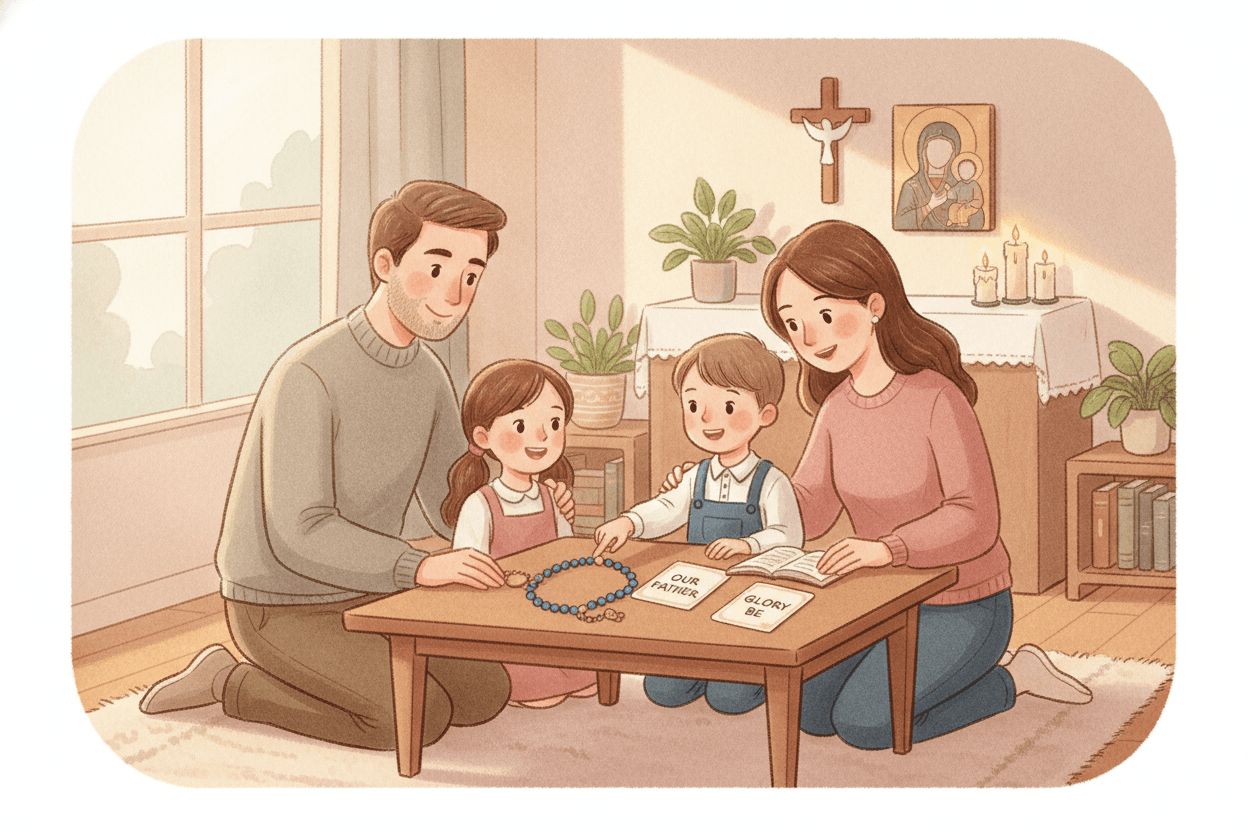
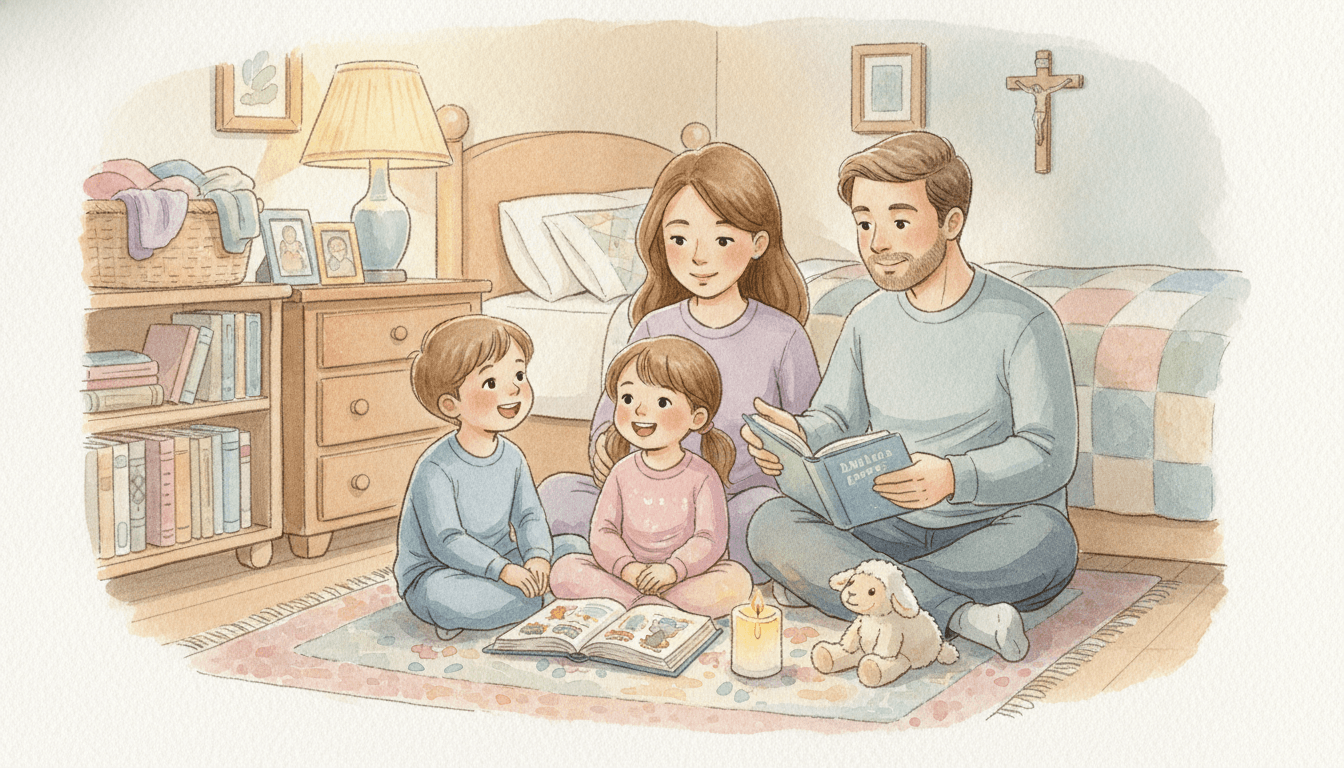
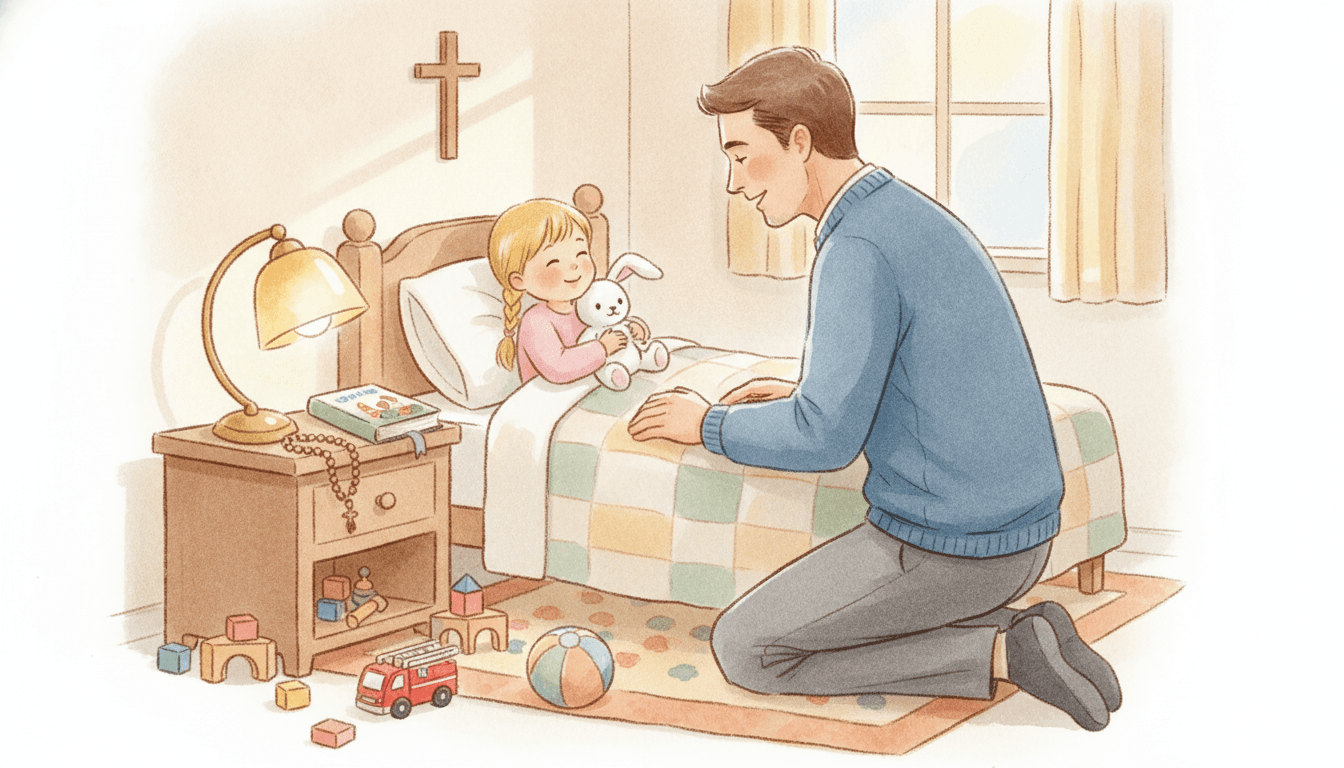
At 7:15 p.m., with one child still holding a stuffed animal and another asking whether she gets to hold the beads, I would not aim for a polished family devotion. I would gather everyone in the same small place each time: the couch, the edge of a child’s bed, or a prayer corner with a crucifix. Put one rosary in each child’s hands if possible, but one shared rosary is enough. Begin by saying, “We are going to spend a few minutes thinking about Jesus with Mary.” That sentence gives children the center before asking them to learn a sequence.
Then invite one simple intention: “Who or what should we pray for tonight?” Keep it concrete. A sick grandparent, a hard day at school, a friend who is lonely, gratitude for a birthday—these are real offerings. Next, hold up the rosary and slowly show the path: the large bead is for the Our Father; the next ten small beads are for ten Hail Marys; at the end, we pray the Glory Be. Let a child trace the beads with a finger as you explain. Children ages six to nine are quite capable of learning the pattern when they can see and touch it.
Here’s how I’d teach this in the first session: choose one mystery, perhaps the Nativity, and announce it in a single sentence: “Jesus is born in Bethlehem, and Mary and Joseph welcome him.” Show a picture from a children’s Bible or a holy card. Ask one question, not five: “What do you think it was like for Mary to hold baby Jesus?” Receive the answers without correcting every detail, then give one clear truth: Jesus truly became man for us. The Rosary is not a string of words we race through; it is a way of remembering the saving events of Christ’s life. As the Catechism reminds us, meditation engages thought, imagination, emotion, and desire (CCC 2708).
Pray the Our Father on the large bead. On the ten small beads, pray ten Hail Marys at an unhurried but steady pace. A child may lead the first words, “Hail Mary, full of grace,” or alternate prayers with a parent. If a child loses count, simply find the next bead and continue; the beads are there to serve prayer, not to test performance. The words of the Hail Mary begin in Scripture, with Gabriel’s greeting to Mary and Elizabeth’s blessing, yet every decade directs our attention to Jesus, “the fruit of your womb.”
After the tenth Hail Mary, pray the Glory Be, make the sign of the cross, and stop while everyone is still peaceful. Resist adding another decade because the first one went well. A child should leave thinking, “I can do that again,” rather than associating the Rosary with endurance. Return to the same place tomorrow or later in the week, use the same gentle structure, and let the child’s readiness—not an adult’s timetable—determine when to add more. Mary herself shows us the posture we are teaching: she kept the events of Jesus’ life, “reflecting on them in her heart.”
And Mary kept all these things, reflecting on them in her heart.
Turn Each Mystery Into a Gospel Scene Children Can Enter
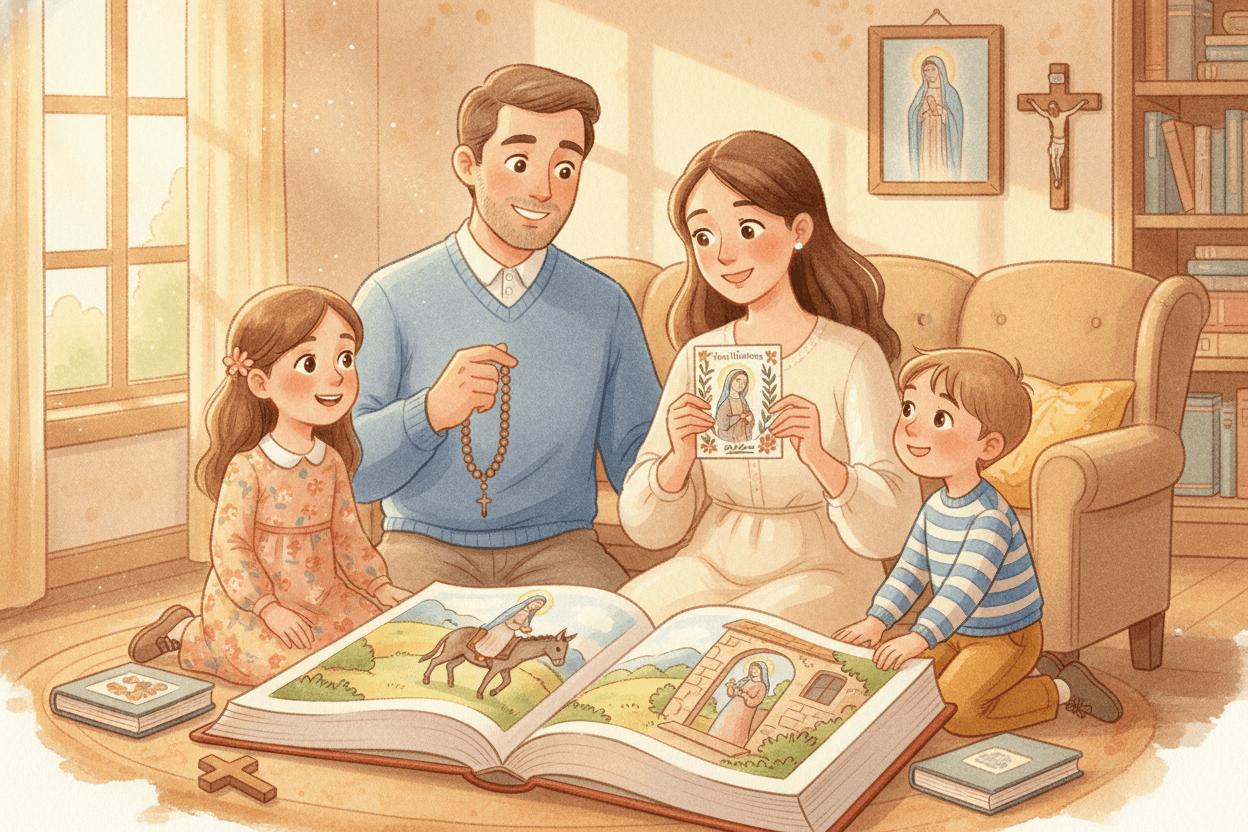
The beads are in little hands, but the children’s eyes have already drifted to the dog, the window, or the sibling who touched their place on the couch. That is not a sign that the Rosary has failed. It is often a sign that they have been given words without a scene. Children ages six to nine are capable of real meditation, but they need something definite to attend to: a person, a place, an action, a question. Before the first Hail Mary, give them the Gospel moment they are about to hold in prayer.
Here’s how I’d teach this in a parish classroom or at the kitchen table. Announce one mystery slowly: “The Finding of Jesus in the Temple.” Show a holy card, an illustration from a picture Bible, or a simple image on a family prayer card. Then read one or two verses from the children’s Bible or the NABRE. Do not turn this into a long lesson. Let the image and the brief reading establish the scene: Mary and Joseph searching; Jesus speaking in his Father’s house; the relief, confusion, and wonder of finding him.
Then ask one concrete question, and allow a few seconds of quiet before anyone answers. “What might Mary have felt while she was looking for Jesus?” “What do you notice about Jesus?” “When have you been worried and wanted to be found?” A child does not need a polished answer. “Scared,” “happy,” or “I don’t know” is enough to begin. The question is not a test of Bible knowledge. It gives the child a way to look at Christ rather than merely finish ten Hail Marys.
Scripture gives us Mary’s own pattern for this kind of prayer: she received God’s works, considered them, and held them close. Luke tells us, “And Mary kept all these things, reflecting on them in her heart.” The Rosary asks us to do likewise. John Paul II called it a compendium of the Gospel because the prayers accompany contemplation of the saving events of Jesus’ life. Mary is not placed beside Jesus as a distraction; she teaches us how to look steadily at him.
Keep the participation simple. One child can hold up the image; another can announce the mystery; another can lead the Our Father. Before the decade, invite each person to name one intention connected to the scene: a worried friend for the Finding in the Temple, a family member who needs courage for the Agony in the Garden, gratitude for a new baby during the Visitation. As the Catechism reminds us, meditation engages thought, imagination, emotion, and desire (CCC 2708). A Gospel scene gives those faculties somewhere true to rest. If the children remember one image of Jesus, one feeling Mary may have carried, and one intention they placed before God, the decade has done its work.
And Mary kept all these things, reflecting on them in her heart.
Prevent Tears by Building Participation, Movement, and Choice
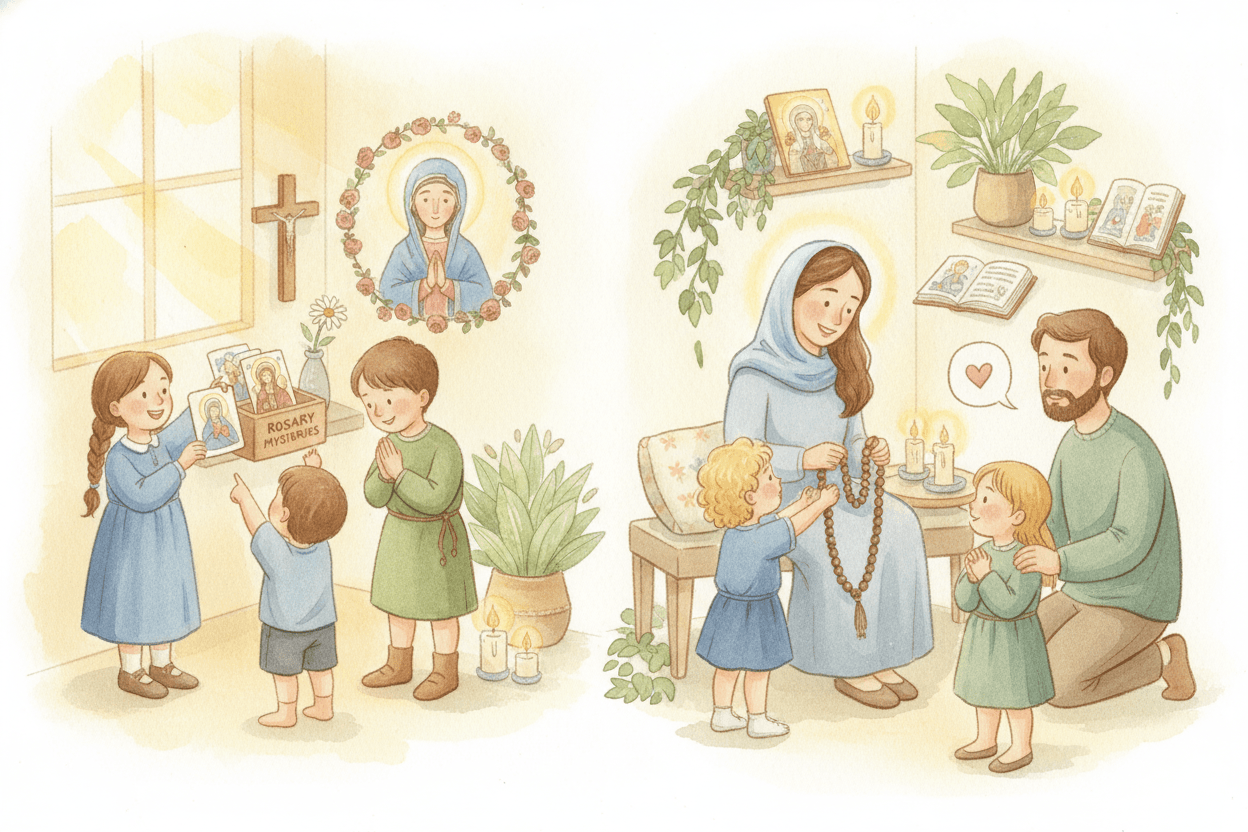
The first child begins sliding beads through his fingers before anyone has finished the Sign of the Cross. Another wants to stand beside the candle. A third interrupts to ask whether Jesus was afraid in the garden. In a parish classroom, these are not automatic signs that the Rosary has failed. They are invitations to give children a real part in the prayer rather than asking them to imitate adult stillness for ten uninterrupted minutes.
Here’s how I’d teach this: assign small jobs before the decade begins. One child carries the Rosary carefully to the prayer table. Another places a holy card or picture Bible image for the mystery where everyone can see it. Let one lead the Our Father, and invite each child to lead one Hail Mary if that helps the group stay attentive. Before praying, ask for a brief intention: “Jesus, help Grandma feel better,” or “Thank you for my new baby cousin.” These are not distractions from the Rosary; they help children offer the mystery with their own lives in mind.
A simple question can give the repeated prayers a place to rest in a child’s imagination. For the Annunciation, ask, “What might Mary have wondered when the angel came?” For the Finding in the Temple, ask, “How do you think Mary and Joseph felt when they could not find Jesus?” Receive one or two answers, then begin. Scripture invites us to notice Mary’s own prayerful attention: “And Mary kept all these things, reflecting on them in her heart.” Children are learning this same habit—holding an event from Jesus’ life in the heart while the familiar prayers continue.
Reverence still matters. The Rosary is a sacramental: an object set apart by the Church to dispose us to receive God’s grace (CCC 1667). Teach children not to toss beads, swing them at a sibling, or treat them as a toy. Yet reverence does not require rigid immobility. A child may stand quietly, hold the mystery picture, sit near a parent, or rejoin after losing his place. Calmly point to the bead where the family is praying and say, “You can come back in here.” That is better formation than public correction or visible frustration.
Jesus’ words set the tone for the adult leading the prayer: “Let the children come to me, and do not prevent them; for the kingdom of heaven belongs to such as these.” Make room for the child who needs a concrete task, a whispered reminder, or a second chance. Over time, the child who carries the Rosary, names an intention, and listens to one Gospel scene will learn that prayer is not a performance. It is a family turning together toward Christ, with Mary teaching us how to pay attention.
but Jesus said, “Let the children come to me, and do not prevent them; for the kingdom of heaven belongs to such as these.”
Let the Mysteries Meet Your Child’s Real Week
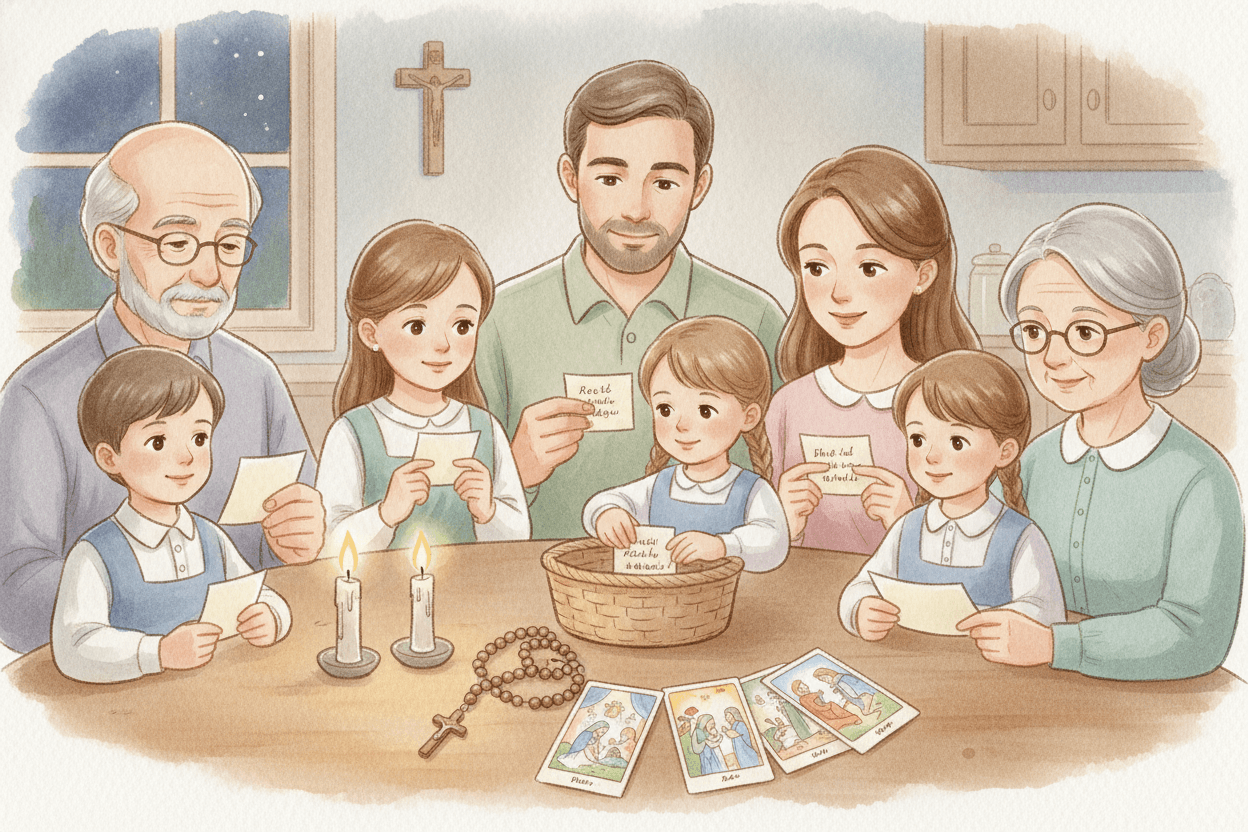
On Monday evening, a child may be worried about a spelling test; by Thursday, she may be bursting to tell everyone that her new baby cousin arrived. Those moments do not need to be set aside before the Rosary begins. They can become the doorway into it. Before the decade, ask one plain question: “What in your week would you like to bring to Jesus?” Then name a mystery that meets the moment.
For a school worry, pray the Agony in the Garden. Explain that Jesus knew fear and sadness, and he still chose to speak to his Father. A child does not need a polished intention: “Jesus, help me not be scared about my test” is enough. For the arrival of a sibling, a visit with grandparents, or a moment of gratitude, choose the Visitation. Mary carried Jesus to Elizabeth, and joy was shared. A child can pray, “Thank you for our new baby,” or “Help me be kind to my sister.”
Some weeks carry heavier things. If a pet dies, a friend moves away, or the family is grieving, the Crucifixion gives children honest words without pretending that sadness is small. Say simply, “Jesus, you know what it is to suffer. Stay with us.” When there is a fresh start after a hard day, recovery from illness, or hope after disappointment, the Resurrection helps a child see that Jesus brings life where we cannot yet see the whole answer. Catholic children are capable of holding both sorrow and hope when we give them the Gospel scenes and do not rush them past either one.
This is why intentions matter. They are not a preliminary list to get through; they teach children that the mysteries of Christ are not far away from Tuesday afternoon or bedtime. St. John Paul II called the Rosary “a prayer of and for the family,” urging families to return to praying it together. In the family Rosary, each person’s concern can be carried into the life of Jesus: a parent’s job interview, a grandparent’s illness, a child’s friendship trouble, a thank-you for an answered prayer.
Here’s how I’d teach this at home or in a parish group: offer two or three mystery-and-intention pairings, then let the child choose. Keep the connection truthful rather than forced. Not every problem has a neat match, and children may simply say, “I want to pray for Dad.” Receive that intention respectfully, place it before the decade, and begin. As the Catechism reminds us, Christian prayer joins us to Christ’s own prayer (CCC 2565). The Rosary teaches that joining in a form children can understand: Jesus and Mary are near to the real life already unfolding in their home.
When Jesus saw his mother and the disciple there whom he loved, he said to his mother, “Woman, behold, your son.” Then he said to the disciple, “Behold, your mother.” And from that hour the disciple took her into his home.
Your One-Week Family Rosary Reset
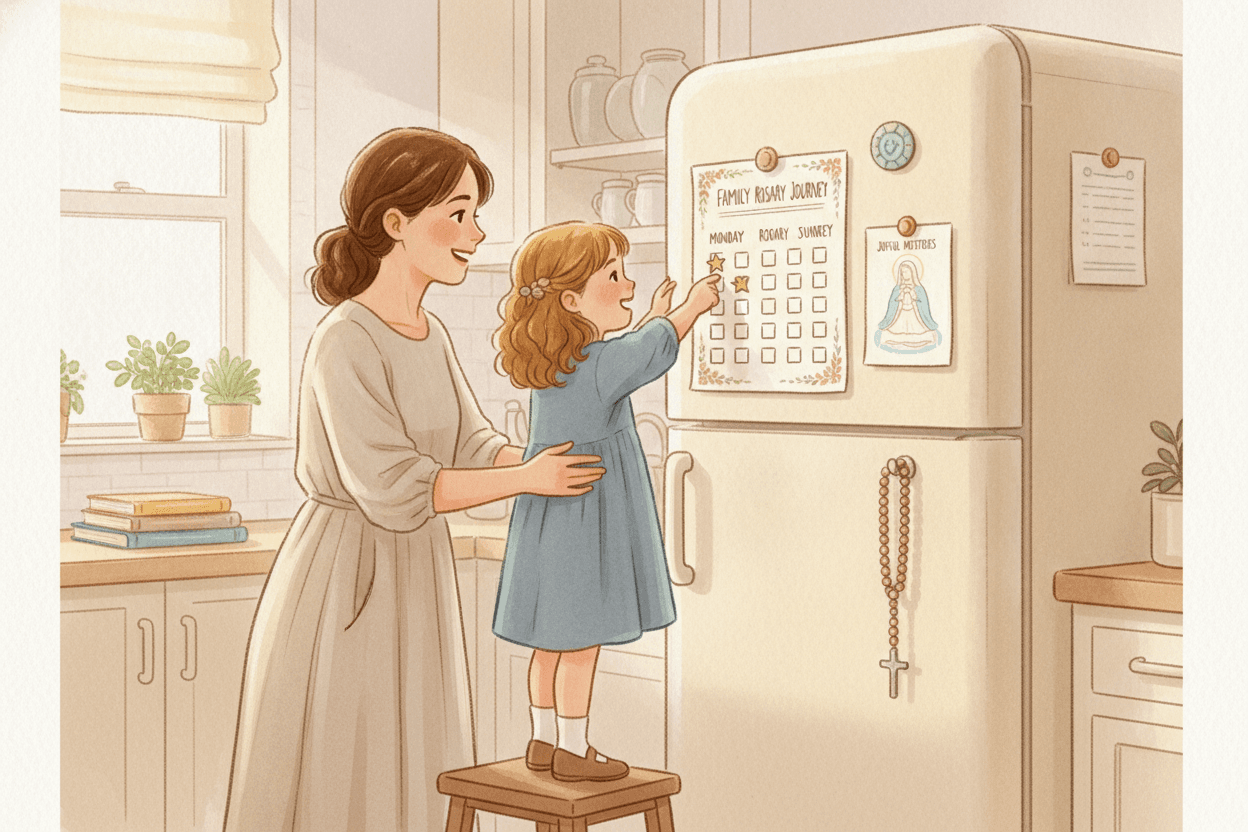
At 7:40 p.m., when everyone is already reaching for pajamas and one child is under the table, is not the moment to prove that your family can finish five decades perfectly. It is the moment to make a small, steady appointment with Jesus. Pick one predictable five-to-ten-minute window for the next seven days: after dinner, in the car before school, or beside the beds before lights out. Keep the Rosary basket, beads, and one holy card or picture Bible image in that same place. Predictability does much of the teaching before anyone says a prayer.
Choose one mystery for the whole week rather than changing the material every night. For younger children, the Annunciation works well: show an image of Gabriel visiting Mary, tell the Gospel scene in two or three sentences, and let them look carefully. Ask, “What do you notice?” Then give one clear truth: Jesus came to us because Mary said yes to God. Scripture invites us to notice Mary’s prayerful attention: “And Mary kept all these things, reflecting on them in her heart.” A child can begin to pray the Rosary by looking, listening, and wondering before he or she can sit still for long.
Pray only one decade. Announce the mystery, offer one family intention, pray the Our Father, ten Hail Marys, and the Glory Be if that is already part of your family’s practice. Invite one child to hold the image, one to lead the Our Father, one to name the intention, or one to move a finger along the beads. These are not distractions from prayer; they give children a real task within it. The Rosary is a sacramental, so teach reverence kindly: we handle the beads carefully because they help direct our hearts to God.
Here’s how I’d teach this as a seven-day reset: Day 1, establish the time and show the image. Day 2, let a child announce the mystery. Day 3, ask each person for one intention. Day 4, let a child lead the Our Father. Day 5, pause after the Gospel scene and ask one observation. Day 6, invite a child to lead one Hail Mary or keep count on the beads. Day 7, repeat the same decade with no new expectations. Each night, close with one plain sentence: “Jesus, thank you for being with our family today.”
Do not measure this week by silence, speed, or whether every word was pronounced correctly. As the Catechism reminds us, meditation engages “thought, imagination, emotion, and desire” (CCC 2708). A child who wiggles while studying the holy card, offers a worried intention, or remembers one detail about Jesus may be praying more truly than appearances suggest. Faithful repetition, offered without scolding, gradually teaches children that family prayer is a place where they are welcomed to bring their real lives to Christ.
And Mary kept all these things, reflecting on them in her heart.
Frequently asked questions
How do I teach my child what the Rosary is really about?
Begin by explaining that the Rosary is about looking at Jesus’ life with Mary, not simply getting through a number of prayers. Before each decade, name the mystery in child-friendly words and ask a simple question, such as, “What do you notice about Jesus?” The beads and repeated prayers give children a rhythm for staying with that Gospel scene.
Do young children have to pray all five decades of the Rosary?
No. For many children, especially ages six to nine, one decade is a realistic and fruitful beginning. Pray one mystery attentively, then stop peacefully; you can add decades gradually as their understanding and attention grow.
What should I do when my child fidgets or gets distracted during the Rosary?
Do not assume fidgeting means your child is not praying or learning. Keep your tone calm and offer a faithful role: let a child hold the beads, announce the mystery, share an intention, or look at a holy card. End prayer with gratitude rather than corrections about behavior.
How can I make the Rosary less boring for kids?
Give children something concrete to focus on for each mystery, such as a picture Bible, holy card, or image at the center of the table. Use plain-language descriptions of the Gospel event and invite a short intention connected to it. Treat each decade as ten small moments of noticing Jesus rather than a long task to finish.
Are the words of the Hail Mary based on the Bible?
Yes. The opening of the Hail Mary comes from the angel Gabriel’s greeting to Mary, and the next words echo Elizabeth’s praise in Luke 1. Help children listen especially to the phrase “the fruit of your womb, Jesus,” so they understand that this prayer honors Mary while remaining centered on Christ.
When is the best time for a family to pray the Rosary?
Choose a short, repeatable time that works for your household, such as after dinner, before school in the car, or at bedtime on one regular day. Gather in the same simple place when possible—a couch, bedside, or prayer corner—and begin with a clear invitation to spend a few minutes thinking about Jesus with Mary. Consistency matters more than completing a long routine.
Sources: usccb.org · usccb.org · vatican.va · vatican.va · vatican.va · st-bart.org · ewtn.com · catholicbrain.com · catholicicing.com · pewresearch.org
Scripture quotations in this article use the NABRE translation.