Explaining Jesus’ Parables to Kids at Home
Help children ages 10–13 move beyond remembering memorable characters and events in Jesus’ parables. This practical guide offers thoughtful questions that uncover Kingdom truths and connect each Gospe
Your child may remember the Samaritan who stopped or the seed that sprang up quickly—but do they know what Jesus is revealing about his Kingdom? These vivid Gospel stories are not merely moral lessons; with a few good questions, parents can help children ages 10–13 read them closely, think deeply, and carry them into ordinary life.
Why Jesus Taught in Parables—and Why Kids Need More Than a Moral
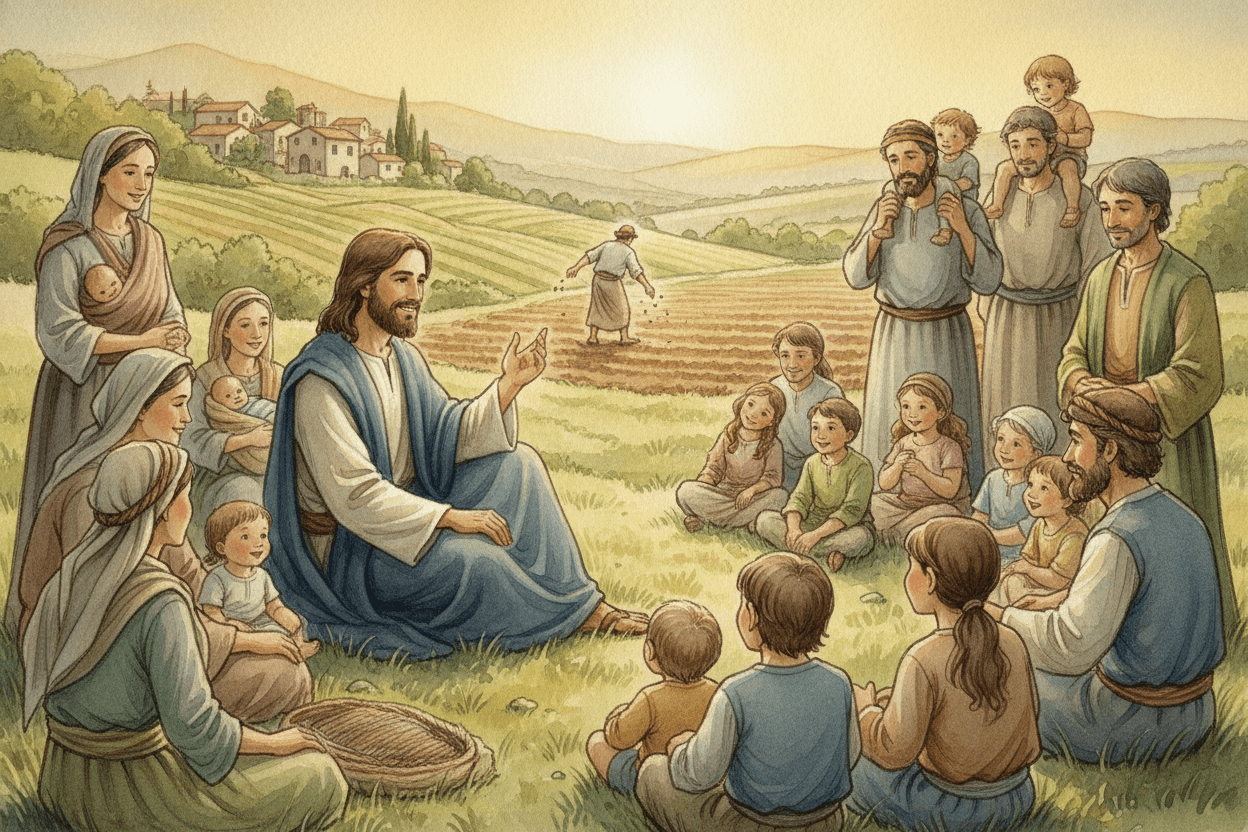
A child hears the story of the sower and quickly picks a favorite detail: the birds swooping down, the rocky ground, or the enormous harvest. That response is not a distraction from Jesus’ teaching; it is often the doorway into it. Jesus taught with scenes people could picture because seeds, fields, bread, lamps, fathers, and roads belong to ordinary life. A parable is an earthly comparison that discloses a heavenly reality. Through a story children can enter, Jesus teaches about the Kingdom of God, his own mission, mercy, sin, conversion, and the daily shape of discipleship.
But a parable is more than a pleasant story with a moral pasted onto the end. If we tell a child only, “Be kind,” after the Good Samaritan, we have left out Jesus’ sharp question about who counts as our neighbor—and his command to show costly mercy. If we say the Sower means merely “try harder,” we miss Jesus’ concern for hearts that receive or resist the word. Bishop Robert Barron observes that parables are invitations into the mystery of the Kingdom, drawing us into a new way of seeing reality. They ask children not only, “What should I do?” but also, “Who is Jesus, and what is God doing in the world?”
Here is how I’d teach this at home or in a parish classroom: begin with four questions. What happens in the story? What would the original listeners have noticed? What does this show us about Jesus and his Kingdom? What is one faithful response I can make this week? The second question matters. A Samaritan was not simply a random traveler; Jesus’ listeners knew the tension between Jews and Samaritans. The details make his mercy startling. Children ages ten through thirteen are capable of noticing such context, and they deserve more than a simplified lesson.
Scripture has a true meaning; it is not a container for whatever idea we happen to prefer. Jesus’ explanations, the occasion of the parable, the words around it, and the whole of Scripture guide us. As the Catechism reminds us, Catholics read the Bible with attention to its content and unity, within the living Tradition of the Church, and with attention to the analogy of faith (CCC 112–114). The Church also recognizes the literal and spiritual senses of Scripture (CCC 115–119). That means a child may notice something personally meaningful in a parable, but that insight should grow from what Christ is actually teaching—not replace it.
And he spoke to them at length in parables, saying: "A sower went out to sow. And as he sowed, some seed fell on the path, and birds came and ate it up. Some fell on rocky ground, where it had little soil. It sprang up at once because the soil was not deep, and when the sun rose it was scorched, and it withered for lack of roots. Some seed fell among thorns, and the thorns grew up and choked it. But some seed fell on rich soil, and produced fruit, a hundred or sixty or thirtyfold. Whoever has ears ought to hear."
The Four Questions That Unlock Any Parable

A child hears the Good Samaritan and quickly says, “So we should be nice.” That is not wrong, but it is not yet enough. Jesus did not tell this story merely to produce polite children. He answered a lawyer who wanted to limit the command to love his neighbor. A good parent’s task is not to rush past a child’s first answer, but to help that answer become more attentive to the Gospel itself.
Here’s how I’d teach this: begin with, “What happens in the story?” Let your child retell the events before offering an explanation. Who is hurt? Who walks past? Who stops? What does the Samaritan actually do? For the Sower, ask where each seed lands and what happens to it. Keep the Bible open, and invite children to point to details they notice. This respects their intelligence and prevents us from turning a parable into a lesson we have invented.
Then ask, “What would Jesus’ first listeners have noticed?” This question supplies the context children need. In Luke 10, the Samaritan is not simply a helpful stranger; Samaritans and Jews had a painful history of division. Jesus makes the unexpected person the merciful neighbor. In Matthew 13, a farmer scattering seed over different ground would have been a familiar sight, while Jesus’ later explanation identifies the seed with the word of the kingdom. Context helps a tween see that Jesus is addressing real sin, prejudice, distraction, and the need for conversion—not offering a vague slogan about being good.
The third question is the center: “What does this reveal about Jesus and the Kingdom of God?” Parables are earthly stories that disclose heavenly realities. The Good Samaritan shows us the mercy God asks of His people, and it also teaches us to recognize the wounded person placed before us. The Sower reveals Christ’s generous proclamation of God’s word and asks whether our hearts are ready to receive it. As the Catechism reminds us, the family is the first school of Christian life, where children discover the Gospel in ordinary situations (CCC 1657).
Only after these steps should you ask, “What does this ask of us now?” Keep the application concrete and connected to the text: “Whom might I be avoiding at school?” “What thorn—screen time, resentment, worry—keeps God’s word from growing in me?” “What act of mercy can our family do this week?” Return to the passage and let Jesus’ words, rather than parental moralizing, carry the weight. Scripture invites us to listen carefully before we act.
Whoever has ears ought to hear.
Read the Context Before You Explain the Lesson

A child hears the Good Samaritan and quickly says, “So we should be nice.” That is not wrong, but it is not yet the whole lesson Jesus is teaching. Before asking what a parable means for our family, open the Bible and read a few verses before it. In Luke 10, a scholar of the law asks Jesus what he must do to inherit eternal life. Jesus leads him back to the commandments: love God and love your neighbor. Then comes the revealing question: “And who is my neighbor?” The man is not merely curious; Luke tells us he wished to justify himself. That detail changes how we hear the story.
Here’s how I’d teach this at the kitchen table or in a parish classroom: ask your child, “What is this man hoping Jesus will say?” Many children can recognize the temptation to make love manageable: I will help people I already like, people who are like me, or people who have been kind to me. Jesus answers with a wounded man, two respected religious figures who pass by, and a Samaritan who stops. The parable exposes a divided heart before it gives an instruction for good behavior. It speaks about sin, mercy, and the conversion that makes us capable of loving beyond our comfort.
Children also need one cultural detail that makes the story startling. Jews and Samaritans had a long history of hostility and religious division. Jesus deliberately makes the Samaritan—the person His Jewish listeners might have expected to distrust—the merciful neighbor. Do not soften that surprise. A ten-year-old can understand that Jesus is not saying, “Be kind when it is easy.” He is showing that neighbor-love crosses resentment, labels, and old divisions. The question at the end is not, “Who qualifies to receive my help?” but, “Will I become a neighbor to the person in need?”
The verses after a parable matter too. Jesus asks which person acted as neighbor, and the scholar answers, “The one who treated him with mercy.” Jesus then says, “Go and do likewise.” This keeps us from treating the story as an abstract lesson. Christ Himself is the teacher and the center of every parable; the Church receives His word and helps us read it faithfully; then the Christian life puts that word into practice. As the Catechism reminds us, the family is the first school of Christian life (CCC 1657). A parent can ask, “Whom might we be tempted to pass by this week—in school, online, or at home?”
Reading context is not a complicated extra step reserved for Bible experts. It is a way of respecting both Scripture and your child’s intelligence. Notice who is speaking, who is listening, what question or conflict comes first, and how Jesus closes the exchange. Then let the parable address real life: a classmate excluded at lunch, a sibling whose mistake is irritating, a neighbor whose needs interrupt our plans. The story will still be memorable, but now it will point beyond a vague moral toward the mercy of Christ and the kind of conversion He asks of us.
But because he wished to justify himself, he said to Jesus, "And who is my neighbor?"
Two Short Models: The Good Samaritan and the Sower
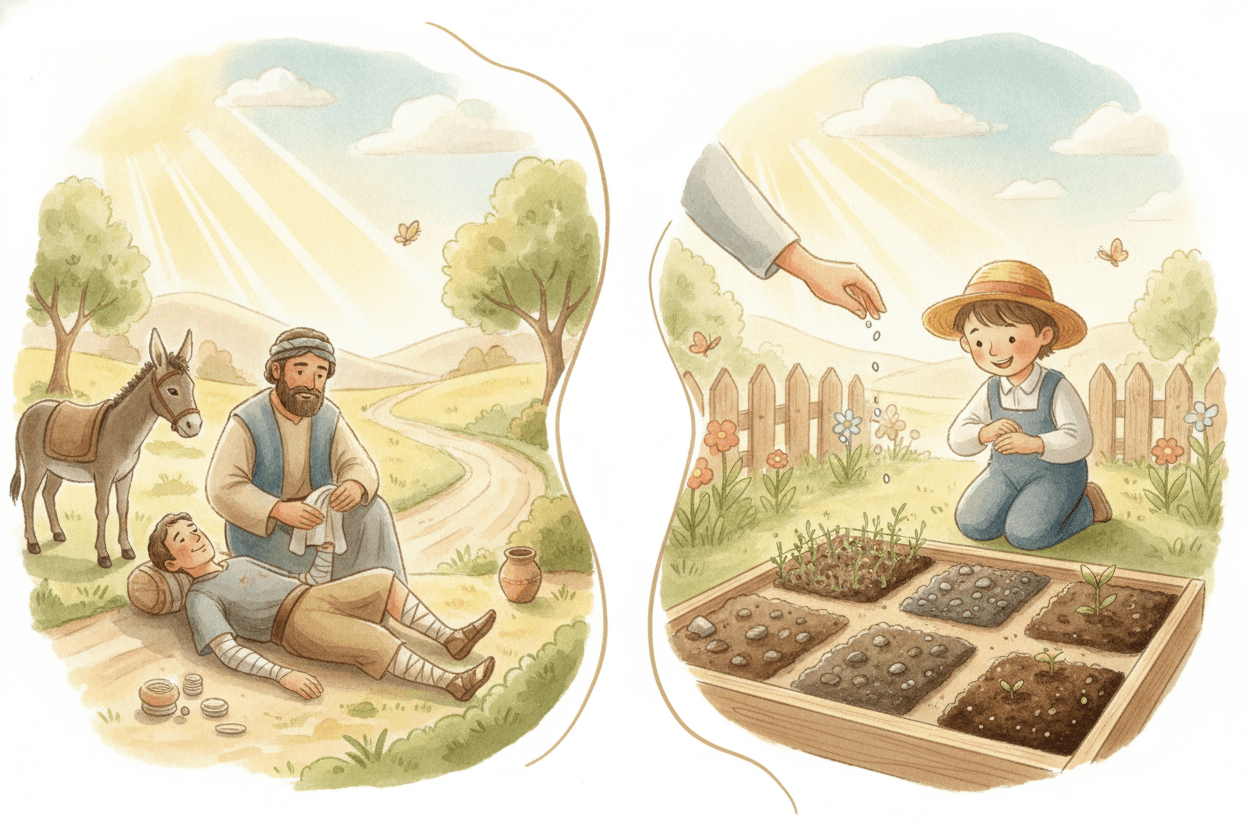
A child who has just been ignored at lunch understands the road from Jerusalem to Jericho better than we may think. Begin the Good Samaritan by letting your child name what happens: a man is attacked; two respected religious men see him and pass by; then a Samaritan stops, treats the wounds, provides transportation, pays for care, and promises to return. Do not hurry past the detail that the helper is a Samaritan. Jesus’ listeners would have known that Jews and Samaritans were divided people. The unexpected neighbor is the person the listener might have preferred to avoid.
Then ask what Jesus reveals about love of neighbor. The lawyer asks, “And who is my neighbor?” because he wants a limit. Jesus overturns the question. The issue is not, “Which people have earned my care?” but, “Will I become a neighbor to the person before me?” The Samaritan’s compassion costs time, money, effort, and a change of plans. For a child, the symbol is clear: mercy is not merely feeling sorry for someone. It moves toward need. Yet understanding that point is different from choosing a response. Here’s how I’d teach this: ask your child to name one person at school, on a team, or in the family who is easy to overlook. This week’s response might be sitting with that child, refusing to join a joke at someone’s expense, or offering practical help without waiting to be asked. Jesus’ final instruction is direct: “Go and do likewise” (Luke 10:37, NABRE).
The Sower provides a different kind of honest conversation. Read the scene first: seed lands on a path, rocky ground, thorns, and rich soil; only the good soil bears abundant fruit (Matthew 13:3-9). When Jesus explains the parable later in the chapter, he identifies the seed with the word of the kingdom (Matthew 13:18-23). The seed is not defective. God’s word is generously sown. The question is what receives it.
Children ages ten to thirteen are quite capable of examining the soil without being shamed. A hard path can look like a child who hears Scripture at Mass but dismisses it before the car ride home. Rocky ground may be an enthusiastic start—wanting to pray for two days—without roots when prayer feels dry or inconvenient. Thorns may be constant noise, scrolling, competition, worry, or a schedule so crowded that God’s word is squeezed out. Rich soil is not a perfect heart. It is a heart that makes room, returns after failure, and accepts the patient work of grace.
Keep the final step small and observable. Rather than asking, “Will you have better soil?” ask, “What would make one little patch of your week more ready for God’s word?” Your child might place the Sunday Gospel beside breakfast, spend five quiet minutes with one verse, attend Mass attentively by listening for a repeated phrase, or bring one distraction to Confession. As the Catechism reminds us, the family is the first school of Christian life, where children discover the Gospel in ordinary situations (CCC 1657). These two parables teach both sides of discipleship: love the neighbor placed in your path, and prepare your own heart to hear Christ.
Jesus said to him, "Go and do likewise."
Make Gospel Images Concrete Without Making Them Shallow
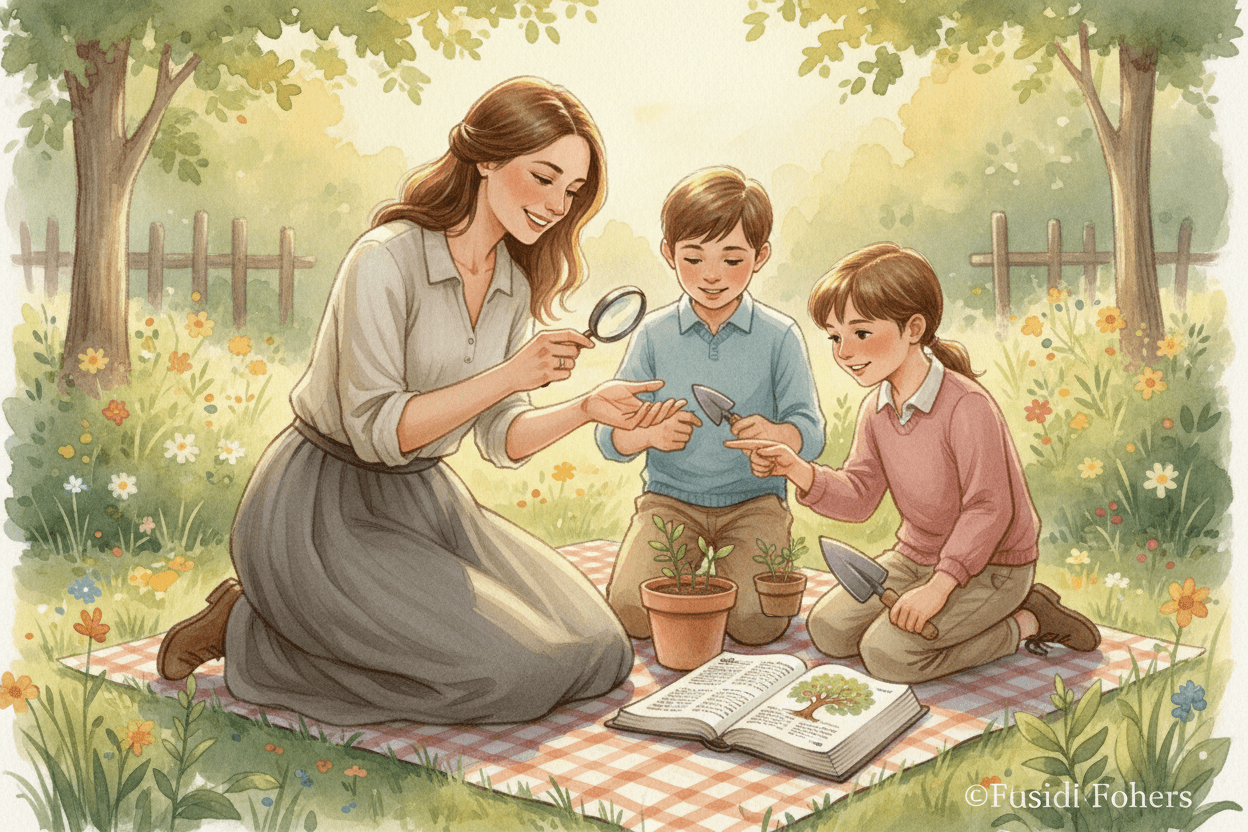
Put a mustard seed, a handful of soil, or even a photo of a nesting bird on the kitchen table before opening the Gospel. Children ages 10–13 are quite capable of thinking symbolically, but concrete objects give their thinking somewhere to begin. Read Jesus’ image first, then let them look closely: What is small here? What takes time? What does a bird need from a branch? The object is not the lesson; it is a doorway into the words of Christ.
For the parable of the mustard seed, a short outdoor observation can do more than a long explanation. Notice seeds tucked into cracks in a sidewalk, weeds growing where no one planned them, or birds finding shelter in a hedge. Then return to Matthew 13 and ask, “Why do you think Jesus chose something so small to describe the Kingdom?” A child may connect it to a quiet act of prayer, a new habit of honesty, or one invitation to a lonely classmate. Let the answer develop. Scripture invites us to receive the Kingdom as reality, not merely as a moral slogan.
At home or in a parish group, vary the response. Ask children to sketch one scene from the parable and label only details actually present in the text. Have them act out the dialogue in the Good Samaritan, including the lawyer’s question, “And who is my neighbor?” Invite them to retell the Sower from the viewpoint of the seed, the farmer, or a person trying to grow something in difficult soil. These activities help children remember what they heard, while requiring them to attend to characters, choices, and consequences. Here’s how I’d teach this: read the passage aloud, give two quiet minutes for observation, choose one activity, and then open the Bible again to check whether the children’s retelling fits the passage.
The best follow-up questions do not rush to fill every silence. Try, “What surprised you?” “Which person in this story is hardest to understand?” “Where do you see this kind of choice at school, with friends, or in our family?” A tween might recognize rocky soil in a prayer habit abandoned after two days, thorns in the pressure to impress friends, or Samaritan mercy in sitting with the child others avoid. Gently bring the conversation back to Jesus and the Kingdom He reveals. As the Catechism reminds us, the family is the first school of Christian life (CCC 1657); a simple Gospel conversation after dinner can teach children that Christ’s words belong in ordinary life.
He proposed another parable to them. "The kingdom of heaven is like a mustard seed that a person took and sowed in a field. It is the smallest of all the seeds, yet when full-grown it is the largest of plants. It becomes a large bush, and the birds of the sky come and dwell in its branches."
Build a Small Weekly Parable Habit This Week
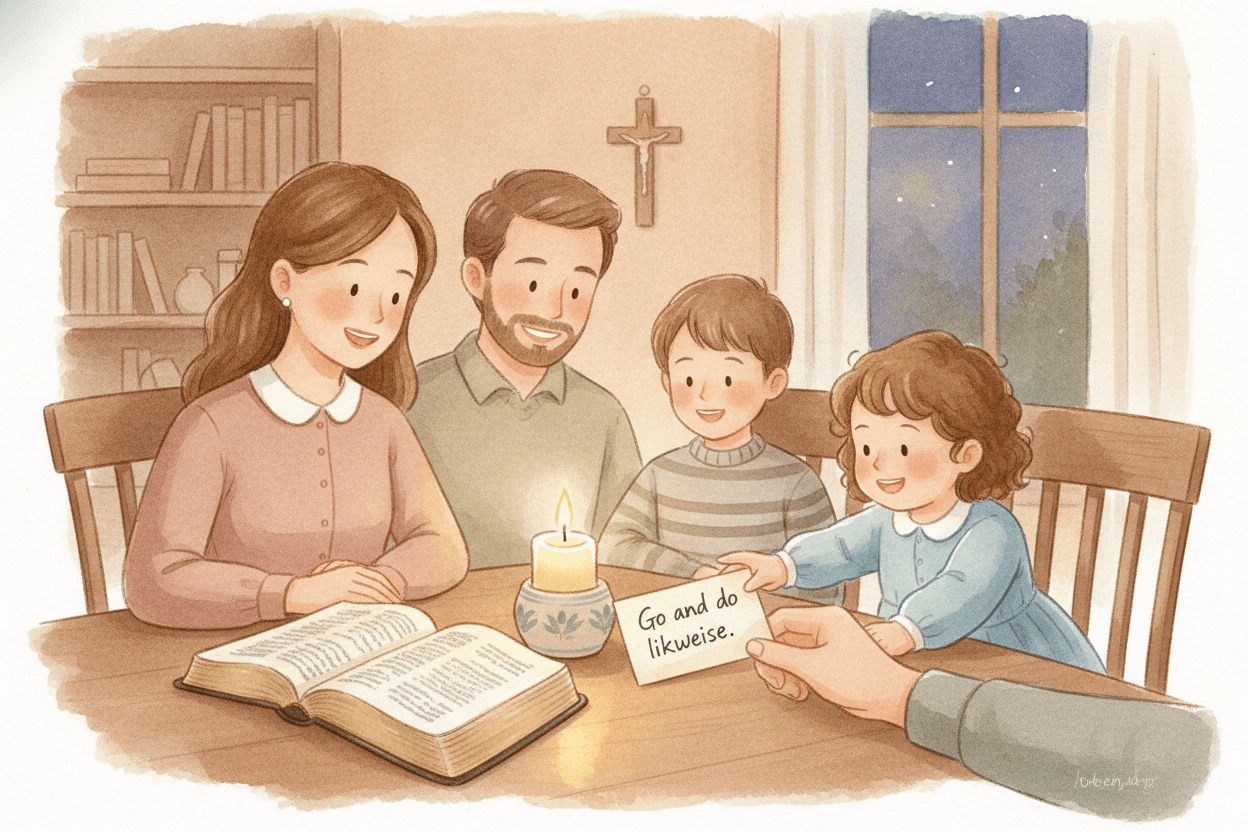
Sunday evening can be enough: the dinner dishes are drying, backpacks are waiting by the door, and you open one short passage before everyone scatters into the week. This need not become a long lesson or a polished family discussion. Choose one parable, read it aloud twice, and let the second reading slow the room down. Children, especially tweens, notice details they missed the first time: who stopped, who walked away, what Jesus actually asked, and what He told someone to do.
Then use the same four questions each week: What happens in the story? What did it mean for the people listening to Jesus? What does it show us about God’s Kingdom and about Jesus? What is one thing it asks us to do now? Here’s how I’d teach this: allow a few seconds of quiet after each question, and do not rush to supply the answer. A child’s honest observation—“The man was scared,” or “The Samaritan did more than feel sorry”—gives you something real to discuss. If a question is difficult, say so, read the passage again, and return to it another week.
Brief consistency matters, particularly around ages 10–12, when family Bible conversations often begin to decline. A ten-minute practice that happens most weeks forms a stronger pattern than an ambitious plan that disappears after two attempts. Keep the Bible open, not merely a retelling or a worksheet. Scripture comes first; then a parent can clarify a word, explain a custom, or connect the passage to a situation at school, on a team, or among siblings.
As the Catechism reminds us, “The family is the first school of the Christian life where children learn to pray and to discover the meaning of the Gospel by living it in everyday situations” (CCC 1657). This is the work of the domestic church: not parents pretending to have every answer, but parents returning with their children to Christ’s words. Jesus makes room for children rather than treating them as interruptions: “Let the children come to me and do not prevent them; for the kingdom of God belongs to such as these” (Luke 18:16).
Try a simple plan before next Sunday. Read the Good Samaritan in Luke 10:29–37 aloud twice. Ask the four questions, then name one person at school, in the neighborhood, or at church who may feel left out. Each family member chooses one merciful action for the week: sit with someone at lunch, include a sibling in a game, send encouragement, or offer practical help without being asked. At the next reading, ask not only, “What did we learn?” but also, “Where did we try to go and do likewise?”
Jesus, however, called the children to himself and said, "Let the children come to me and do not prevent them; for the kingdom of God belongs to such as these. Amen, I say to you, whoever does not accept the kingdom of God like a child will not enter it."
Frequently asked questions
How do I explain a parable to my child without making it just a moral lesson?
Start by reading the passage together and letting your child retell what happens. Then ask what the first listeners would have noticed and what the story reveals about Jesus and God’s Kingdom. Save the personal application for last, so “be kind” grows into a response to Christ’s actual teaching.
What questions should I ask my child after reading one of Jesus’ parables?
Use four simple questions: What happens in the story? What would Jesus’ original listeners have noticed? What does this show us about Jesus and his Kingdom? What is one faithful response I can make this week? Keep the Bible open so your child can point to details in the text.
How can I teach the Good Samaritan to a tween?
Begin with the setting in Luke 10: a lawyer asks who counts as his neighbor while trying to justify himself. Help your child see why making a Samaritan the helper was shocking to Jesus’ Jewish listeners. Then discuss concrete, costly mercy toward people they may be tempted to avoid at school or in daily life.
What does the Parable of the Sower teach children?
The Sower is not simply a lesson to “try harder.” Jesus explains that the seed is the word of the Kingdom and the different soils show ways people receive, neglect, or resist it. Ask your child what might keep God’s word from taking root, such as distractions, worry, resentment, or screen time.
Can children have their own interpretation of a parable?
Children can notice details and make personal connections, and those observations are worth hearing. But a parable does not mean whatever we want it to mean; its meaning is guided by Jesus’ explanation, the surrounding passage, and the Church’s reading of Scripture. Help your child connect a personal insight back to what Christ is teaching.
Why does the historical context of a parable matter?
Context keeps parables from becoming vague slogans. Knowing the hostility between Jews and Samaritans makes the Samaritan’s mercy startling, while knowing that farming was familiar imagery helps children understand the Sower’s picture. These details reveal that Jesus addresses real division, sin, conversion, and discipleship.
Sources: catholic.com · aleteia.org · aleteia.org · bible.usccb.org · bible.usccb.org · barna.com · access.barna.com · pewresearch.org · cgsusa.org
Scripture quotations in this article use the NABRE translation.