The Parable of the Sower for Kids:Growing Faith
Explore the Parable of the Sower with children through everyday examples of distracted minds, worried hearts, and growing faith. This gentle guide helps families discover how God’s word can take root,
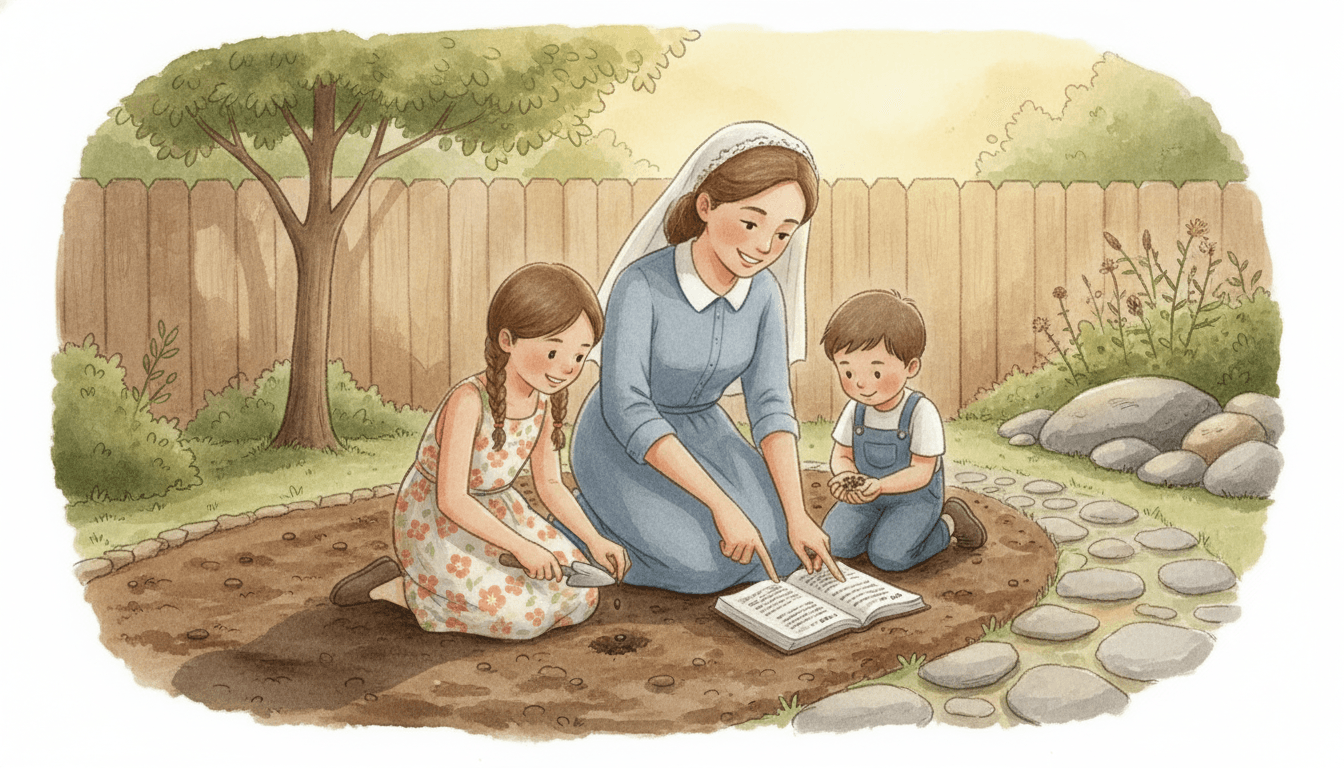
You finish a Gospel story at breakfast, and before the last word is explained, someone is asking for a screen or searching for a missing shoe. Jesus knew that God’s word would meet distracted, worried, and still-growing hearts. The Parable of the Sower gives parents a compassionate way to help children notice what helps faith grow—without ever calling a child “bad soil.”
Start with the generous Sower, not the different soils
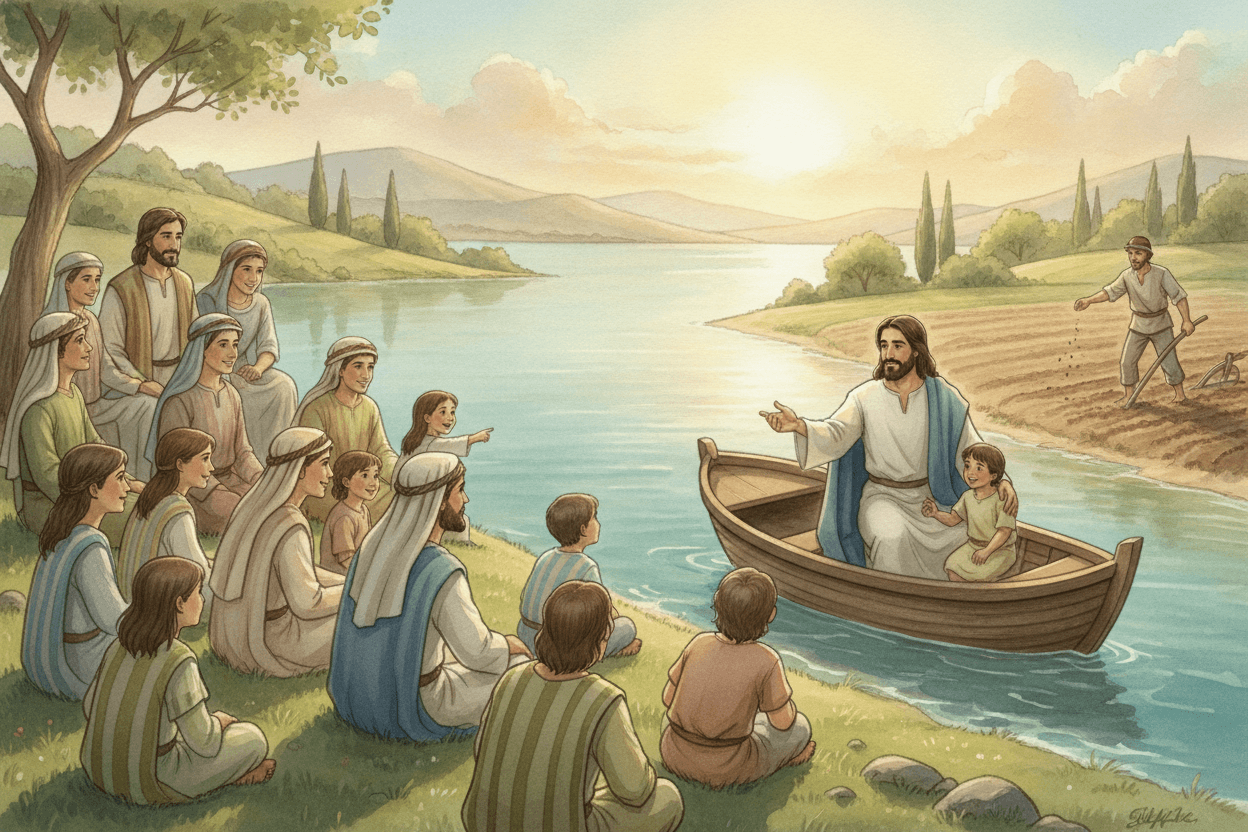
Picture a farmer with a full bag of seed, walking across his field and casting it with an open hand. Some lands on the packed path, some on shallow rocky places, some among thorny weeds, and some in good soil. Jesus begins the parable this way in Matthew 13:1–9, and the first detail children should notice is not the soil. It is the sower. He does not pinch out a few seeds only for the most promising patch of ground. He scatters generously.
Here’s how I’d teach this: before asking children to identify the path, rocks, thorns, or good soil, let them wonder about the farmer. Why would he sow so widely? The answer leads us toward God’s own generosity. The seed is God’s word, offered freely. Every child is invited to hear Jesus, to know that he is loved, and to answer him. No child in a family, classroom, or parish group should receive the impression that God’s word is meant only for the naturally attentive, well-behaved, or already knowledgeable. Grace comes first; our response follows.
Jesus’ parables are not puzzles meant to keep people out. As the Catechism teaches, “Jesus’ invitation to enter the kingdom comes in the form of parables” (CCC 546). They invite faith, asking listeners to receive what Christ reveals. That matters when teaching children. We are not assigning permanent labels: You are rocky soil; you are full of thorns. A child can be distracted during one Gospel reading, discouraged the next week, and deeply generous the day after that. So can an adult. The parable helps us notice what is happening in a heart today and bring it honestly to Jesus.
The good news is that the sower keeps sowing. Parents and catechists participate in that patient work when they read the Sunday Gospel, bring children to Mass, answer questions calmly, practice forgiveness, and make room for a brief prayer at bedtime. We may not see immediate results, but God’s word is not wasted. Jesus says, “But some seed fell on rich soil, and produced fruit, a hundred or sixty or thirtyfold.” Fruitfulness is God’s work in receptive hearts, and he gives each child many chances to listen, understand, and begin again.
But some seed fell on rich soil, and produced fruit, a hundred or sixty or thirtyfold.
How Jesus explains the parable to children
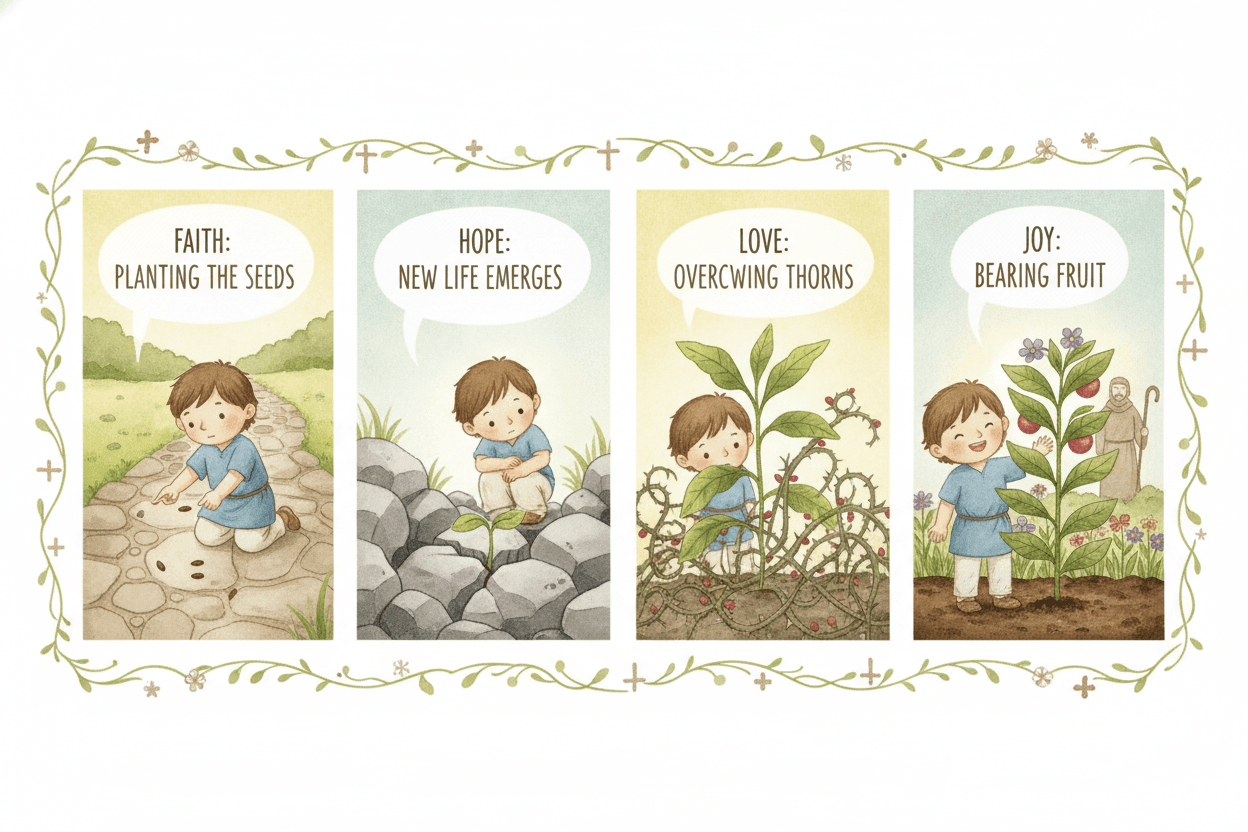
When I ask a group of children why a seed might not grow, their answers come quickly: “It got stepped on!” “There were rocks!” “It didn’t get water!” Jesus begins his explanation in much the same concrete way. In Matthew 13:18-23, he identifies the seed as “the word of the kingdom” and helps his disciples see what can happen when God’s word is heard. The parallel accounts in Mark 4 and Luke 8 tell the same lesson: Jesus is speaking honestly about the different ways people receive him.
The path is not a label for a careless or bad child. Jesus says that this is the person who hears God’s word without understanding it (Matthew 13:19). Children know this experience. They may hear a Gospel reading while thinking about lunch, a game, a disagreement, or the screen waiting at home. Sometimes the obstacle is not distraction but confusion: a child may not know what a word in the reading means. Here’s how I’d teach this: pause after the Gospel and ask, “What did you hear Jesus say?” Then clarify one small point. Understanding gives the seed a place to settle.
Rocky ground describes a beginning that is real but has not yet grown roots. A child may come home excited after First Communion preparation or eagerly volunteer to pray, then lose heart when prayer feels quiet, friends make a different choice, or doing what is right costs something. Jesus does not mock that early joy; he shows why repeated practice matters. Family prayer, Sunday Mass, a parent’s calm correction, and chances to begin again are the ordinary ways roots grow. As the Catechism reminds us, faith is both a gift from God and a genuinely human response (CCC 153-155).
The thorns are also familiar to children. Jesus names “worldly anxiety and the lure of riches” as forces that choke the word (Matthew 13:22). For a child, thorns may look like worries about school, a crowded schedule, wanting the newest thing, or so much entertainment that there is little room to notice another person’s need. This calls for curiosity, not accusation. A parent might ask, “What is making it hard to listen to Jesus today?” That question opens a conversation and avoids treating a child as though he or she permanently belongs to one kind of soil.
Rich soil, then, is not the heart of a perfect child. It is the heart that listens, understands, and keeps trying. Luke adds that such people “bear fruit through perseverance” (Luke 8:15). Help children choose one visible response to the word they heard: apologize without being prompted, include someone at recess, put away a device when asked, or pray for a worried friend. The fruit may be thirtyfold rather than a hundredfold, and Jesus still calls it fruit. Parents can sow patiently, trusting that God is at work even when growth is gradual.
But the seed sown on rich soil is the one who hears the word and understands it, who indeed bears fruit and yields a hundred or sixty or thirtyfold.
Teach the four soils without shaming your child

A child has just heard the Gospel at Mass, but the ride home is noisy, lunch is waiting, and a favorite show is calling. By afternoon, the story of the sower may feel far away. That does not mean the child has failed, or that the seed was never planted. It means ordinary life can make listening difficult. In a catechism classroom, I would not ask, “Which soil are you?” That question can make a child feel labeled. I would ask, “What is making it hard to listen to Jesus today?”
The path is a helpful image for distraction and confusion. A child may hear a Bible story while thinking about a game, a friendship problem, or what comes next. Sometimes the difficulty is simpler: he or she did not understand the story. Jesus himself speaks of hearing “without understanding” in Matthew 13:19. Rather than correcting quickly, try, “What part was confusing?” Then retell one small piece, perhaps with figures, a drawing, or a question such as, “What did Jesus want people to know?” Children deserve clear answers, and repeated hearing is part of how the Word settles into the heart.
Rocky ground can describe the child who is excited to pray, serve, or be kind, but becomes discouraged when doing the right thing costs something. Maybe she decides not to copy homework, then feels left out. Maybe he tries to forgive a sibling and gets hurt again. This is not bad character; it is a need for roots. Say, “That was hard, and you kept trying. Let’s ask Jesus to help you tomorrow.” As the Catechism reminds us, faith is both God’s gift and the person’s free response (CCC 153). Roots grow through patient practice, not through one emotional moment.
Thorns often look very familiar in family life: worries about school, too many activities, constant screens, a wish for the next toy or game, and a schedule with no quiet space. A child can name these honestly without guilt. One child may be distracted at breakfast, brave at school, worried before bed, and ready to pray at night—all in the same day. The four images are not permanent labels. They give families words for noticing what is happening in a heart that God continues to love and cultivate.
Here’s how I’d teach this at home: take five minutes after dinner or before bed. Read one short Gospel line, ask what word or image the child remembers, pray one sentence, and choose one act of love for tomorrow. Then use four gentle questions: “What distracted me? What made faith hard? What worried or crowded me? What helped me remember Jesus?” Rich soil is not a perfect child. It is a child who keeps receiving the Word, with the help of grace, family prayer, Sunday Mass, forgiveness, and small chances to love.
The seed sown on the path is the one who hears the word of the kingdom without understanding it, and the evil one comes and steals away what was sown in his heart.
Rich soil means perseverance, not a perfect child
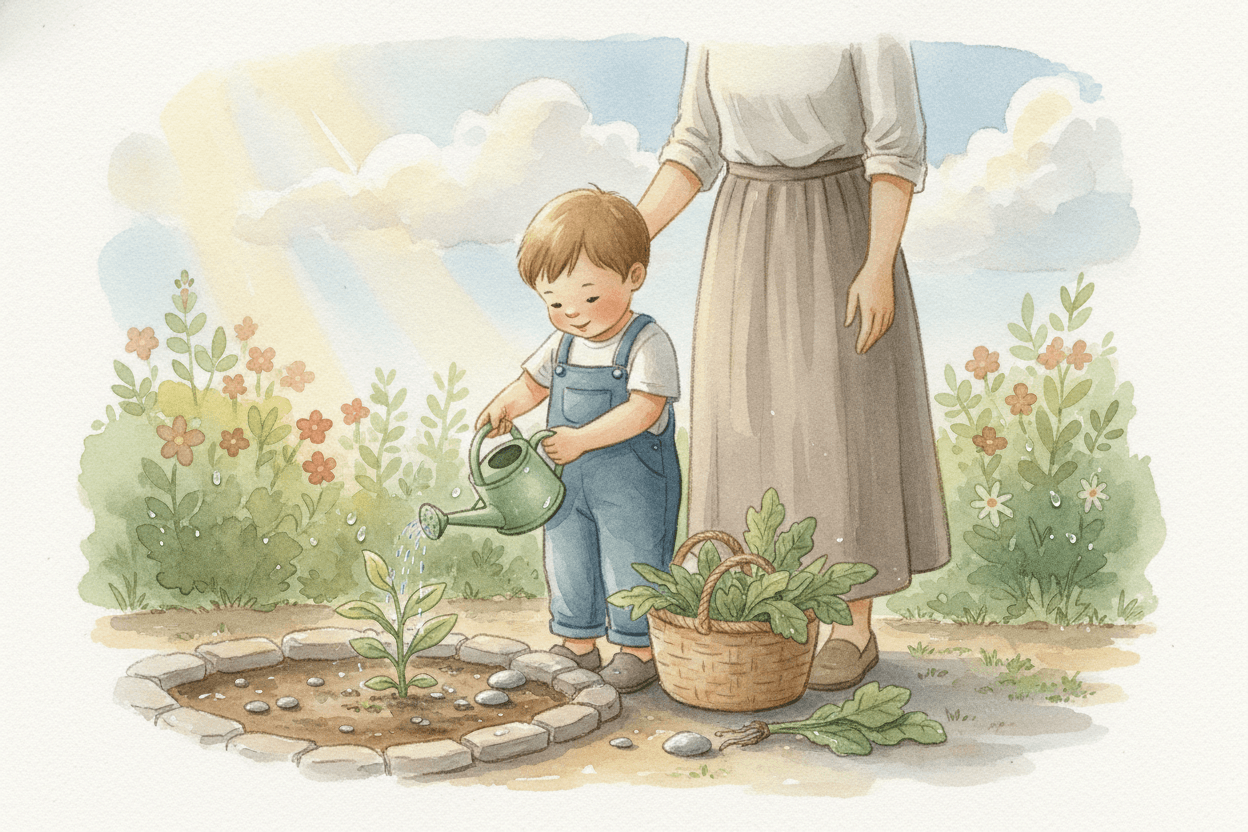
A child hears Sunday’s Gospel, comes home eager to be kind, and then argues with a sibling before lunch. That moment does not prove the seed failed. Nor does it mean the child was only pretending to listen. Children, like adults, receive God’s word in real lives: with fatigue, strong feelings, distractions, and habits that take time to change. Rich soil is not the heart of a flawless child who obeys immediately and never loses enthusiasm. It is the heart that keeps receiving Jesus again.
Luke gives us the essential word: perseverance. Jesus says that those on rich soil hear the word, embrace it “with a generous and good heart,” and “bear fruit through perseverance” (Luke 8:15). Fruit often appears in small, repeated choices. A child returns attention to prayer after looking around the room. She tries again to tell the truth after making a mistake. He says sorry without being forced to make a long speech. A worried child brings one fear to Jesus at bedtime. These are not minor substitutes for faith; they are signs that faith is taking root.
Here’s how I’d teach this at home or in a parish classroom: do not ask, “Were you good soil today?” Ask, “What can we try again with Jesus tomorrow?” That question leaves room for honesty and hope. After a hard moment, a parent might say, “We were distracted at prayer tonight. Let’s read one verse tomorrow and listen for one word,” or, “You were angry with your brother. What is one loving action you can choose now?” The goal is not to inspect a child’s spiritual performance. It is to help the child recognize that God’s word can be heard, welcomed, and practiced anew.
Pope Francis teaches that the Holy Spirit gives fortitude by freeing the soil of the heart from sluggishness, uncertainty, and fears that hinder us from putting the Lord’s word into practice. Children need to know they are not expected to manufacture courage by themselves. At Baptism, they received the Holy Spirit; in Confirmation, they are strengthened for Christian witness (CCC 1302-1303). We can teach them a simple prayer when obedience feels costly: “Holy Spirit, help me do the next loving thing.”
A five-minute Gospel pause gives perseverance a steady shape. Read a short passage; let each person name one word or image noticed; pray one sentence; then choose one concrete act of love for the day. Keep the practice even when no one seems especially inspired. Family prayer, Sunday Mass, forgiveness, Scripture, and quiet acts of charity are the patient conditions in which roots grow. Parents may sow for a long time before seeing clear fruit. Their task is faithful tending, trusting that the Lord continues to work in a child’s heart.
But as for the seed that fell on rich soil, they are the ones who, when they have heard the word, embrace it with a generous and good heart, and bear fruit through perseverance.
A family conversation after reading Matthew 13

The dishes are still on the table, someone is looking for a shoe, and bedtime is approaching. That is often the right moment for a family conversation about Matthew 13—not because everyone is especially calm, but because the day has given each person something real to bring to Jesus. Read a few verses aloud, slowly. Then let the questions be simple enough for a child and honest enough for an adult.
I would begin by answering first: “What distracted me today?” A parent might say, “I was distracted by my phone when you were telling me about school,” or “I was so worried about my work that I was not very patient.” This changes the tone immediately. The parable is not a test for children to pass or a way to sort family members into categories. It is Jesus’ word for the whole household. When parents speak truthfully without making a display of guilt, children learn that everyone needs grace, repentance, and another chance to listen.
Then ask, “What made loving Jesus difficult?” Children may name a fight with a sibling, tiredness, wanting their own way, fear, or the desire to keep playing. Parents can name their own difficulties too. Matthew’s image of thorns gives language to the pressures that crowd a heart. Jesus says, “The seed sown among thorns is the one who hears the word, but then worldly anxiety and the lure of riches choke the word and it bears no fruit.” The point is not to make a child anxious about having thorns. It is to notice what needs God’s care.
Follow with, “What helped me remember him?” Perhaps it was grace before meals, a crucifix in the bedroom, a kind teacher, a line from Sunday’s Gospel, or receiving forgiveness after an argument. Finally ask, “What loving action can I practice this week?” Keep the answer concrete: help set the table without complaining, include a lonely classmate, apologize promptly, pray for a grandparent, or put away the device when someone is speaking. Here’s how I’d teach this in parish formation as well: one small act, named clearly, is easier for a child to remember and practice than a large promise.
Do not expect every conversation to produce a moving answer. Sometimes a child will shrug; sometimes the fruit will appear much later. Pope Francis encouraged parents to sow goodness and faith in their children “without being discouraged even if at times they seem not to understand or to appreciate their teachings.” That patience is part of family discipleship. Read, ask, listen, pray one sentence together, and entrust the hidden growth to the Lord.
The seed sown among thorns is the one who hears the word, but then worldly anxiety and the lure of riches choke the word and it bears no fruit.
Try a five-minute Gospel pause this week
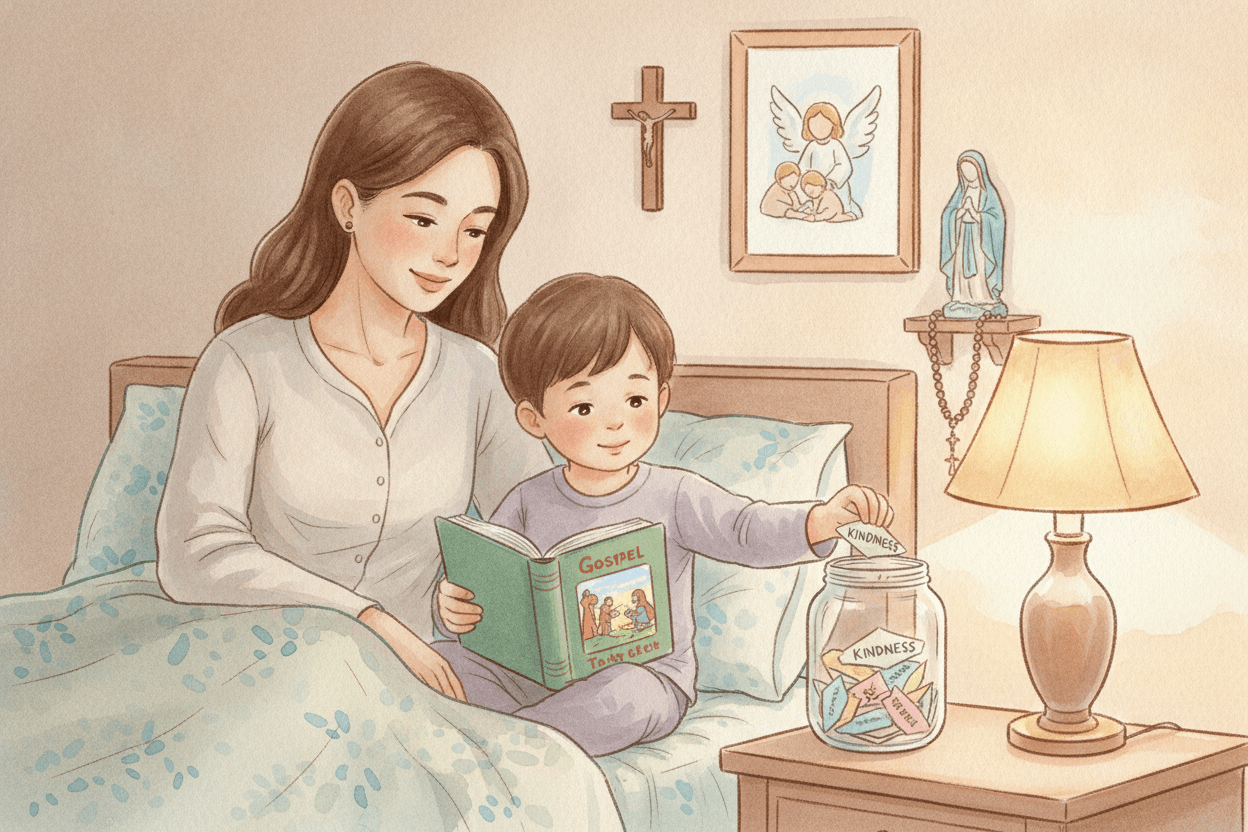
The most workable faith habit in a busy family may begin while cereal bowls are still on the table, backpacks are by the door, or the bedroom light has just been switched off. Five minutes is enough to make room for the Gospel—not enough to create pressure, but enough to return, day after day, to the word Jesus sows. Children do not need a long explanation every time. They need to hear that Scripture belongs in the ordinary rhythm of home life, where questions, distractions, and second attempts are all expected.
Choose a short passage from one of the Gospels and read it aloud slowly. Then invite each person to name one word, action, or image they notice. A younger child may say, “seed,” “bird,” or “Jesus”; an older child may notice a question or a difficult phrase. Receive each response without turning the moment into a quiz. If someone does not know what to say, offer a simple prompt: “What do you picture?” or “What part do you want to hear again?” Scripture invites us to listen before we try to explain everything. This is especially helpful when a child’s faith feels enthusiastic one day and forgotten the next.
Jesus speaks honestly about that unevenness: “But he has no root and lasts only for a time. When some tribulation or persecution comes because of the word, he immediately falls away.” A child can understand this as a reason to grow roots, not as a label for a weak heart. Roots grow through repeated contact with Christ: Sunday Mass, a brief family prayer, forgiveness after a hard moment, and small acts of charity offered quietly. As the Catechism reminds us, prayer is a living relationship with God (CCC 2558); relationships are formed through faithful return, not instant mastery.
Here is how I’d teach this as a repeatable five-minute Gospel pause: link it to breakfast, the school run, or bedtime; read one short Gospel passage aloud; let each person name one word or image; pray one sentence; then choose one concrete act of love for the day, such as helping a sibling, speaking kindly, or checking on someone who is lonely. Continue the lesson with the BibleHeroes Parable of the Sower comic, and return to the passage during the week. Parents are not asked to measure immediate results. They are called to sow patiently, trusting that God can give the seed time and care to take root.
But he has no root and lasts only for a time. When some tribulation or persecution comes because of the word, he immediately falls away.
Frequently asked questions
How can I explain the Parable of the Sower to my child?
Begin with the generous farmer who scatters seed everywhere, showing that God offers his word and love to every person. Then explain that the different soils show what can make listening to Jesus easier or harder on a particular day. Emphasize that no child is permanently one kind of soil.
What do the path, rocky ground, thorns, and good soil mean for kids?
The path can represent distraction or not understanding what Jesus says. Rocky ground is an excited beginning that needs stronger habits and support, while thorns can be worries, busyness, wanting things, or entertainment that crowds out faith. Good soil means listening, understanding, and continuing to respond to Jesus with perseverance.
How do I talk about distractions without making my child feel guilty?
Ask a gentle question such as, “What is making it hard to listen to Jesus today?” A child may be confused, worried, tired, or focused on something else, rather than refusing God’s word. Help with one small next step, such as explaining a phrase from the Gospel or saying a short prayer together.
What does it mean to help faith take root in a child?
Roots grow through ordinary repeated practices, not through one perfect religious experience. Sunday Mass, a brief bedtime prayer, reading the Gospel, calm correction, forgiveness, and chances to try again all help children stay close to Jesus when faith feels difficult. Faith is God’s gift, but children also learn to respond through these daily habits.
What are practical examples of bearing fruit after hearing the Gospel?
Invite your child to choose one concrete response to Jesus’ word that day. They might apologize, include someone who is left out, turn off a device when asked, help at home, or pray for a worried friend. Small acts of love are real fruit, even when growth is gradual.
Why is the sower important in the Parable of the Sower?
The sower reminds children that God is generous and keeps offering his word, even when people are distracted or struggling. God does not reserve grace for only the most attentive or well-behaved children. Parents share in this patient work whenever they make room for Scripture, prayer, Mass, and loving conversation.
Sources: bible.usccb.org · vatican.va · press.vatican.va · vatican.va · catholic.com · vatican.va · bible.usccb.org · usccb.org
Scripture quotations in this article use the NABRE translation.