Gideon’s 300:A Kid-Friendly Guide to Judges 7
Discover how Gideon’s tiny army of 300 faced a mighty enemy with courage, cleverness, and trust in God. This kid-friendly story shows that God can accomplish big things through people who obey Him.
What can 300 people do against a vast army? In Judges 7, God gives Gideon an answer that children can remember: the victory does not depend on having the biggest team, the loudest voice, or the strongest hands. It depends on trusting the Lord and doing the small good He asks of us.
Why Did God Send Most of Gideon’s Army Home?
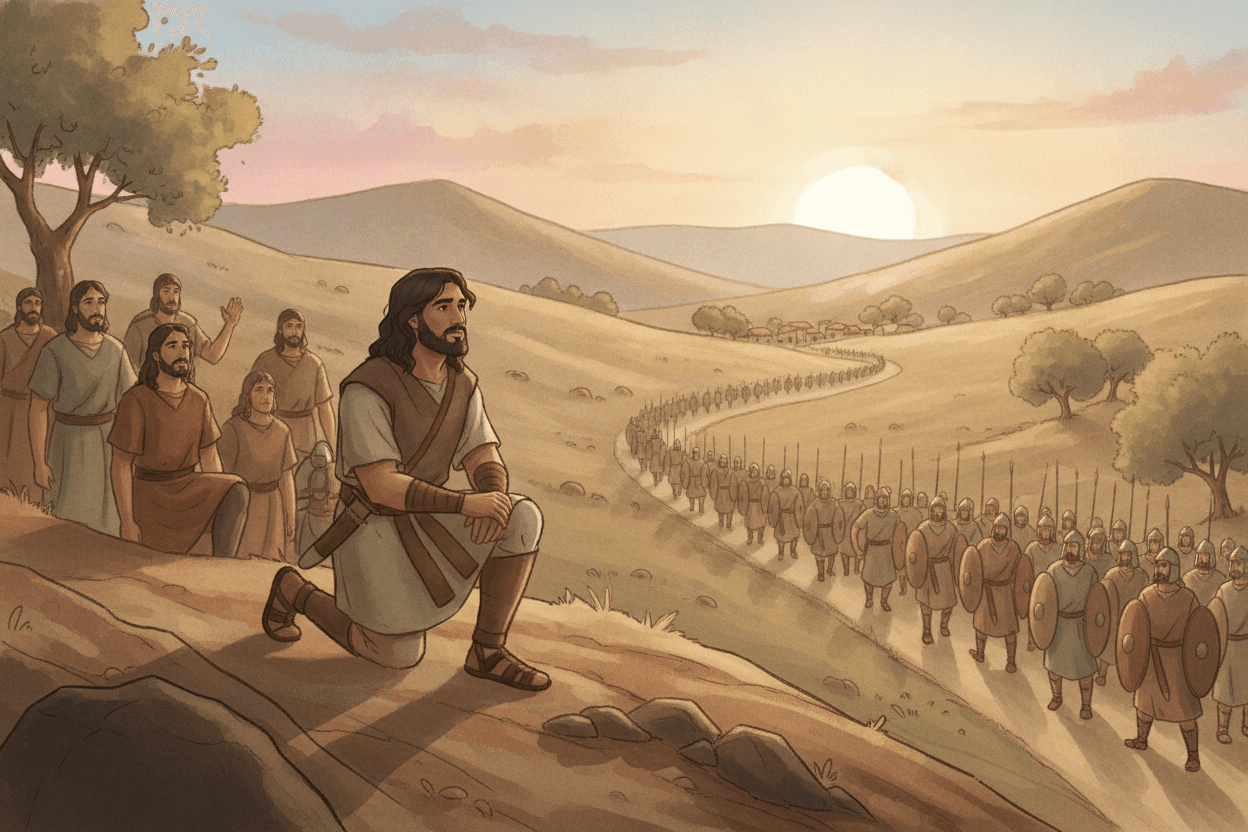
Imagine Gideon looking across the hillside as most of his soldiers head home. An army that had begun with many thousands was reduced to only 300 men. That sounds like the opposite of a sensible battle plan. Yet God was teaching Israel something they needed to remember: their rescue would not come from having the biggest army, the strongest weapons, or the cleverest leader. It would come from the Lord.
God explained the reason plainly. He knew that, after a victory, the Israelites might be tempted to say, “We did it all by ourselves!” In child-sized words, that is boasting: taking all the credit for something God helped you do. A child might finish a hard school project, score a goal, or learn to read a new book. It is good to be happy about working hard. But a Christian also remembers to thank God for a mind that can learn, people who teach and encourage us, health and energy, and the chance to try again.
This does not mean Gideon’s 300 men did nothing. They had to listen carefully, obey God’s instructions, stay in their places at night, and act together. But their victory could not honestly be explained by their numbers. God used horns, empty jars, and hidden torches—not the sort of equipment anyone would choose for an attack—to throw the Midianite camp into confusion. Judges tells us that the Lord caused the enemy to turn against one another. The point was clear: God was fighting for His people.
As the Catechism reminds us, “Nothing is impossible with God” (CCC 272), and God’s power is shown even when people feel small or weak. That truth can steady a child who says, “I am only one person,” or “I cannot do much.” Children are not asked to solve every problem. They are asked to offer God their faithful little part: telling the truth when it is difficult, including someone at recess, saying sorry without excuses, helping set the table, or praying for a worried friend.
Here’s how I’d teach this at home or in a parish classroom: ask, “What is one good thing you did this week?” Let each child answer, then add a second question: “Who helped you do it?” Help them name God, as well as parents, teachers, siblings, and friends. This is not meant to make children feel less capable. It teaches gratitude and honesty. Gideon’s small army shows that God can work through willing people, even when they do not look impressive to the world.
The LORD said to Gideon: “You have too many with you for me to deliver Midian into their hands, lest Israel vaunt itself against me and say, ‘My own power saved me.’”
Gideon’s 300: The Story Children Need to Know
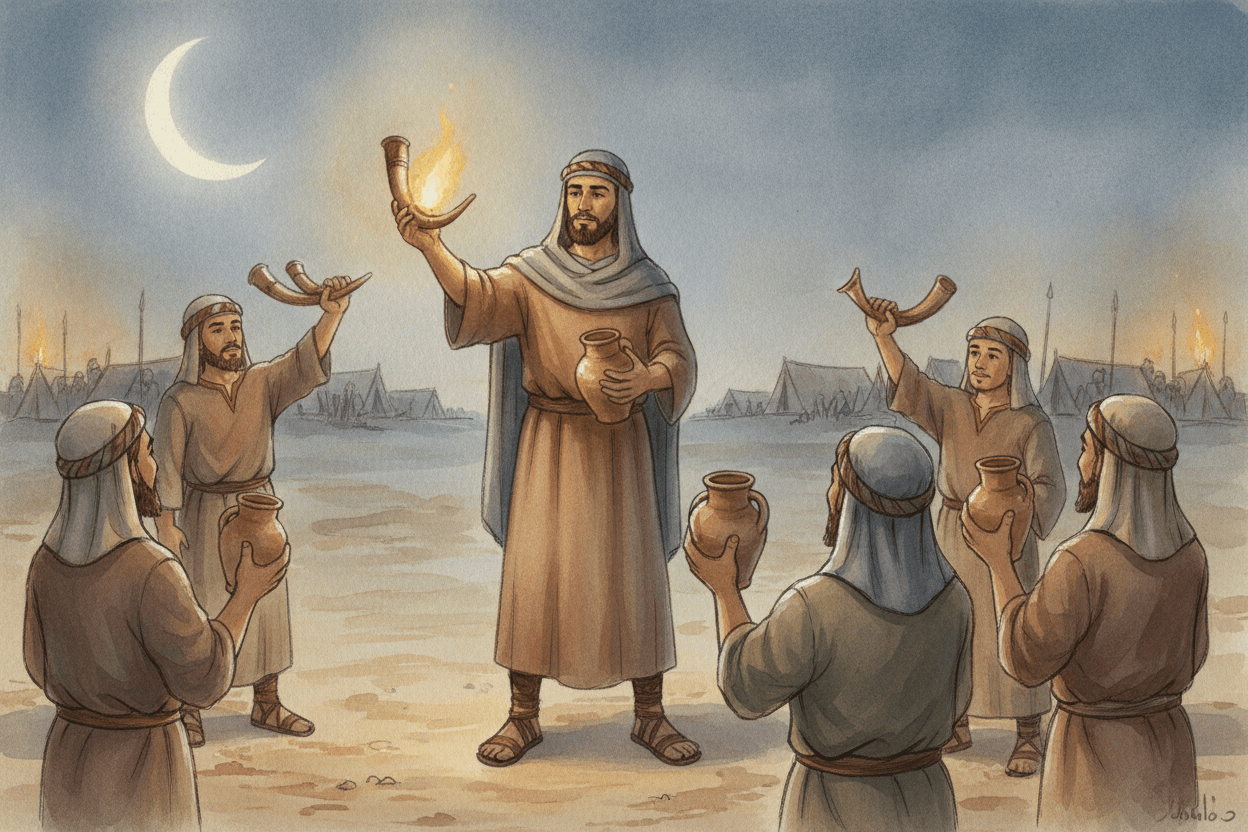
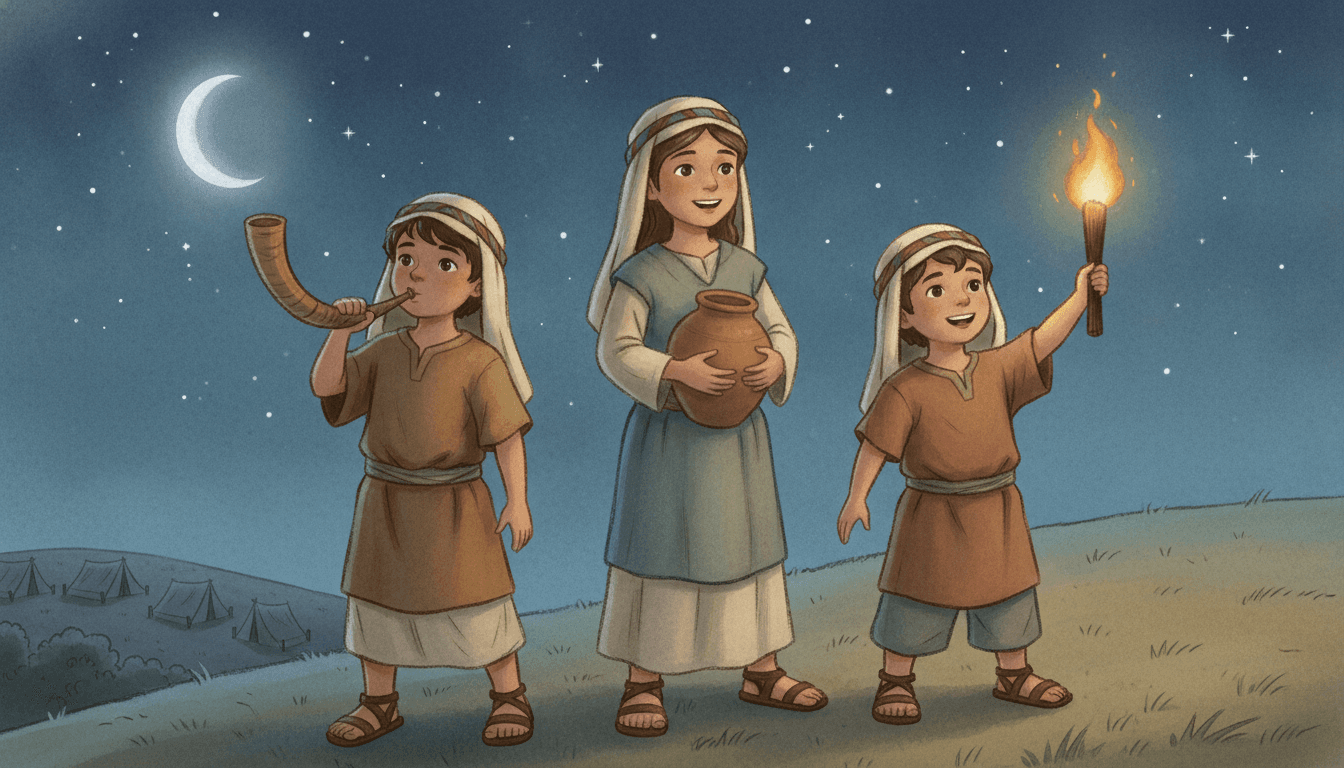
Picture three hundred tired men standing in the dark with no ordinary battle plan in their hands: each carries a horn, an empty jar, and a torch hidden inside the jar. Gideon had begun with a much larger army, but God told him to send most of the men home. Israel was facing the Midianites, yet the point was not to prove that Gideon had the strongest soldiers. God was rescuing His people and teaching them to trust Him rather than boast about their own strength.
Gideon obeyed, even though keeping only 300 men must have seemed strange. God promised that these 300 would be enough because the victory would come from Him. Then Gideon divided the men into three groups and placed them around the Midianite camp at night. He gave careful instructions: when he blew his horn, they would blow theirs; when he broke his jar, they would break theirs; and they would lift up their torches and call out for the Lord and for Gideon. Here’s how I’d teach this: Gideon was not making up a clever trick on his own. He listened to God and led the people in obedience.
At the signal, the quiet night suddenly filled with the sound of 300 horns and the crash of breaking jars. Torches flashed around the camp. The Midianites woke in fear and confusion, and Judges tells us that the Lord caused them to turn against one another and flee. The Israelites did not win because they had more people or better weapons. In fact, the first action of Gideon’s men was not a sword attack at all. They stood where Gideon had placed them and followed the plan God had given.
Children should hear one important point clearly: this story is not telling us to look for fights or to frighten others. God’s people were in danger, and God rescued them in a particular moment in Israel’s history. The lesson for us is about trust. When a child feels small before a hard task—telling the truth, apologizing, including someone who is left out, or praying when worried—he or she can remember Gideon. God is not limited by numbers, size, or our confidence. As the Catechism reminds us, nothing is impossible for God, and He is the master of history (CCC 272–273). Our part is to listen, obey, and leave the outcome in His hands.
Then the LORD said to Gideon: “With the three hundred who lapped I will deliver and give Midian into your power. Let all the others go home.”
Trumpets, Jars, and Torches: What Was God’s Plan?
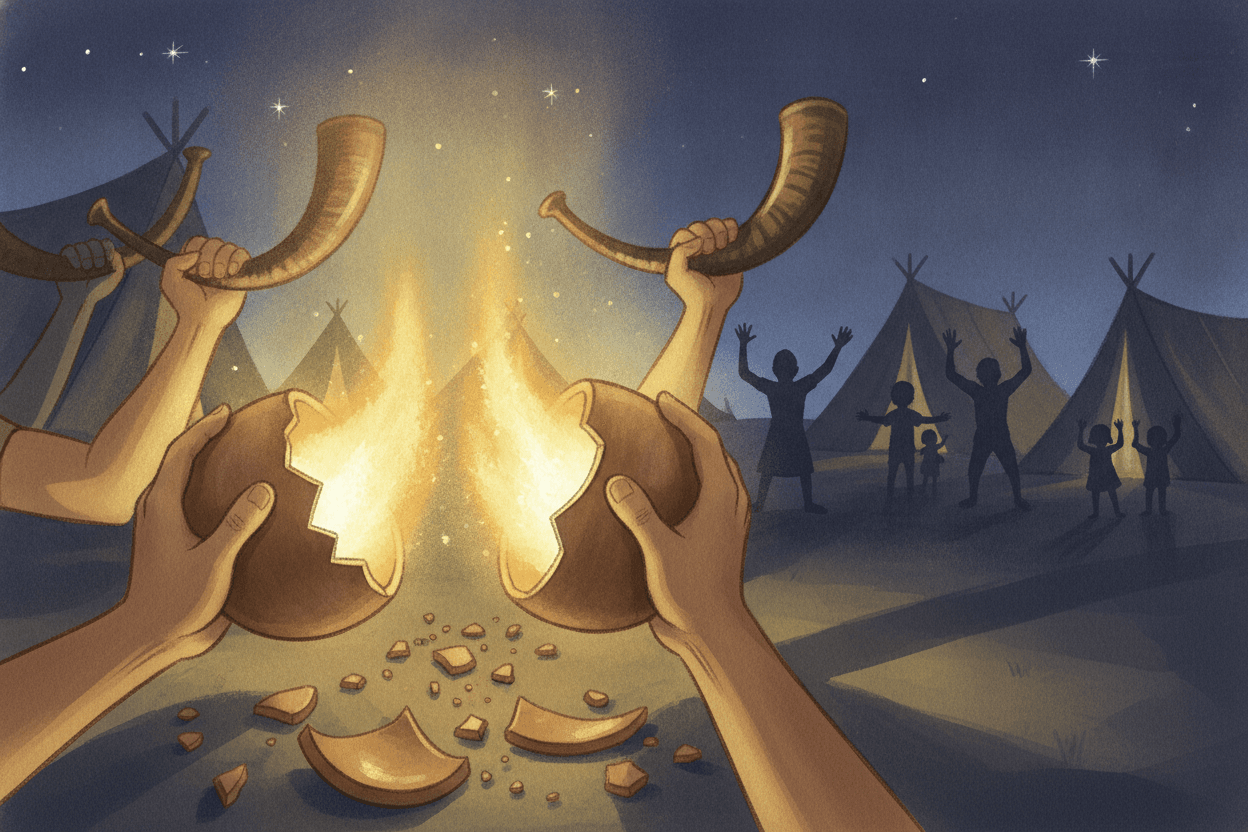
Picture a child trying to carry three awkward things at once: a horn to blow, an empty clay jar, and a burning torch hidden inside that jar. This was not the equipment Gideon’s men would have chosen for a nighttime battle. Yet each of the 300 received exactly these items, along with a clear instruction: watch Gideon, do what he does, and trust the Lord’s plan. Scripture invites us to notice how carefully God prepared even these surprising details.
Gideon divided the 300 men into three companies and stationed them around the Midianite camp. At the appointed moment, the men blew their horns. Then they smashed the jars, revealing the torchlight that had been hidden inside. All around the camp came the crash of clay, the blast of trumpets, and sudden circles of fire in the darkness. The Midianites were startled and confused. From their camp, it likely sounded and looked as if a much larger army had surrounded them.
The most important detail is easy to miss: Gideon’s men did not charge forward to begin the victory. Judges 7:22 says that they “remained standing in place around the camp,” while the Lord caused the enemy to run, shout, and flee. God did not need Israel’s large army, clever weapons, or impressive strength. As the Catechism reminds us, nothing is impossible with God, whose power works even where human strength is limited (CCC 272–273).
Here’s how I’d teach this at home or in a parish classroom: let children name what each object did before explaining what it may help us remember. The horn announced something important. The jar hid the light and then broke. The torch shone in the dark. We should not pretend that every object has only one secret meaning; the passage first tells us what happened in Israel’s real history. But the images can help children remember to speak openly about God’s goodness, admit that they need His help, and let the light of Christ be seen in their choices.
A child may feel small when a friend leaves her out, when he has to apologize, or when a family problem seems too big to fix. Gideon’s men teach a sturdier lesson than “be brave on your own.” They teach: obey God’s word, take the next faithful step, and leave the victory to Him. A prayer before bed, a truthful answer, help with a chore, or kindness toward a lonely classmate may seem small. In God’s hands, small faithfulness is never wasted.
He divided the three hundred men into three companies, and provided them all with horns and with empty jars and torches inside the jars. “Watch me and follow my lead,” he told them. “I shall go to the edge of the camp, and as I do, you must do also. When I and those with me blow horns, you too must blow horns all around the camp and cry out, ‘For the LORD and for Gideon!’”
What the Jar and Torch Can Teach Us About Weakness

A child may look at Gideon’s empty jar and think, “That would break so easily.” That is exactly why the jar is worth noticing. The three hundred men carried torches hidden inside ordinary clay jars until the moment Gideon told them to break the jars. The sudden sound, light, and trumpet blasts startled the Midianite camp—but the victory came from the Lord, not from the strength of the jars or the size of Gideon’s army.
Here is an important distinction to make with children: being weak or limited does not mean that a child is worthless or “broken.” Children are growing. They need help, make mistakes, feel afraid sometimes, and cannot do everything on their own. So do parents, teachers, and every other adult. The clay jar can help us name this truth kindly: we are not God, and we need God’s grace. As the Catechism reminds us, nothing is impossible with God; he shows his power even where human strength seems small (CCC 272–273).
The torch inside the jar gives us the next part of the lesson. God does not ask children to pretend they are strong all the time. He asks them to let his goodness be seen in truthful and loving actions: telling the truth when it is hard, including someone at recess, saying sorry without excuses, helping carry in groceries, or praying when they are worried. These acts may seem small, but they are not hidden from God. They are ways his light becomes visible in daily life.
Scripture invites us to look closely at what happened after the jars broke. Gideon’s men did not win because they had impressive weapons or a clever plan of their own. They stood where they were told to stand, and the Lord brought confusion upon the enemy camp. This teaches children that faithful obedience matters, even when they cannot yet see how God will work. A child who chooses kindness may not change the whole classroom in one afternoon, but that choice is real, and God can use it.
Here’s how I’d teach this at home or in a parish group: place a small flashlight inside a paper bag or behind a sheet of paper, then let children see how the light is harder to notice when it is covered. Ask, “What helps God’s light show through us?” Write down their answers—prayer, honesty, forgiveness, courage, and service. Then gently add: “We do not have to be the biggest, loudest, or most talented person. We can ask Jesus to help us do the next loving thing.”
So Gideon and the hundred men he had with him came to the edge of the camp at the beginning of the middle watch, just after the posting of the guards. They blew the horns and broke the jars they were holding. All three companies blew their horns and broke their jars. They held the torches in their left hands and the horns for blowing in their right, and they cried out, “A sword for the LORD and for Gideon!”
What “Small” Looks Like in a Child’s Real Life
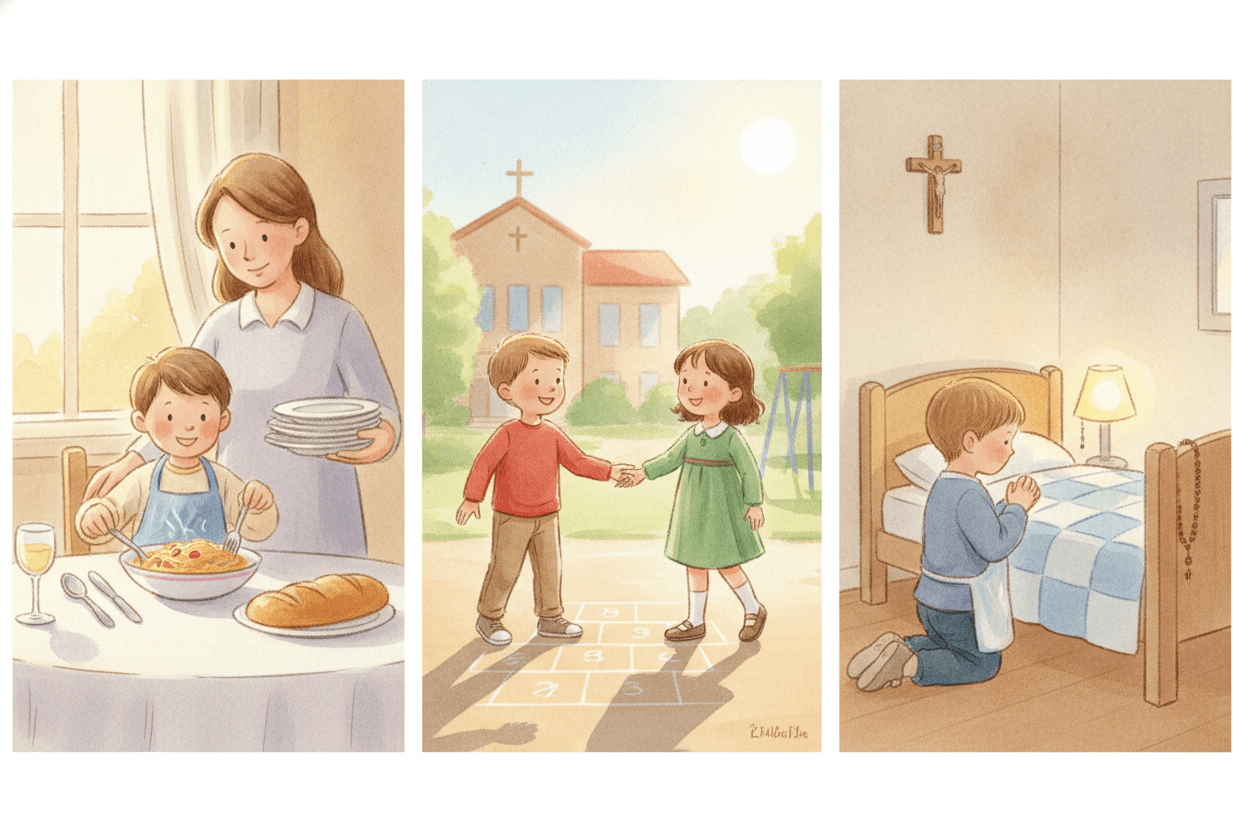
A child notices that Mateo is sitting alone at lunch again. No one has assigned a heroic mission. There is only a free chair, a sandwich, and the quiet choice to say, “Do you want to sit with me?” That may look small to grown-ups, but it is not small to the child who has been alone. Gideon’s three hundred did not win because they seemed impressive; the Lord showed that the outcome rested in his power. Children can learn the same truth: God is able to work through an ordinary act of love offered faithfully.
Here’s how I’d teach this to children ages six to nine: make the examples plain enough to recognize before the day is over. “Small” can mean sharing crayons or a favorite toy without waiting to be told. It can mean telling the truth after spilling juice, breaking something, or making an unkind choice. It can mean looking a sibling or parent in the eye and saying, “I am sorry. Will you forgive me?” A sincere apology does not erase every consequence, but it begins to repair what sin has damaged.
Small faithfulness also belongs at home. A child can feed the pet, put away shoes, clear a place at the table, or carry laundry without grumbling. These are not chores that make God finally pleased with us. God loved us first. We respond to his love by learning to love the people he has placed near us. As the Catechism reminds us, God’s almighty power is never separated from his fatherly goodness and wisdom (CCC 268, 273). He does not need our help, yet he graciously invites us to take part in doing good.
Prayer can feel small too, especially when a child is worried about a test, a friendship, a bad dream, or someone in the family who is sick. A simple prayer is enough: “Jesus, I am scared. Please help me.” Parents and catechists need not demand polished words. We can help children pause, make the Sign of the Cross, name what worries them, and ask God for help. Then we can remind them that being afraid does not mean they have failed at faith; bringing fear to God is itself an act of trust.
In Judges, the three hundred stood where Gideon directed them, and the Lord brought the victory. “When they blew the three hundred horns, the LORD turned the swords of all of them against one another throughout the camp” (Judges 7:22). A child’s kind invitation, honest confession, helpful hand, apology, or bedtime prayer may not change everything at once. But each is a real way to say, “Lord, I trust you, and I want to follow you today.” That is a lesson children are fully capable of understanding—and practicing.
They all remained standing in place around the camp, while the whole camp began to run and shout and flee. When they blew the three hundred horns, the LORD turned the swords of all of them against one another throughout the camp.
Try This This Week: Your Family’s Small-Light Plan
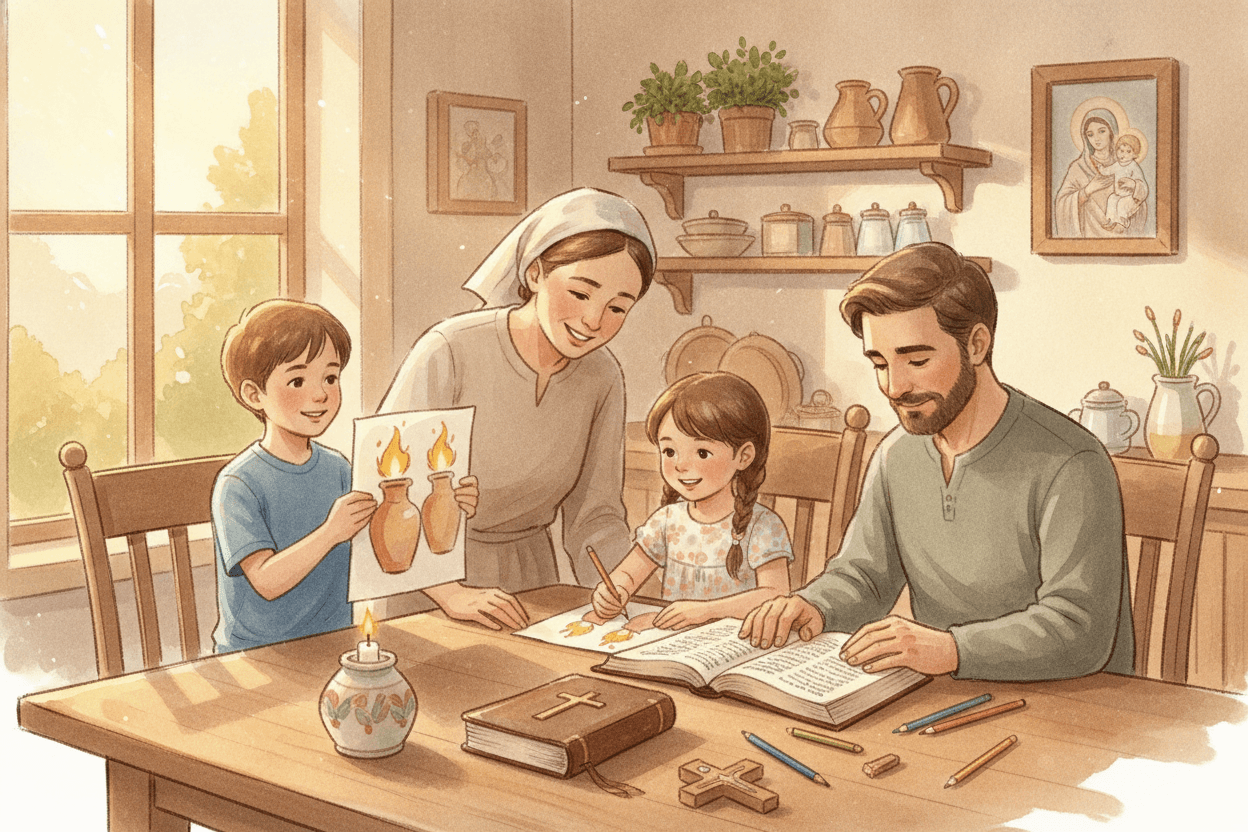
After dinner, place a sheet of paper and a few crayons on the table before anyone reaches for a screen. Tell the children: “Tonight we are going to make a picture from Gideon’s story—and then we are going to make one choice that lets God’s goodness show in our home.” This is not a craft meant to keep little hands busy. It is a family way of remembering that God worked through 300 men, ordinary horns, empty jars, and hidden torches.
Begin by opening the Bible together. Read Judges 7:2 slowly, then read Judges 7:16–22. If the children are young, pause to name what they hear: the 300 men, the three groups, the horns, the jars, the torches, and the frightened enemy camp. Ask one careful question: “Why did God want Gideon to have a small army?” Help them find the answer in the passage itself: God did not want Israel to claim, “My own power saved me.” Scripture invites us to trust God’s strength rather than brag about our own.
Next, let each child draw a large jar with a bright torch inside it. Parents may draw one too. Near the jar, each person writes—or dictates—one small act of love for the coming week. Keep it specific: share without being asked, put away shoes, speak kindly to a sibling, help set the table, say “I am sorry,” or include someone who is left out. Then add one short prayer beneath the picture, such as: “Jesus, help Your light show in me today.” A child does not need a grand assignment to practice faithfulness. Small acts of charity are real acts of love, and love is the heart of Christian life.
Place the drawings somewhere visible: the refrigerator, a bedroom door, or beside the family prayer corner. At dinner each day, ask, “Where did you notice God helping you today?” Give children time to answer without correcting every response. One may say, “I remembered to share.” Another may admit, “I was mad, but I did not yell.” These are worthwhile moments to notice. As the Catechism reminds us, God’s almighty power is shown not as a distant force but in His care for His people and His work within history (CCC 268–273).
Before bedtime, pray each child’s short prayer together. You might close by recalling the scene in which Gideon’s men broke their jars and raised their torches. Their light was visible because God’s plan, not their military strength, brought victory. Continue the conversation with the Gideon’s 300 comic, and let your children retell what happened in their own words. When children can tell the story, point to the Scripture, and practice one small act of love, they are learning to recognize that God can work through what looks small.
So Gideon and the hundred men he had with him came to the edge of the camp at the beginning of the middle watch, just after the posting of the guards. They blew the horns and broke the jars they were holding. All three companies blew their horns and broke their jars. They held the torches in their left hands and the horns for blowing in their right, and they cried out, “A sword for the LORD and for Gideon!”
Frequently asked questions
Why did God reduce Gideon's army to 300 men?
God wanted Israel to know that victory came from Him, not from a large army or impressive strength. If they had won with thousands of soldiers, they might have taken all the credit themselves. The 300 men helped show that God can work through people who trust and obey Him.
What did Gideon's 300 men use in the battle?
Each man carried a horn, an empty jar, and a torch hidden inside the jar. At Gideon's signal, they blew the horns, smashed the jars, and lifted the torches. God used the noise and light to confuse the Midianite camp.
Did Gideon's army win because they had a clever battle plan?
The men did follow clear instructions, but the story says the Lord caused the enemy to panic and turn against one another. Gideon's 300 stayed in their assigned places rather than winning through superior weapons or numbers. Their obedience mattered, but God gave the victory.
How can I explain Gideon's 300 to my child?
Tell your child that God does not need us to be the biggest, strongest, or most confident person in the room. Our job is to do the faithful small thing in front of us, such as telling the truth, saying sorry, helping at home, or including someone who is alone. We can work hard and thank God for the help, abilities, and people He gives us.
What does Gideon's story teach children about feeling small or unable to help?
It teaches that being only one person does not mean a child has nothing to offer. God can use a small act of kindness, courage, prayer, or obedience in ways we cannot see. As the Catechism says, nothing is impossible with God (CCC 272).
Does the story of Gideon's 300 teach children to fight or scare people?
No. Gideon's battle happened during a particular time when Israel was in danger and God rescued His people. For children today, the lesson is to trust God in hard moments and obey what is right, not to seek fights or frighten others.
Sources: bible.usccb.org · integratedcatholiclife.org · sacredtextsguide.com · patternsoftruth.org · integratedcatholiclife.org · barna.com · wordonfire.org · tips.translation.bible · christianstudylibrary.org · jcgm.org
Scripture quotations in this article use the NABRE translation.