How to Teach Kids About the Eucharist Before Mass
Help children recognize the Eucharist as Jesus truly present by explaining the sanctuary lamp, practicing reverent gestures, and answering questions simply. These gentle preparations turn curiosity in
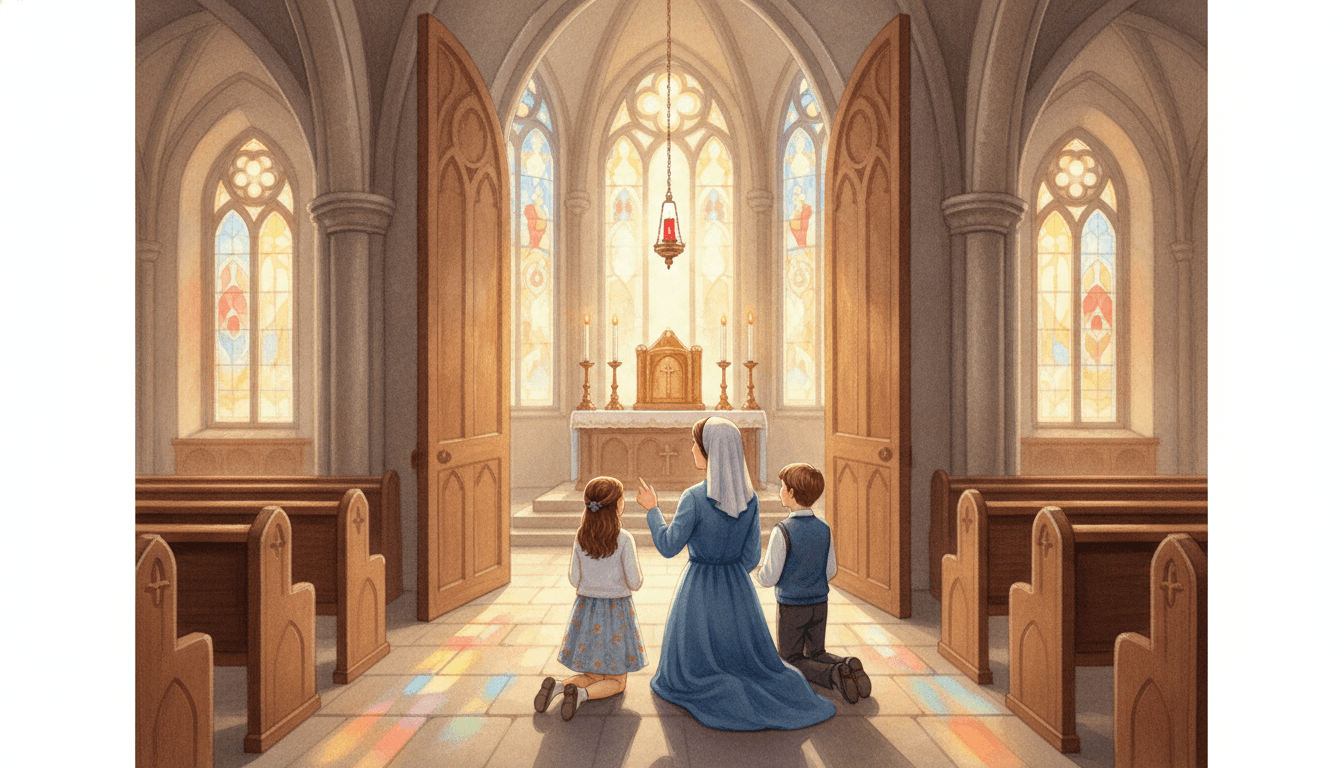
Your child notices the red sanctuary lamp, watches you kneel, and asks, “Is Jesus really in there?” That question is not an interruption to manage; it is a doorway into the Church’s great gift. Before Mass, a few clear words and quiet habits can help children meet Jesus with understanding, wonder, and peace.
Begin With the Question Your Child Is Already Asking

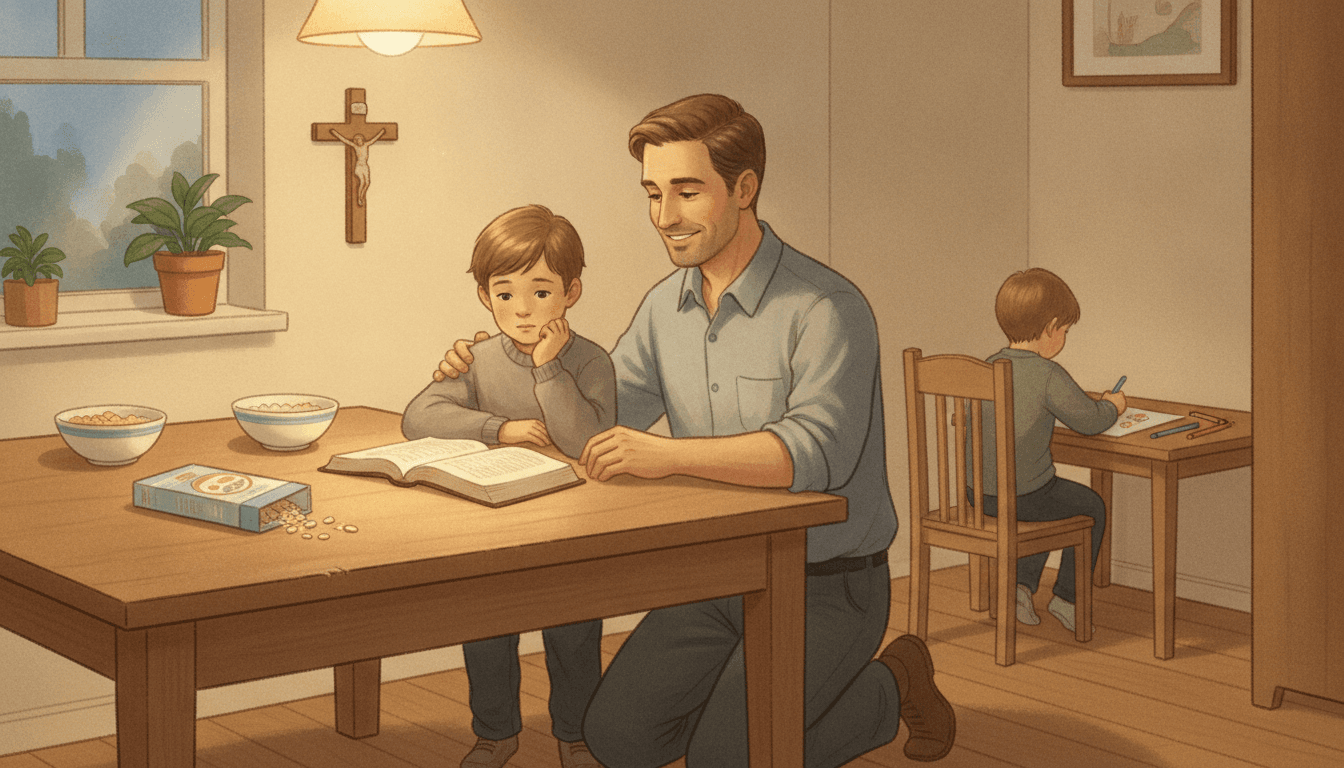
“Why do we kneel there?” a child asks while the family slides into the pew. Or, looking toward the sanctuary lamp, “Is Jesus in that little house?” Another child notices the host at Communion and asks, “Why doesn’t it look different?” These are not interruptions to get past before Mass begins. They are the questions that tell us where a child is already paying attention. Receive them calmly, answer briefly, and return to them later when there is time to talk.
For children ages six through nine, visible signs are a sound starting point because they are learning to reason from what they see toward what it means. Point to the tabernacle and explain that Jesus is truly present there in the Eucharist. Point to the red sanctuary lamp: it tells us that the Blessed Sacrament is reserved inside. Explain kneeling or genuflecting as the Church’s way of honoring Jesus. Then say plainly: “Jesus is really here, hidden under the appearance of bread and wine. We cannot see everything that is true, but we trust what Jesus tells us.” As the Catechism teaches, Christ is present “whole and entire” in the Eucharist (CCC 1374).
This is not beyond a child’s reach, nor does it require a lecture before leaving the house. Jesus’ own words give parents the foundation: “Take and eat; this is my body.” Read Matthew 26:26 together at another time, perhaps the evening before Sunday Mass. A child may still ask how bread can be Jesus if it looks and tastes like bread. Answer honestly: the appearance remains, but at the consecration the bread and wine become Christ’s Body and Blood. The Church calls this change transubstantiation (CCC 1376). We do not pretend it is ordinary food, and we do not expect children to solve a mystery before they can reverence it.
About age seven is traditionally associated with the use of reason and preparation for Confession and Holy Communion, but it should never become a narrow First Communion checklist. One child will be ready to notice the altar and ask about sacrifice; another will need to practice making the Sign of the Cross attentively and sitting quietly for a few moments. Both are participating in the Church’s worship. Before Mass, try one question: “What would you like to watch for today—the altar, the Gospel book, the priest’s hands, or the sanctuary lamp?” Then let your child bring that observation home. Here’s how I’d teach this: begin with the question in front of you, give a true answer suited to the child, and let regular Sunday Mass supply the patient repetition that formation needs.
While they were eating, Jesus took bread, said the blessing, broke it, and giving it to his disciples said, “Take and eat; this is my body.”
Teach the Real Presence Clearly and Gently
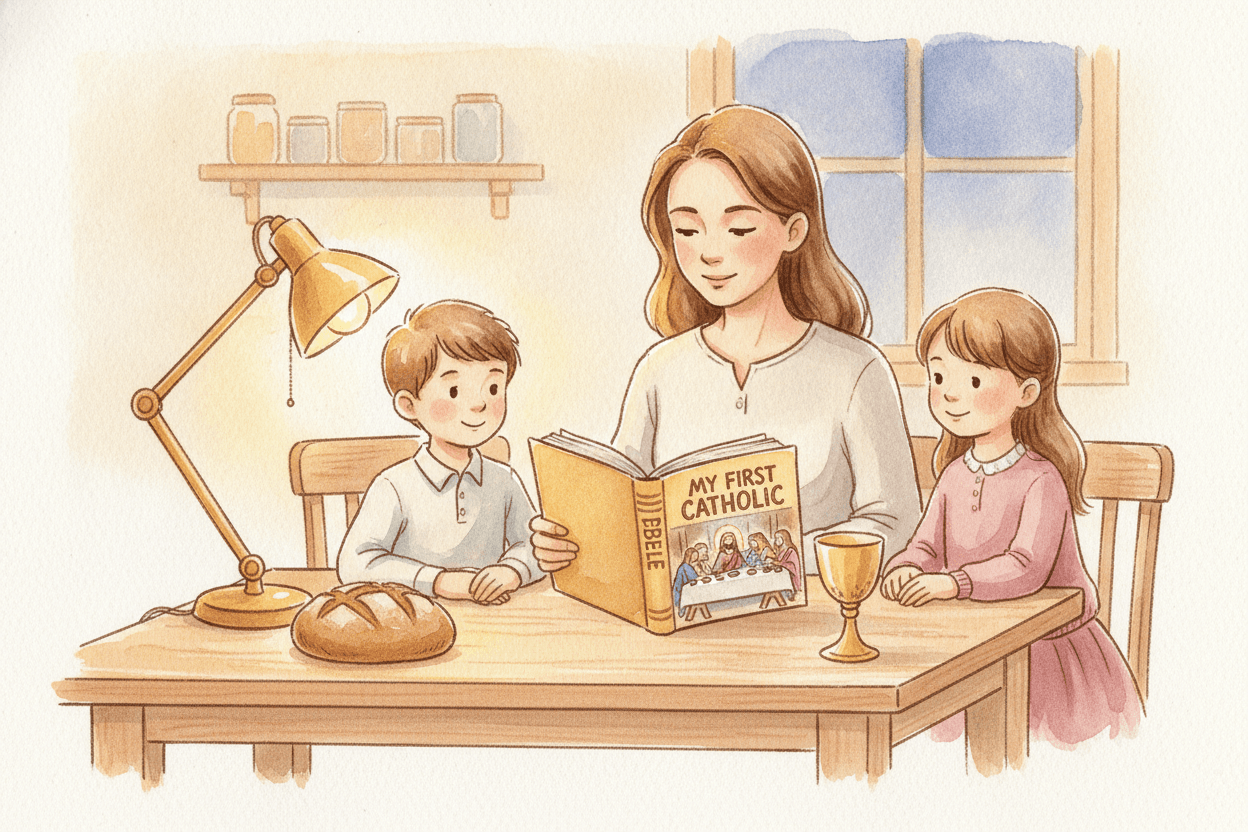
A child watches the priest lift the host and whispers, “Is that still bread?” That question deserves a plain answer, not a vague one. Before Mass, try saying: “Jesus is really here, hidden under the appearance of bread and wine. We cannot see everything that is true, but we trust what Jesus tells us.” Speak calmly. Children are capable of receiving a mystery without being given a pretend explanation.
Here’s how I’d teach this: the Eucharist is not ordinary food, and it is not merely a symbol that helps us remember Jesus. At the consecration, bread and wine become Jesus Christ truly present: his Body, Blood, Soul, and Divinity. What our eyes see—the shape, color, and taste of bread and wine—remains. But what they are has changed by Christ’s word and the power of the Holy Spirit. This is why Catholics kneel, why we keep silence, and why the tabernacle matters.
Anchor the lesson in Jesus’ own words at the Last Supper. He did not say, “This represents my body.” Matthew tells us that Jesus took bread, blessed it, broke it, and gave it to his disciples. Then he said, “Take and eat; this is my body.” A child does not need to master the word transubstantiation before First Communion. He or she does need to know that Jesus speaks truthfully and gives himself to us in love.
As the Catechism reminds us, Christ is present in several ways at Mass: in the gathered Church, in the proclaimed Word, and in the ordained minister who acts in Christ’s person. Yet Christ is present in the Eucharistic species in a unique way: wholly and entirely, substantially present (CCC 1373–1374). You might tell your child, “Jesus is with us whenever the Church gathers to pray. But after the consecration, he is present in the host and chalice in the special way he promised.” This both protects the truth of the Real Presence and helps children notice the whole Mass.
Keep the tone reverent, never frightening. Before entering church, invite your child to look for the sanctuary lamp, which signals the presence of the Blessed Sacrament in the tabernacle. Practice a thoughtful genuflection or bow, then sit quietly for a moment and pray, “Jesus, I believe you are here. Help me love you.” If your child asks whether the host looks different, answer honestly: “No, it still looks like bread. But Jesus has told us that he is truly present.” Faith begins not by pretending we can see everything, but by trusting the Lord who gives himself to his Church.
While they were eating, Jesus took bread, said the blessing, broke it, and giving it to his disciples said, “Take and eat; this is my body.”
Connect the Altar to the Last Supper and the Cross
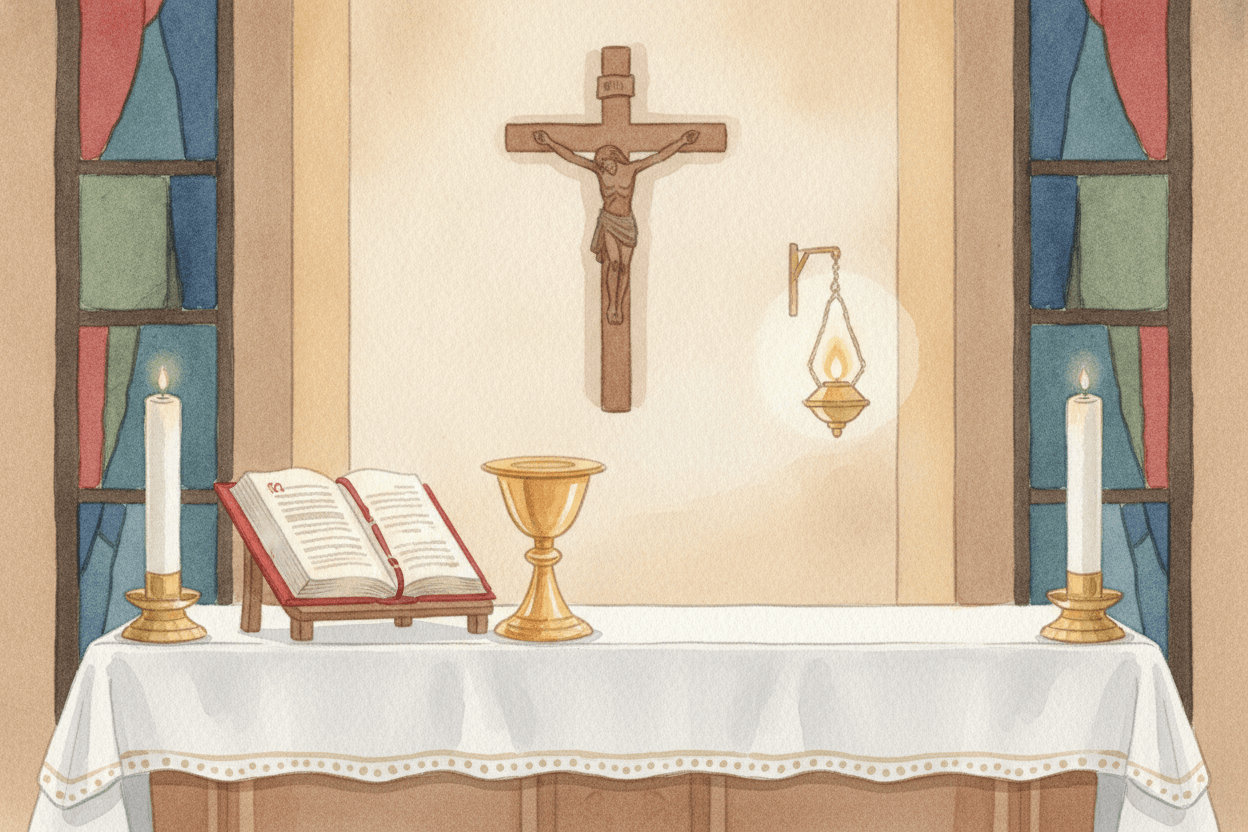
A child watching the priest lift the chalice may whisper, “Is that when Jesus died?” That question deserves more than a quick yes or no. Begin by pointing to the altar and saying, “This is where the Church gathers to thank God and receive the gift Jesus gave us.” The altar is like a table because the Lord feeds his people there. It is also connected to the Cross because the food he gives is himself, offered in love for us.
Here’s how I’d teach this in words a child can carry into Mass: “At the Last Supper, Jesus gave his disciples bread and wine and told them to do this in memory of him. The next day, he gave his life for us on the Cross. At every Mass, we do not make Jesus die again. His one sacrifice is made present for us sacramentally, and he gives himself to the Father and to us.” This is careful Catholic language, but children can understand its heart: Jesus’ love was not left in the past.
The Catechism teaches that the Eucharist is the memorial of Christ’s Passover, in which his sacrifice is made present in the Church’s worship (CCC 1362–1367). “Memorial” here does not mean merely thinking about something long ago, as when we look at an old photograph. God draws his Church into Christ’s one offering. When the priest prays the Eucharistic Prayer, the family is not watching a religious reenactment. They are joining the worship of Christ, who offers himself in love.
Before Mass, choose one visible sign to notice together. You might say, “When Father stands at the altar, listen for the words Jesus used at the Last Supper.” Or ask, “What do you see that reminds you this is more than an ordinary meal?” The chalice, paten, altar cloth, priest’s gestures, and the congregation’s kneeling all help teach the truth. Children need not grasp every part at once. Invite them to place one intention silently on the altar: a sick grandparent, a worry at school, gratitude for a friend. In this way, they learn that they participate by praying and offering their hearts with Jesus.
Keep the tone reverent but peaceful. We kneel not because we are trying to look serious, but because Jesus is truly present and we love him. If your child asks whether the host will look different after the consecration, answer honestly: it still appears to be bread, yet Jesus is truly present. Then return to the central gift: at the Last Supper, Jesus gave us the Eucharist; on the Cross, he gave himself completely; at Mass, he invites us into that same self-giving love.
“For this is my blood of the covenant, which will be shed for many for the forgiveness of sins.”
Show Children How They Already Participate Before Communion
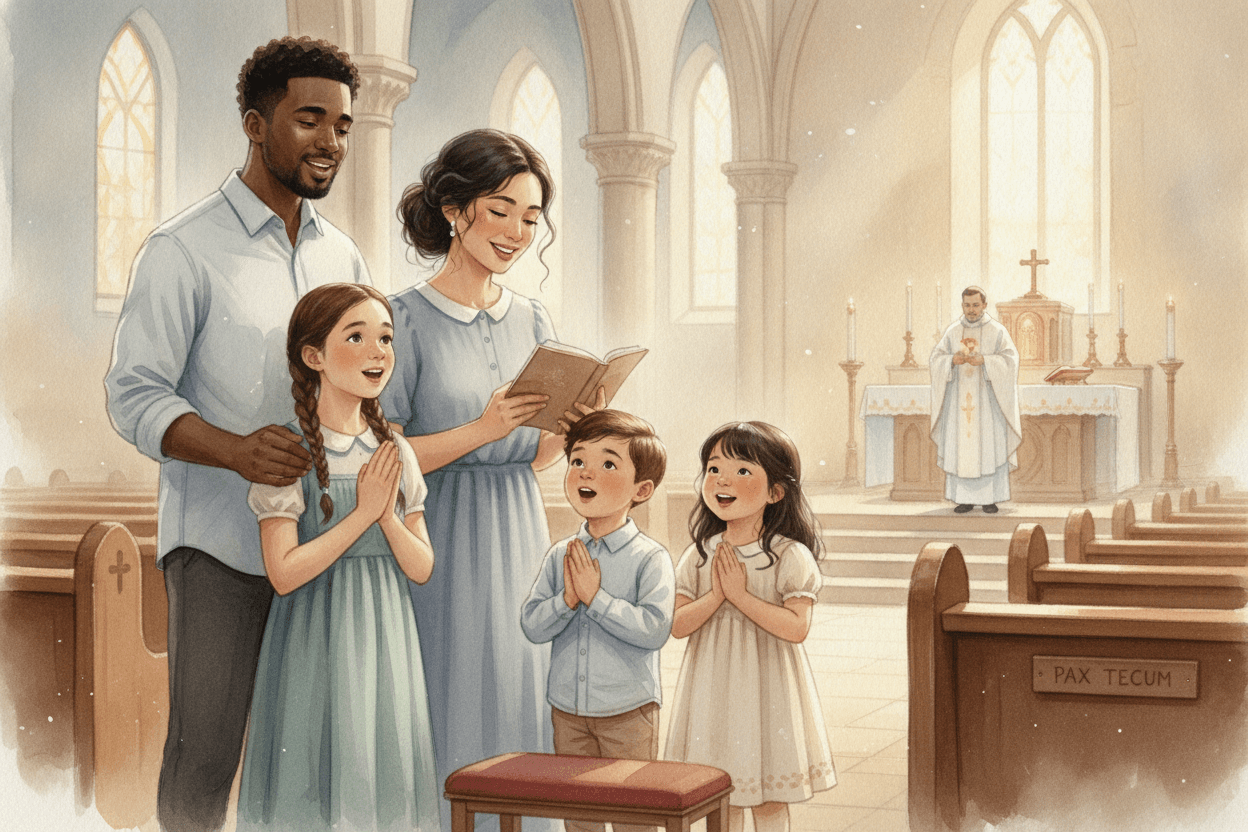
A child who cannot yet receive Holy Communion can still arrive at Mass with a real task: to pray. I often tell families not to let the Communion procession become the only moment their child watches for. From the first Sign of the Cross to the final blessing, children are being formed as members of Christ’s Body. They are not spectators waiting for a future sacrament; they are learning to join the Church’s worship now.
Begin at the church door. Slow down enough to bless yourselves with holy water and make the Sign of the Cross attentively: forehead, chest, left shoulder, right shoulder. Pope Francis has specifically urged that children be taught to make this prayer properly. It is a small action, but it says something large: we belong to the Father, the Son, and the Holy Spirit. When parents make this sign carefully rather than hurriedly, children learn that prayer involves both body and heart.
Then give them concrete ways to take part. Invite them to listen for one phrase in the readings, answer “Amen” and the other responses aloud, sing the hymn they know, and place one person or need before God during the prayers of the faithful. During the Eucharistic Prayer, a child can silently offer thanks, ask help for someone who is sick, or pray for a worry they carry. Here’s how I’d teach this to a child: “When the priest prays at the altar, you can give Jesus your love and your prayers too.”
Their posture also teaches. We stand to honor the Gospel, sit to listen, and kneel in adoration when the parish’s custom calls for it. Explain these gestures without threats: we kneel because Jesus is truly present in the Eucharist, and love responds with reverence. If a young child wiggles, whispers, or needs a brief correction, guide them calmly. The goal is not anxious silence or perfect behavior. It is a gradual habit of recognizing that church is a place where we listen, pray, and give our attention to the Lord.
Jesus says, “I am the bread of life; whoever comes to me will never hunger, and whoever believes in me will never thirst.” A child comes to Jesus at Mass by listening to his Word, praying with the Church, and learning to adore him before receiving him sacramentally. As the Catechism reminds us, Christ is present in the assembly gathered in his name, in his Word, in the priest, and most especially in the Eucharistic species (CCC 1088). Before Communion, help your child notice these gifts. Their preparation has already begun.
Jesus said to them, “I am the bread of life; whoever comes to me will never hunger, and whoever believes in me will never thirst.”
Use a Quiet Church Visit to Make the Signs Familiar
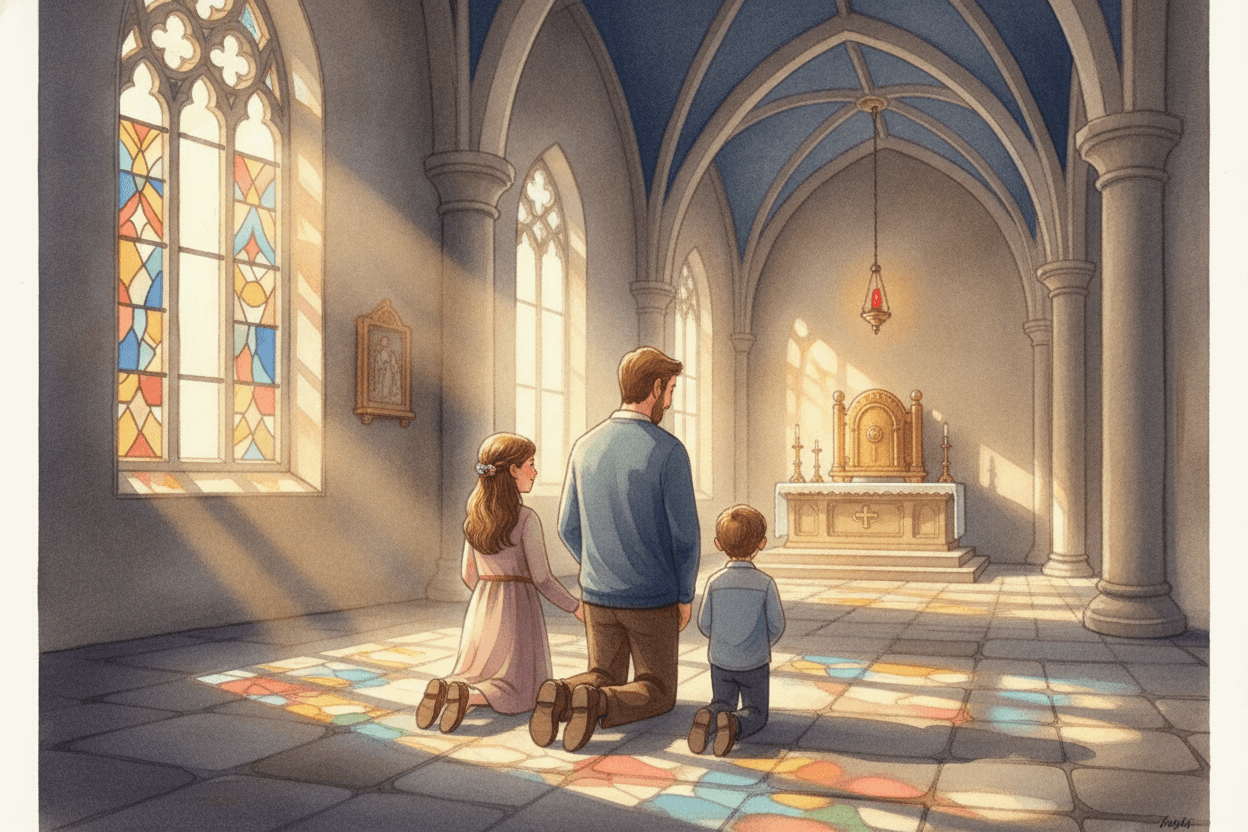
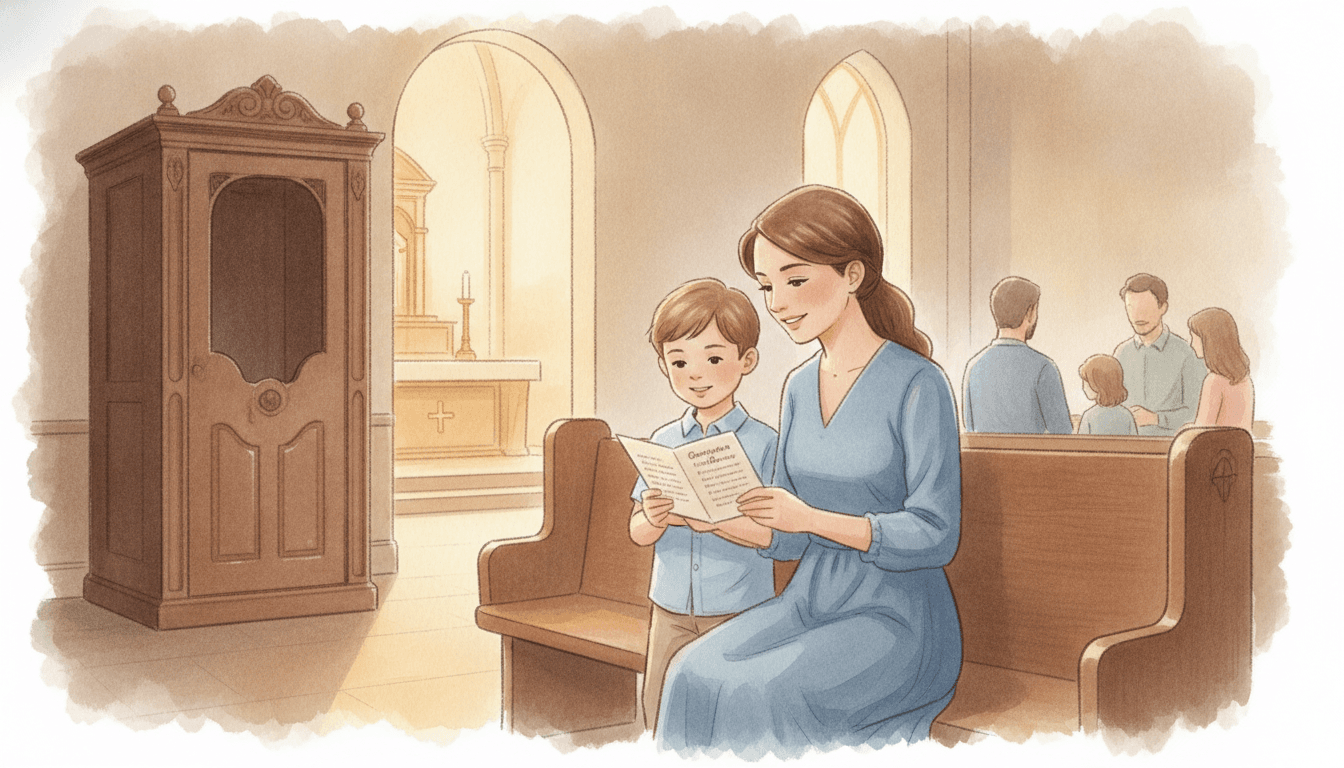
A quiet church on a weekday can teach what a hurried Sunday morning often cannot: where to look, when to be still, and why the family changes its posture when entering. Plan ten to fifteen minutes, not a lengthy lesson. Tell your child, “We are going to learn the signs in God’s house so that Mass feels familiar.” The aim is not perfect behavior; it is to help a child recognize that the church is a place where the Church gathers to worship the living Lord.
Begin near the sanctuary. Point to the altar and explain that it is the table of the Eucharist and the place where the sacrifice of Christ is made present sacramentally at Mass. Then find the ambo, where Scripture is proclaimed: from here, God’s Word is read and preached for his people. Keep the explanations plain, but do not make them vague. Children can grasp that the altar and ambo are not ordinary furniture; they help us receive Christ in the Eucharist and in the Word.
Next, look for the tabernacle and the sanctuary lamp. Explain that the tabernacle is the place where the consecrated hosts are reserved, and the burning lamp tells us that Jesus is present there in the Eucharist. If the tabernacle is present, show your child how to genuflect slowly and simply toward it. If a genuflection is not possible, a reverent bow is appropriate. This is not a performance or a test. It is a bodily way of saying, “Jesus, I believe you are here.” As the Catechism reminds us, Christ is present in the Eucharistic species in a unique way (CCC 1373).
Sit together for one quiet minute. A minute may feel long to a child, so give it a purpose: each person can silently pray for someone who is sick, worried, or grieving. Then read one short Gospel verse, perhaps Jesus’ words: “I am the living bread that came down from heaven; whoever eats this bread will live forever; and the bread that I will give is my flesh for the life of the world.” Ask, “What do you think Jesus is promising us?” Receive the answer without correcting every imperfect phrase; you are teaching your child to listen and respond.
Before leaving, invite your child to draw the altar, chalice, or sanctuary lamp when you get home, and ask what each sign helped them remember. On Sunday, quietly name one familiar place: “There is the ambo; now we will listen to God’s Word,” or “See the sanctuary lamp? Jesus is here.” Repeated, calm practice removes mystery without removing wonder. Your child will learn that reverence is not anxious silence or fear of doing the wrong thing. It is a loving response to Jesus and a way of joining the prayer of the whole Church.
“I am the living bread that came down from heaven; whoever eats this bread will live forever; and the bread that I will give is my flesh for the life of the world.”
Answer Common Eucharist Questions Without Overexplaining
The question usually comes in a whisper at the Communion line: “Does the host look different after Father says the prayer?” Give a direct answer: “No, it still looks and tastes like bread. But Jesus is truly present—his Body, Blood, Soul, and Divinity—under the appearance of bread.” Children can hold this distinction when we do not talk around it. We cannot see everything that is true, but we trust Jesus’ words and the faith of the Church.
If your child asks why he or she cannot receive Holy Communion yet, resist answers that sound like exclusion. Try: “Receiving Jesus in Holy Communion is a great gift, and the Church helps us prepare to receive him with understanding and reverence. You are already part of the Mass: you pray, listen, sing, offer your intentions, and adore Jesus with us.” The Catechism teaches that those approaching Communion prepare themselves appropriately (CCC 1385). Preparation for First Communion, including the parish’s sacramental process, is meant to form a child rather than hold a child at a distance.
St. Paul gives parents a helpful reason to speak plainly about preparation: “A person should examine himself, and so eat the bread and drink the cup.” This is not language for frightening a child. It tells us that receiving the Eucharist matters because the One received matters. If your parish permits those not receiving to come forward for a blessing, explain what will happen before Mass. If not, reassure your child that remaining in the pew to pray is a real and reverent way to participate.
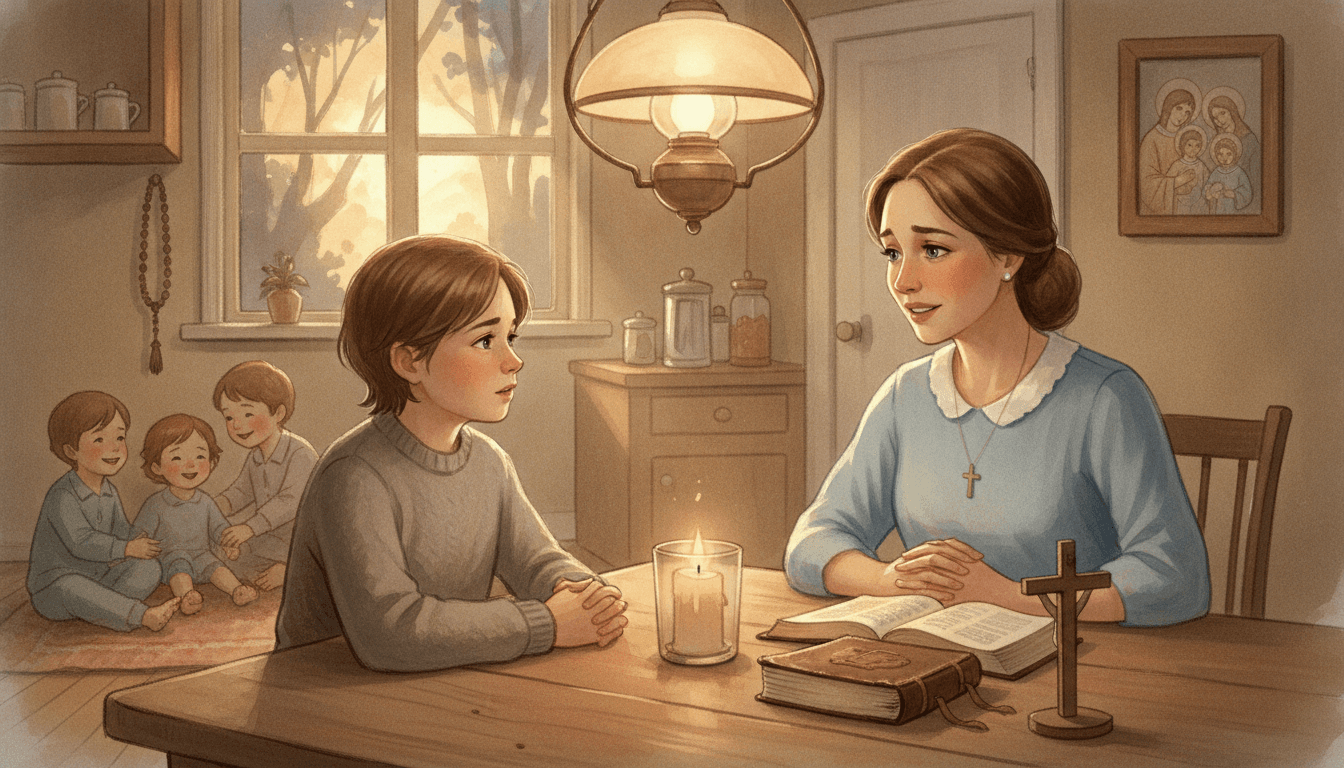
On the ride home, ask one question rather than conducting a quiz. “What did you notice at Mass today?” may open a conversation about a hymn, the priest’s vestments, a baby crying, or the elevation of the Host. Then gently extend the child’s observation: “Why do we kneel?” “What can we pray for during the Eucharistic Prayer?” “How is the altar both a table and connected to Jesus’ sacrifice?” Their answers need not be polished. Listen first, then supply one clear truth from Scripture and the Church’s teaching.
Here’s how I’d teach this in a family: answer only the question asked, use the same truthful words each time, and leave room for wonder. A six-year-old may need one sentence; an older child may be ready to ask why the Church uses the word sacrifice or why we genuflect. Catholic children do not need vague language to feel welcomed. They need calm adults who show, by their own attention at Mass, that Jesus’ gift deserves both joy and reverence.
“A person should examine himself, and so eat the bread and drink the cup.”
Try a Five-Minute Eucharist Habit This Week
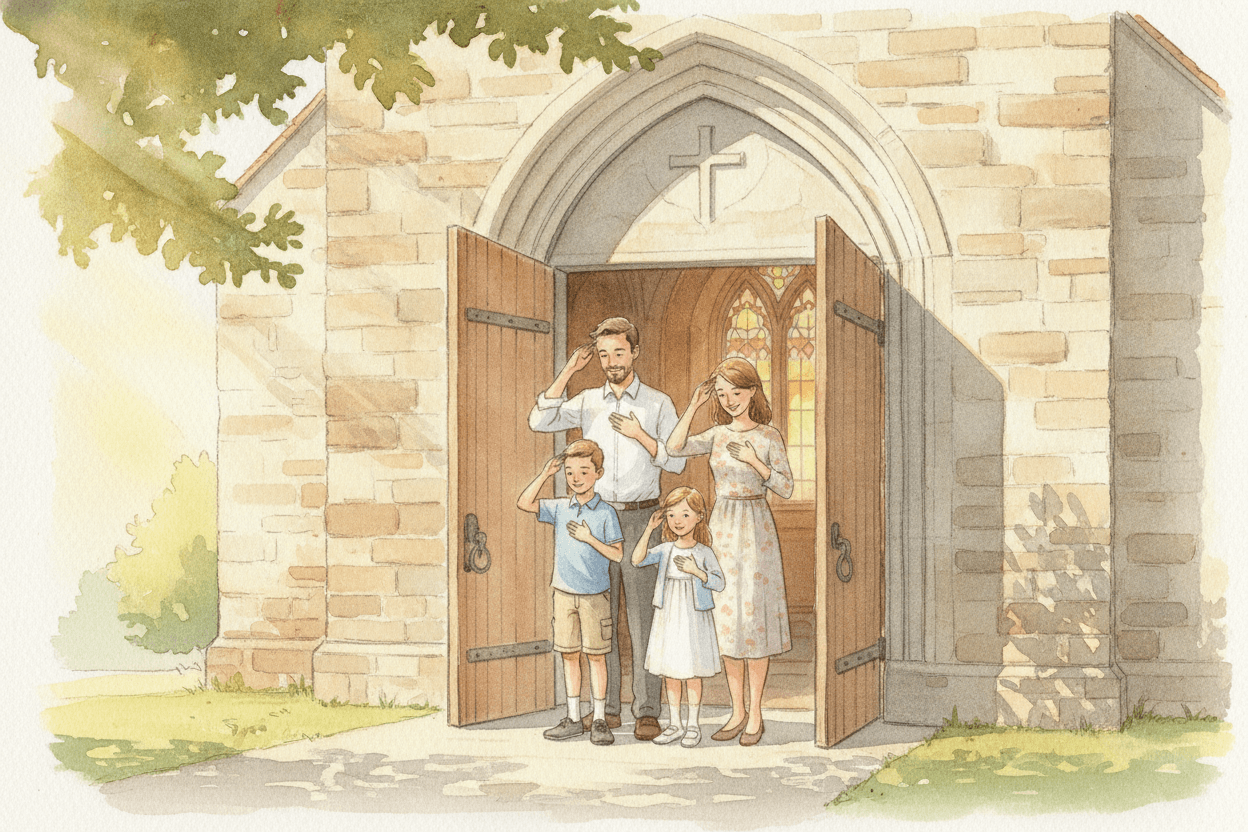
Five minutes can change the temperature of a family’s arrival at Mass. Instead of sliding into the pew while opening snack wrappers, locating crayons, and whispering hurried instructions, try arriving early enough to let everyone notice where they are. At the church door, pause. Make the Sign of the Cross slowly and attentively—not as a signal that Mass has begun, but as a confession of the God into whose presence you are entering. Pope Francis has specifically urged that children be taught to make this prayer properly.
Before you enter the pew, give your children one sentence they can carry into the liturgy: “Jesus is really here, hidden under the appearance of bread and wine.” Say it quietly, without drama, and let it become familiar through repetition. As the Catechism reminds us, Christ is present in several ways in the liturgy, and he is present in the Eucharistic species in a unique and substantial way (CCC 1373–1374). Children do not need a technical explanation every Sunday. They need truthful words, spoken calmly by the adults who bring them to Mass.
Then ask each person to name one intention: a sick neighbor, a struggling classmate, a grandparent, a family facing hardship. A young child may simply say, “I want to pray for Dad,” and that is enough. When the gifts are brought forward and when the Eucharistic Prayer begins, quietly remind children that they can offer that person to Jesus. This is real participation, even for a child who has not yet received First Communion. Scripture invites us to come to Christ with trust: “Jesus said to them, ‘I am the bread of life; whoever comes to me will never hunger, and whoever believes in me will never thirst.’”
After Mass, resist turning the car ride home into a quiz. Choose one question and give it room: “What did you notice at Mass today?” “Why did we kneel?” or “What can we pray for next Sunday?” Listen before correcting. If an answer is incomplete, add one clear truth rather than supplying a long lesson. Here’s how I’d teach this: “Yes, the priest held up bread, and after the consecration Jesus was truly present under what still looked like bread.”
This month, add one short visit to the church when it is quiet, or attend a few minutes of Eucharistic adoration if your parish offers it. Practice a reverent genuflection or bow, sit in silence, and pray for the same people your family named at Mass. The habit need not be polished to be fruitful. A parent’s steady witness—arriving early, praying honestly, kneeling with attention, and returning week after week—forms children more reliably than one impressive explanation.
Jesus said to them, “I am the bread of life; whoever comes to me will never hunger, and whoever believes in me will never thirst.”
Frequently asked questions
How do I explain the Eucharist to my child before Mass?
Start with what your child can see: the tabernacle, the sanctuary lamp, the altar, or the priest lifting the host. Say simply, “Jesus is really here, hidden under the appearance of bread and wine.” Keep the answer short, truthful, and calm; regular Mass attendance will deepen it over time.
What does the red sanctuary lamp mean in a Catholic church?
The red sanctuary lamp tells us that the Blessed Sacrament is reserved in the tabernacle. You can help your child connect the sign to a simple truth: Jesus is truly present there in the Eucharist. This is why Catholics enter quietly and show reverence toward the tabernacle.
Why do Catholics kneel or genuflect before the tabernacle?
Catholics kneel or genuflect to honor Jesus, who is truly present in the Blessed Sacrament. Practice a slow, thoughtful genuflection with your child, or a bow if needed. You might add a brief prayer together: “Jesus, I believe you are here. Help me love you.”
How can I answer when my child asks if the host is still bread?
Explain that after the consecration, the host still looks and tastes like bread, but it has become Jesus’ Body and Blood by Christ’s word and the power of the Holy Spirit. Catholics call this change transubstantiation. Children do not need to understand every detail to know that Jesus truly keeps his promise to give himself to us.
Is the Eucharist only a symbol or remembrance of Jesus?
The Eucharist is not merely a symbol or an ordinary meal that reminds us of Jesus. At Mass, Jesus is wholly and truly present in the consecrated host and chalice. Reading Jesus’ words at the Last Supper—“This is my body”—can give children a clear foundation for this belief.
What should my child watch for during Mass to learn about the Eucharist?
Choose one thing before Mass, such as the altar, Gospel book, priest’s hands, sanctuary lamp, host, or chalice. Ask your child to watch carefully and tell you afterward what he or she noticed. This gives children a manageable way to participate while they learn that the altar is both the Lord’s table and a sign of his loving sacrifice.
Sources: vatican.va · vatican.va · vatican.va · vatican.va · vatican.va · usccb.org · usccb.org · catholic.com · catholic.com
Scripture quotations in this article use the NABRE translation.