When Kids Doubt:A Catholic Parent’s Honest Response
When children question prayer, suffering, or God’s presence, Catholic parents can respond without fear or easy answers. By listening honestly and pointing toward Scripture, the Church, and Christ’s en

“Does God actually hear me when I pray?” When a child asks this at the dinner table or after a hard day, the goal is not a perfect comeback; it is to show that faith can bear an honest question. Catholic parenting gives children both room to speak plainly and solid ground in Scripture, the Church, and the love of Christ.
Start Here: A Doubt Is Not a Disaster

The question often arrives between ordinary things: on the drive home from Mass, while clearing dinner plates, or after a child hears troubling news. “What if God is not really there?” A parent may feel a jolt of fear, as though one sentence has undone every bedtime prayer and religion lesson. But a question is not a verdict. A child who voices uncertainty may be doing something important: bringing a real struggle into the open rather than carrying it alone.
Catholic teaching makes a needed distinction here. CCC 2088 describes involuntary doubt as hesitation in believing, difficulty overcoming objections, or anxiety caused by faith’s mystery. This is not the same as voluntary doubt, which deliberately refuses what God has revealed and the Church proposes for belief. A child can be confused by suffering, troubled that a prayer seemed unanswered, or unsure how miracles are possible without choosing unbelief. Often, especially in the preteen and teen years, the question is an effort to understand faith with a growing mind. Parents need not treat that effort as rebellion.
Scripture gives us a remarkably honest prayer. A father seeking healing for his son says to Jesus, “I do believe, help my unbelief!” He does not hide his weakness, and Jesus does not turn him away. Here’s how I’d teach this: faith is not pretending we have no questions; faith brings our questions to Christ. When your child raises a hard concern, begin with calm attention: “I am glad you told me. Tell me more about what makes you wonder that.” Listen for the story beneath the words. Is this about an argument at school, a friend’s suffering, a disappointment, or a fear that God has been silent?
Then answer honestly at your child’s level. It is good to say, “That is a serious question, and I do not want to give you a shallow answer,” followed by, “Let’s look for the Church’s answer together.” Open Scripture, consult the Catechism, ask a trusted catechist or priest when needed, and return to the conversation later. Parents are the first teachers of faith, but they are not required to have instant answers to every objection. Your steady presence teaches something essential: the Catholic faith can bear examination, and no sincere question puts a child beyond the patient mercy of Jesus.
Then the boy’s father cried out, "I do believe, help my unbelief!"
Listen for the Story Behind the Question
A seventh-grader once raised his hand after class and said, “I don’t think God answers prayers.” The room went quiet. It would have been easy to offer a quick answer about God’s timing, but the better first question was, “What happened that makes you say that?” His grandmother had been ill for months. The question was not chiefly about prayer; it was grief looking for words. Catholic parents will hear similar questions at the dinner table, in the car after practice, or late at night when a child is supposed to be asleep. The first task is not to win an argument. It is to hear the child God has entrusted to you.
Here is a classroom-tested pattern: pause, thank, ask, reflect, then teach. First, pause long enough that your face and voice do not communicate alarm. Then say, “Thank you for telling me that.” Ask, “What made you wonder about this?” or “Can you tell me more?” Before offering an explanation, reflect back what you heard: “It sounds as though you are angry because you prayed for Grandpa and he is still suffering,” or “You feel alone at school when your friends dismiss what you believe.” This small discipline tells a child that honesty is welcome in your home. The USCCB advises parents to speak naturally and simply about God and faith; that includes speaking naturally when the subject is confusion, not only when it is devotion.
Questions about God often carry a story underneath them. “Does God exist?” may follow a family loss. “Why should I go to Mass?” may hide peer pressure or embarrassment. “Prayer does not work” may mean, “I asked for something important, and I am disappointed.” A child who suddenly argues about the Church may also be carrying strain in a friendship or at home. None of those possibilities cancels the intellectual question, but they change how we respond. Ask gently, “Did something happen?” “Has someone said something to you?” “Are you worried about something?” One-on-one conversation, without siblings listening in, can make room for a fuller answer.
Scripture gives parents words for this mixed place of faith and uncertainty. The father in Mark’s Gospel does not pretend confidence he does not possess: “I do believe, help my unbelief!” That prayer is not a polished theological statement. It is an honest cry directed toward Jesus. As the Catechism reminds us, the family is the first school of Christian life (CCC 2223). In that school, children should learn that bringing a hard question to Christ is different from turning away from him. We can pray simply with them: “Jesus, help us understand. Stay close to us in this.”
Only after listening should you begin to teach, and even then, teach the question actually asked. If the concern is suffering, speak truthfully about human freedom, a wounded world, and Christ, who entered suffering rather than observing it from a distance. If the concern is prayer, explain that prayer is relationship with the Father, not a method for controlling outcomes. If you do not know an answer, say so without embarrassment: “That is an important question. Let’s look at Scripture and the Catechism together, and we can ask Father or your religion teacher too.” Such honesty respects a child’s intelligence and keeps the door open for faith to grow.
Then the boy’s father cried out, "I do believe, help my unbelief!"
Give Clear Answers Without Pretending to Know Everything
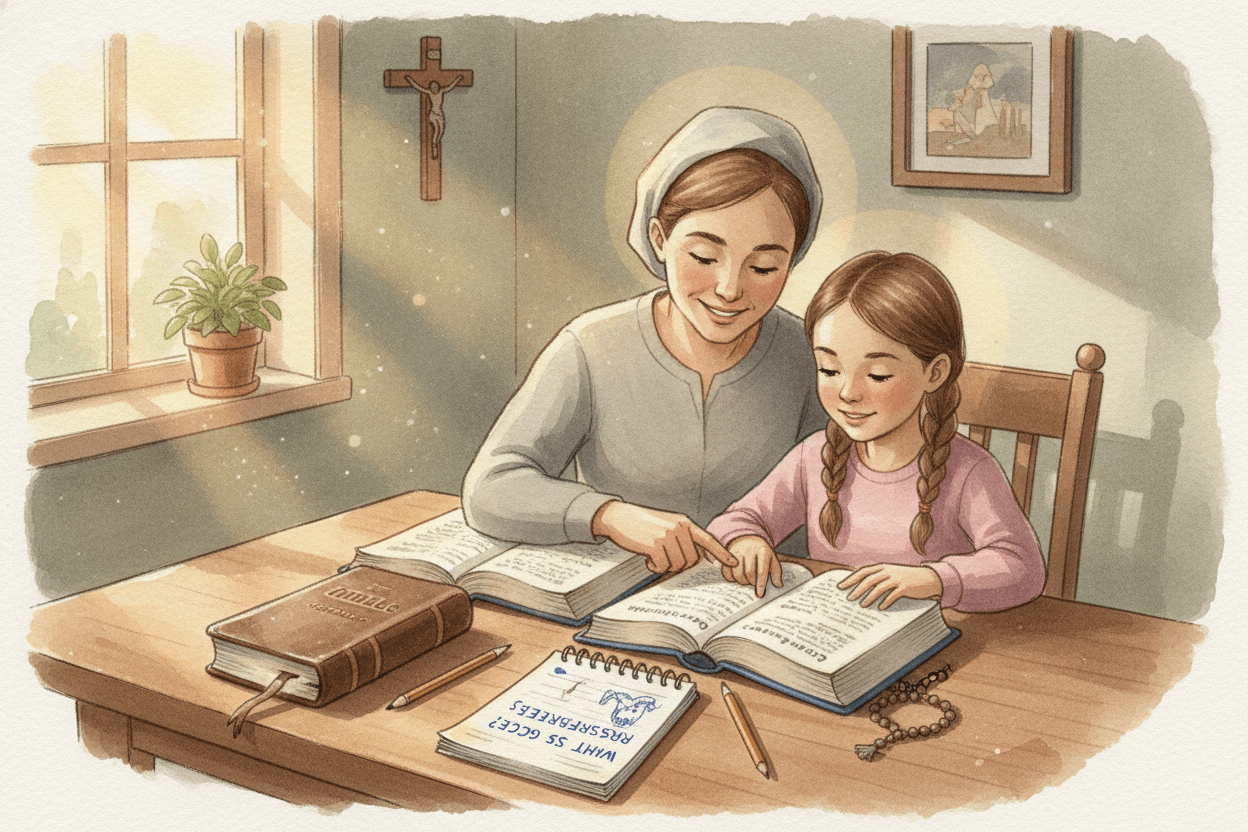
At the kitchen table, a child may ask, “How do we know God is real?” just as you are clearing dishes. Resist the urge to produce a polished speech—or to end the conversation with “Because I said so.” A steady answer can begin: “That is an important question. We do not see God as we see a chair, but we can know him through what he has made, through the longing for truth and goodness in us, and most clearly through Jesus Christ.” Then open a Gospel passage together and ask, “What do you notice about Jesus—what he says, does, and promises?” Scripture comes first because Christian faith is an answer to the God who has spoken, not merely a family custom (CCC 50-53).
For a younger child, keep the language concrete: “When we see a painting, we know there was a painter. The world’s beauty, order, and life point us toward a Creator. And Jesus shows us what God is like.” With a preteen or teen, you might add, “There are serious philosophical reasons to believe in God, but faith is also trust in the God who has revealed himself.” If your child presses a question beyond your knowledge, say plainly, “I do not know every part of that yet, but we can look for a trustworthy answer together.” That sentence teaches intellectual humility without suggesting that the faith has no answers.
The question “Why should I believe what the Church teaches?” also deserves more than “That is what Catholics do.” Try: “The Church does not invent a new message for each generation. She receives what Christ gave to the apostles, protects it, and explains it across time. Here is what the Church teaches and why; let’s begin with Scripture, then see how the Catechism explains it.” For example, when discussing the Eucharist, read Jesus’ words in John 6 before turning to CCC 1324, which calls the Eucharist “the source and summit of the Christian life.” If the topic is moral teaching, help your child distinguish between a difficult teaching and an unsupported teaching. Difficulty does not make a claim untrue, and their honest struggle need not be treated as defiance.
Parents do not need to become the household’s instant-answer machine. Keep a Bible and Catechism within reach, and return to a question after checking a reliable parish resource, a trusted Catholic publisher, or speaking with a priest or catechist. The USCCB counsels parents to speak “naturally and simply about God and their faith,” as they would about other matters they want children to understand. Here’s how I’d teach this in formation: thank the child for asking, give the clearest truthful answer you can, name what you still need to learn, and set a time to revisit it. James gives us a fitting family prayer for these moments: “But if any of you lacks wisdom, he should ask God who gives to all generously and ungrudgingly, and he will be given it.”
But if any of you lacks wisdom, he should ask God who gives to all generously and ungrudgingly, and he will be given it.
When They Ask Why God Allows Suffering
A child sees a classmate lose a parent, hears about war on the news, or watches a beloved grandparent suffer—and suddenly the question is not theoretical: “If God is good, why did he let this happen?” Do not rush to fill that silence. Sit beside your child. Say plainly, “That is a hard and important question. What happened is sad, and it is not what God wants for us.” Before offering an explanation, let them name what hurts, what angers them, or what makes them afraid. Evil is truly evil; Catholic faith never asks us to call it good.
Here’s how I’d teach this in a parish classroom: God created persons with real freedom, because love cannot be forced. People can use that freedom to wound one another, and our fallen world also bears sickness, death, and disorder. This does not make God the author of evil. As the Catechism reminds us, God is in no way the cause of moral evil, though in his providence he can bring good from it (CCC 311–312). That distinction matters. We should not tell a grieving child, “Everything happens for a reason,” as though God directly planned every loss or cruelty.
The Christian answer is not first an argument but a Person. God did not remain distant from human pain. In Jesus Christ, he entered a world marked by betrayal, injustice, grief, bodily suffering, and death. Jesus wept at a friend’s tomb and endured the Cross. A helpful insight from Word on Fire puts it directly: evil has a logical answer, but more importantly, it has a personal and relational answer—Jesus Christ knows the pain of evil and suffering better than anyone. When children ask where God is in their suffering, lead them to the crucified and risen Lord, who is with them rather than ashamed of their tears.
Romans 8:28 gives real hope, but it must be handled carefully. St. Paul does not promise that every painful event will soon make sense or feel good. He teaches that God can work even within what is broken, drawing his people toward good according to his purpose. Sometimes that good may be courage, compassion, reconciliation, or a deeper dependence on Christ; sometimes we cannot yet see it at all. Pray simply with your child: “Jesus, stay close to us in this pain. Help us trust you and show us how to love.” If their question rises from a particular loss, abuse, anxiety, or trauma, seek help from a trusted pastor, Catholic counselor, or parish minister as well. Faithful answers include both truth and care.
We know that all things work together for good for those who love God, who are called according to his purpose.
When They Say, “Prayer Doesn’t Work”
The words often come after a hard disappointment: a grandparent was not healed, the friendship still ended, the team was not chosen, or anxiety did not disappear after bedtime prayers. When a child says, “Prayer doesn’t work,” resist the urge to correct the wording immediately. Begin with the wound underneath it: “You prayed for Dad’s job situation to change, and it has been hard to see that it hasn’t happened. I understand why you feel disappointed.” A child who feels heard is far more ready to learn than a child who feels debated.
Here’s how I’d teach this: prayer is not a machine that produces the result we request. It is real conversation with our Father, who sees more than we do and never turns away from his children. We may ask plainly for healing, protection, reconciliation, or help with a test. We should ask. But God’s answer is not limited to giving the exact outcome on our timetable. He may give a person courage to endure, wisdom for the next decision, help through another person, or peace in the middle of what remains painful. This is not a way to explain away grief. It is the Christian claim that God is present and active even when we do not yet understand his work.
St. Paul gives families words for this very moment: “Have no anxiety at all, but in everything, by prayer and petition, with thanksgiving, make your requests known to God. Then the peace of God that surpasses all understanding will guard your hearts and minds in Christ Jesus.” Notice that Philippians does not promise that every petition will unfold as we hope. It promises that we can bring everything to God and that his peace can guard us. As the Catechism reminds us, Christian prayer is covenant relationship with God, who first seeks us (CCC 2564). Jesus himself invites us to bring our needs to the Father; therefore, honest disappointment belongs in prayer too.
Try a simple response at the kitchen table or in the car: name the request, name the feeling, and pray without polishing the words. “Lord, we asked you to help Grandma get better, and we are sad and confused. Please be near to her. Give us strength, show the doctors what to do, and help us trust you today.” Then keep watching together for concrete signs of grace: a meal delivered, a needed conversation, endurance for one more difficult day. Do not force a lesson from every hardship. Instead, return to prayer tomorrow. That steady return teaches a child that prayer is not pretending everything is fine; it is refusing to face anything alone.
Have no anxiety at all, but in everything, by prayer and petition, with thanksgiving, make your requests known to God. Then the peace of God that surpasses all understanding will guard your hearts and minds in Christ Jesus.
Build a Home Where Faith Questions Can Keep Growing

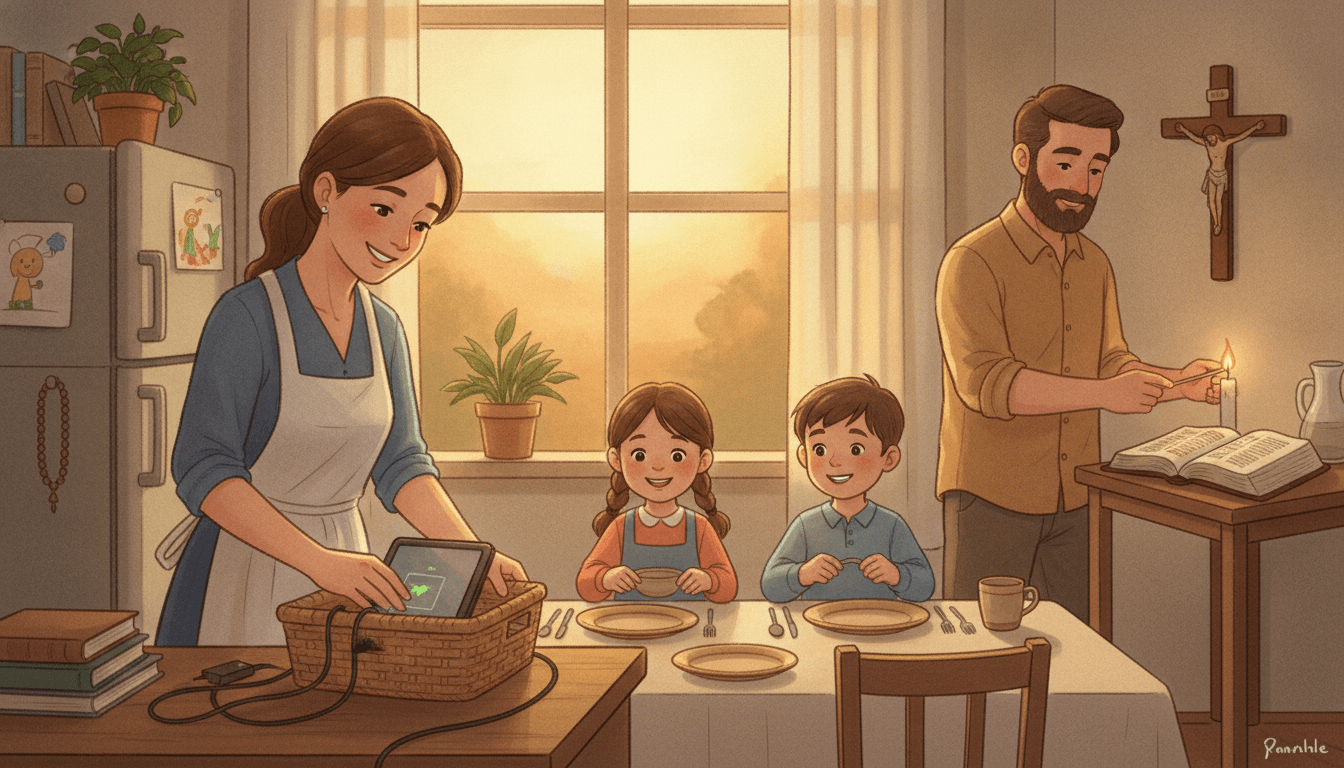
The most useful faith conversation may begin while the kitchen is still messy after Sunday Mass: “What did you notice in the Gospel today?” A child who shrugs is not failing a test. Give them time. Someone may remember a line from the homily, wonder why Jesus spoke so strongly, or admit that none of it made sense. Those small exchanges teach children that faith belongs in ordinary family life, not only in a classroom or church building.
This kind of openness matters. In Barna’s research, 79% of engaged Christian teens said they could share honest questions, struggles, and doubts with their parents. That does not mean parents must have a polished response to every question. It means children learn that a hard question will be met with attention rather than alarm. Scripture invites us to bring what is unfinished to Christ. The father in Mark’s Gospel does not pretend certainty; he prays honestly, “I do believe, help my unbelief!” That is a prayer a child can learn to make.
The Church gives parents a weighty and hopeful responsibility. The Catechism teaches that the home is well suited for education in the Christian virtues and that parents have the first responsibility for their children’s education (CCC 2221–2223). Vatican II is equally direct: parents have a “primary and inalienable duty and right” in educating their children in faith (Gravissimum Educationis 6). This is not a call to turn every dinner into a lesson. It is an invitation to make the sources of our faith familiar: open the Sunday Gospel, read a short passage, ask one sincere question, and listen.
Here’s how I’d teach this in a family setting: choose one low-pressure practice and keep it small enough to sustain. On Sunday, ask each person what word or action from the Gospel stood out. During the week, keep one family intention near the dinner table and let everyone add a need. BibleHeroes stories can be useful discussion starters when parents ask, “What was hard about trusting God in this story?” or “What would you have asked?” And let children see you seek answers: “I am not sure; let’s check the Catechism, Scripture, or ask Father after Mass.” Seventy percent of Christian parents report at least one form of religious education at home. Consistent, conversational practices form habits of turning toward God together.
Some questions need a wider circle of care. Reach out to a pastor, youth minister, Catholic school religion teacher, or diocesan family-life office when doubts persist alongside trauma, isolation, major distress, or a marked change in a child’s well-being. Ask for help, too, when the question exceeds your competence. Bringing in a trusted adult does not surrender a parent’s role; it serves that role. A child should come away knowing: my parents take my mind seriously, the Church has resources, and I do not have to carry this question alone.
Then the boy’s father cried out, "I do believe, help my unbelief!"
Try This Week: One Question, One Scripture, One Prayer
After dinner, when backpacks are dropped by the door and no one is rushing to the next thing, set a timer for ten minutes. Put phones aside. This is not a family quiz, a miniature catechism class, or a moment for parents to prove that they have every answer ready. It is a small, steady way of telling your children: questions about God have a place at our table.
Begin with one invitation: “What is one question you have about God, the Church, prayer, or something we believe?” Let each child answer—or pass. Resist the quick correction, even if the question contains a misunderstanding. A child who says, “Why would God need Mass?” or “How do we know Jesus really hears us?” is giving you an opening into his or her real thought. Thank the child for asking. If clarification is needed, try, “That is an important question. Let’s look for the Church’s answer together.” Parents are the first educators in faith; as the Catechism reminds us, this duty belongs first to the family (CCC 2223). Teaching includes making room for a child to speak honestly.
Then choose one short passage of Scripture and read it slowly. For a week centered on questions, Mark 9:24 is especially fitting. The father in that scene does not hide his conflict from Jesus; he brings it directly to him. Here’s how I’d teach this: faith is not pretending that every hard question has vanished. Faith is turning toward Christ with what is true in us and asking for help. After reading, ask one simple question: “What words stand out to you?” Do not force a lesson from every answer. A brief silence is also a real response to God’s word.
Close with one honest sentence of prayer from each person. Parents may go first, because children learn candor by hearing it. “Jesus, help me trust you when I do not understand.” “Lord, show me how to be patient.” “God, I am still wondering about heaven.” Keep the prayers plain. If a child does not want to pray aloud, invite him or her to say the sentence quietly or simply listen. The point is not polished language; it is teaching children that they may bring both belief and uncertainty before God.
During the week, follow up on any question that remained open. Read the relevant passage in Scripture, consult the Catechism, or ask a trusted pastor, parish catechist, youth minister, or Catholic school religion teacher for help. Return to the child with what you found, even if the answer is partial: “I kept thinking about your question, and here is what I learned.” That follow-through matters. It shows that seeking truth is not a detour from discipleship; it is one of the ways disciples learn to know and love the Lord.
Then the boy’s father cried out, "I do believe, help my unbelief!"
Frequently asked questions
How should I respond when my child says they are not sure God is real?
Stay calm and thank them for telling you rather than treating the question as rebellion. Ask what prompted it, since doubt may be connected to grief, peer pressure, suffering, or a disappointing prayer. Then explore the question together through Scripture, the Catechism, and a trusted priest or catechist if needed.
Is it a sin for a Catholic child to have doubts about God?
Not necessarily. The Catechism distinguishes involuntary doubt—confusion, hesitation, or anxiety about faith—from a deliberate refusal of what God has revealed. A child who is trying to understand a difficult belief or make sense of suffering needs patient guidance, not shame.
What can I say when my child thinks God does not answer prayers?
First ask what happened and listen for the hurt beneath the statement. Explain that prayer is a relationship with God, not a way to control outcomes, and that Jesus is close to us in suffering. You can pray together using the honest words from Mark's Gospel: “I do believe, help my unbelief!”
How do I talk about unanswered prayer with my child?
Acknowledge the disappointment directly, especially if someone is sick or a hoped-for outcome did not happen. Avoid quick slogans, and help your child name what they asked God for and how they feel now. Remind them that Christ entered human suffering and that they can bring anger, sadness, and questions to him.
What if I do not know how to answer my child's question about Catholic faith?
You do not need an instant or flawless answer. Tell your child the question matters and that you will look for the Church's answer together. Read a relevant Scripture passage or Catechism section, and involve a priest, catechist, or religion teacher when helpful.
How can I make my home a safe place for faith questions?
Respond with a steady voice and simple phrases such as, “I am glad you told me,” and, “Can you tell me more?” Give sensitive conversations privacy, especially when a child may be carrying friendship problems, fear, or grief. Your willingness to listen teaches that sincere questions can be brought to Christ and discussed within the family.
Sources: usccb.org · usccb.org · vatican.va · catholic.com · catholic.com · aleteia.org · wordonfire.org · barna.com · pewresearch.org · pewresearch.org
Scripture quotations in this article use the NABRE translation.