How to Teach Kids the Sign of the Cross
Learn how to teach the Sign of the Cross through simple gestures, patient repetition, and meaningful explanations of the Trinity and Baptism. Discover ways to turn your child’s enthusiastic zigzag int
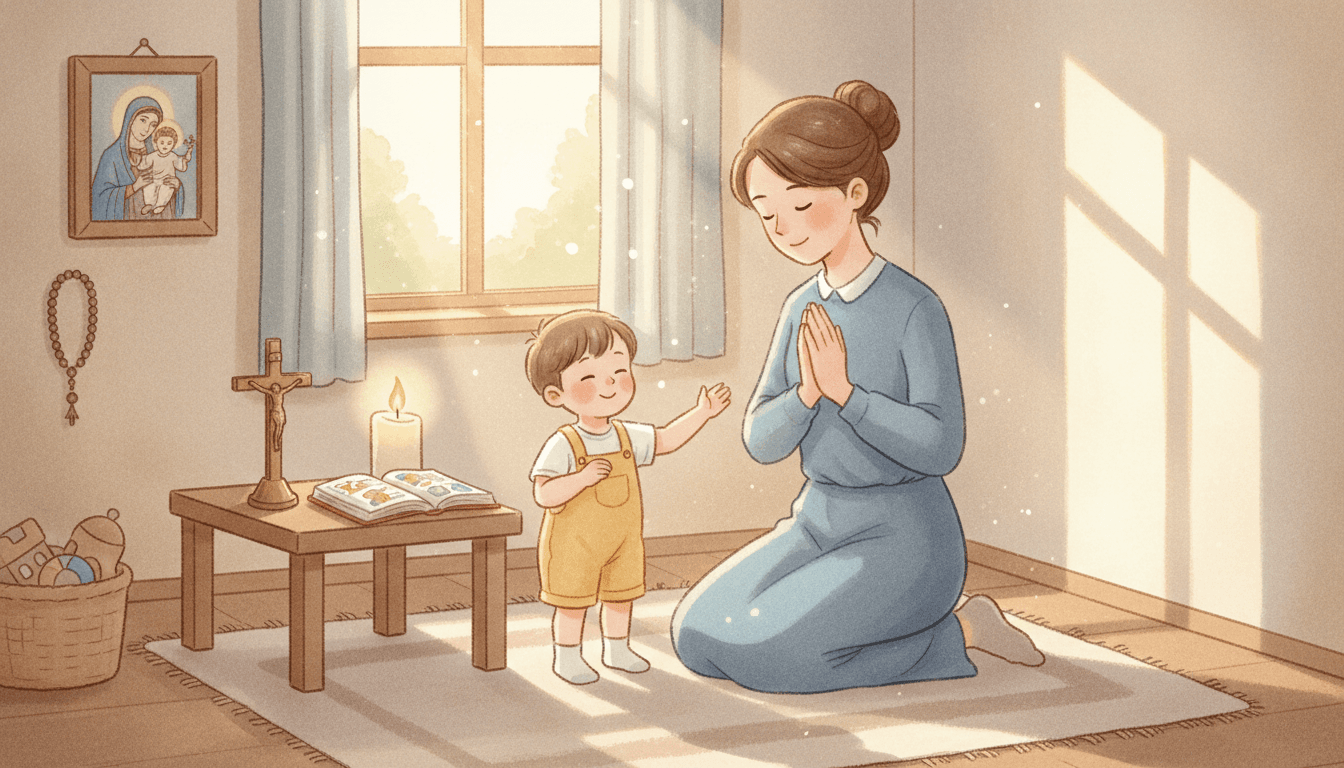
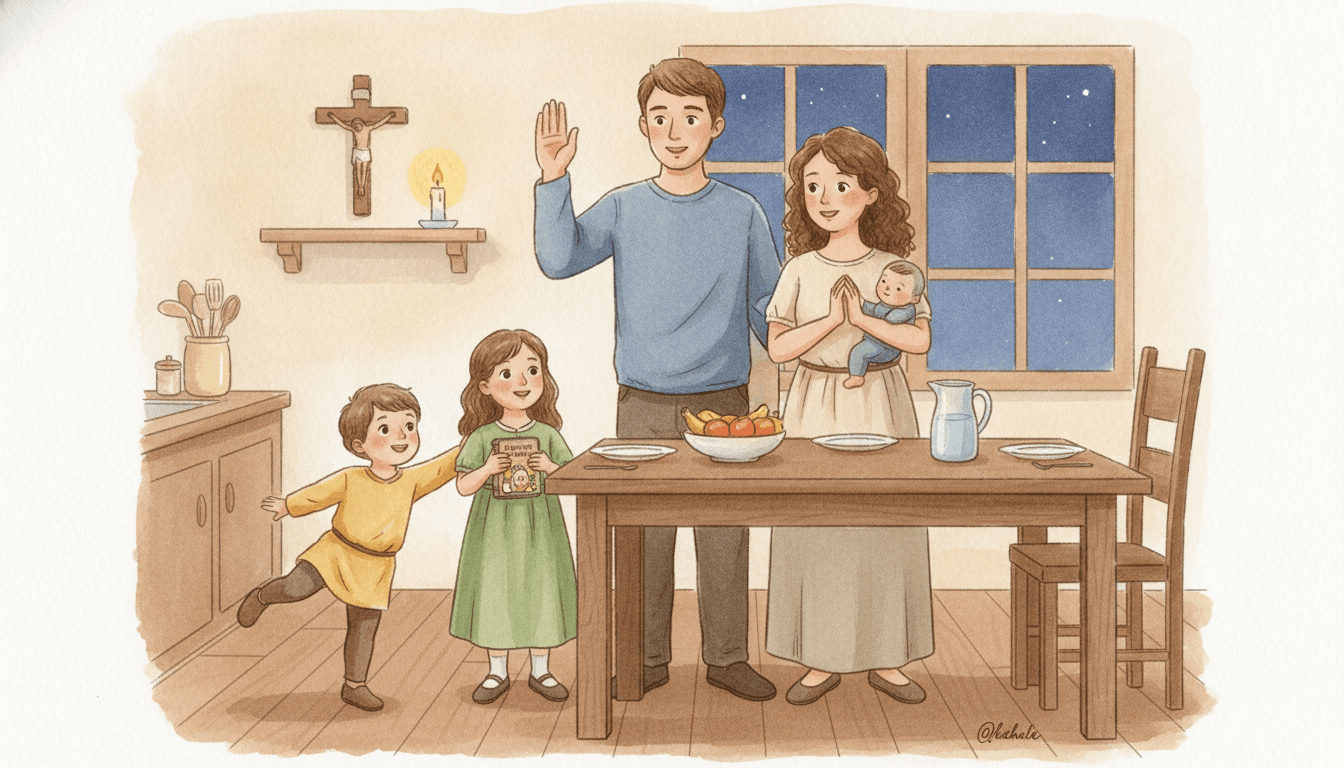
At the church door, your preschooler may reach for the holy water, make a very enthusiastic zigzag across his shirt, and look to you for what comes next. That small moment is worth teaching patiently: the Sign of the Cross is a real prayer that names the Trinity, recalls Baptism, and helps a child begin to belong consciously to Christ.
Start With the Meaning, Not Perfect Coordination
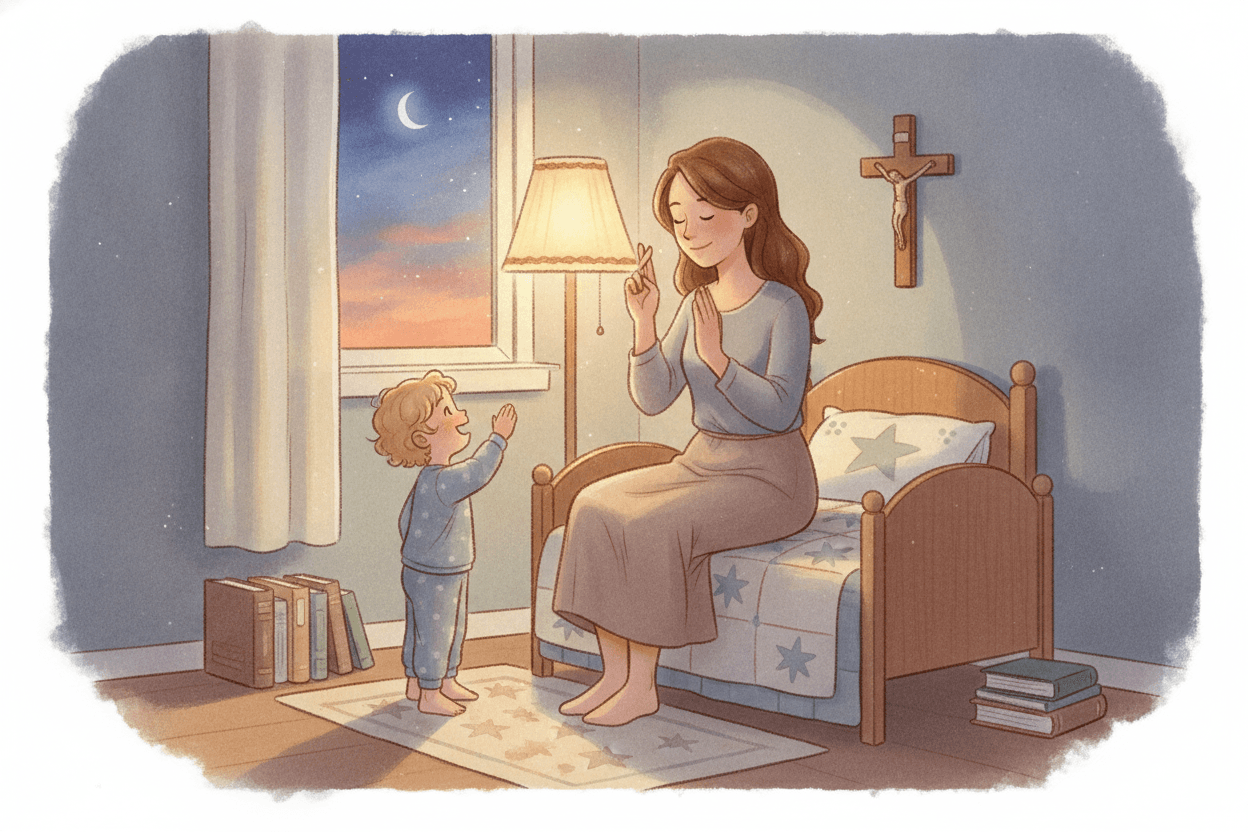
A preschooler’s hand may land somewhere between her shoulder and her ear, while an older child may race through the words as if trying to finish first. Resist the urge to make coordination the first concern. Before children can make the gesture neatly, they should know that they are praying. The Sign of the Cross is not a Catholic hand signal, a lucky charm, or a performance to master. It is a brief prayer in which we remember the one God—Father, Son, and Holy Spirit—and the saving Cross of Jesus Christ.
Scripture gives us the words we say. Before his Ascension, Jesus commanded the apostles to baptize “in the name of the Father, and of the Son, and of the holy Spirit” (Matthew 28:19). Those are not incidental words. They connect a child to his Baptism, when he was claimed for Christ and received into the life of the Church. A simple explanation is enough: “There is one God. The Father, the Son, and the Holy Spirit are three Persons, and God loves us.” Young children do not need a complete explanation of the Trinity before they begin praying; they need truthful words they can return to as they grow.
The cross we trace over ourselves also matters. Saint Paul writes, “But may I never boast except in the cross of our Lord Jesus Christ” (Galatians 6:14). When we make this sign, we remember that Jesus died and rose to save us. We are not trying to keep bad things away through a ritual. We are turning ourselves toward God, asking his blessing, and placing the beginning or ending of an ordinary moment under the name of the Triune God.
As the Catechism reminds us, “The Christian begins his day, his prayers, and his activities with the Sign of the Cross” (CCC 2157). Here’s how I’d teach this at home: say the full words slowly, then make the gesture slowly alongside your child—forehead at “Father,” chest at “Son,” left shoulder and then right at “Holy Spirit,” followed by “Amen.” Let imitation do most of the teaching. If little hands miss the spot, simply model it again the next time. A child who learns, “This is how we remember God and begin to pray,” has learned something far more lasting than perfect coordination.
But may I never boast except in the cross of our Lord Jesus Christ, through which the world has been crucified to me, and I to the world.
Teach the Words and Movements One Small Step at a Time
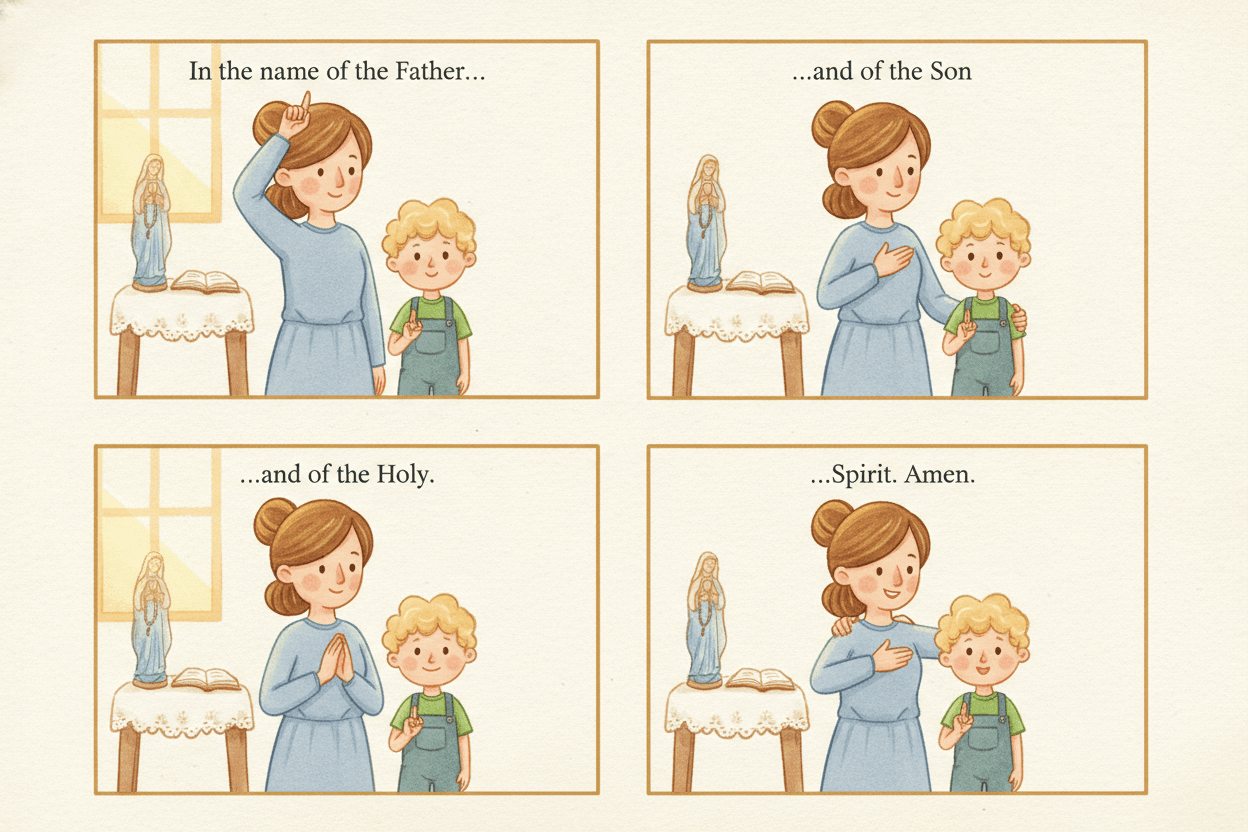
A three-year-old may touch her forehead, then her ear, then both shoulders at once—and still be praying. In the parish classroom, I have found that children learn this prayer best when the adult first lets them see and hear it as one calm, complete act rather than turning it into a test of coordination. Stand or sit beside your child, make the Sign of the Cross slowly, and say every word clearly: “In the name of the Father, and of the Son, and of the Holy Spirit. Amen.”
Then break the gesture into its small parts. On “Father,” touch your forehead. On “Son,” touch your chest. At “Holy Spirit,” touch your left shoulder and then your right shoulder. Finish with “Amen.” Keep your pace unhurried enough that little eyes can follow. Here’s how I’d teach this in a class: first, I say and make the entire prayer while the children watch; next, we do it together once; then I invite them to try. That sequence gives a child something solid to imitate before expecting him to perform it.
The words are not arbitrary. Jesus gave his disciples the Trinitarian name at the end of Matthew’s Gospel: “Go, therefore, and make disciples of all nations, baptizing them in the name of the Father, and of the Son, and of the holy Spirit.” When children learn these words, they are beginning to recognize the name spoken over them at Baptism. You need not offer a full theology lesson in that moment. A simple explanation is enough: “There is one God: Father, Son, and Holy Spirit. We belong to him.”
Resist the urge to stop your child after every misplaced hand. Repeated correction can make a prayer feel like a performance. Instead, demonstrate again beside her: “Let’s try it with me.” Notice what she did well—perhaps she said “Amen,” remembered “Father,” or tried to copy your hands. For children ages three to five, one reverent repetition is enough. A brief prayer offered with attention forms more than a row of hurried attempts.
Make the practice part of ordinary family life: after waking, before meals, as you pull out of the driveway, and at bedtime. At Mass, quietly point out when the priest and congregation make the Sign of the Cross, helping your child see that your family is praying with the whole Church. As the Catechism reminds us, Christians begin “his day, his prayers, and his activities” with this sign (CCC 2157). Over time, the words and movement will settle into the child’s body—not as magic, but as a prayer that remembers God and the Cross of Christ.
Go, therefore, and make disciples of all nations, baptizing them in the name of the Father, and of the Son, and of the holy Spirit.
Give a True, Child-Sized Explanation of the Trinity
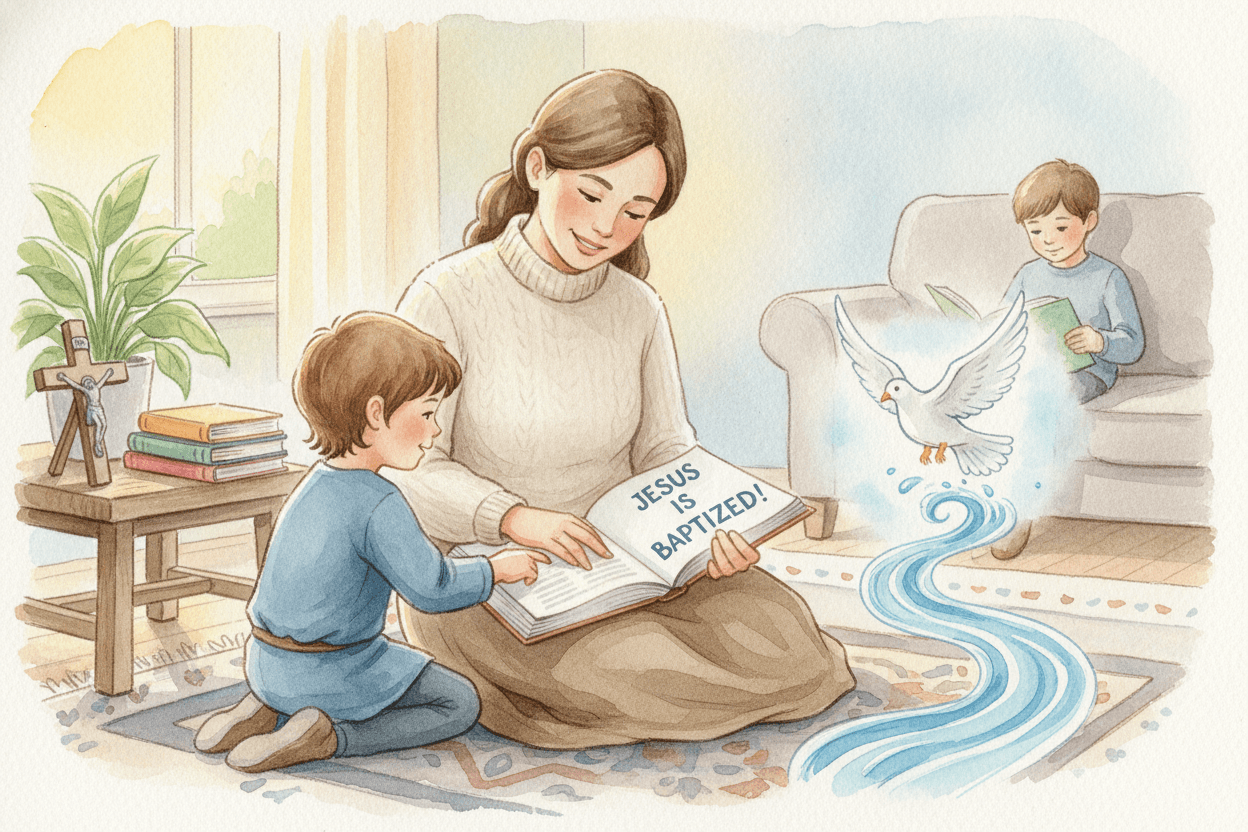
A preschooler may pause midway through the Sign of the Cross and ask, “Is Jesus God, or is God somebody else?” That is not a question to brush aside with a quick answer. It is the child beginning to hear the real words of Christian faith. We need not give a lecture, but we can answer truthfully and calmly: “There is one God. The Father, the Son, and the Holy Spirit are three Persons, and God loves us.”
Those sentences give children the Church’s actual language without pretending that the Trinity is easy to picture. Avoid comparisons that can quietly teach something untrue—such as water changing between ice, liquid, and steam, as though God were one Person appearing in three forms. The Father is not the Son; the Son is not the Holy Spirit; and yet there are not three gods. This mystery exceeds our understanding, but it is not empty or confusing language. Children can learn the true words before they can explain every part of them, just as they learn the names of family members long before they understand all that those relationships mean.
Here’s how I’d teach this in a family setting: after making the Sign of the Cross, say, “We named the Father, the Son, and the Holy Spirit. They are the one God.” If a child asks who Jesus is, add, “Jesus is the Son of God. He became man for us.” If the questions keep coming, welcome them, then end simply: “The Trinity is a great mystery, and God lets us know him truly.” This respects a child’s intelligence while keeping the lesson within reach. The Catechism calls the Trinity “the central mystery of Christian faith and life” (CCC 234); no child needs to master that mystery in one sitting.
Scripture itself gives us these names together. Saint Paul blesses the Church with “The grace of the Lord Jesus Christ and the love of God and the fellowship of the holy Spirit be with all of you.” When children hear the Trinitarian words in prayer, at Mass, and in the Sign of the Cross, they are not reciting a formula without meaning. They are being formed in the name into which they were baptized and learning that the God we worship is Father, Son, and Holy Spirit.
The grace of the Lord Jesus Christ and the love of God and the fellowship of the holy Spirit be with all of you.
Connect the Sign to Baptism and Belonging to Christ
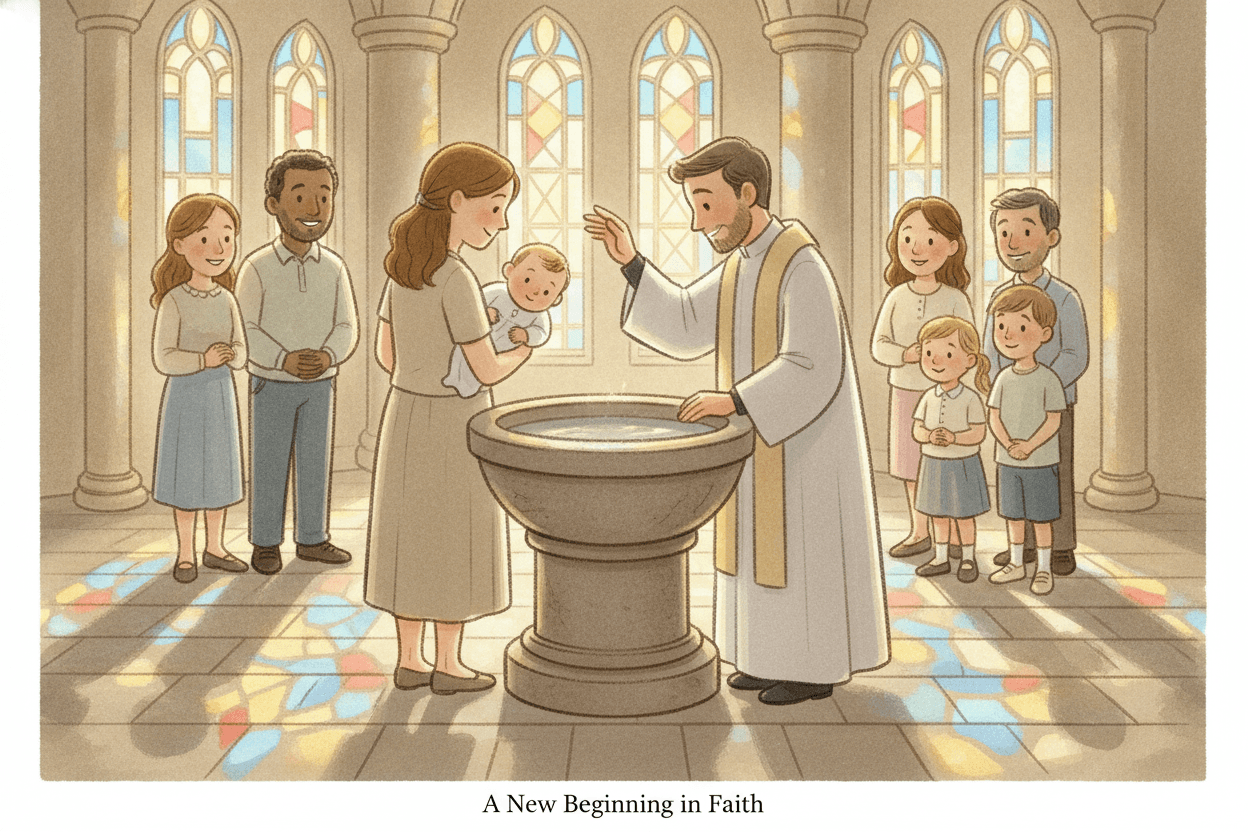
When a child traces a small, crooked cross over her body before bedtime, she is doing more than copying a family habit. She is praying with the mark placed upon her at the very beginning of her Christian life. That connection gives parents a sturdy answer when a child asks, “Why do we do this?” We make the Sign of the Cross because we belong to Jesus Christ.
At Baptism, the Church receives a child with the sign of the Cross. The priest, parents, and godparents trace it on the child’s forehead, claiming him or her for Christ. The Catechism explains that this first signing “signifies the grace of the redemption Christ won for us by his cross” (CCC 1235). Even if your child does not yet remember that day, Baptism is not merely a past family event. It is the beginning of a real identity: baptized into Christ, welcomed into his Church, and called by the name of the Father, Son, and Holy Spirit.
Here’s how I’d teach this in a family: after making the Sign of the Cross together, say, “This cross reminds us that Jesus loves us, died for us, and made us his own in Baptism.” For a younger child, keep it even simpler: “You are Jesus’ child. This is his cross.” These are not sentimental slogans. They give children language for the belonging they already possess through Baptism, while leaving room for them to ask more as they grow.
The words of the prayer come from Christ’s own command to his disciples: “Go, therefore, and make disciples of all nations, baptizing them in the name of the Father, and of the Son, and of the holy Spirit.” Every careful, imperfect Sign of the Cross echoes those baptismal words. Pope Francis observed that the mystery of the Trinity “embraces our entire life and our entire Christian being” and that we remember it whenever we make this sign. This is why the gesture belongs at ordinary moments: leaving for school, beginning homework, entering church, or settling down to sleep.
Invite your child to watch for this connection at Mass. Notice when the priest begins prayer with the Trinitarian words, when the congregation signs itself, and when holy water at the church door recalls Baptism. A child need not perform the gesture flawlessly to pray it truly. Gently model the movement, then let the larger truth remain clear: this is the prayer of someone who has been marked by Christ’s Cross and named in the life of the Trinity.
Go, therefore, and make disciples of all nations, baptizing them in the name of the Father, and of the Son, and of the holy Spirit.
Let Daily Rhythms Do the Teaching
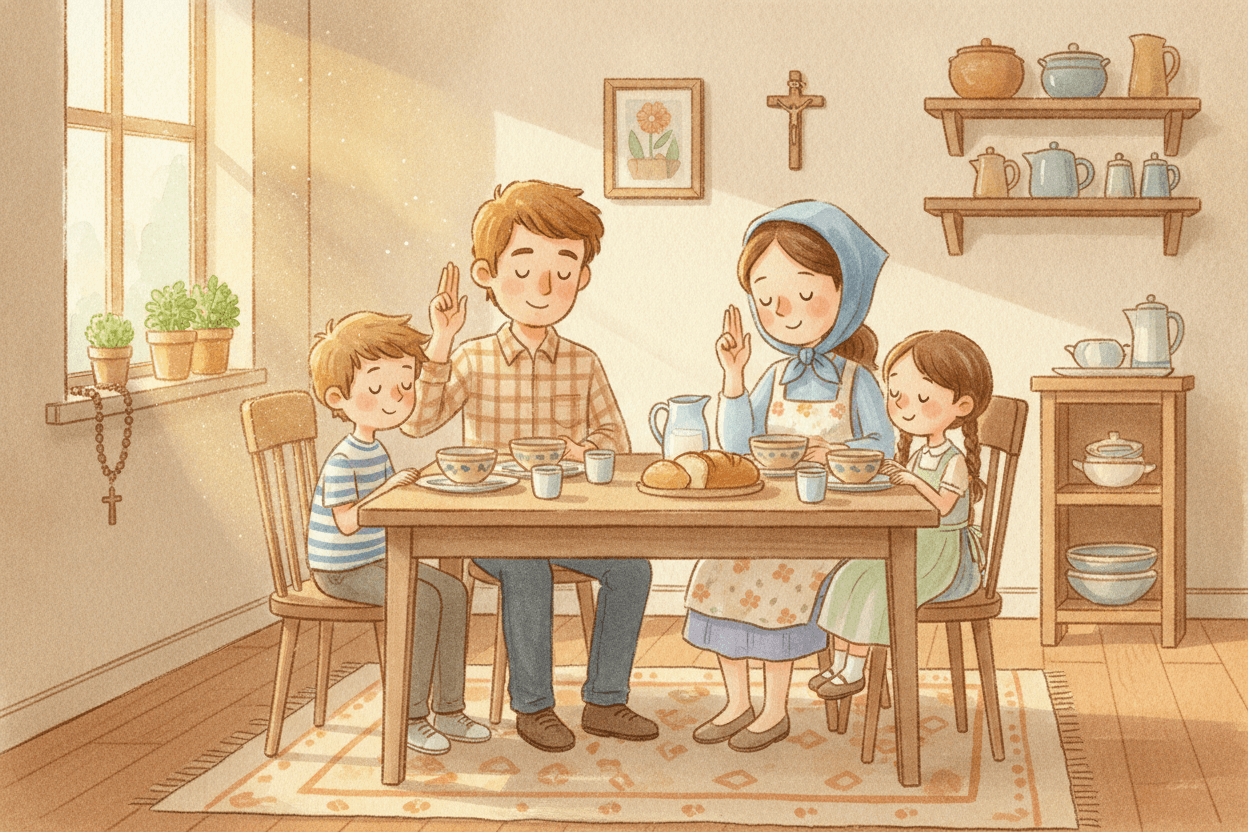
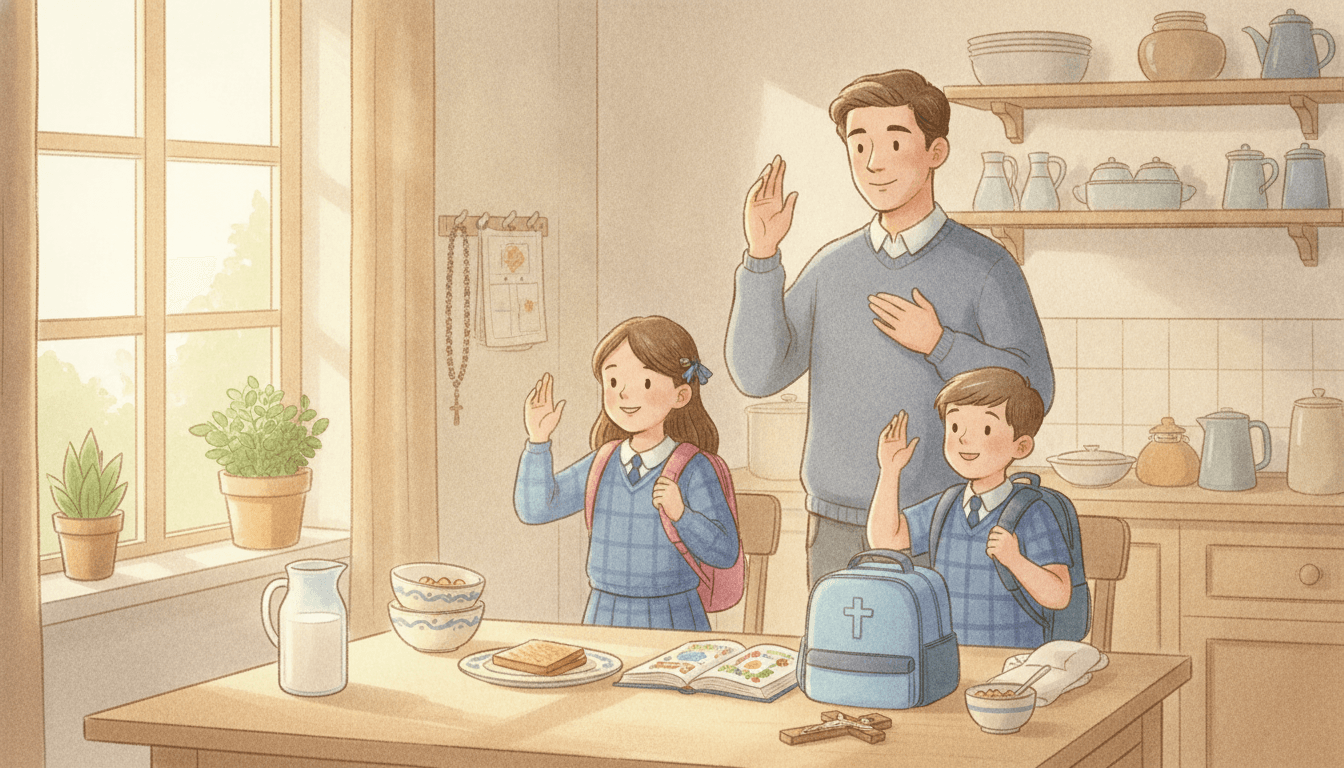
The most effective practice may happen while everyone is still sleepy: a parent opens the curtains, makes the Sign of the Cross slowly, and says the words aloud. A child who sees this day after day learns that this gesture belongs to ordinary Christian life, not only to religion class or the opening minutes of Mass. The Catechism says that Christians begin the day, prayers, and activities with this prayer (CCC 2157).
Keep the cues simple and repeatable. Try making the Sign of the Cross together on waking, before meals, before getting into the car, when entering church, and at bedtime. Do not begin with all five if that will turn the practice into a checklist. Choose one or two moments that already happen reliably in your home. Before breakfast and before sleep are often enough to establish a habit.
At each cue, make the sign aloud together: “In the name of the Father, and of the Son, and of the Holy Spirit. Amen.” Let your child watch your hand move from forehead to chest, then left shoulder to right shoulder. A toddler may touch an ear or wave a hand across the air; receive the effort warmly and model it again without turning prayer into a correction session. Consistency matters more than a perfectly coordinated gesture.
Before a car ride, you might add one brief petition: “Lord, keep us safe as we travel.” At bedtime, the Sign of the Cross can begin a familiar prayer and also close it. When entering church, pause long enough that your child notices this is a place set apart for worship. These small repetitions teach that we turn to God in gratitude, need, and quiet reverence—not because the gesture is magic, but because it is prayer.
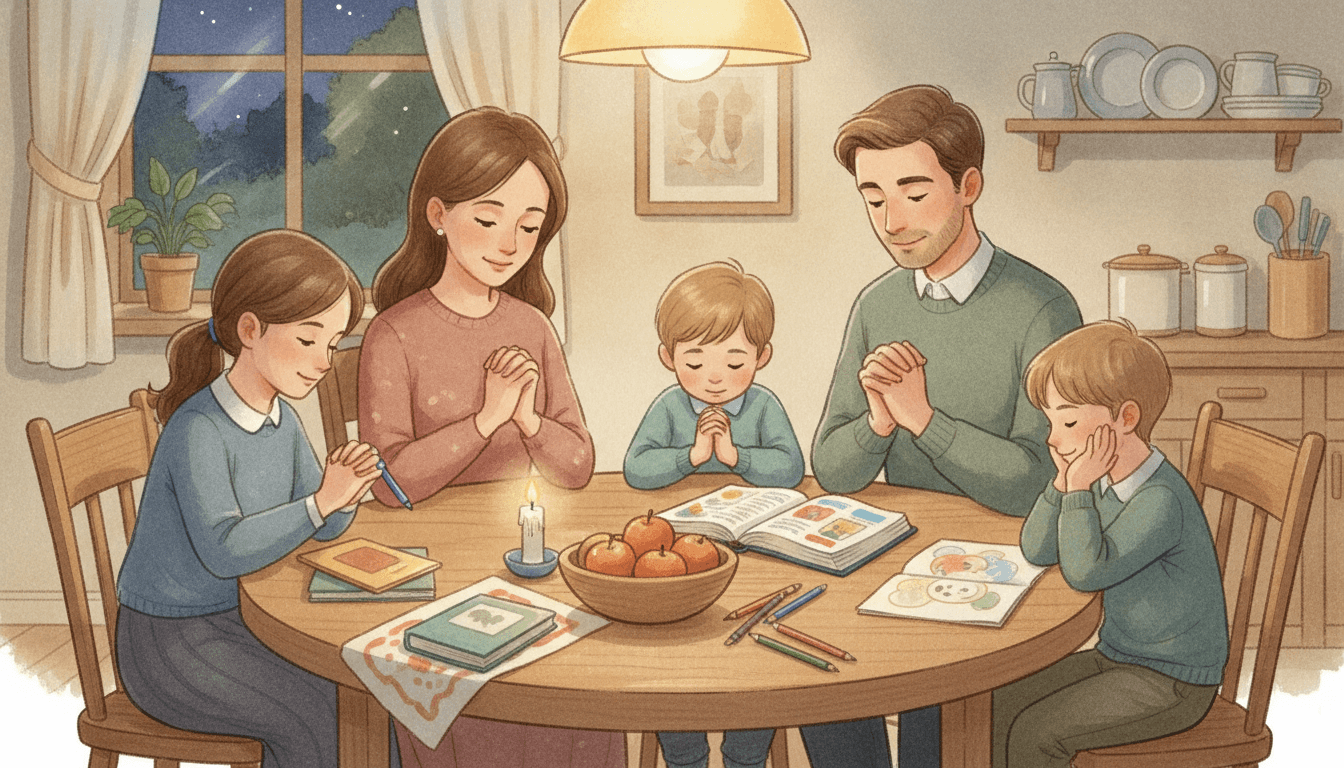
Children also need to see that their parents mean it. Make the Sign of the Cross naturally when you begin grace, when you sit down for family prayer, or when a worry arises. Here’s how I’d teach this in a parish classroom: I would not ask for ten repetitions. I would ask for one attentive sign, then return to it at the next familiar moment. Scripture invites us to take the Cross seriously: it is not a decoration or a rushed habit, but the saving sign of Christ, carried into the daily life of the family.
The message of the cross is foolishness to those who are perishing, but to us who are being saved it is the power of God.
This Week: Choose One Moment to Pray It Together
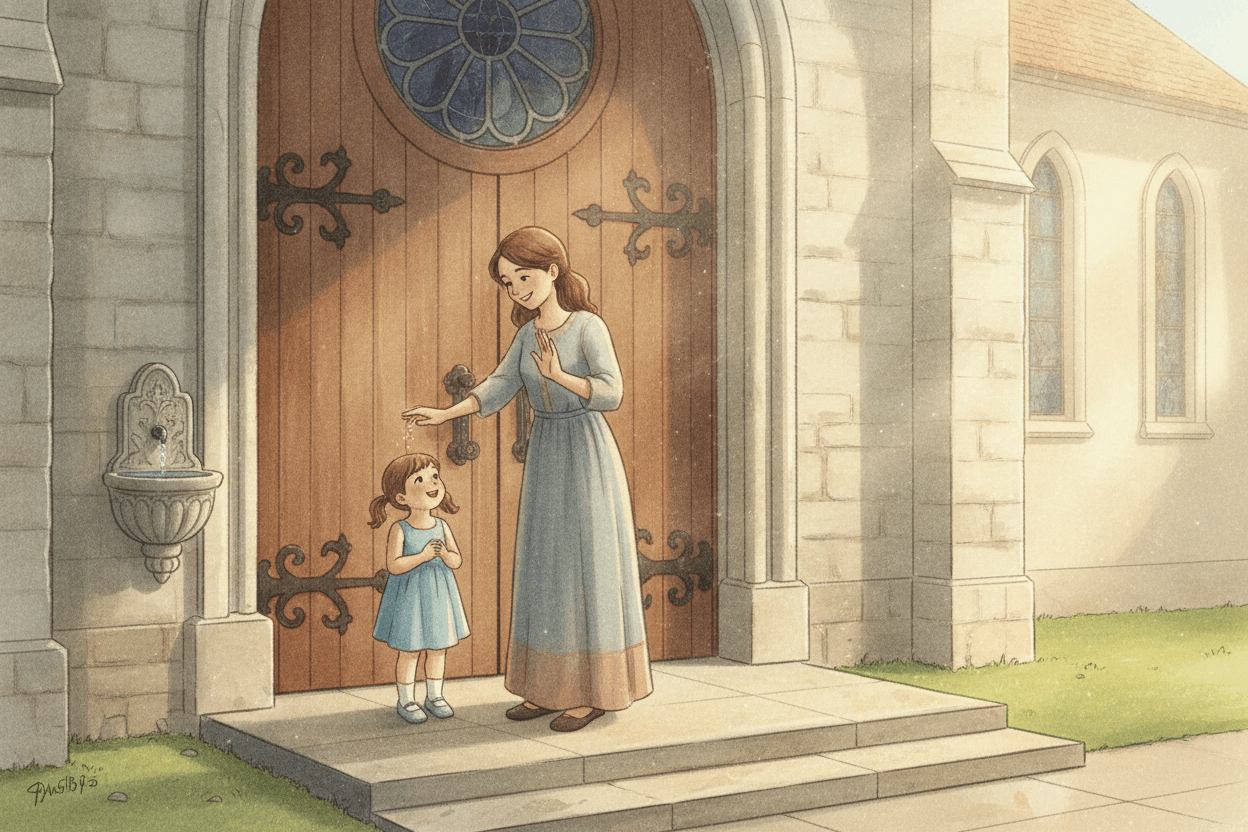
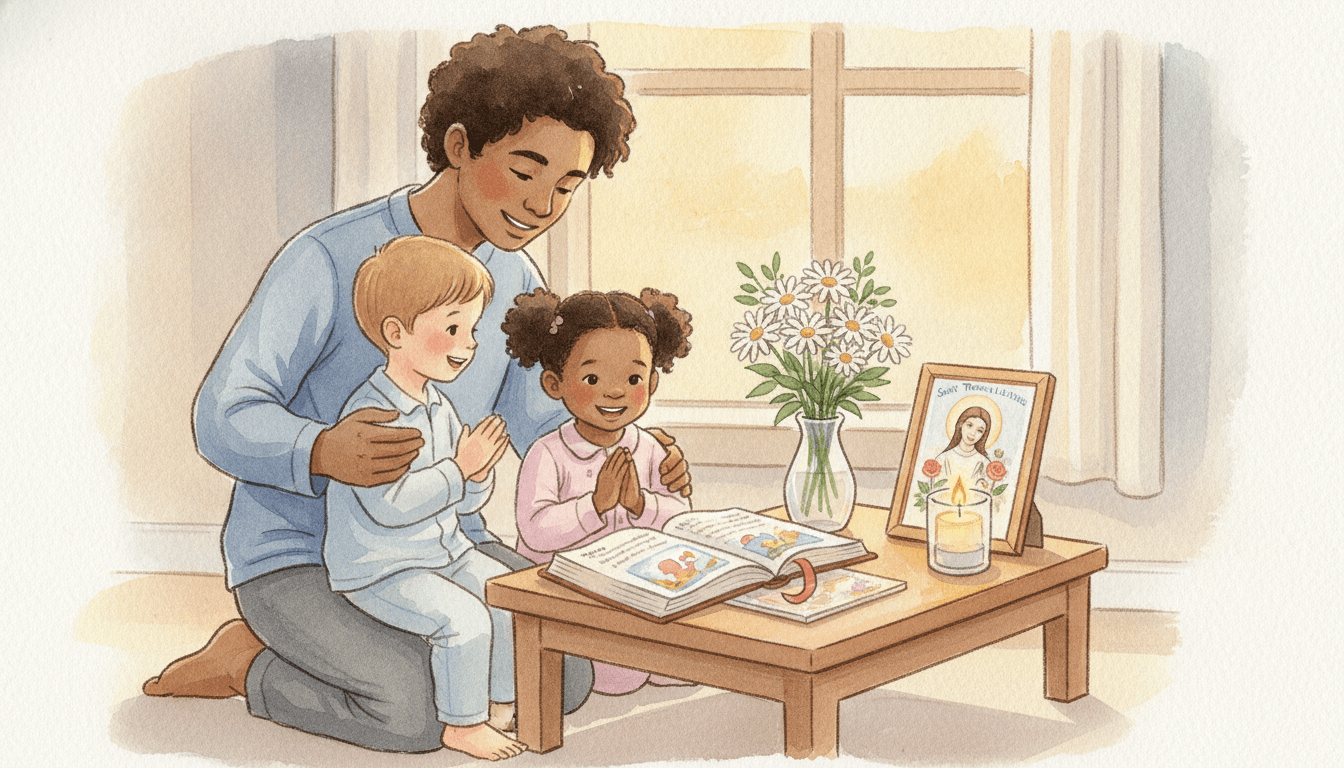
At bedtime, when the pajamas are on and the last glass of water has been requested, resist the urge to add one more lesson. Stand beside your child, lower your pace, and say, “Let us begin our prayer.” Then make the Sign of the Cross slowly together. A young child does not need a long explanation in that moment. He needs to see that this small prayer belongs naturally in the life of your family.
Choose one dependable daily anchor for the next seven days: bedtime is often easiest, though breakfast, leaving for school, or getting into the car can work well. Keep the pattern identical each day. Say the invitation, make the Sign of the Cross with the words, and offer one sentence of thanks: “Thank you, God, for our family,” or “Thank you, Jesus, for this day.” Consistency matters more than adding extra prayers. For a child ages three to five, one calm and reverent repetition is enough.
Here is how I’d teach this across the week: on days one and two, simply let your child copy you. On days three and four, invite him to say the words with you, even if only “Father, Son, Holy Spirit” comes out clearly. On days five and six, pause briefly after the prayer and ask, “Whom did we pray to?” Receive a simple answer gladly: “God.” On day seven, let your child lead as much of the gesture or the words as he can. This is practice, not a performance.
If little hands touch the wrong shoulder, or the words arrive out of order, do not interrupt with a stream of corrections. Finish the prayer warmly. The next time, stand where your child can see you and model it again. Prayer should never feel like a test a child can fail. As the Catechism reminds us, “The Christian begins his day, his prayers, and his activities with the Sign of the Cross” (CCC 2157). Your patient repetition teaches that this sign is a real way Catholics begin in God’s name.
On Sunday, add one simple observation at Mass: “Watch—we make the Sign of the Cross when we begin.” You might quietly point it out when the priest begins, or when your family makes the sign before receiving a blessing. This helps your child see that the prayer at bedtime is not a private family habit alone. It is the prayer of the Church, joined to the worship of God’s people. By the end of one ordinary week, your child may not have perfect coordination, but he will have begun to recognize a faithful rhythm: we turn to God together.
Frequently asked questions
How do I teach my preschooler to make the Sign of the Cross?
Begin by making the whole prayer slowly while your child watches: forehead, chest, left shoulder, then right shoulder. Say the words clearly and invite your child to copy you once. Focus first on prayerful attention rather than exact hand placement.
What words do we say during the Sign of the Cross?
Say, “In the name of the Father, and of the Son, and of the Holy Spirit. Amen.” Touch the forehead at “Father,” the chest at “Son,” and the left then right shoulder at “Holy Spirit.” These are the Trinitarian words Jesus gave his disciples in Matthew 28:19.
Does my child have to make the Sign of the Cross perfectly?
No. Young children may miss their chest or shoulders, touch an ear, or make the motion out of order while they are learning. Model it calmly again rather than repeatedly correcting them, so the Sign of the Cross remains a real prayer and not a coordination test.
What does the Sign of the Cross mean for children?
It is a short prayer that names the Father, Son, and Holy Spirit and remembers Jesus’ saving Cross. It also connects children to their Baptism, when they were claimed for Christ. You can simply say, “We remember God and begin to pray.”
How can I explain the Trinity to a young child?
Use simple, true language: “There is one God: Father, Son, and Holy Spirit. They are three Persons, and God loves us.” Do not worry if your child cannot fully understand the mystery yet, and avoid illustrations that suggest God merely changes forms.
When should our family make the Sign of the Cross at home?
Use it at natural transitions: after waking, before meals, before leaving the house or driveway, and at bedtime. Making it regularly helps children see that ordinary activities can be placed under God’s blessing. At Mass, quietly point out when the congregation makes the sign together.
Sources: vatican.va · vatican.va · vatican.va · vatican.va · vatican.va · vatican.va · usccb.org
Scripture quotations in this article use the NABRE translation.