Catholic Screen Time Boundaries That Protect Family Life
Learn how Catholic families can set screen boundaries that protect attention, strengthen virtue, and leave room for prayer, conversation, and service. Practical guidance helps parents turn media decis

The tablet is quiet, dinner is almost ready, and everyone is suddenly getting along—until it is time to turn it off. The question is not whether screens are always bad, but whether this particular use is helping your child become freer, wiser, and more available to God and others.
Begin With What Screens May Be Replacing
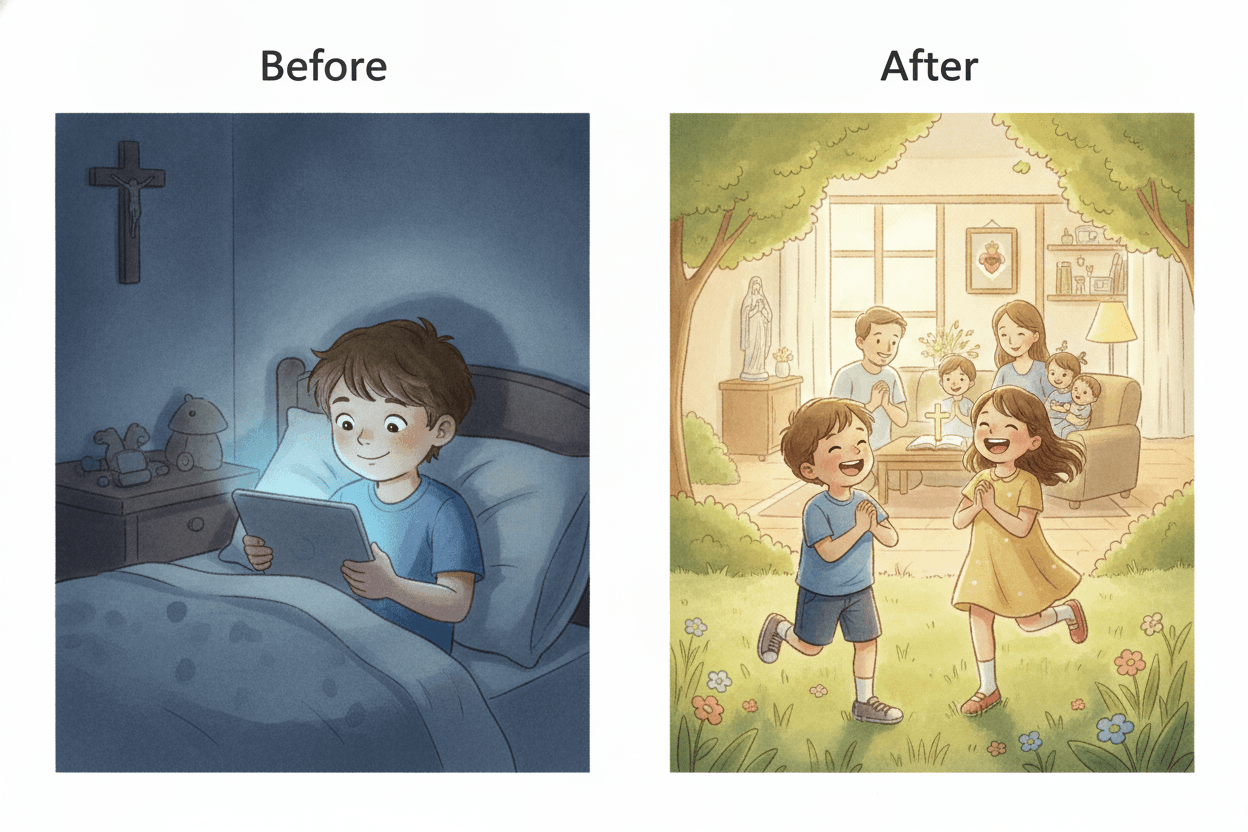
The first question I ask parents is not, “How many minutes?” It is, “What happened in the hour after the tablet came out?” If bedtime became a struggle, the backyard stayed empty, a sibling was ignored, or the family prayer was rushed away, we have learned something important. A screen is not automatically a problem because it is a screen. The concern is what it may be taking the place of in a child’s ordinary life.
Children are persons, made in the image of God, not consumers to be kept occupied. They need sleep for growing bodies, movement for healthy energy, unhurried conversation for learning to listen, and imaginative play for making sense of the world. They also need moments of boredom. A child who says, “There is nothing to do,” is not necessarily in trouble; he may be standing at the threshold of invention, reading, drawing, building, helping, or simply noticing God’s world.
Scripture gives us a useful measure: not merely whether something is permitted, but whether it is beneficial and whether it begins to rule us. That applies to parents as well as children. If a phone pulls a parent away from a child’s story at the dinner table, the lesson is already being taught. Warm, firm boundaries work best when children see adults practicing the same freedom from constant interruption.
As the Catechism reminds us, the Christian home is a “domestic church” (CCC 2204). In a domestic church, shared meals, apologies, chores, laughter, Sunday worship, and prayer are not empty spaces to fill with background entertainment. They are formative acts. Before setting a timer, look at the family’s actual rhythm: Are devices off at meals? Is there enough time before bed for washing, reading, and prayer? Does anyone have a screen in the bedroom? These questions reveal more than a weekly total can reveal.
Here’s how I’d teach this at home: make a short list with your children called “Things We Protect.” Put sleep, meals, outdoor play, reading, family conversation, and prayer on it. Then explain that screens fit around those goods; they do not push them aside. For younger children, this might mean one carefully chosen, co-viewed program after responsibilities are done. For older children, it means clear limits, regular check-ins, and a real say in building the household plan. The goal is not fear of media. It is the freedom to choose what helps us love God and one another well.
"Everything is lawful for me," but not everything is beneficial. "Everything is lawful for me," but I will not let myself be dominated by anything.
A Catholic Lens: Forming Temperance, Prudence, and Communion
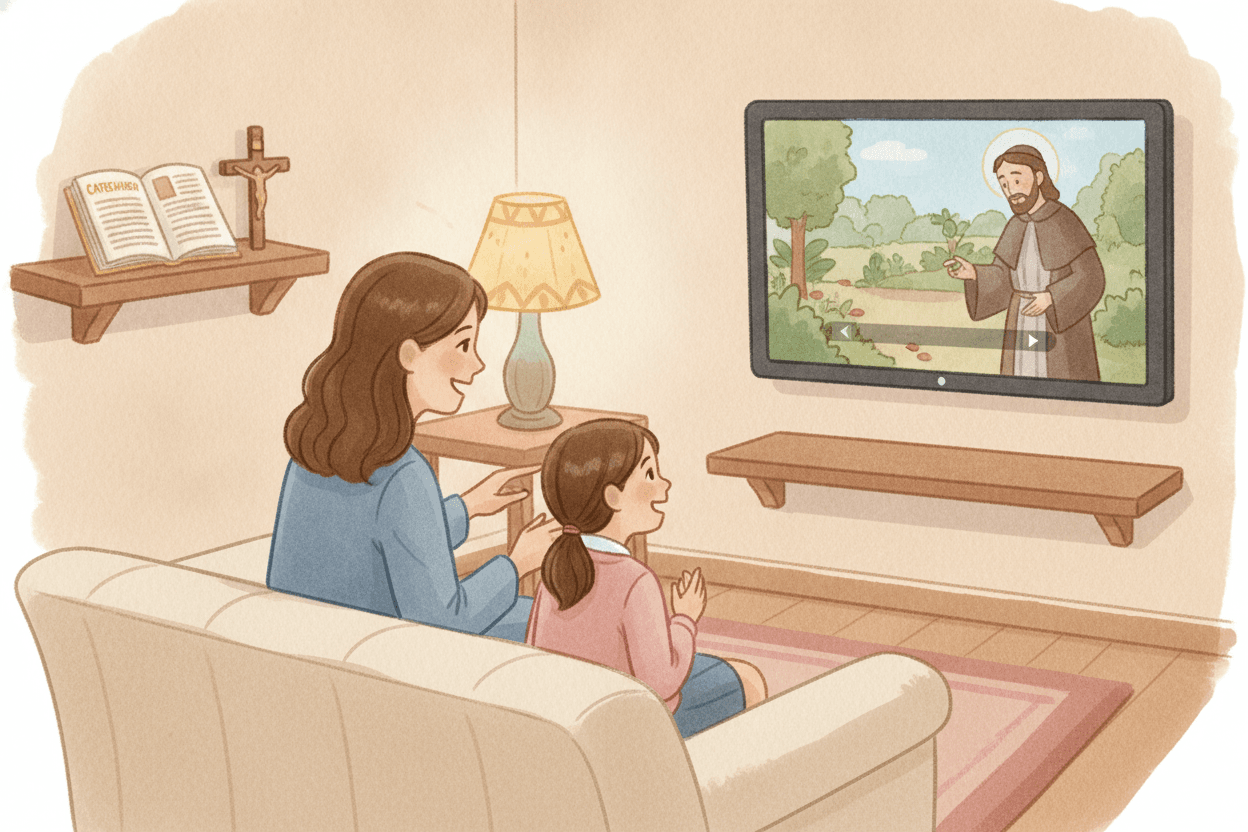
A child finishes a funny video and immediately asks for another. The question is not simply whether the clip was harmless. It is whether this small habit is teaching the child to receive entertainment without pause, or to choose what is good with freedom. Technology is a genuine good: it can help a child learn, create, speak with distant grandparents, encounter worthwhile Catholic teaching, and even share the faith. Yet a screen should not become the household’s automatic answer to boredom, waiting, sadness, or silence.
Scripture gives us a clearer standard than “Is everyone else watching it?” St. Paul writes, “Finally, brothers, whatever is true, whatever is honorable, whatever is just, whatever is pure, whatever is lovely, whatever is gracious, if there is any excellence and if there is anything worthy of praise, think about these things.” This is not a command to fear every form of media. It is an invitation to discern its direction. Does this program train the imagination toward truth and goodness? Does this game foster patience and creativity, or agitation and selfishness? Children can learn to ask these questions when parents ask them calmly and consistently.
Here is how I’d teach this in a parish family session: a boundary is not merely a parental “no”; it is practice in virtue. Temperance helps a child stop before entertainment becomes an appetite that rules the day. Prudence helps him judge the right content, time, and place for a device. Justice asks whether his online words honor another person’s dignity and whether his screen use keeps him from duties to siblings, school, or home. Charity directs media toward love of God and neighbor rather than isolation or ridicule. The Catechism describes temperance as moderating attraction to pleasures and providing balance in the use of created goods (CCC 1809). That is precisely the work of a sensible family media plan.
The Church has long treated communications media as gifts requiring moral formation. Inter mirifica calls for their proper use, and Cardinal Ennio Antonelli urged parents to train children in a “moderate, critical, watchful and prudent use of the media,” with sober limits and real alternatives such as play, work, and conversation. Pope John Paul II was equally direct: parents, as their children’s primary educators, are the first teachers of media. Filters and time settings can assist, but they cannot replace a parent who knows what a child is watching, talks about it afterward, and is willing to say no when a choice does not serve the child’s good.
This is why family rules work best when they protect communion, not simply compliance. Keep devices in shared spaces; make meals and the hour before bed screen-free; choose some programs together; and set aside regular time for prayer, reading, outdoor play, and unhurried talk. For older children, explain the reason behind the rule and invite their honest assessment: “What did this content make you want? How did you feel afterward? Did it help you love anyone better?” Such questions respect a child’s intelligence while forming a conscience. Parents must also examine their own habits. When adults put phones aside to listen, pray, and be present, children see that the family’s deepest connection is not Wi-Fi but communion.
Finally, brothers, whatever is true, whatever is honorable, whatever is just, whatever is pure, whatever is lovely, whatever is gracious, if there is any excellence and if there is anything worthy of praise, think about these things.
Use Age-Appropriate Limits Without Treating Every Screen the Same
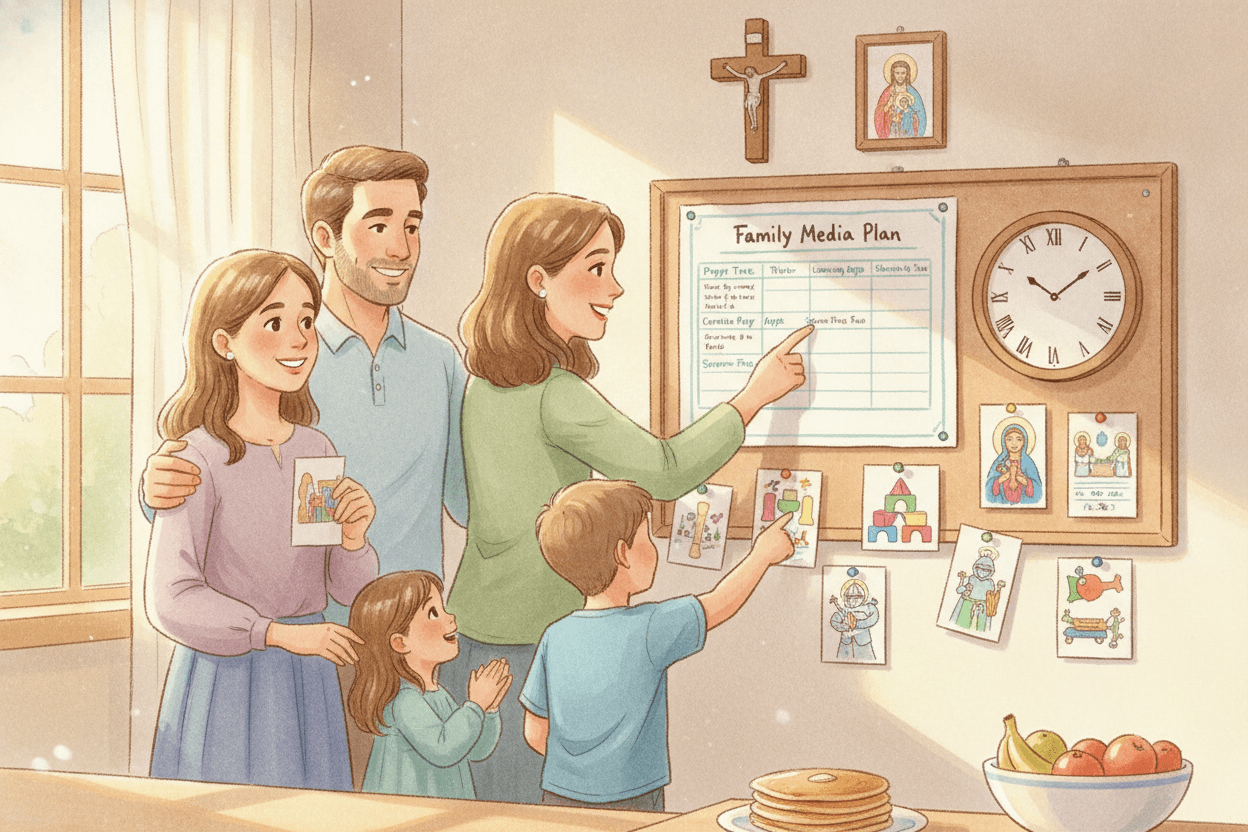
A toddler reaching for a parent’s face on a video call is not doing the same thing as a toddler transfixed by autoplay. Both involve a screen, but they ask very different things of the child. One can support a real relationship when a parent is nearby; the other can quickly replace the talk, movement, rest, and shared attention through which young children grow. Catholic parents need not count every glowing rectangle as identical. We can ask a more useful question: What is this particular use asking of my child, and what is it taking the place of?
For children under about 18 to 24 months, keep entertainment media at zero, apart from occasional video chatting with a parent. At this age, the child learns most through faces, voices, touch, play, and the ordinary give-and-take of family life. A call with Grandma can be relational when Mom or Dad helps the child wave, listen, and respond. A cartoon playing in the background is different; it does not know the child, pause for his question, or draw him into communion. This is not a judgment on tired parents. It is a clear guardrail that protects a season of rapid, embodied development.
From ages two to five, aim for about one hour a day of high-quality content, preferably watched together. Co-viewing turns a program into a small lesson in discernment. Pause and ask, “Was that character truthful?” “How did she treat her brother?” “What would charity look like here?” Here’s how I’d teach this in a parish family setting: choose the program before turning on the device, watch in a common room, and end it when the episode ends. Avoid letting an algorithm decide what comes next. A Catholic story, a carefully chosen educational show, or a family call may have a fitting place; endless clips designed to hold attention do not deserve equal access.
For children six and older, the need is not one universal number but clear, consistent family limits for both time and content. A homework assignment, a child’s stop-motion project, a video call with a godparent, and an afternoon of scrolling or gaming are not morally or developmentally interchangeable. Parents can set screen-free meals, devices charging outside bedrooms, and a firm stopping point before bedtime. Keep televisions, tablets, and computers in shared spaces whenever possible. These practices make supervision ordinary rather than suspicious, and they leave room for parents to know what their children are actually encountering.
Scripture invites us to form freedom, not mere compliance: “Everything is lawful for me,” but not everything is beneficial. “Everything is lawful for me,” but I will not let myself be dominated by anything. A child gradually learns to say, “I may be able to watch this, but is it good for me now?” As the Catechism reminds us, temperance disposes us to avoid excess (CCC 1809). Family limits become credible when parents also put down their phones, protect conversation, and choose real presence over constant interruption.
"Everything is lawful for me," but not everything is beneficial. "Everything is lawful for me," but I will not let myself be dominated by anything.
Build a Family Media Rule of Life Around Shared Spaces and Sacred Times
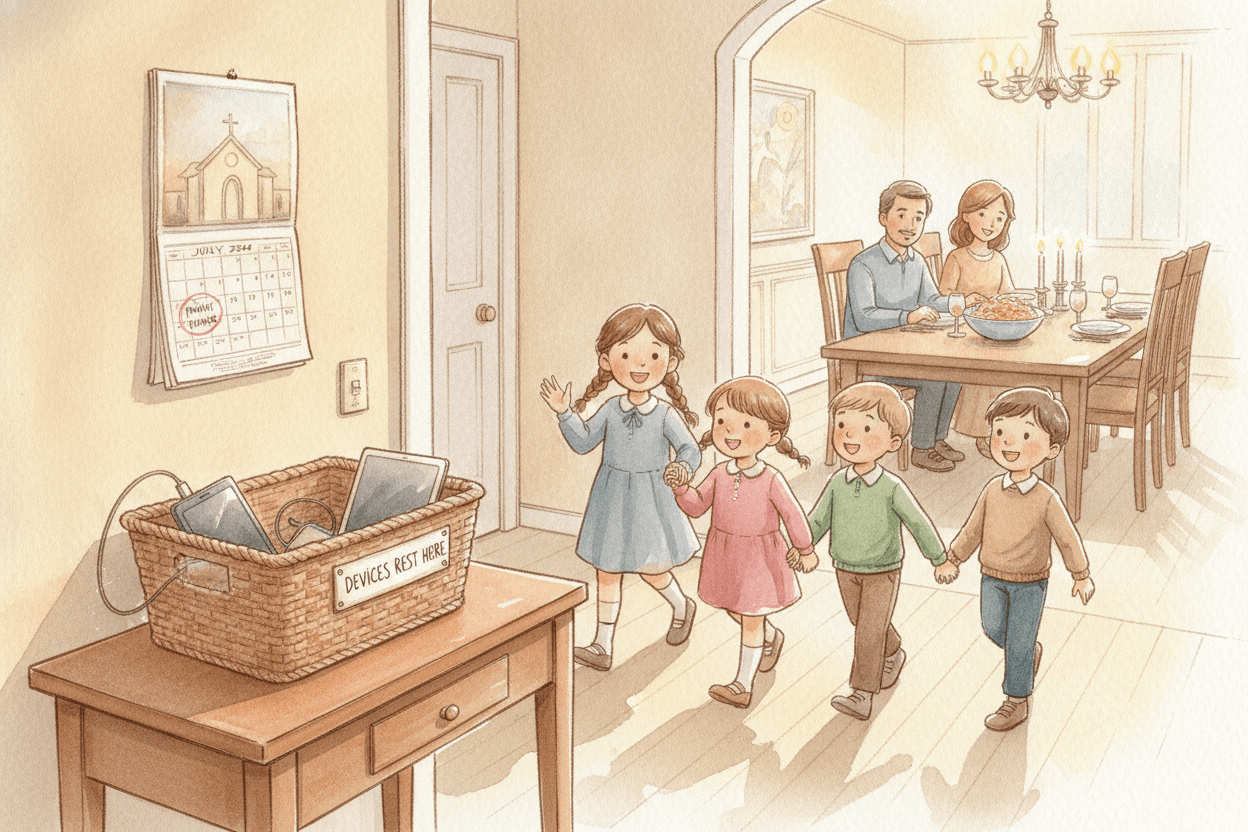
At 8:30 p.m., the rule should not have to be invented while everyone is tired. A child who knows where the tablet goes, what happens after dinner, and when the family phone basket comes out is not being controlled by a random mood; he is being given a dependable pattern. In parish formation, I have found that children usually receive clear household rhythms better than parents expect, especially when the rules are explained before the moment of conflict.
Begin with the spaces of the home. Let televisions, computers, tablets, and gaming systems remain in common areas whenever possible. Devices can charge overnight at a kitchen counter or another shared station, not beside a child’s bed. This makes co-viewing, conversation, and ordinary parental awareness much more likely. It also matters for older children: research associates active parental monitoring and limits on bedroom devices with lower adolescent screen and smartphone use. A closed bedroom door should not become a private media world beyond a parent’s care.
Then protect a few times that belong to persons rather than devices: meals, the hour before bed, family prayer, Sunday worship, and visits with relatives or friends. No entertainment screens at the table gives everyone practice in listening, telling stories, and noticing one another. A screen-free hour before bed supports rest, but it also leaves room for a child to read, talk, pray, or simply be still. Scripture invites us to make faith part of the home’s ordinary speech: not merely a lesson reserved for class, but a word spoken amid the day’s real habits.
Write the plan down in plain language and state weekday and weekend expectations in advance. For example: homework and chores first; a stated amount of entertainment media after responsibilities; family-approved content only; and no new downloads, accounts, or shows without permission. Parents can pre-select programs, set age-appropriate filters, and periodically watch with their children. Afterward, ask a simple question: What did this story say was worth wanting? This teaches discernment rather than making a child dependent on a parent’s constant verdict.
The tone is as important as the rule. Warm, firm consistency is different from harshness, and it is also different from reopening every limit as a debate. A parent can acknowledge disappointment—“I know you wanted another episode”—while calmly holding the boundary. Parents should also let children see them put their own phones away during dinner, prayer, and conversation. As the Catechism reminds us, the family is a domestic church (CCC 1655–1658). Its media practices should make communion more available, not less.
These words that I command you today shall be in your heart. Take to heart these words that I give you today. Repeat them to your children. Teach them carefully to your children. Speak of them at home and abroad, whether you are busy or at rest.
Teach Discernment Through Co-Viewing and Better Questions
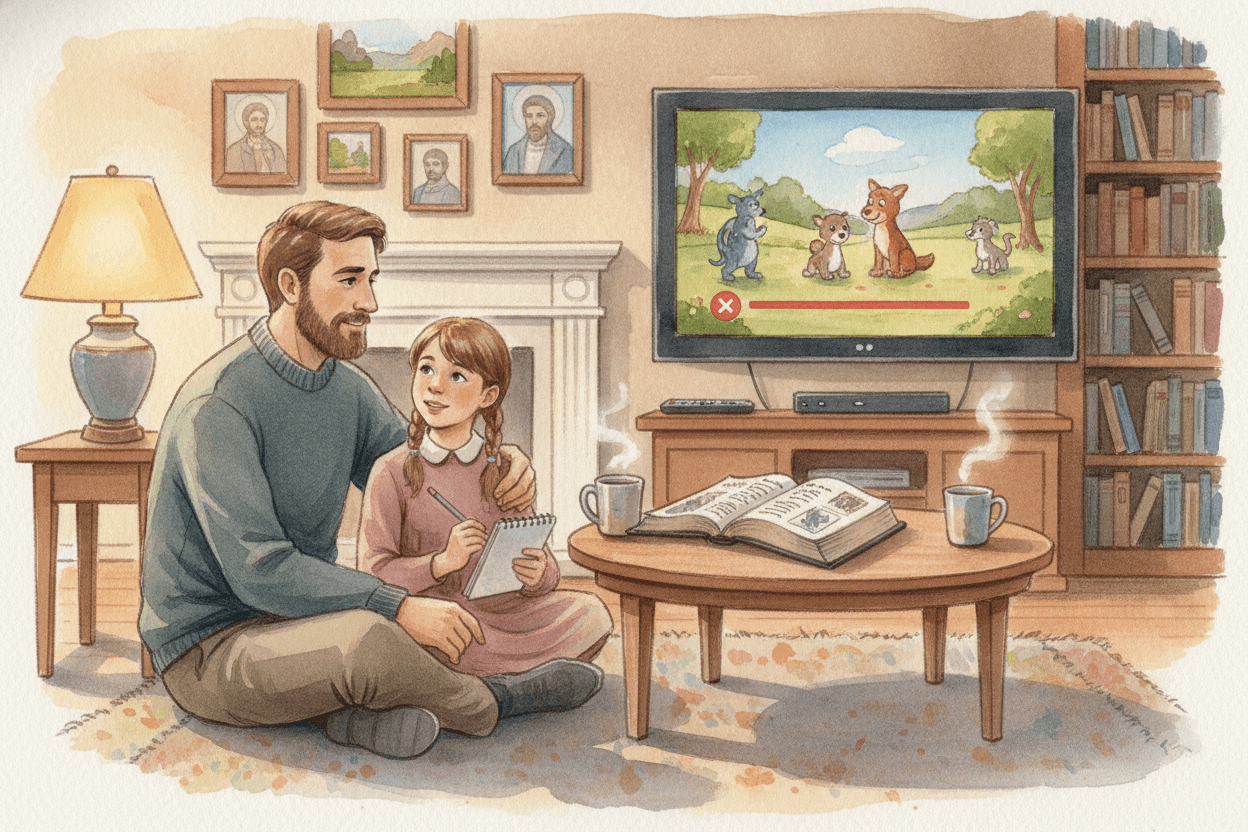
The episode ends, the credits begin to roll, and your child says, “Everyone at school watches it.” That is a small but important catechetical moment. The goal is not to panic, confiscate the remote, or deliver a lecture before anyone has caught a breath. Sit down beside your child when you can. Watch enough to know what the program is asking them to admire, laugh at, excuse, or desire. Co-viewing tells a child, “I take your world seriously, and I will help you judge it wisely.”
Here’s how I’d teach this: pause occasionally, especially when a character lies, mocks faith, treats another person as an object, or solves conflict through cruelty. Ask, “What does this story say a person is worth?” Then ask, “Does it make vice look admirable or consequence-free?” Children are often more perceptive than adults expect. They may notice that a funny scene was also unkind, or that a supposedly confident character was really lonely. Let them answer honestly before supplying the Catholic answer. Formation is not merely identifying forbidden material; it is training the mind and heart to recognize truth, goodness, and beauty.
Scripture gives this work a clear standard: “I do not allow into my presence anything base. I hate wrongdoing; I will have no part of it.” Psalm 101:3 is not a command to be frightened of every imperfect story. It is a refusal to make peace with what degrades God’s children. As the Catechism reminds us, conscience needs formation; moral judgment is enlightened by learning the truth and receiving the wisdom of the Holy Spirit (CCC 1783). A child who can explain why a message is false is better prepared than a child who has only heard, “Because I said so.”
Keep a few questions ready for the car ride or the end of a movie: How are family, faith, the body, and conflict portrayed? Who is treated with dignity, and who is dismissed? What would charity or courage have looked like in that scene? How do you feel after watching: peaceful, restless, envious, numb, angry? These questions also make room to notice what is good. A story may offer loyalty, sacrifice, humor, or perseverance, even when its moral vision is incomplete. Teach children to receive what is good without swallowing every message attached to it.
At times discernment will require a calm, firm no to content that is popular among friends. That can be costly for a child, and parents should acknowledge the disappointment rather than minimize it. “I know you do not want to be left out. But this is not something our family will make room for” is both clear and compassionate. Offer a real alternative: invite a friend over, find a better film, play outside, or choose a family activity. We are not raising children to fear culture or retreat from it. We are raising them to meet it with clear eyes, a formed conscience, and the freedom to choose what leads them toward Christ.
I do not allow into my presence anything base. I hate wrongdoing; I will have no part of it.
This Week: Make One Faith-Filled Screen Swap

On Sunday afternoon, when everyone is tired and the next video begins before anyone has chosen it, do not try to reform the entire family’s media life at once. Choose one recurring screen slot: the cartoon before dinner, the tablet in the car, or the scrolling that fills the first minutes after school. A small, clear change gives children something more important than a restriction: practice in choosing what is good rather than simply what is available.
Begin with a ten-minute family conversation. Parents can say, “Screens can be useful, but they are not in charge of our home. We want time for God, one another, rest, and play.” Then ask each child what screens help them do and what leaves them irritable, distracted, or lonely. Children are capable of this kind of honest reflection when we ask concrete questions. As the Catechism reminds us, temperance disposes us to avoid excess (CCC 1809); a limit is not a punishment but training in freedom.
For the next seven days, choose two non-negotiable boundaries that every adult will keep as well. Make them simple and visible: no devices at meals; no entertainment screens in the hour before bed; no personal devices in bedrooms; or phones charge overnight in one common place, perhaps on a kitchen counter. Create that charging place today. It removes the late-night argument and quietly teaches that a phone is a tool a person uses, not a companion that must remain within reach.
Next, replace one predictable entertainment slot with one concrete alternative. Watch a short BibleHeroes comic and ask, “What choice in this story pleased God?” Or read Scripture together for ten minutes, pray one decade of the rosary, send the children outside, open a board game, or call a grandparent. Keep the replacement modest enough to repeat. Here’s how I’d teach this in a parish family session: do not ask whether the alternative is as instantly exciting as a screen. Ask whether it makes us more present, more grateful, and more able to love.
Parents, name one phone habit you will change this week: leave the phone outside the bedroom, put it away during dinner, or stop checking it while a child is telling you about his day. Your example gives the family rule its credibility. Jesus said, “Let the children come to me, and do not prevent them; for the kingdom of heaven belongs to such as these.” The aim is not merely a quieter house. It is to make room, in the ordinary hours of home, for children to come to Christ.
Jesus said, "Let the children come to me, and do not prevent them; for the kingdom of heaven belongs to such as these."
Frequently asked questions
How do I set Catholic screen time limits without making screens seem evil?
Start by identifying the parts of family life you want to protect: sleep, meals, prayer, outdoor play, reading, conversation, and chores. Explain that screens are a good tool but must fit around these goods rather than replace them. Frame limits as training in freedom and wise choices, not as punishment.
What are good Catholic family screen rules for kids?
Keep devices in shared areas, make meals and the hour before bedtime screen-free, and avoid screens in bedrooms. For younger children, choose limited, co-viewed content after responsibilities; for older children, set clear limits and revisit the plan together. Build regular alternatives into the day, including prayer, reading, play, and family conversation.
How can I tell if my child is getting too much screen time?
Look at what happens after the device is used, not only at the number of minutes. Screen use may be crowding out something important if bedtime worsens, play disappears, siblings are ignored, duties are neglected, or family prayer is rushed. Also notice whether your child can stop calmly or seems ruled by the next video, game, or notification.
How do I choose media that supports my child's Catholic formation?
Ask whether the content is true, honorable, pure, lovely, and worthy of praise, and whether it encourages patience, creativity, and respect for others. Talk with your child after watching or playing: what did it make them want, and how did they feel afterward? Filters can help, but parental awareness and conversation are more important than settings alone.
Why should Catholic parents avoid using screens for every moment of boredom or sadness?
Children need opportunities to handle boredom, waiting, and difficult feelings without immediately reaching for entertainment. Those pauses can open space for imagination, reading, drawing, helping, prayer, or simply noticing the world around them. Screens can be useful, but they should not become the automatic solution for every uncomfortable moment.
How can parents model healthy phone habits for their children?
Practice the same boundaries you ask of your children, especially during meals, conversations, prayer, and before bed. Put your phone aside when a child is speaking and show that people deserve your full attention. A calm adult example teaches that technology is meant to serve family communion, not interrupt it.
Sources: vatican.va · vatican.va · aacap.org · apa.org · apa.org · onlinelibrary.wiley.com · sci-hub.se · apa.org · tandfonline.com · ewtnnews.com
Scripture quotations in this article use the NABRE translation.