Simple Ordinary Time Traditions for Catholic Families
Discover how families can turn Ordinary Time into a season of wonder through simple green-season traditions, table prayers, service projects, and everyday practices that help children recognize discip

The green vestments can feel like a cue to pack away the family faith extras—until a child asks, “So, is this the boring Church season?” Ordinary Time is not empty space between celebrations; it is the Church’s long, patient school of discipleship, where children learn that following Jesus belongs at the dinner table, in the carpool line, and on an ordinary Tuesday.
Ordinary Time Is When Discipleship Takes Root

When the white and gold of Easter give way to green vestments, children sometimes ask, “Is church back to normal now?” It is a fair question, especially after the vivid feasts of Christmas and Easter. But Ordinary Time is not the Church’s empty space or an unimportant pause. It is the season in which we stay near Jesus as he teaches, heals, calls disciples, confronts sin, and sends his followers into the world. In the Sunday Gospel cycle, the Church patiently follows his public ministry—and asks our families to do the same.
The name “Ordinary” refers to numbered weeks, not to a lesser kind of faith. These weeks give children repeated practice in listening to Christ and answering him in ordinary circumstances: a difficult sibling moment, an assignment they would rather avoid, a neighbor who needs help, a disappointment handled without complaining. The Holy See calls the liturgical year “a permanent school of the faith, in which every believer, helped by the Holy Spirit, is called to grow in the likeness of Jesus.” That is a strong description of what happens at the family table, in the car, and on a Sunday afternoon when parents return to one question from Mass: What is Jesus asking us to do this week?
Green is an excellent teaching tool because children can see what growth requires. A houseplant does not become healthy through one dramatic watering; it needs light, water, and steady care. Place a green cloth, leaf, or small plant near your family prayer space. Then let each person name one virtue God may be growing: patience, courage, kindness, self-control, or generosity. This is not a chart for earning God’s love. It is a way to notice that baptismal life is meant to bear fruit. Scripture gives the image plainly: “I am the vine, you are the branches. Whoever remains in me and I in him will bear much fruit, because without me you can do nothing.”
As the Catechism reminds us, the Church “unfolds the whole mystery of Christ during the course of the year” (CCC 1163). Ordinary Time matters precisely because Christian maturity is usually formed through faithful repetition. Here’s how I’d teach this at home: choose one small practice for the week—read the coming Sunday Gospel, pray a decade of the Rosary on a walk, or quietly name one way you noticed Jesus that day. Five consistent minutes can teach children that discipleship belongs not only to feast days, but to Tuesdays, chores, school runs, and every green week in between.
I am the vine, you are the branches. Whoever remains in me and I in him will bear much fruit, because without me you can do nothing.
Let Sunday Mass Set the Family’s One Small Focus
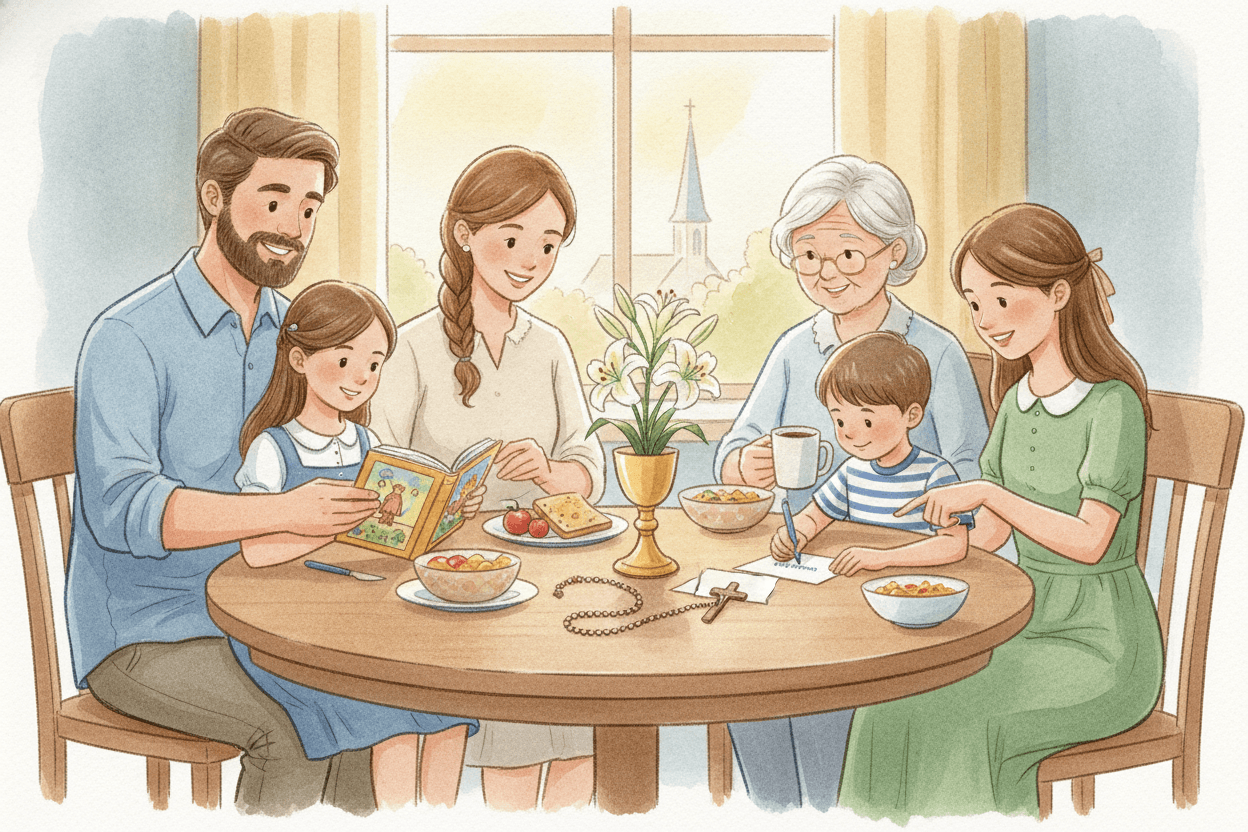
The first question after Mass need not be, “What is for lunch?” Before everyone scatters to meals, sports, homework, or a needed nap, pause for five minutes. Sunday Mass is not one more family obligation to manage; it is the source from which the week receives its direction. The readings, prayers, and Eucharist gather us again around Christ, and then send us into the ordinary places where discipleship is learned.
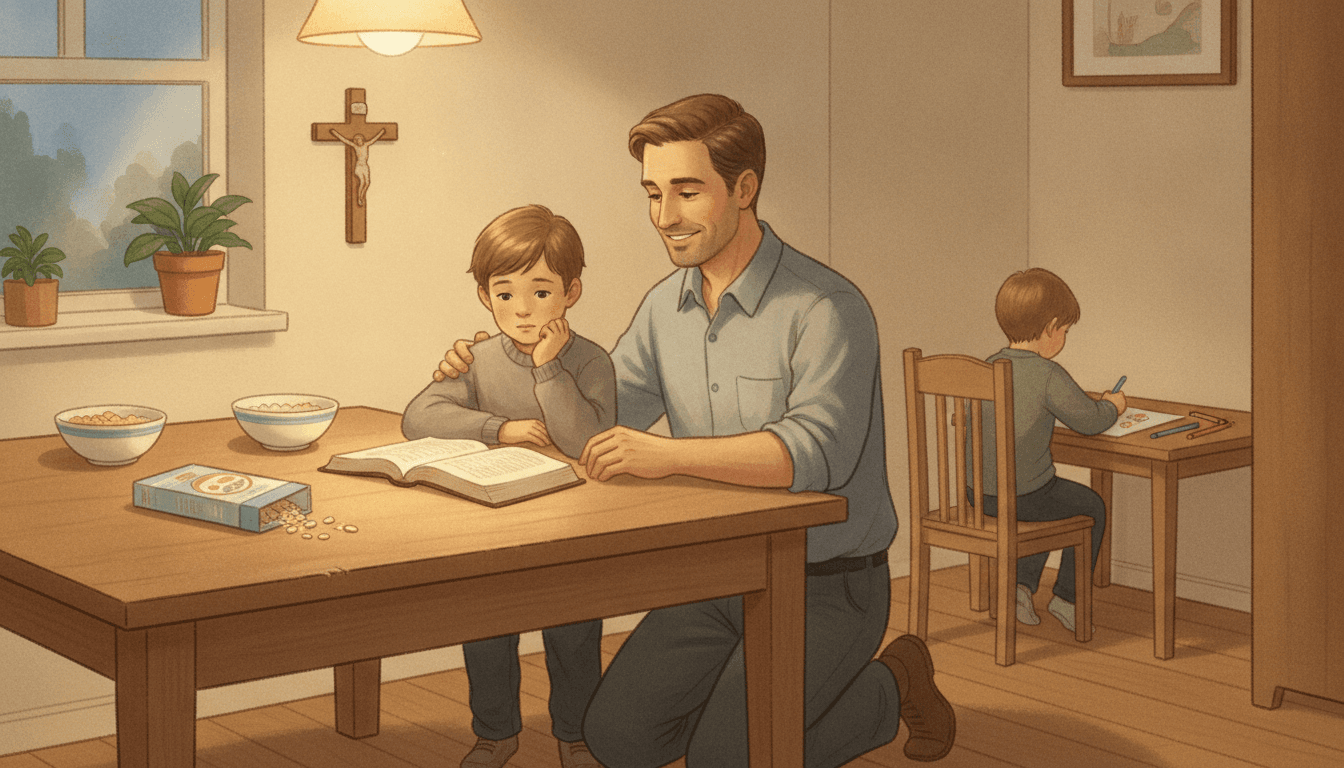
Try a small, repeatable conversation on Sunday afternoon or Monday evening. Ask each person to name one word, image, or moment they remember from the Gospel: a question Jesus asked, a person he noticed, a command that felt difficult, or a phrase that stayed with them. Then ask one steady question: “What is Jesus asking us to do this week?” Let children answer in their own words. They are often more attentive to the Gospel than adults expect when they know their answers will be taken seriously.
Choose one response that can actually be practiced by the whole family. If the Gospel points to mercy, perhaps each person makes peace quickly after an argument. If it concerns service, the family might take on one unnoticed household task without being asked. If Jesus speaks about trust, name one worry during evening prayer and place it before him. Keep the response concrete enough that a child can remember it on Tuesday afternoon. Here’s how I’d teach this: one Gospel message, one family action, one week at a time.
Ordinary Time gives this practice room to breathe. The sustained Gospel readings allow families to remain with Jesus’ teaching rather than rushing from one major feast to another. As the Catechism reminds us, the liturgical year unfolds “the whole mystery of Christ” (CCC 1163). A brief return to Sunday’s Gospel at the dinner table, in the car, or before bedtime teaches children that Scripture belongs in the texture of family life, not only in a church building.
Christ’s final instruction joins teaching with daily obedience: “Go, therefore, and make disciples of all nations, baptizing them in the name of the Father, and of the Son, and of the holy Spirit, teaching them to observe all that I have commanded you. And behold, I am with you always, until the end of the age.” The week’s small focus is not a family self-improvement project. It is a response to the Lord who remains with us, helping parents and children practice what they have heard at Mass.
Go, therefore, and make disciples of all nations, baptizing them in the name of the Father, and of the Son, and of the holy Spirit, teaching them to observe all that I have commanded you. And behold, I am with you always, until the end of the age.
Build a Green Prayer Corner That Teaches Growth
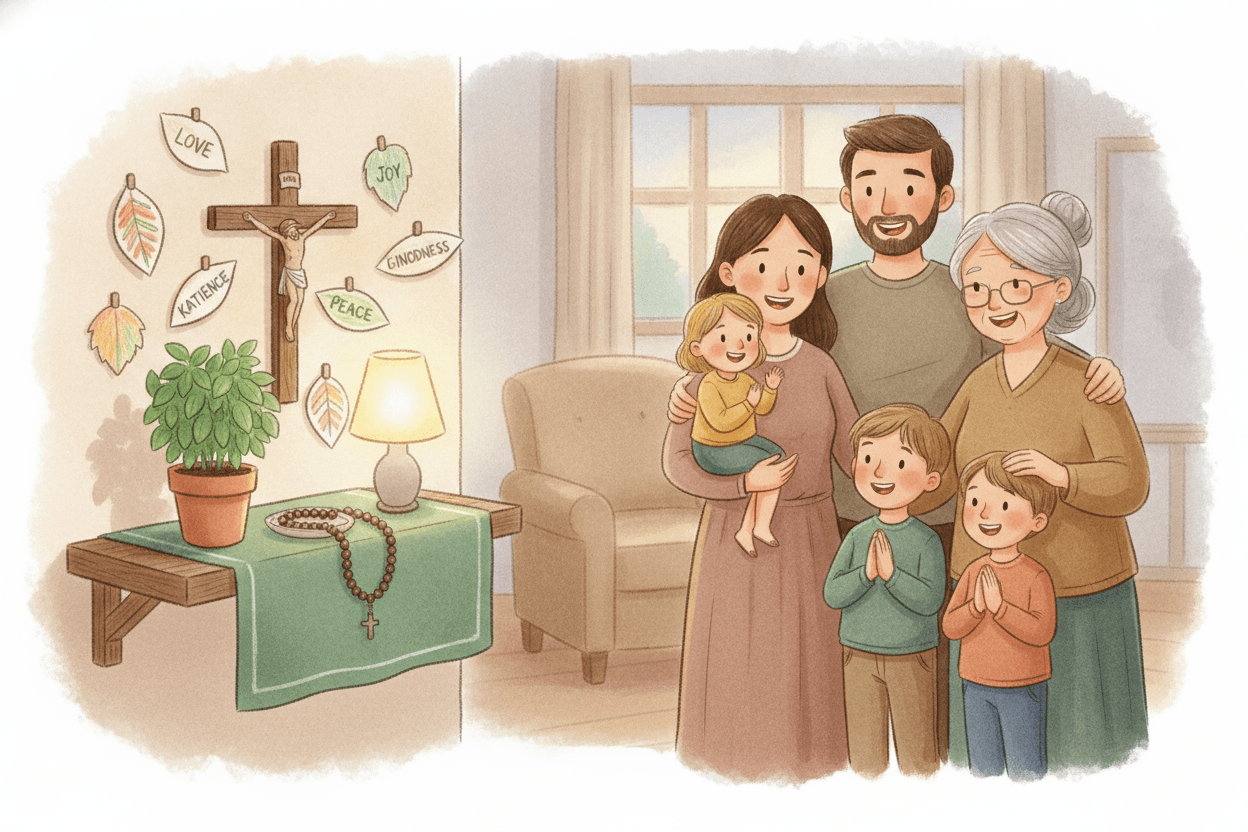
On the first Sunday in green, place a simple green cloth on the table where your family prays. It may be a runner, a square of fabric, or even a sheet of green paper beneath a candle and Bible. Add a small plant if you have one. Children understand signs when we let the sign do real teaching: green is not decoration alone. It tells us that, in this part of the Church’s year, Christ is patiently growing his life in us.
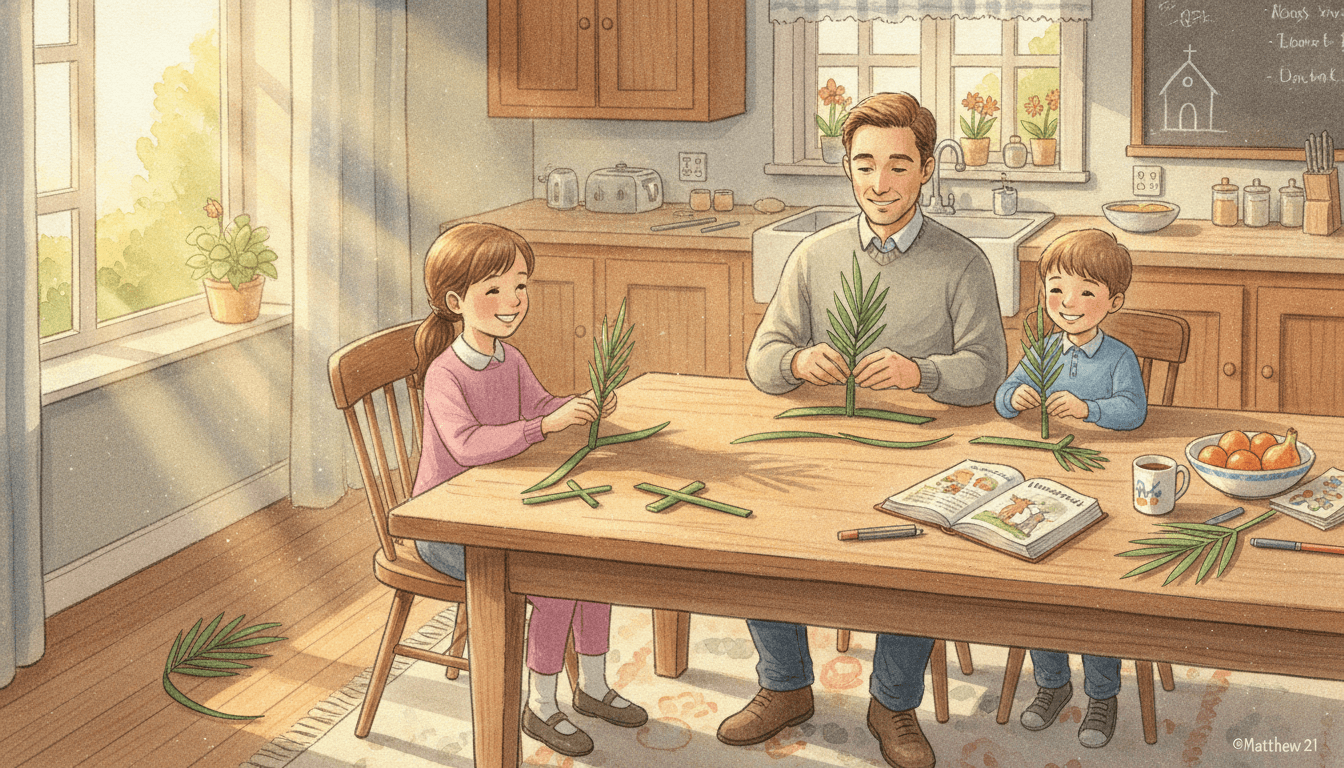
Then give each person one question: “What do you hope Jesus will grow in you?” Keep the answers concrete. A child may name patience with a sibling, courage at school, or remembering to tell the truth. A parent may name gentleness during the evening rush or gratitude at the dinner table. Write each answer on a paper leaf and place the leaves near the plant or cloth. This is not a behavior chart, and it should not become a record of failures. It is a visible family prayer: Lord, make this good fruit grow in us.
Scripture gives parents the right language here. St. Paul names the fruit that comes from the Holy Spirit—love, joy, peace, patience, kindness, generosity, faithfulness, gentleness, and self-control. Notice that these are not merely personality traits we force into existence. They are fruit. Fruit grows by remaining connected to its source. Catholic children do best when we make that distinction clear: we practice cooperation with grace, but God gives the growth.
Here’s how I’d teach this in a parish classroom and at home: once a week, perhaps after Sunday Mass or before a family meal, look at the leaves for two minutes. Ask, “Where did we notice this growing?” and “Where do we need Jesus’ help this week?” Let every answer be received calmly. If a child says, “I was not patient at all,” thank him for telling the truth and pray simply, “Jesus, give us patience tomorrow.” The goal is honest self-knowledge joined to confidence in grace, not a family performance review.
You can refresh the corner without adding work. Water the plant together. Replace a torn paper leaf. Let the green cloth remain in place through Ordinary Time as a quiet reminder that discipleship belongs in kitchens, carpools, homework, apologies, and ordinary evenings. As the Catechism reminds us, the Holy Spirit’s fruits are perfections formed in us as the first fruits of eternal glory (CCC 1832). A small green corner helps children see that holiness is not distant; Christ is forming it in the life they are already living.
In contrast, the fruit of the Spirit is love, joy, peace, patience, kindness, generosity, faithfulness, gentleness, self-control. Against such there is no law.
Use the Sunday Gospel for One Question and One Prayer
On Saturday evening, before the backpacks are packed and the kitchen is fully cleaned, place the coming Sunday’s Gospel on the table beside one candle. This need not become a second religion class at home. It is a brief family habit: open the Lectionary reading, read a few verses aloud, sit quietly for ten seconds, ask one honest question, and pray. Five minutes is enough when it happens faithfully. Over time, children learn that Sunday Mass is not a weekly event that ends at the church door; Jesus’ word is meant to shape Monday morning, sibling disagreements, homework, and family decisions.
Begin with the actual Gospel passage assigned for Sunday. Children deserve the real words of Scripture, not a watered-down retelling that removes its challenge or its mystery. Read slowly, then explain unfamiliar details plainly: who is speaking, what has happened, and what Jesus asks or reveals. If the passage is long, choose one small scene or several verses. A preschooler may listen for a repeated word; an older child may notice a choice, command, or question. Here’s how I’d teach this in a mixed-age group: let the youngest answer first without correcting every imperfect phrase, then invite older children to point to a line in the reading that supports what they heard.
Ask only one question, and let it be concrete. For a Gospel about forgiveness: “Is there someone we need to forgive, or someone from whom we need to ask forgiveness?” For courage: “What good thing is hard for us to do because we are afraid?” For gratitude: “What gift have we treated as ordinary this week?” For service: “Who in our home needs help without having to ask twice?” For trust: “What worry can we bring to Jesus?” For vocation: “What good work or responsibility might God be asking us to do right now?” These are not quizzes with a preferred answer. They train children to listen, discern, and respond.
Scripture invites us to a renewed mind rather than a borrowed set of habits: “Do not conform yourselves to this age but be transformed by the renewal of your mind, that you may discern what is the will of God, what is good and pleasing and perfect.” The family’s question helps make that discernment specific. A child who says, “I think I should include the new boy at recess,” has not merely understood a story. He or she has begun to hear the Gospel as a call to action. This is active discipleship, practiced at a scale children can genuinely live.
Close without extending the discussion into a lecture. A parent can pray, “Jesus, help us to hear your word and do it this week. Give us the grace to forgive, serve, and trust you. Amen.” Or allow each person to add one short petition. As the Catechism reminds us, the liturgical year unfolds the whole mystery of Christ (CCC 1171); the Sunday readings give families a steady path through that mystery. Keep the practice simple enough to repeat, even during a busy week. Consistency will teach more than an elaborate plan used once.
Do not conform yourselves to this age but be transformed by the renewal of your mind, that you may discern what is the will of God, what is good and pleasing and perfect.
Meet One Saint a Week and Imitate One Virtue
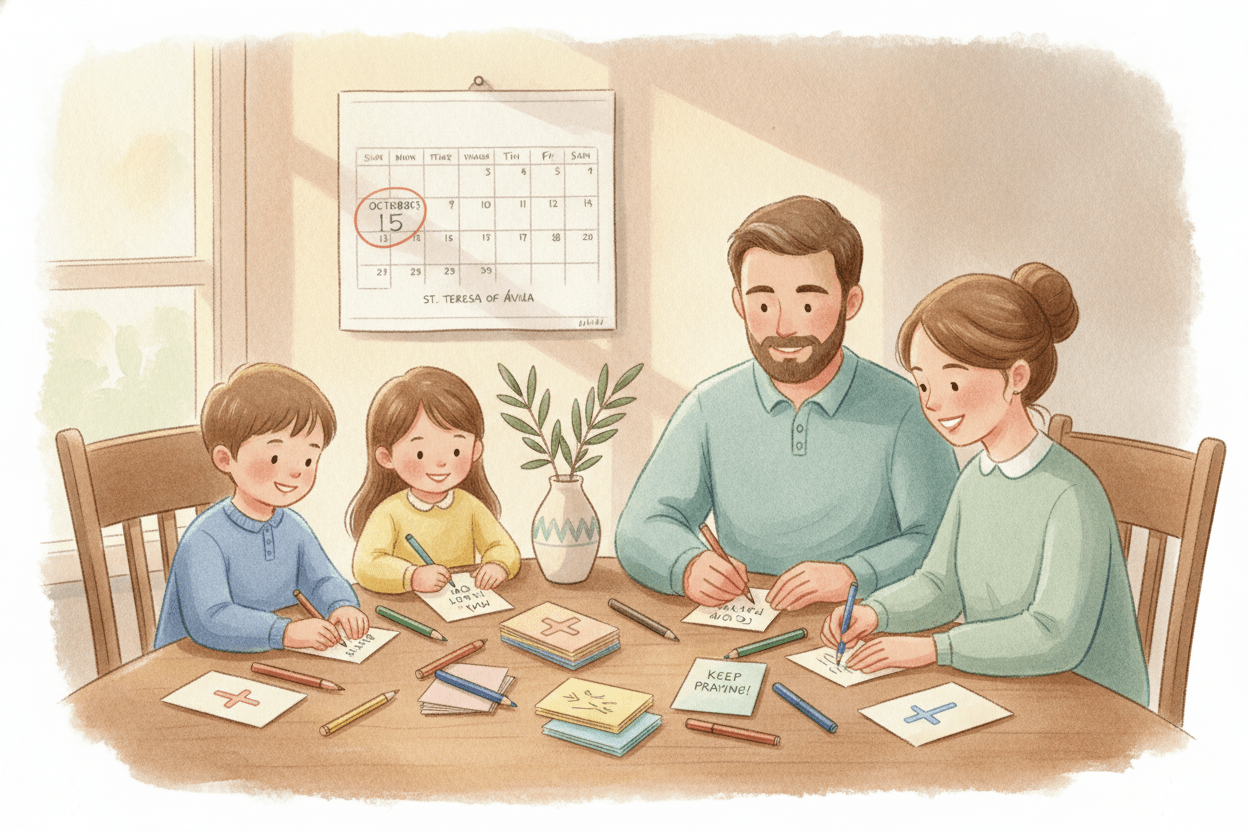
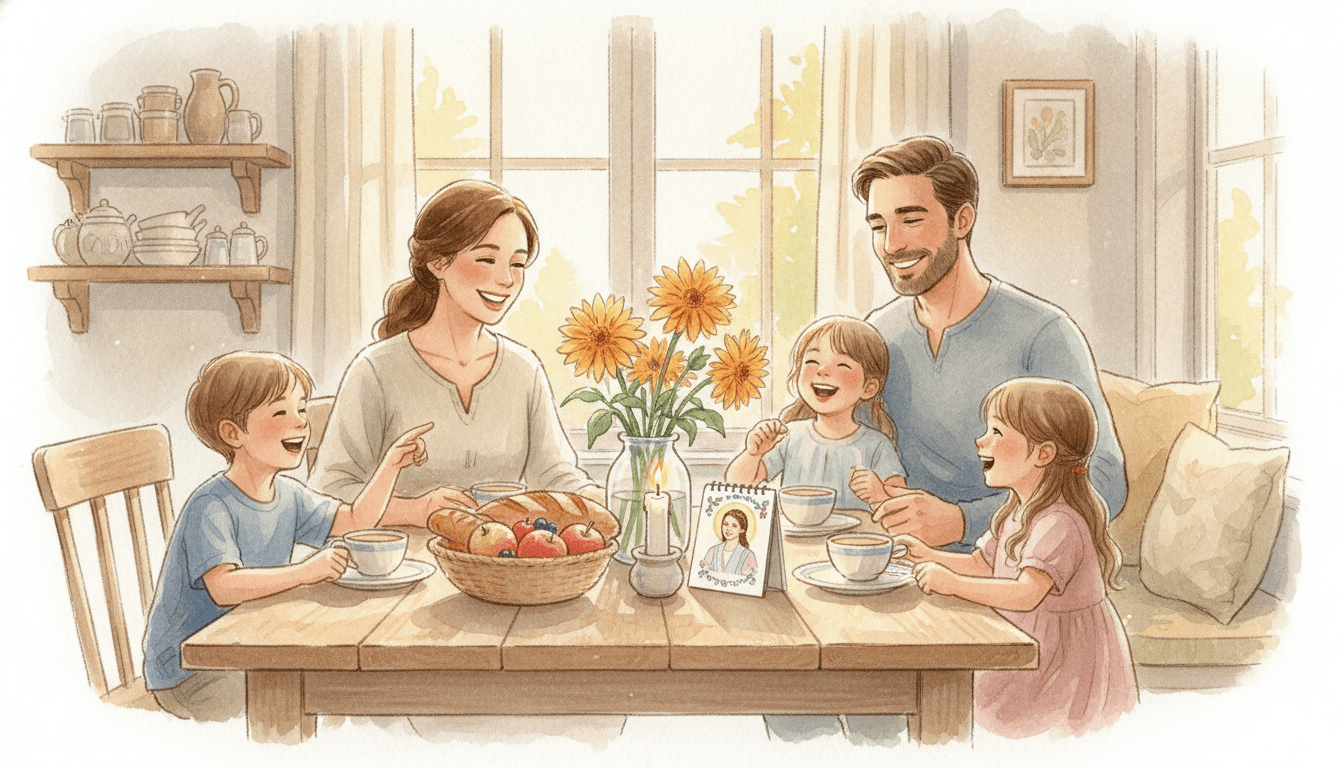
On Monday morning, before backpacks and breakfast dishes take over the kitchen, open the parish bulletin or a reliable Catholic calendar and find the day’s saint. This need not become another subject to manage. One saint, one true fact, one virtue, and one small response is enough. The Church places saints’ memorials throughout the year because they are not distant religious celebrities; they are men and women in whom Christ’s grace bore fruit. As the Catechism reminds us, the Church honors the saints because they "continue to intercede with the Father for us" (CCC 956).
Begin with a dependable source: the daily Mass readings page from the USCCB, a diocesan calendar, or a trusted saint resource. Tell the children one fact they can hold onto: St. Martin de Porres cared for the sick and poor; St. Elizabeth Ann Seton opened schools; St. Teresa of Calcutta served people others ignored. Then name one virtue plainly—mercy, perseverance, courage, hospitality, or patience. Catholic children do best when we do not reduce saints to pleasant stories. Ask what choice showed that virtue, what it may have cost, and how God strengthened that person for it.
Next, choose an imitation action small enough to complete that same week. A family learning from a saint known for charity might write two encouragement notes: one for a lonely relative and one for a classmate or neighbor. A saint marked by hospitality can prompt children to greet a guest warmly, set an extra place, or include someone at recess. Courage may mean telling the truth after a mistake. Service may look like unloading the dishwasher without announcing it. Here’s how I’d teach this: say, “We are not pretending to be this saint. We are asking Jesus to grow this virtue in us.”
This practice belongs naturally to Ordinary Time because the liturgical year sets before us the whole mystery of Christ and also honors those who now live in his glory. The saints show what discipleship looks like in different homes, cultures, jobs, and hardships. Keep the record simple: write the saint’s name and the family’s chosen action on a small card near the prayer corner. At week’s end, ask, “Where was this hard? Where did we receive help?” That brief review forms the habit of noticing grace without turning family prayer into a demanding curriculum.
Let the children come to me, and do not prevent them; for the kingdom of heaven belongs to such as these.
This Week: Choose One Ordinary-Time Rhythm and Keep It Small
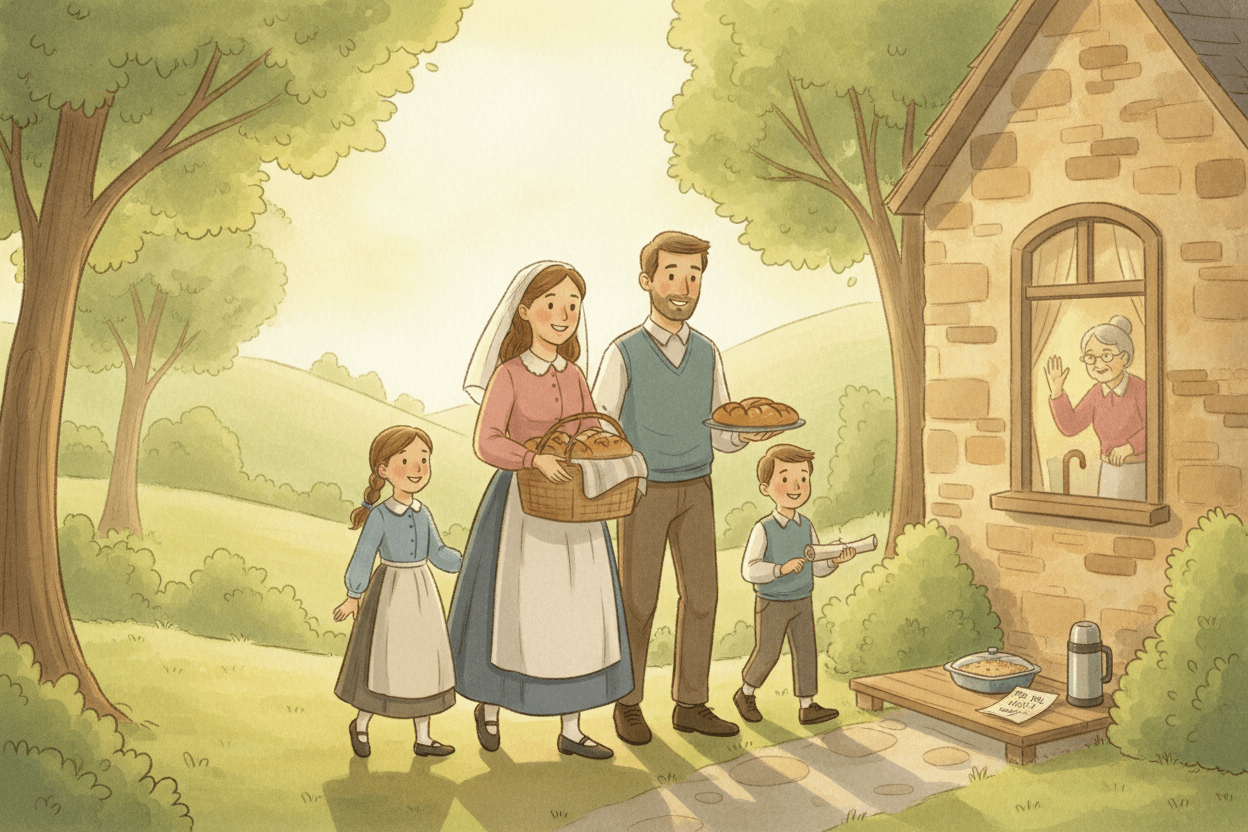
By Wednesday, most family plans have met the real test: a forgotten permission slip, a late practice, dishes in the sink, and someone asking what is for dinner. That is precisely why an Ordinary Time rhythm should be small enough to survive a normal week. We are not trying to create a second school at the kitchen table. We are teaching children that following Jesus belongs in the actual life God has given us—not only in a carefully arranged prayer moment.
In parish formation, I have found that children notice repetition long before they can explain it. A green cloth beside a candle, a familiar prayer before supper, or one weekly question from the Sunday Gospel tells them: our family has a way of returning to Christ. The Catechism teaches that the liturgical year unfolds the whole mystery of Christ (CCC 1194). Green becomes more than seasonal decoration when it quietly prompts a question: What is God growing in us this week—patience, courage, generosity, self-control?
Keep the practice concrete. At one meal each day, pray grace slowly and attentively rather than racing through it. Once this week, read the Gospel for the coming Sunday. Let each person answer one question: “What is Jesus asking us to do?” If a child gives a brief or unexpected answer, receive it seriously. Catholic children do best when they know the Gospel is not a puzzle with one approved adult response; it is the living word that forms our judgment and our choices.
Add one saintly virtue and one work of mercy, but do not make either elaborate. You might learn that a saint was known for generosity, then choose generosity at home: share a snack, carry in groceries for a neighbor, make an encouragement note, or take on an unnoticed chore without complaint. Here’s how I’d teach this: name the virtue, identify one action, and do it together. The point is not to complete a list. It is to let love take a visible form.
For the next seven days, set out one green reminder in your prayer space; pray grace attentively at one meal each day; read the upcoming Sunday Gospel once; name one saintly virtue; and complete one small work of mercy as a family. That is enough. Pope Francis teaches, “Only a personal encounter with Jesus engenders a journey of faith and of discipleship.” Consistency matters more than complexity, so choose just one of these practices to repeat through the season. A small, faithful return to Jesus can become the rhythm your children remember.
Frequently asked questions
What does Ordinary Time mean in the Catholic Church?
Ordinary Time does not mean an unimportant or boring season. “Ordinary” refers to the numbered weeks of the Church year, when Catholics follow Jesus’ public ministry and grow in everyday discipleship. Its green color is a sign of steady spiritual growth.
How can I explain Ordinary Time to my children?
Tell children that Ordinary Time is when the Church practices following Jesus in regular life—at school, during chores, and in difficult moments with siblings. Use a plant as an example: growth usually comes through light, water, and steady care, not one dramatic event. Invite each child to name one virtue, such as patience or kindness, that Jesus can grow in them.
What are simple Ordinary Time traditions for Catholic families?
Set out a green cloth, leaf, or small plant near your family prayer space to mark the season. Choose one small weekly habit, such as reading the next Sunday’s Gospel, praying a decade of the Rosary on a walk, or sharing where each person noticed Jesus that day. Keep the practice short enough to repeat consistently.
How do we talk about Sunday Mass with kids after church?
Take five minutes on Sunday afternoon or Monday evening to ask what word, image, or Gospel moment each person remembers. Then ask, “What is Jesus asking us to do this week?” Choose one concrete family response, such as reconciling quickly, doing an unnoticed chore, or bringing a worry to evening prayer.
How can our family live the Sunday Gospel during the week?
Turn one Gospel message into one action your children can remember on an ordinary Tuesday. If the reading emphasizes mercy, practice making peace after arguments; if it emphasizes service, everyone can help without being asked. Return briefly to the Gospel at meals, in the car, or at bedtime to connect Mass with daily life.
Why is green used during Ordinary Time?
Green is the liturgical color of growth and hope during Ordinary Time. A green prayer-space cloth or small plant can remind your family that Christ is patiently forming virtues in each person. It is not a way to earn God’s love, but a visible reminder that baptized life is meant to bear fruit.
Sources: vatican.va · vatican.va · vatican.va · vatican.va · vatican.va · vatican.va · vatican.va · wordonfire.org
Scripture quotations in this article use the NABRE translation.