Palm Sunday at Home:Helping Kids Meet Jesus the Humble King
Turn those crumpled palms and enthusiastic reenactments into a hands-on lesson about Palm Sunday. Simple questions, a short Gospel reading, and a donkey craft can help children discover what the crowd
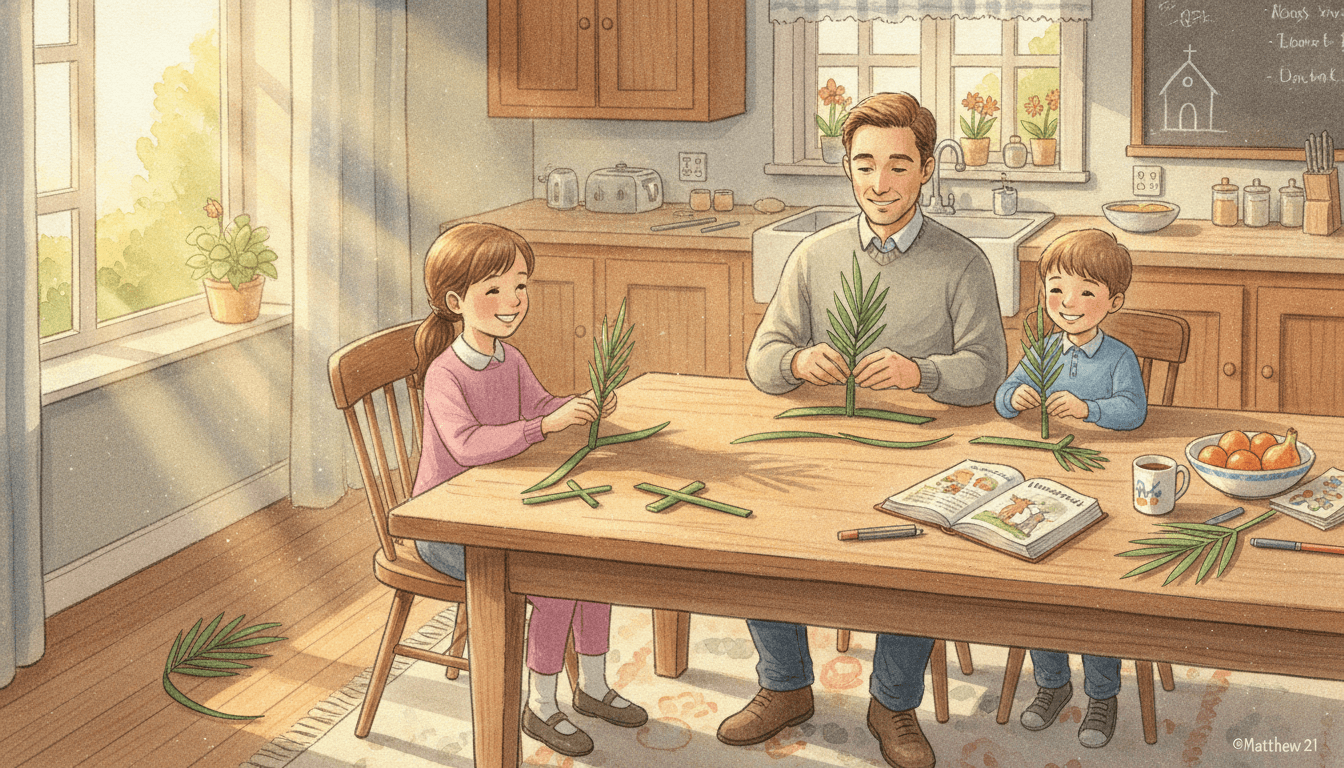
By the time we got home from Mass, one palm was wedged under a car seat and another had become a light saber. That is not a failed Palm Sunday. It is a good opening to help kids see why the crowd welcomed Jesus—and why their King chose a donkey.
Start With the Palm in Your Child’s Hand
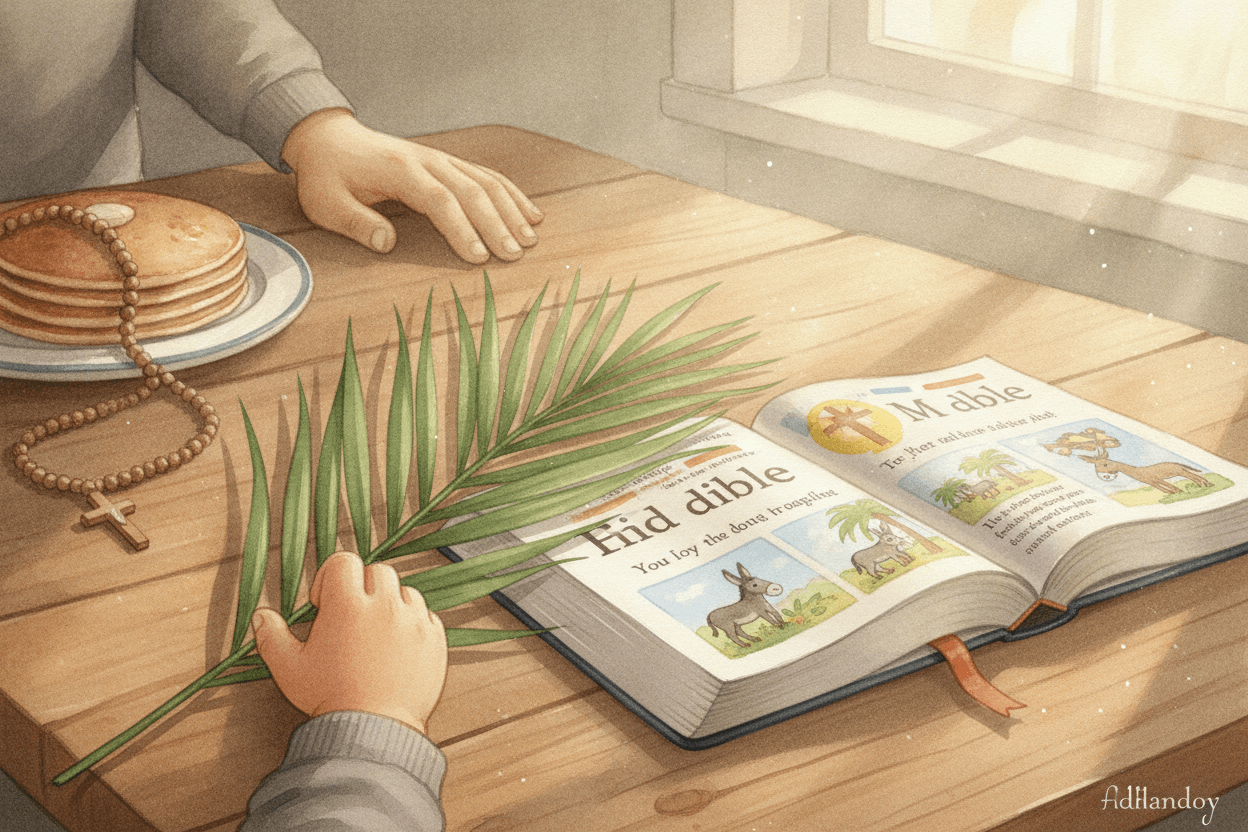
By the time we get to the car, somebody’s palm is usually bent in half, somebody else is brushing bits of it off the seat, and one child has decided it is a sword. I try not to panic about the palm’s condition. That little green strip has already done its job: it gives us something to hold while we talk about what happened at Mass.
I tell the kids that the people in Jerusalem waved branches and shouted because they were welcoming Jesus. They thought about kings. A king was someone important, someone with authority, someone worth cheering for. So the palm in your child’s hand is not just a souvenir from Sunday. It is a small sign that says, “Jesus, we welcome you.” For a six-year-old, that is a good place to begin. Jesus came into the city, and the crowd was glad he was there.
Then comes the question that slows things down: what kind of king was Jesus? Not the kind who arrived on a big war horse with soldiers behind him. Jesus rode on a donkey. He came gently. He came in peace. He had real authority, but he did not come to push people around or make everyone afraid. Here’s what landed with our kids: Jesus is the King who came close enough for ordinary people to see him, cheer for him, and follow him.
At our table, one small thing we tried was placing the palm in the middle and asking each child to finish this sentence: “Jesus is my King when I…” The answers may be wonderfully uneven. “When I share my cereal.” “When I listen the first time.” “When I don’t yell at my brother.” Let them be concrete. Then remind them that Palm Sunday is not only a happy parade. Jesus is walking toward the Cross because he came to save us. The cheering crowd helps us see both truths: Jesus is King, and his way of being King is humble, loving, and brave.
Hosanna to the Son of David! Blessed is he who comes in the name of the Lord!
Jesus Is a King, but Not the Kind They Expected
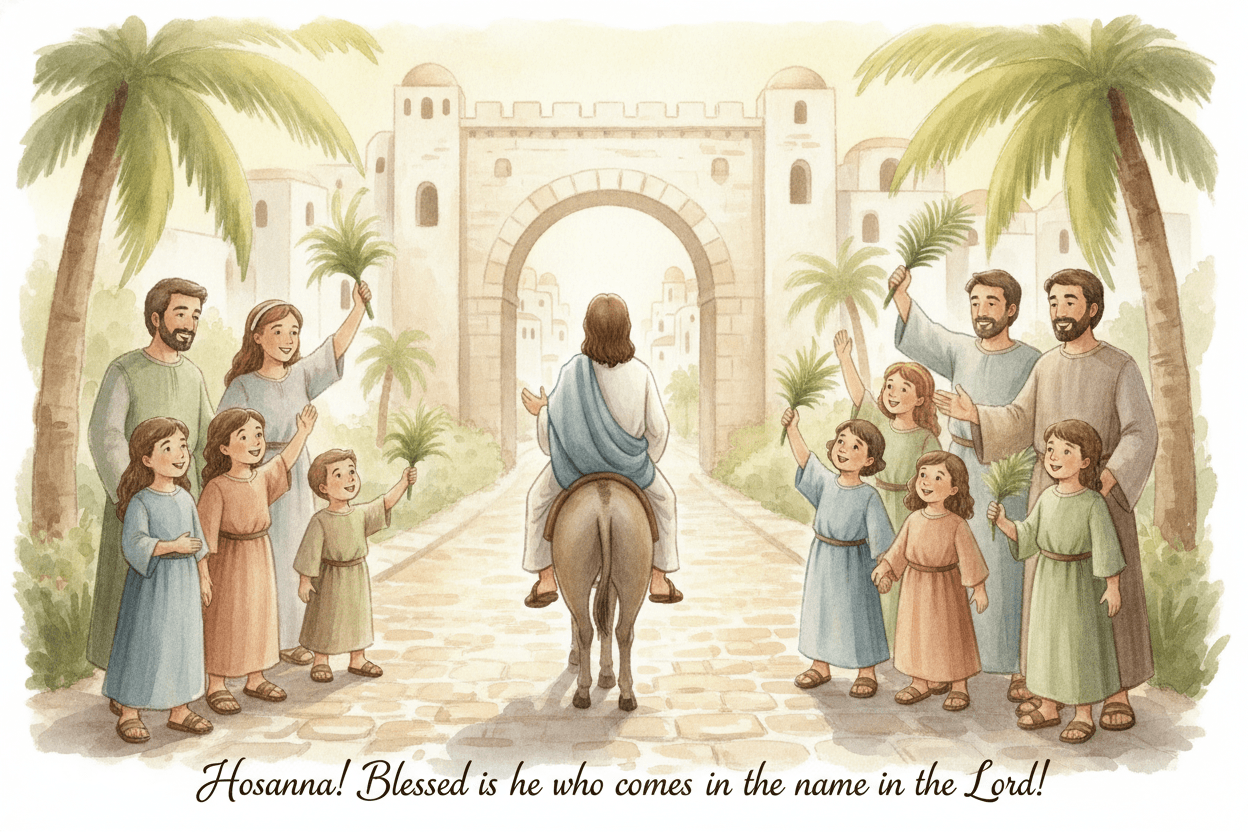
The first time one of my kids heard that Jesus rode into Jerusalem on a donkey, he laughed. “Why not a big horse?” Fair question. In the stories he knew, kings rode the biggest, fastest, shiniest thing around. A donkey sounded more like the animal that might stubbornly stop in the middle of a family photo. But that is exactly the point Palm Sunday gives us.
Jesus really is a King. The crowd was not wrong to welcome him with branches and shouts. They were looking for God’s promised rescuer. Long before that day, the prophet Zechariah told God’s people to watch for a king who would come “meek, and riding on an ass, on a colt, the foal of an ass.” Jesus chose the colt on purpose. He was showing them who he was.
He did not enter like a political conqueror, ready to push enemies aside and grab power. He came as a king of peace. For kids, I put it this way: imagine being picked as captain and choosing to help tie everyone’s shoes instead of bragging that you are the boss. You still have the job. You still have real authority. But you use it to care for people. Jesus had more authority than anyone in Jerusalem, yet he came humbly.
At our table, one small thing we tried was asking, “What would a show-off king do? What would Jesus do?” The kids usually supply the answers quickly. A show-off king wants the best seat, the loudest cheers, and everybody doing what he says. Jesus welcomes the weak, serves his friends, and keeps going toward the cross. Palm Sunday begins with happy shouting, but it also points us toward Holy Week. Jesus comes to save his people, not by making a grand display of force, but by giving himself in love.
Before Mass, let your child hold the palm and say, “Jesus is my King.” Then add, “He is a humble King.” During the procession, notice the people welcoming him. After Mass, ask one simple question: “How can we act like Jesus the King at home this week?” Maybe it is letting a sibling choose first, helping without being asked, or saying sorry before bedtime. Small acts do not look very kingly to the world. In our house, that is usually where the lesson lands.
Exult greatly, O daughter Zion! Shout for joy, O daughter Jerusalem! See, your king shall come to you; a just savior is he, meek, and riding on an ass, on a colt, the foal of an ass.
Read the Promise and the Fulfillment Together
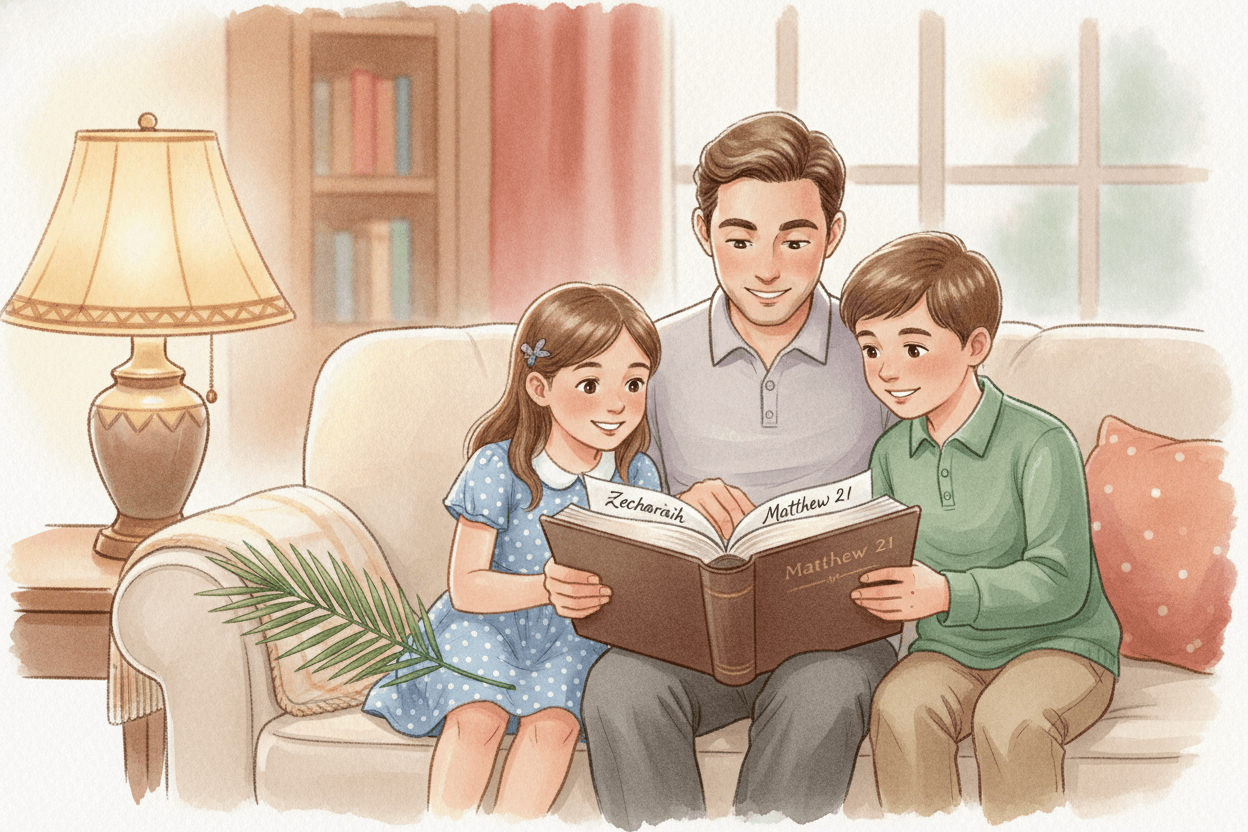
Last Palm Sunday, one of our kids heard the word “procession” and immediately asked if that meant everyone got to parade around church. Honestly, that is not a bad place to begin. There are palms, people walking, voices singing, and plenty for little eyes to notice. But before Mass, give your family ten quiet minutes with two Bible passages. This helps the palms become more than a fun branch to wave in the back seat on the way home.
Start with Zechariah 9:9. Read it slowly, then ask one simple question: “What does God say the king will ride?” Let your children answer: a donkey, or a colt. Then read Matthew 21:1–11. You do not need a lecture afterward. Just help them spot the same detail again. Jesus tells the disciples to bring the colt. He rides into Jerusalem that way. The crowds welcome him, but Matthew wants us to notice something bigger than a parade.
Here’s what landed with our kids: God had promised this kind of king long before Jesus came to Jerusalem. Jesus was not making a last-minute choice because a donkey happened to be nearby. He was showing who he is. He is the promised King. And he comes humbly. A king arriving on a big war horse might look ready to fight. Jesus comes on a young donkey. He is strong, yes, but he is not coming to grab power or frighten people.
You can say it in kid-sized words: “Jesus is King, but he comes gently. He came to save us, not boss people around.” That is enough for ages six to nine. If they ask why people shouted “Hosanna,” tell them it was a cry of praise and a plea for help. They were welcoming Jesus. Soon, though, the story will turn toward the cross. Palm Sunday holds both things together: the cheering crowd and the Savior who freely goes forward to suffer for us.
One small thing we tried was having each child draw a tiny donkey beside the words “God keeps his promises.” Put the paper in the Bible at Matthew 21, or tuck it beside the palm cross after Mass. Then, when your child waves a palm or notices the procession, ask, “Why did Jesus ride a donkey?” The answer does not need to be polished. If they say, “Because he is the humble King God promised,” they have heard the heart of it.
Say to daughter Zion, ‘Behold, your king comes to you, meek and riding on an ass, and on a colt, the foal of a beast of burden.’
Help Kids Hold Joy and Holy Week Together
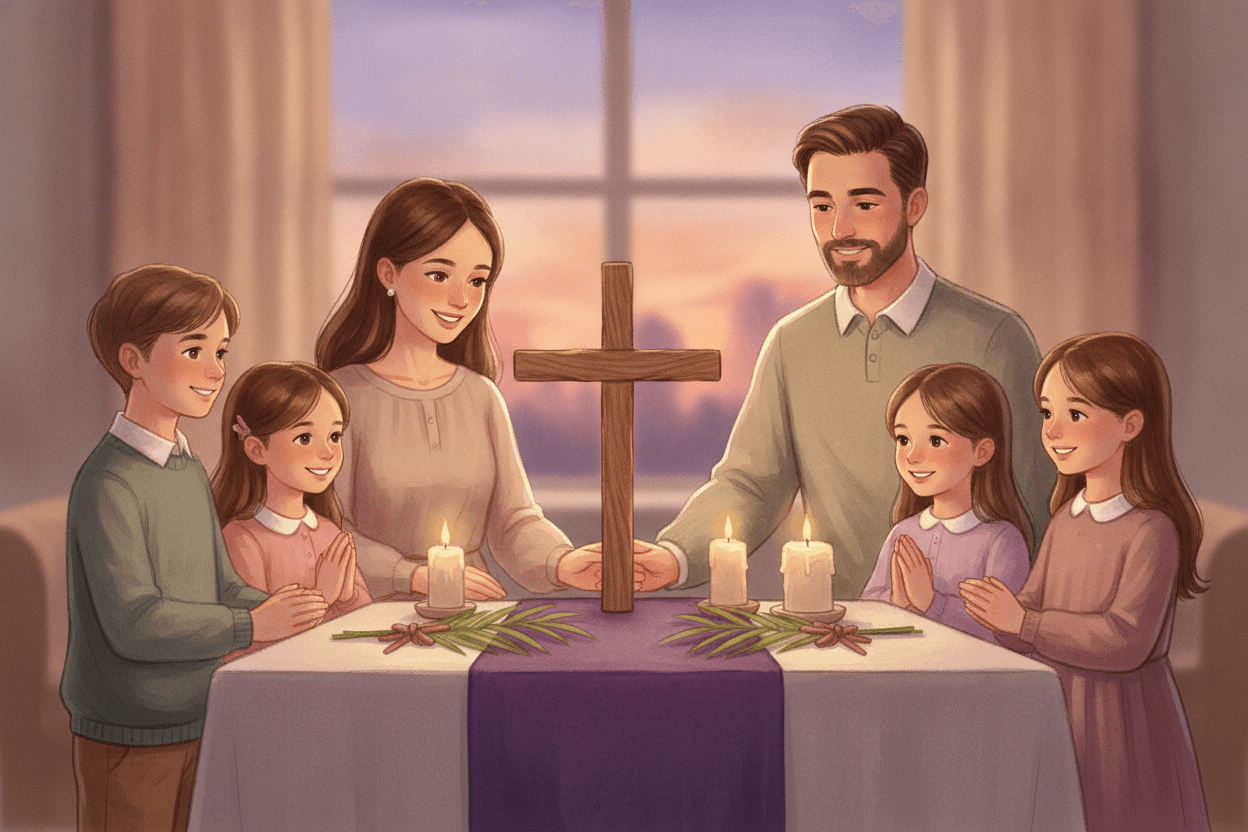
The palm branch was still tucked behind our kitchen crucifix when one of my kids asked, “Wait. If everybody was happy, why do we get sad at church later?” That is a very good Palm Sunday question. The cheering crowd can feel like the whole story when you are six. Palms go up. People shout. Jesus comes into Jerusalem. It feels like a parade. And then, before the week is over, we hear about the Cross.
We do not need to rush past either part. Tell your child: “Palm Sunday starts with people welcoming Jesus as King. But Jesus knew that some hard things were coming. He knew he would suffer, and he came anyway because he loves us.” That is plain enough for a young child, and it is true. Jesus was not surprised by Holy Week. He walked into Jerusalem freely. He came humbly, riding on a colt, not acting like a soldier coming to win a battle.
One small thing we tried was making room for both feelings at the table. We would ask, “What is joyful about Palm Sunday?” Then we would ask, “What hard thing happens after Jesus enters Jerusalem?” The answers were usually simple: “They were excited.” “Jesus dies on the Cross.” If a child says, “That is sad,” let that answer sit for a moment. You do not have to fix it with a quick happy ending. You can say, “Yes, it is sad. We stay with Jesus this week. And we remember that death is not the end of his story.”
If your child brings home a palm cross, put it somewhere you will see it during the week. Each day, touch it and name one part of the story: the Last Supper, Jesus praying, the Cross, the quiet of Holy Saturday, then Easter morning. In our house, the palm cross sometimes ends up near a cereal bowl or under somebody’s backpack. That is okay. Let it be a small sign that Jesus meets us in an ordinary, messy house—and that his love carried him all the way through the hard days to Resurrection.
Hosanna to the Son of David! Blessed is he who comes in the name of the Lord!
Use Three Small Moments Around Mass
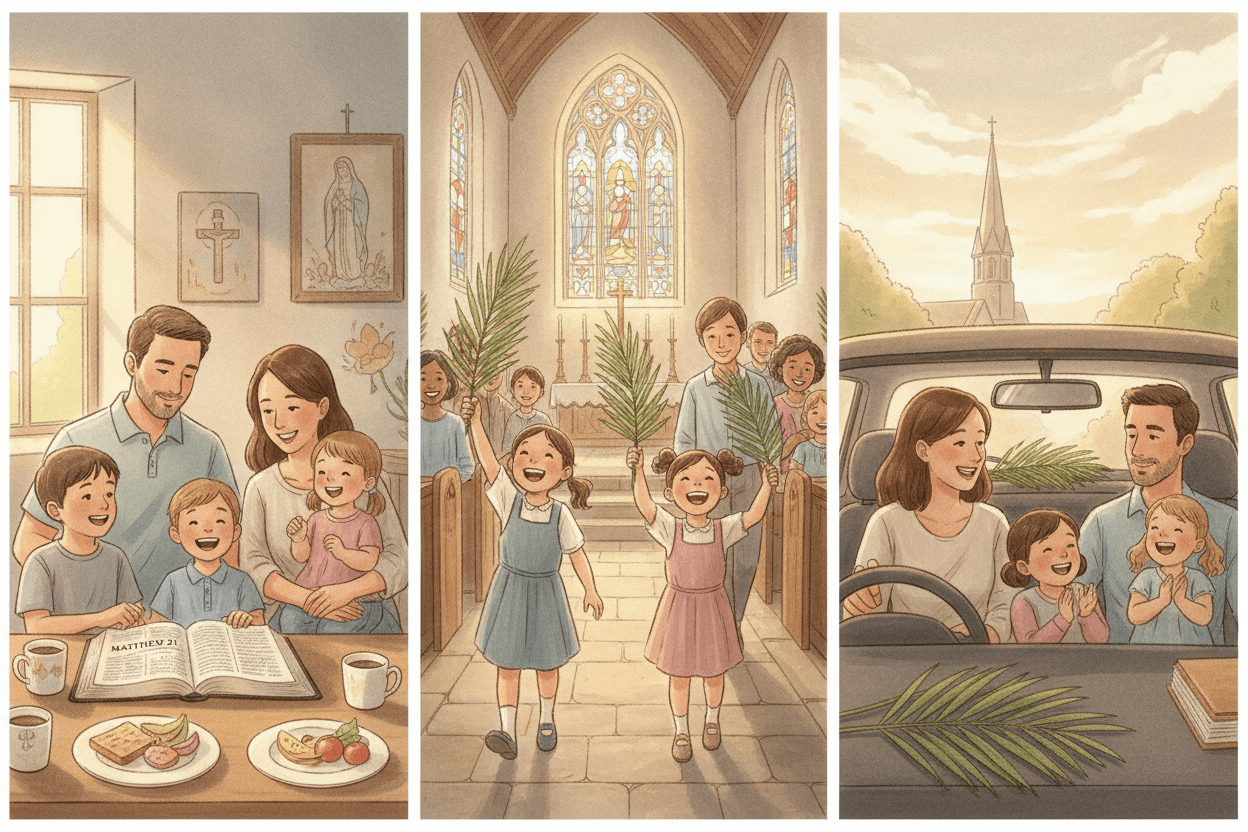
Last year, one of my kids spent the walk into church using his palm as a sword. By the first reading, it looked more like a tired piece of celery. Still, he knew to hold it up when the singing started. That was enough to begin. Palm Sunday does not require a flawless family lesson before everyone gets out the door. It gives us a few small moments to help our children notice what is happening.
Before Mass, read a few lines from the Gospel together—just enough for young ears. You might read Luke 19:38 and tell them, “Listen for the word ‘Hosanna’ today.” Explain that the people were welcoming Jesus as their king. Then give them one job: watch for the palms and listen for the cheering words. Keep it simple. If breakfast is burning or somebody cannot find a shoe, say it in the car. God can work with a three-minute conversation.
During Mass, let the children look. Point out the palms, the people gathering, and the procession if your parish has one. Whisper only what helps: “The people welcomed Jesus into Jerusalem.” If they ask why Jesus rode a donkey, that is a good question to save for later. For now, let them see that this Sunday feels different. Children learn the rhythm of the Church partly by living it with us, even when they are squirming through it.
After Mass, put the palms on the kitchen table and ask what they noticed. Try questions that do not have a quiz-like feel: “What did you hear people say about Jesus?” “Why do you think Jesus rode a donkey instead of a big horse?” “What does it mean to welcome Jesus this week?” Here’s what landed at our table: a donkey is not the ride people expected for a strong king. Jesus came humbly. He came in peace. That answer is small enough for a child to carry and big enough to grow with them.
If your parish allows you to bring palms home, make a simple palm cross together. The folds may be crooked. Ours usually are. Put it somewhere your family will see it during Holy Week: near the prayer table, taped by the front door, or beside the fruit bowl. When a child notices it again, return to the same question: How can we welcome Jesus today? A kind word, an apology, helping without being asked—those are very ordinary answers. They are also a good place for faith to take root.
Blessed is the king who comes in the name of the Lord.
Make a Palm Cross—and Let It Keep the Conversation Going
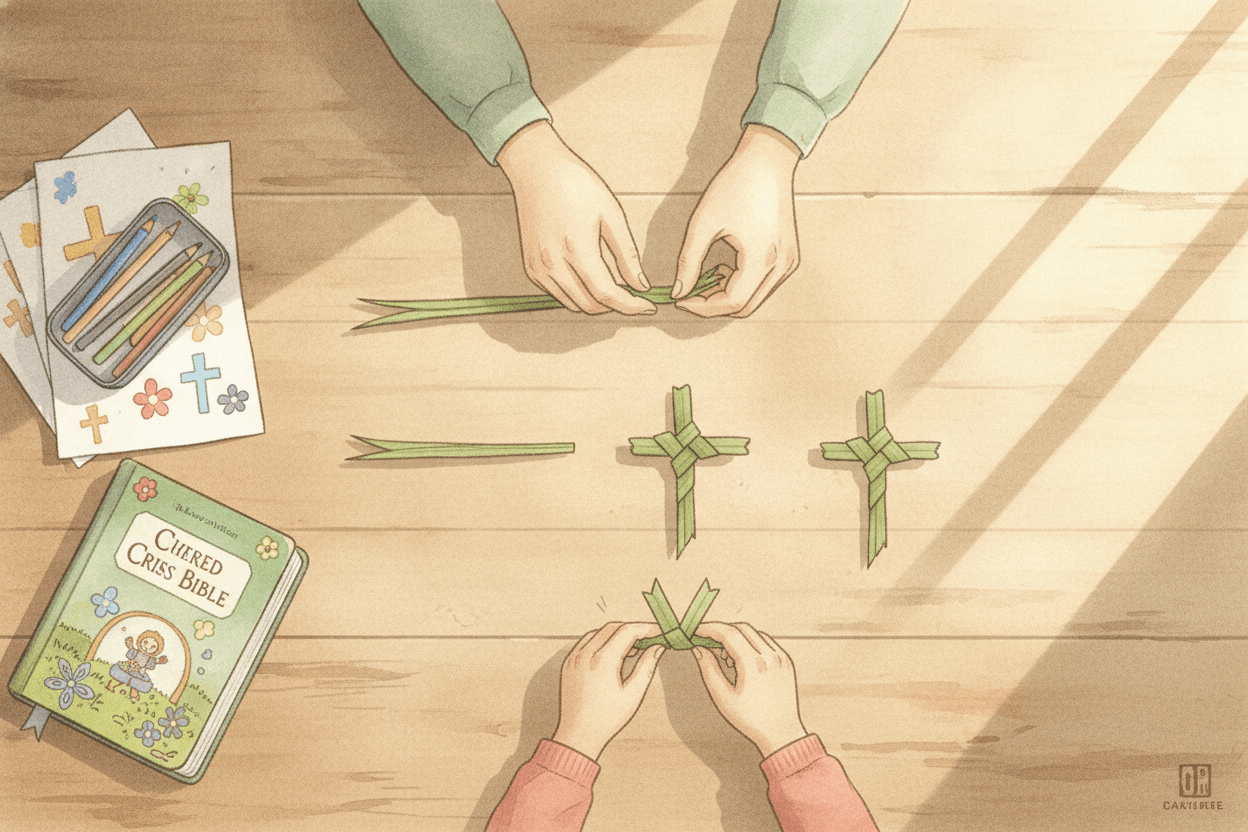
By the time we got home, our palms had already been through a lot. One was bent like a fishing pole. One had little teeth marks near the bottom. A third had disappeared somewhere under the van seat. That is about right for Palm Sunday with kids. Before the palms get crushed beyond recognition, try making one into a simple cross together.
Start with one blessed palm from Mass. Lay it flat on the table. Fold the top section down and across to make the short crossbar. Then take the long end, wrap it once around the middle where the pieces meet, and tuck the tip under the wrap so it stays put. Little hands may need help with the tuck. If the cross leans, wrinkles, or looks more like a green pretzel than a cross, let it be. The point is not a craft-store result. The point is that your child held a palm while hearing about Jesus entering Jerusalem, and now that same palm has become a sign of the week ahead.
As you fold, keep the conversation small enough for the kid in front of you. You might say, “The crowd welcomed Jesus as their king. But he came gently, riding on a colt.” If your child asks why Jesus did not arrive on a big horse with soldiers, that is a good question. Tell them he came to bring peace and to save us, not to show off his strength. Then read one short line together: “Fear no more, O daughter Zion; see, your king is coming, seated upon an ass’s colt.”
Put the finished cross near your family crucifix, on a prayer shelf, or even beside the bowl where everyone drops keys and library books. It becomes a quiet prompt all week. At dinner, ask, “Who did the people think Jesus was?” Another day, ask, “What kind of king is Jesus?” There is no need to squeeze a full lesson out of every question. A few honest answers, repeated over the years, do their work.
One small thing we tried was pairing the palm cross with a Triumphal Entry comic. After Mass, the kids could point to Jesus, the colt, and the cheering crowd while we retold the story in their own words. For children who remember pictures better than explanations—and that includes plenty of adults—a simple visual helps the scene stay in their minds. The little palm cross on the shelf can keep bringing them back to it long after Palm Sunday clothes have been tossed in the laundry.
Fear no more, O daughter Zion; see, your king is coming, seated upon an ass’s colt.
Try This Palm Sunday Plan This Week
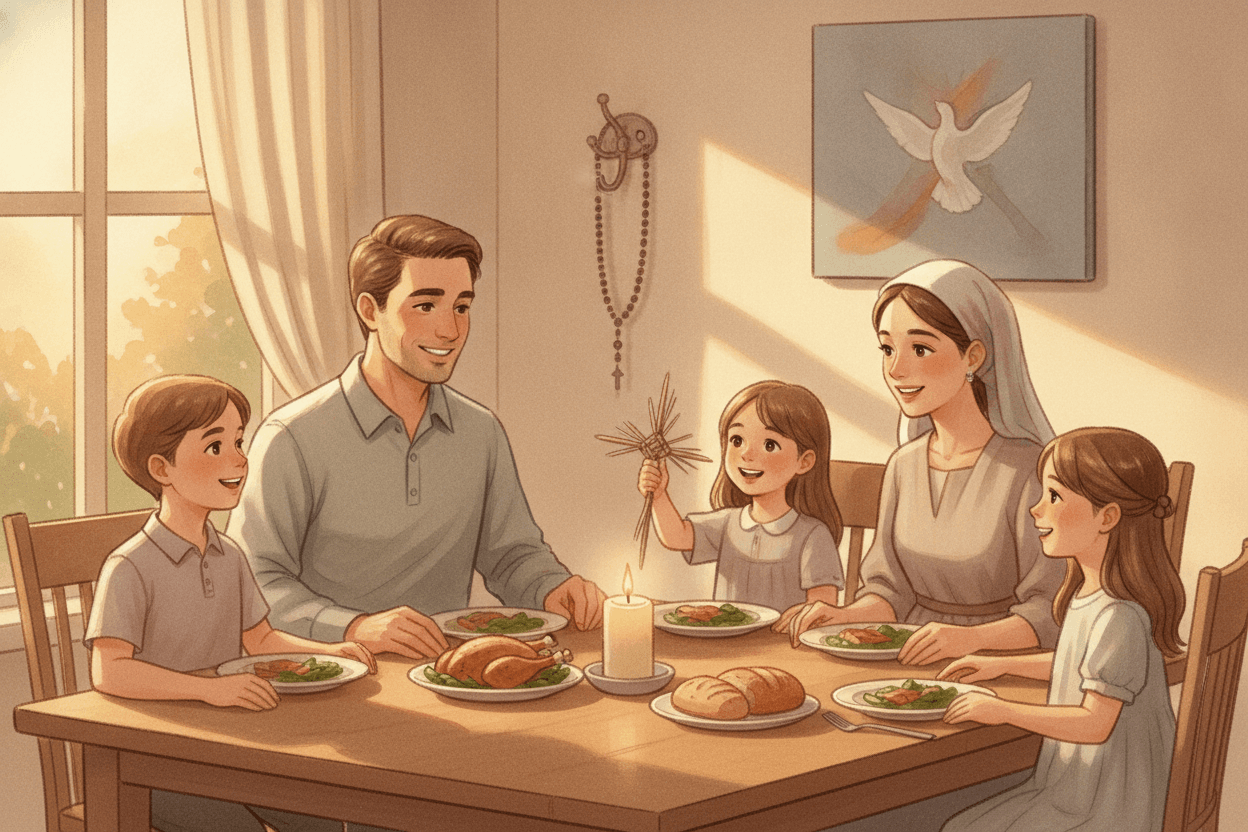
By Sunday afternoon, our palms are usually already looking tired. One is tucked behind a car seat, one has shed little green bits on the kitchen floor, and somebody has tried to turn one into a sword. That is not a failed Palm Sunday. It is actually a good opening. The palm in your child’s hand can bring the whole story back: people welcomed Jesus, called out to him, and then followed him into a hard week.
Keep the plan small enough to do even when dinner is late and someone cannot find a shoe. Read Zechariah 9:9 and Matthew 21:1–11 together. You do not need a long explanation. Just point out what your child can see in the story: Jesus is a king, but he rides a donkey instead of a war horse. The crowds welcome him with branches. Jesus comes gently, not showing off or pushing people around. For a younger child, that may be plenty.
At Mass, choose one thing to notice ahead of time. Maybe it is the palms and the procession. Maybe it is listening for the people’s shout: “Hosanna to the Son of David! Blessed is he who comes in the name of the Lord!” Tell your child, “When we hear that, we are welcoming Jesus too.” One small thing we tried was giving each child a single mission: watch for the palms, listen for the Gospel, or remember one word from the crowd. It gave their wiggly bodies somewhere to put their attention.
After Mass, make a simple palm cross if your parish allows you to take a palm home, or place one where everyone will see it: beside a family crucifix, on the fridge, or near the dinner table. It does not have to look like something from a craft store. At our table, a slightly crooked palm cross has done more work than a carefully planned lesson. It has prompted the useful questions all week: Why did Jesus ride a donkey? Why were people happy? What happened after Palm Sunday?
Here is a low-pressure plan for this week: read Zechariah 9:9 and Matthew 21:1–11; choose one thing to watch or listen for at Mass; make or display one palm cross; and ask one dinner question, such as, “What kind of king is Jesus?” If the conversation lasts two minutes, that counts. If it turns into a discussion about donkeys, that counts too. Aim for one faithful moment, not a flawless Holy Week lesson. And if your kids respond well to pictures and stories, pull out the Triumphal Entry comic for one more simple family conversation.
Hosanna to the Son of David! Blessed is he who comes in the name of the Lord!
Frequently asked questions
How can I explain Palm Sunday to my child?
Start with the simple picture: people in Jerusalem welcomed Jesus by waving branches and cheering for him. Explain that the palm is a sign of saying, “Jesus, we welcome you.” Then add that Jesus is a King, but a gentle and humble one.
Why did Jesus ride a donkey on Palm Sunday instead of a horse?
Jesus chose a donkey to show what kind of King he is. He had true authority, but he did not come like a warrior or conqueror trying to frighten people. His humble entrance fulfilled God’s promise in Zechariah 9:9 and showed that he came in peace to save his people.
What does Hosanna mean for kids?
Hosanna is both a shout of praise and a cry for help. The crowd was welcoming Jesus and asking God to save them. You can tell children, “They were cheering for Jesus because they knew they needed him.”
What Bible verses should we read with children before Palm Sunday Mass?
Read Zechariah 9:9 first, which promises a king who will come riding on a donkey. Then read Matthew 21:1–11 and help children notice that Jesus intentionally rides the colt into Jerusalem. These passages show that Jesus is God’s promised King.
How can our family celebrate Palm Sunday at home?
Place your palm in the center of the table and ask each child to finish the sentence, “Jesus is my King when I…” Encourage specific answers, such as sharing, listening, helping, or apologizing. You can also have children draw a donkey and write, “God keeps his promises.”
How do I connect Palm Sunday to Holy Week for my children?
Remind children that Palm Sunday is joyful, but Jesus is also beginning his journey toward the Cross. He saves us not by showing off power, but by loving, serving, and giving himself for us. Invite your family to choose one humble act of love to practice during Holy Week.
Sources: bible.usccb.org · bible.usccb.org · bible.usccb.org · usccb.org · vatican.va · wordonfire.org · usccb.org · usccb.org
Scripture quotations in this article use the NABRE translation.