What the Five Smooth Stones Really Mean in 1 Samuel 17
Why did David choose five smooth stones when one defeated Goliath? A close reading of 1 Samuel 17 reveals practical preparation, courageous faith, and confidence in the Lord rather than a hidden symbo
“Why did David take five stones if he only needed one?” It is exactly the kind of intelligent question a preteen asks—and Scripture invites us to answer from the text rather than from a clever theory. The stones are not a secret code; they belong to a true account of preparation, courage, and confidence in the Lord.
The Short Answer: Scripture Does Not Assign a Secret Meaning
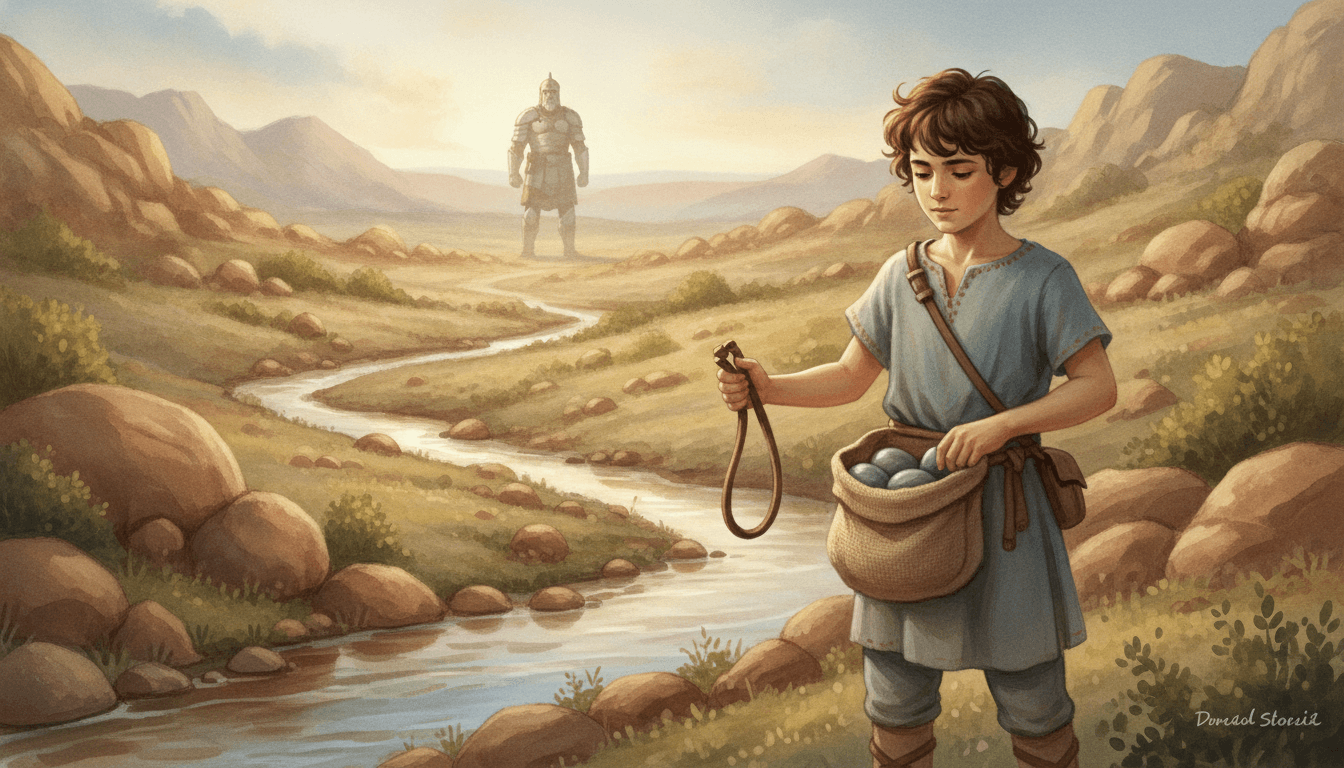
Picture David bending beside the wadi, testing stones with a shepherd’s practiced hand. He chooses five that are smooth, slips them into his bag, takes up his sling, and walks toward Goliath. The inspired author gives us these concrete details, but never pauses to say that each stone represents a virtue, sacrament, prayer, or biblical book. The short and honest answer is that 1 Samuel does not assign a secret doctrinal meaning to either the number five or the stones.
This matters because Catholic interpretation begins with the literal sense of Scripture. The Catechism defines that sense as “the meaning conveyed by the words of Scripture and discovered by exegesis, following the rules of sound interpretation” (CCC 116). In other words, we first ask what the sacred author is actually telling us. Here, David rejects armor he has not tested and relies upon tools he already knows how to use. The stones belong to a real shepherd’s equipment within a real historical conflict.
That does not mean Catholics must read the passage as nothing more than an account of ancient combat. Scripture invites us to recognize spiritual meanings, especially the way David, the anointed king, points forward to Christ. Jesus is the true King who conquers the enemies of God’s people—not merely a Philistine warrior, but sin, death, and the devil. Yet the Catechism cautions that all the senses of Scripture are based on the literal sense (CCC 116). A spiritual interpretation should grow from the text rather than replace it.
Why five stones, then? The text does not tell us. David may simply have prepared wisely in case he needed more than one attempt or faced further danger. What the passage emphasizes is not a code hidden in his shepherd’s bag, but the source of his confidence. David approaches Goliath in the name of the Lord and declares that the battle belongs to God. His skill is genuine, his preparation is sensible, and his trust is firmly placed in the Lord rather than in weapons or physical strength.
Here’s how I’d teach this to preteens: make two columns labeled “What Scripture Says” and “Helpful Teaching Images.” Under the first, place David’s five stones, sling, shepherding experience, and trust in God. Under the second, families may choose five faith practices—perhaps prayer, Scripture, Mass, the sacraments, and wise Christian friendship. Those comparisons can help children remember the lesson, but they are devotional applications, not official explanations of the stones. Catholic kids can understand that distinction, and respecting it teaches them to love Scripture without turning every detail into a secret formula.
Then, staff in hand, David selected five smooth stones from the wadi and put them in the pocket of his shepherd’s bag. With his sling in hand, he approached the Philistine.
What the Stones Reveal About David’s Preparation
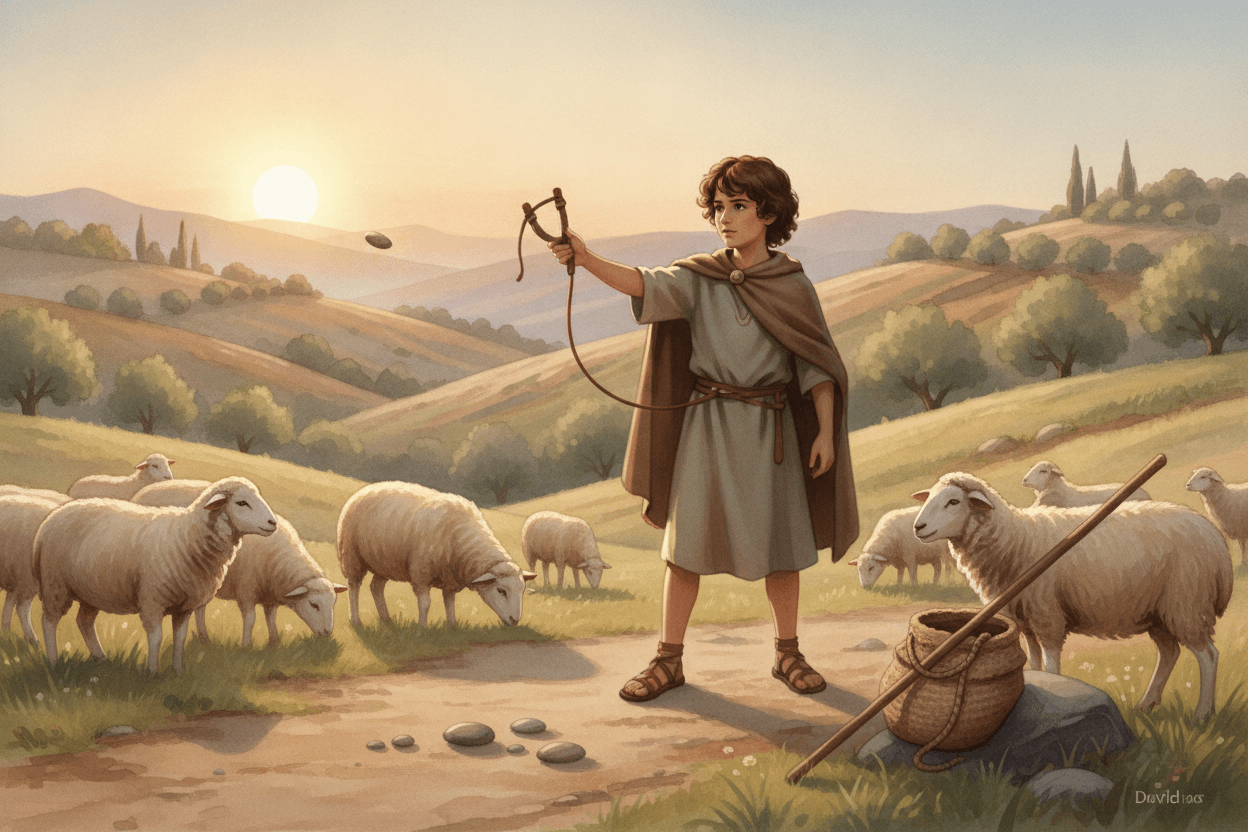
David bends down at the wadi and chooses stones that will sit properly in his sling. He does not grab the first handful of rocks or rush toward Goliath empty-handed. He selects five smooth stones, places them in the pocket of his shepherd’s bag, and approaches with the equipment he knows how to use (1 Samuel 17:40). These are not royal weapons, but neither are they random objects. They are the familiar tools of a shepherd who has spent long hours protecting a flock.
That detail matters because David’s trust in God is not opposed to preparation. Before facing Goliath, David explains that he has defended his sheep from lions and bears. His courage has been formed through earlier responsibilities, many of them carried out when no crowd was watching. Saul’s armor does not fit him, so David refuses to pretend he is a trained soldier. Instead, he prudently chooses the skills and tools already tested in his own life.
Scripture tells us, “Thus David prevailed over the Philistine with a sling and a stone; he struck the Philistine mortally, and did it without a sword” (1 Samuel 17:50, NABRE). The point is not that skill alone saved Israel. David plainly declares that the battle belongs to the Lord. Yet God’s grace works through David’s practiced aim, sound judgment, and willingness to act. As the Catechism reminds us, human cooperation with grace is itself made possible by God’s prior action (CCC 2008). David receives God’s help actively rather than passively.
Here’s how I’d teach this to preteens: ask what David was doing before anyone knew Goliath’s name. He was tending sheep, obeying his father, learning responsibility, and becoming skilled with a sling. Then ask what quiet preparation looks like in their lives. A child who practices telling the truth in small matters is better prepared when friends pressure him to lie. A child who learns to pray when life is calm has words to bring before God when fear arrives. Regular Mass, Scripture reading, honest conversations with parents, and receiving the sacraments are not magic formulas. They are ordinary ways children cooperate with the grace God gives.
The five stones therefore reveal something more grounded than a secret code: David came prepared. He trusted the Lord enough to use his abilities with humility and courage. Catholic formation should give children the same balanced lesson. We do not tell them that faith makes practice unnecessary, nor that success depends entirely on their own talent. We teach them to prepare carefully, choose prudently, pray faithfully, and then take the next right action. God had been preparing David through ordinary shepherding long before the public battle began.
Thus David prevailed over the Philistine with a sling and a stone; he struck the Philistine mortally, and did it without a sword.
David’s Real Strength Was Trust in the Lord
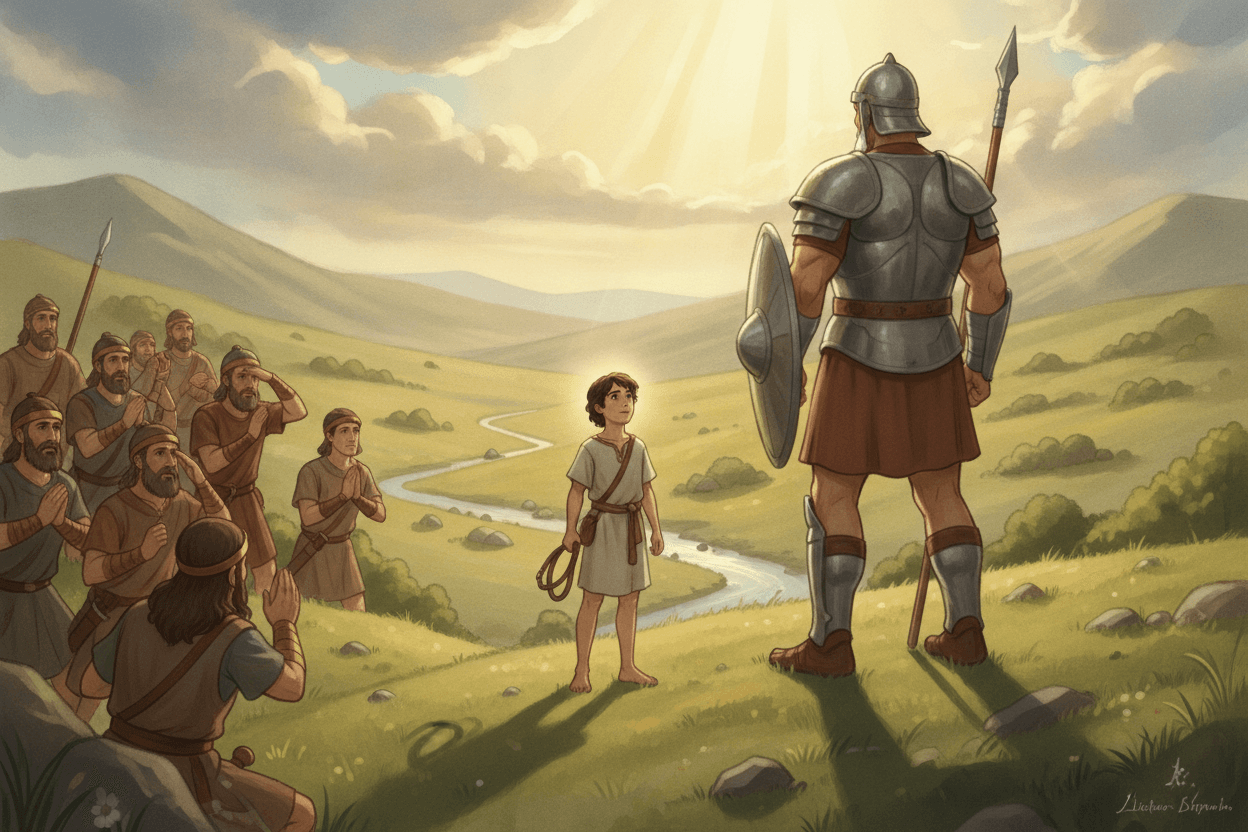
Saul’s armor must have looked impressive: a helmet, a coat of mail, and a sword fit for a king. Yet when David tried to walk in it, he could not move freely. He set it aside and approached Goliath with a shepherd’s staff, a sling, and stones gathered from the wadi. Across the valley stood a trained warrior armed with sword, spear, and scimitar. By every ordinary measure, David was outmatched.
But David did not measure the battle only by what his eyes could see. He knew the covenant God of Israel—the God who had chosen his people, delivered them, and remained faithful to them. David told Goliath exactly where his confidence rested: not in his aim, his courage, or even his experience protecting sheep, but in the name of the Lord. His skill mattered, but it was not his savior.
This distinction is especially important when teaching children. The story is not saying, “Believe in yourself, and you can defeat any giant.” Nor is it a lesson in positive thinking. David acts boldly because he believes God is living, faithful, and able to save. He announces, “All this multitude, too, shall learn that it is not by sword or spear that the LORD saves. For the battle is the LORD’s, and he shall deliver you into our hands” (1 Samuel 17:47, NABRE).
As the Catechism reminds us, faith is the theological virtue by which we believe in God and in all that he has revealed because he is truth itself (CCC 1814). That kind of faith does not make David passive. He still selects the stones, takes up the sling, walks toward Goliath, and releases the stone. Trust in God and responsible action belong together. Grace does not erase David’s preparation; it enables him to use what he has been given with courage and humility.
Here’s how I’d teach this to preteens: ask them to compare three sources of apparent strength—Saul’s armor, Goliath’s weapons, and David’s trust in the Lord. Then name the difference between confidence in God and confidence that we can control every outcome. A child facing bullying, fear, or peer pressure should pray, practice virtue, and seek help from parents, teachers, or the Church. Trusting that the battle belongs to the Lord does not mean handling danger alone. It means acting faithfully while remembering that our hope rests in God, not in our own strength.
All this multitude, too, shall learn that it is not by sword or spear that the LORD saves. For the battle is the LORD’s, and he shall deliver you into our hands.
How David’s Victory Points Catholic Families to Christ
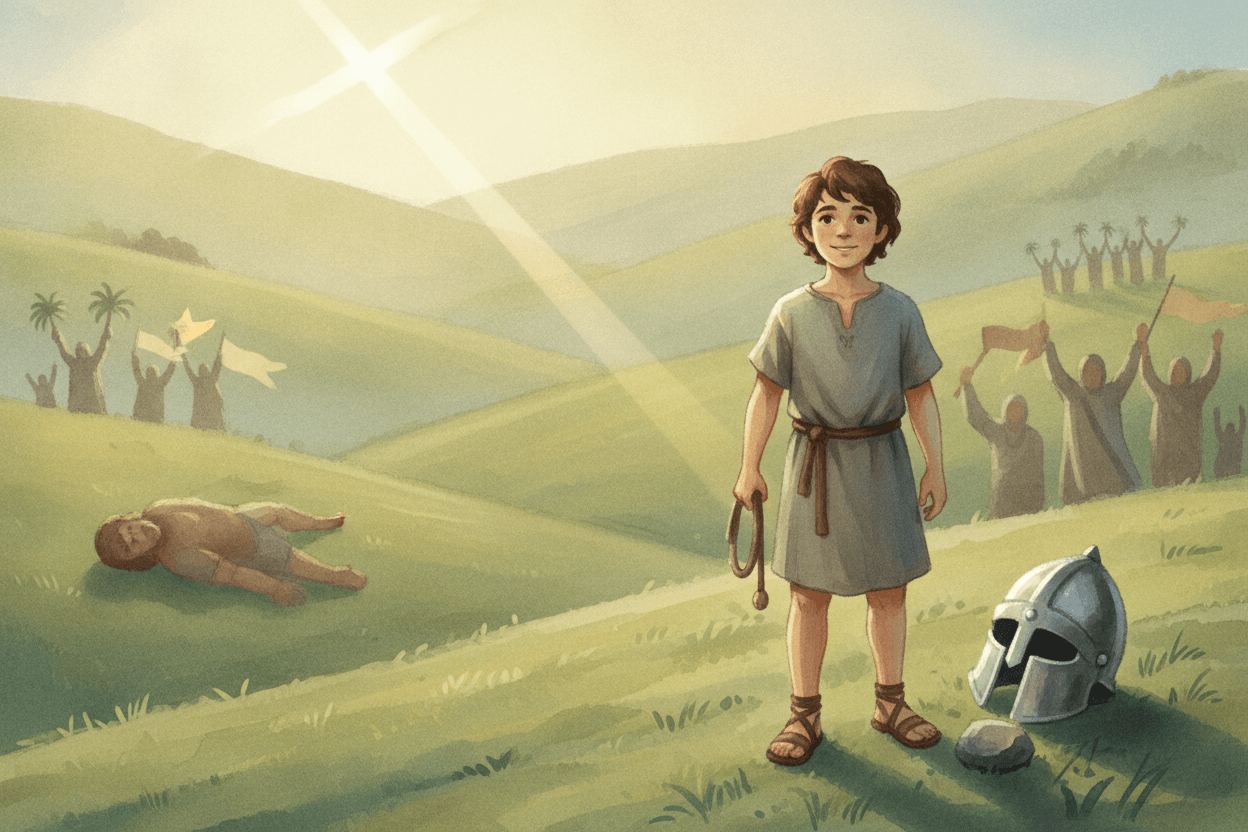
A child once stopped me in the middle of this lesson and asked, “So, is David supposed to be Jesus?” That is exactly the kind of intelligent question we should welcome. The careful answer is: David is not Jesus, but he can be understood as a figure, or type, of Christ. The event first has its own literal sense. David, a young shepherd already anointed by Samuel, truly confronts Goliath and delivers Israel from a terrifying enemy. We should not skip over that historical meaning in our eagerness to find a spiritual lesson.
At the same time, Scripture invites us to recognize how God’s earlier works prepare for greater works to come. The Catechism explains that the Church reads the Old Testament in the light of Christ crucified and risen (CCC 128). Typology identifies in God’s works under the Old Covenant prefigurations of what he accomplishes fully in Christ (CCC 129). This does not erase the Old Testament story or turn every detail into a secret symbol. As CCC 130 teaches, the Old Testament retains its own value even as its meaning is disclosed more fully in Christ.
David is the unlikely, anointed king who defeats the enemy threatening God’s people. Jesus, the Son of David and the definitive Anointed One, wins a far greater victory. He conquers not merely an armed champion but sin, death, and the devil through his Passion, Resurrection, and Ascension. David’s declaration in 1 Samuel 17:45 directs our attention away from human weapons and toward the Lord’s saving power. Likewise, Christ’s victory does not come through worldly force. It comes through obedient love, the Cross, and the power of God.
Here’s how I’d teach this to preteens: draw two columns labeled “David” and “Jesus.” Under David, write “anointed,” “sent to face an enemy,” “appears weak,” and “delivers God’s people.” Under Jesus, write “Christ—the Anointed One,” “confronts sin and death,” “accepts the apparent weakness of the Cross,” and “saves humanity.” Then ask where the comparison stops. David is a sinner who later needs mercy; Jesus is the sinless Son of God. David’s victory is temporary and earthly; Christ’s Paschal victory is definitive. This helps children appreciate typology without confusing resemblance with identity.
For Catholic families, this reading also keeps the story from becoming a message about defeating every problem through enough confidence. Our hope rests first in what Christ has already done. Through Baptism, we are joined to his death and Resurrection; in the Eucharist, he strengthens us to live as members of his Body. Children still need courage when facing bullying, fear, or peer pressure, but Christian courage is not solitary heroism. It is cooperation with grace. David points beyond himself to the true King, and families can teach children to meet their struggles from within Christ’s victory rather than trying to manufacture one alone.
David answered him: "You come against me with sword and spear and scimitar, but I come against you in the name of the LORD of hosts, the God of the armies of Israel whom you have insulted."
When Symbolic ‘Five Stones’ Lessons Help—and When They Do Not
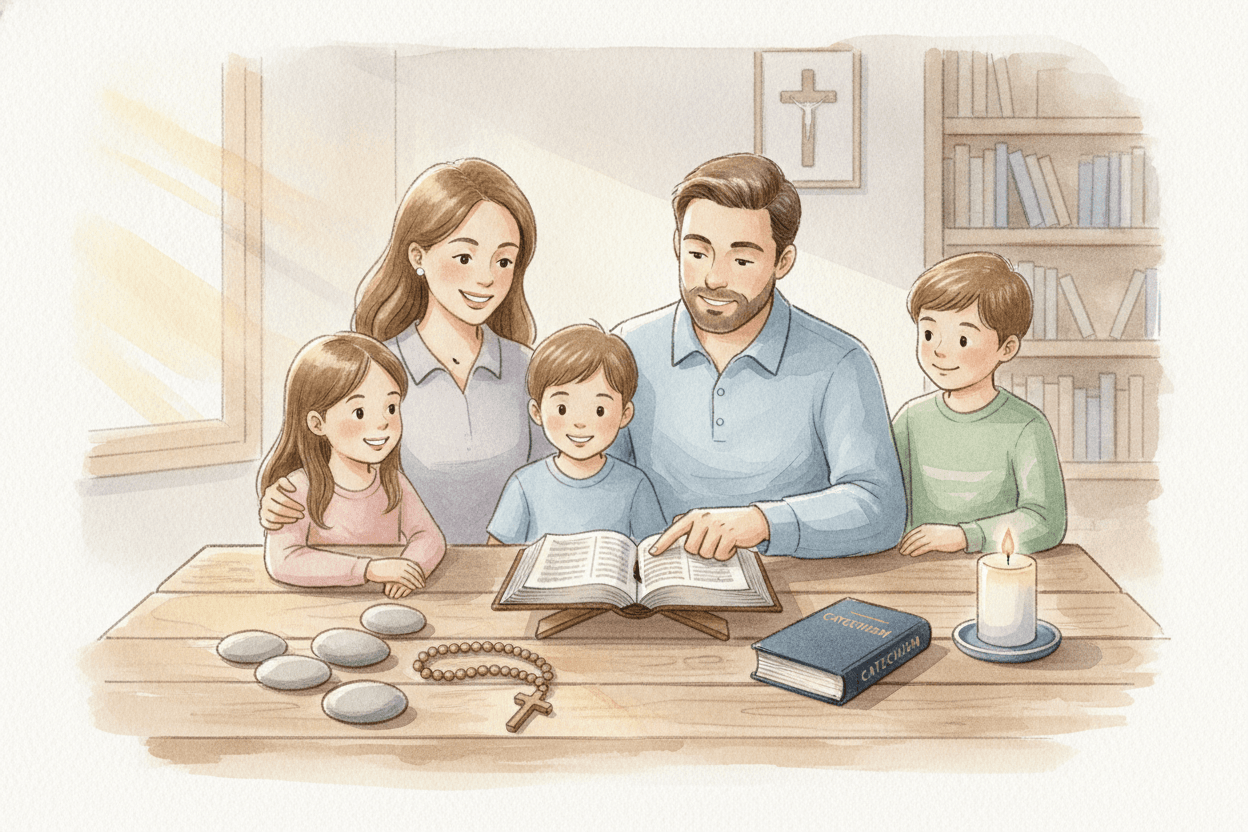
A child in a parish classroom once placed five stones on the table and labeled them Bible, Church teaching, sacraments, prayer, and family. Within minutes, the class could recall all five. That is the genuine value of a devotional list: it gives children a concrete image for remembering the ordinary ways God forms and supports them. The list can serve a lesson well, provided we tell children honestly that these labels are ours, not meanings assigned by the biblical author.
The text itself remains our starting point: "Then, staff in hand, David selected five smooth stones from the wadi and put them in the pocket of his shepherd’s bag. With his sling in hand, he approached the Philistine." David chose suitable stones for a weapon he already knew how to use. The passage does not say that each stone represented a particular belief or practice. Scripture invites us to notice David’s preparation, courage, and reliance on God without turning every narrative detail into a coded message.
The Catechism teaches that Scripture has both a literal sense and spiritual senses, but spiritual interpretation must remain grounded in the unity of Scripture, the Church’s living Tradition, and the coherence of the faith (CCC 115–119). A five-stone lesson can fit within that discipline when it is clearly presented as an illustration. Scripture teaches us God’s word; the Catechism helps us understand the faith; the sacraments communicate grace; prayer trains the heart to turn toward God; and faithful family or parish life gives us companions and guidance. These are sound Catholic realities even though 1 Samuel 17 does not connect them individually to David’s stones.
Here’s how I’d teach this to ten- to thirteen-year-olds: place five stones in a bag, assign each one of those practices, and then ask which practice might help when facing bullying, fear, dishonesty, or peer pressure. A child might choose prayer before a difficult conversation, Scripture when confused about what is right, or help from a parent, priest, catechist, or trusted parishioner when the problem feels too large. Then add the essential clarification: these practices are not magic objects or techniques for controlling an outcome. They dispose us to receive grace and cooperate with God.
The lesson becomes unhelpful when someone claims that five is a secret biblical code, that possessing five particular devotions guarantees victory, or that repeating a formula forces God to act. The Church warns against superstition, which can wrongly attribute almost magical power to religious practices themselves (CCC 2111). David did not win because he discovered a hidden numerical key. Nor should children be told that sufficient prayer will make every hardship disappear. God may deliver us from a trial, or he may give us courage, wisdom, and faithful help within it. Keep the memorable stones if they serve your family, but keep the distinction clear: the image is a teaching aid; God’s grace is the source of strength.
Then, staff in hand, David selected five smooth stones from the wadi and put them in the pocket of his shepherd’s bag. With his sling in hand, he approached the Philistine.
Build a Five-Stone Faith Practice This Week
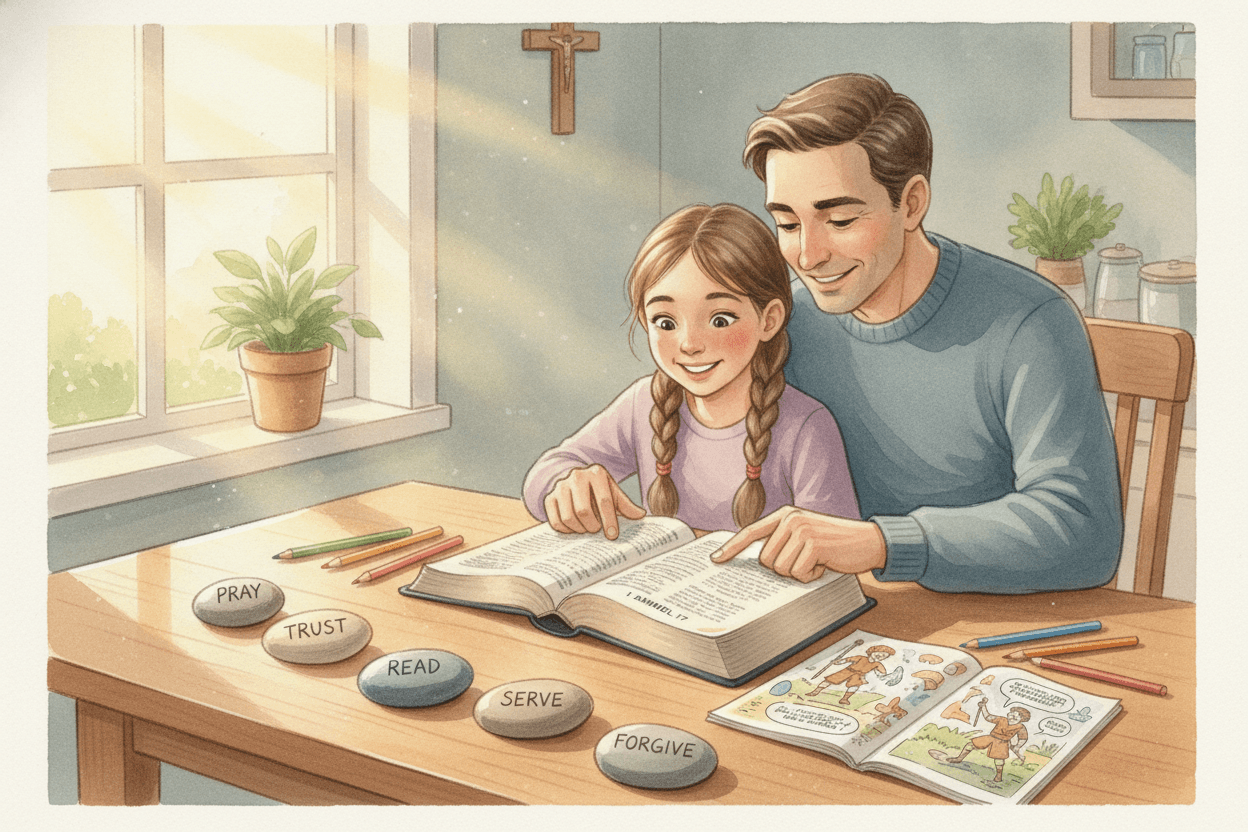
Set five smooth stones—or five paper ovals—on the kitchen table, and watch how quickly a preteen wants to know what each one means. Before anyone labels them, open the Bible and read 1 Samuel 17 together. If the whole chapter feels long, divide the reading among family members and pause at verses 32–50. Ask your child to notice what David refuses, what he chooses, and what he says about the Lord. This keeps the activity anchored in the biblical account rather than turning the stones into a secret code.
Next, invite each person to name one present-day “giant.” For ages 10–13, the answer might be bullying, peer pressure, fear of failure, exclusion from a friend group, dishonesty online, or anxiety about school. Do not rush to solve it. Ask, “What makes this feel bigger than you?” and “Where might God already be preparing you to respond?” David had learned courage and skill during ordinary days as a shepherd. In the same way, children grow through small, repeated acts of faithfulness before a difficult moment arrives.
Now label the five stones: prayer; Scripture; Mass and the sacraments; wise help; and one practiced virtue. Let your child choose the virtue needed for the particular challenge—perhaps courage, patience, honesty, humility, or perseverance. As the Catechism reminds us, fortitude gives firmness in difficulties and constancy in pursuing the good (CCC 1808). Here's how I'd teach this: prayer turns us toward God, Scripture trains us to recognize his voice, the sacraments give grace, wise help keeps us from facing trouble alone, and practiced virtue helps us choose the good when choosing becomes costly.
Be clear that these five labels are a mnemonic, not a magic formula. The Bible does not say that David selected five stones because each represented a spiritual practice, nor does the Church teach that repeating five actions guarantees a desired outcome. David’s confidence rested in the Lord, not in the stones. Our habits matter because they dispose us to cooperate with grace; they do not control God or remove every hardship. Children are capable of understanding that distinction, and Catholic formation should respect their intelligence.
Keep the stones somewhere visible for one week. Each evening, ask which “stone” the family practiced that day. Perhaps someone prayed before a hard conversation, read ten verses of Scripture, went to Confession, sought advice from a parent, or practiced courage by sitting with a lonely classmate. At the end of the week, read the David and Goliath comic together and ask your child to identify where the comic follows the biblical text and where it adds imaginative details. That simple comparison builds biblical literacy while reinforcing the central lesson: God prepares his people through ordinary faithfulness, and we never have to face our giants apart from him.
Then, staff in hand, David selected five smooth stones from the wadi and put them in the pocket of his shepherd’s bag. With his sling in hand, he approached the Philistine.
Frequently asked questions
Why did David choose five smooth stones if he only used one?
1 Samuel 17 does not explain why David chose five. He may have prepared for another attempt or additional danger, showing practical judgment rather than doubt in God.
What do David’s five stones symbolize in the Bible?
Scripture does not assign a symbolic meaning to each stone or to the number five. Families may connect them devotionally with prayer, Scripture, Mass, the sacraments, or Christian friendship, but those are teaching aids rather than the passage’s official meaning.
Why were smooth stones important for David’s sling?
Smooth stones were suitable ammunition for the shepherd’s weapon David already knew how to use. Their selection shows that he approached Goliath with practiced skill and sensible preparation.
What is the main lesson of David and Goliath for Catholic children?
David shows that trusting God does not mean neglecting preparation. Children can learn to develop good habits, use their abilities wisely, pray faithfully, and act courageously while remembering that their strength ultimately comes from the Lord.
How does David’s victory over Goliath point to Jesus?
David, the Lord’s anointed king, can be understood as foreshadowing Christ. Jesus is the true King who defeats the deeper enemies of God’s people: sin, death, and the devil.
How should Catholics interpret the five smooth stones?
Catholic interpretation begins with the literal sense: David selected real stones for a real battle using familiar shepherding tools. Spiritual applications are valuable when they grow from that literal meaning instead of turning details into a secret code.
Sources: bible.usccb.org · pewresearch.org · pewresearch.org · pewresearch.org · deseret.com · catholicmom.com · wordonfire.org
Scripture quotations in this article use the NABRE translation.