5 David and Goliath Devotionals for Catholic Families
Turn five smooth stones into five memorable family devotionals for ages 6–9. In ten minutes each evening, explore David’s courage, ask honest questions, pray together, and discover why his confidence
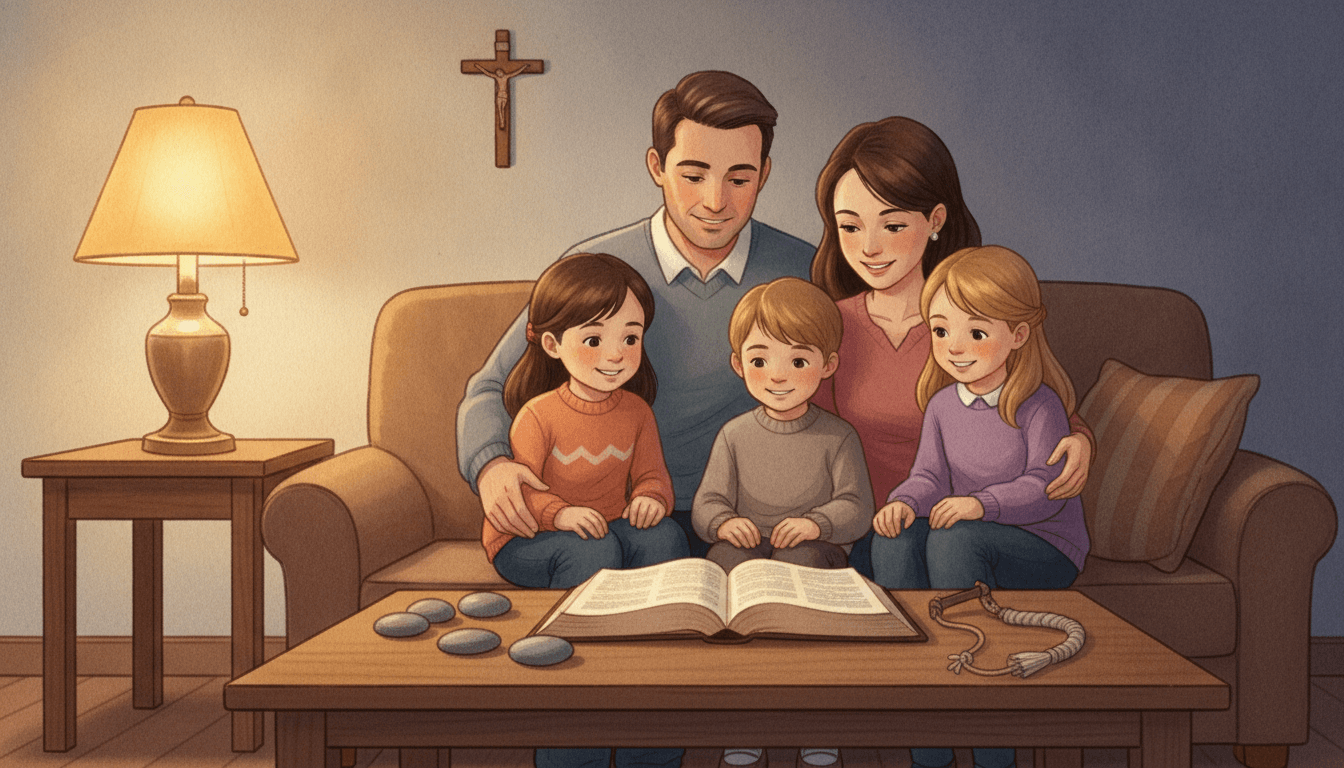
A child may forget a long explanation about courage, but remember holding five smooth stones while hearing David’s story. This five-night David and Goliath family devotional gives children ages 6–9 ten minutes each evening to hear Scripture, ask honest questions, pray, and discover that David’s confidence rested not in himself, but in God.
Night 1: Name the Giant
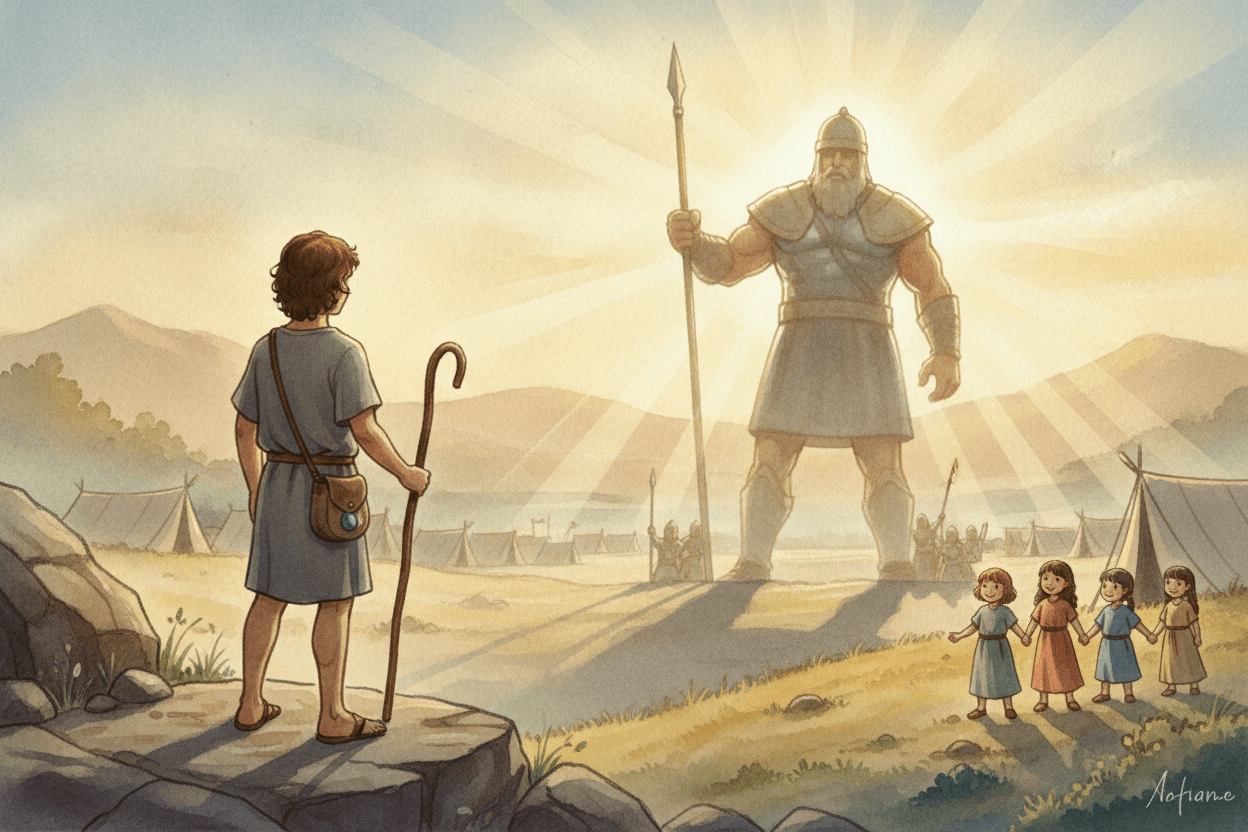
A child draws a giant differently than an adult would. One gives him enormous boots; another fills the page with sharp teeth; a third draws only a dark shape towering over a tiny person. Begin this first devotional with paper and crayons nearby, but do not explain the activity yet. Read 1 Samuel 17:1–11 aloud and let the scene do its work: two armies, a frightening champion, and God’s people frozen by what they see.
Next, repeat verse 4 together as the memory verse. For children ages six to nine, the concrete detail of Goliath’s height makes the danger memorable. Explain that the Israelites were facing a real warrior, not an imaginary monster. Yet their fear also narrowed their attention until Goliath seemed to be the greatest power in the valley. Scripture invites us to notice that fear can distort our vision. A problem may be serious without being greater than God.
Now ask each child to draw or name a fear that feels enormous. It might be sleeping alone, being left out, making a mistake at school, hearing parents argue, or worrying about someone who is sick. Do not rush to correct the fear or say that it is silly. Catholic formation respects a child’s intelligence and experience. Listen first, then ask, “What can fear make us forget about God?” Children may answer that God is present, that he hears prayer, or that he sends people to help us. If they struggle, offer those possibilities without demanding a particular response.
As the Catechism reminds us, Christian hope rests on trusting Christ’s promises rather than relying only on our own strength (CCC 1817). That does not mean faithful people never feel afraid. It means fear does not receive the final word. Here’s how I’d teach this distinction: courage is not pretending the giant is small; courage is remembering that the giant is not God. David’s confidence will become clearer later in the chapter, but tonight let the family remain with the contrast between Goliath’s visible size and God’s often-unseen faithfulness.
Finish by placing the drawings or written fears beside a Bible or family crucifix. Invite each child to name one fear aloud, while allowing anyone who prefers privacy to remain silent. Then pray simply: “Lord God, you saw David and the frightened Israelites. You also see what frightens us. Help us remember that you are present, wise, and faithful. Give us courage to trust you and to ask for help when we need it. Amen.” Keep the whole devotion to about ten minutes. Its strength comes not from a long explanation, but from reading, remembering, speaking honestly, and praying together.
A champion named Goliath of Gath came out from the Philistine camp; he was six cubits and a span tall.
Night 2: Serve God in Small Tasks
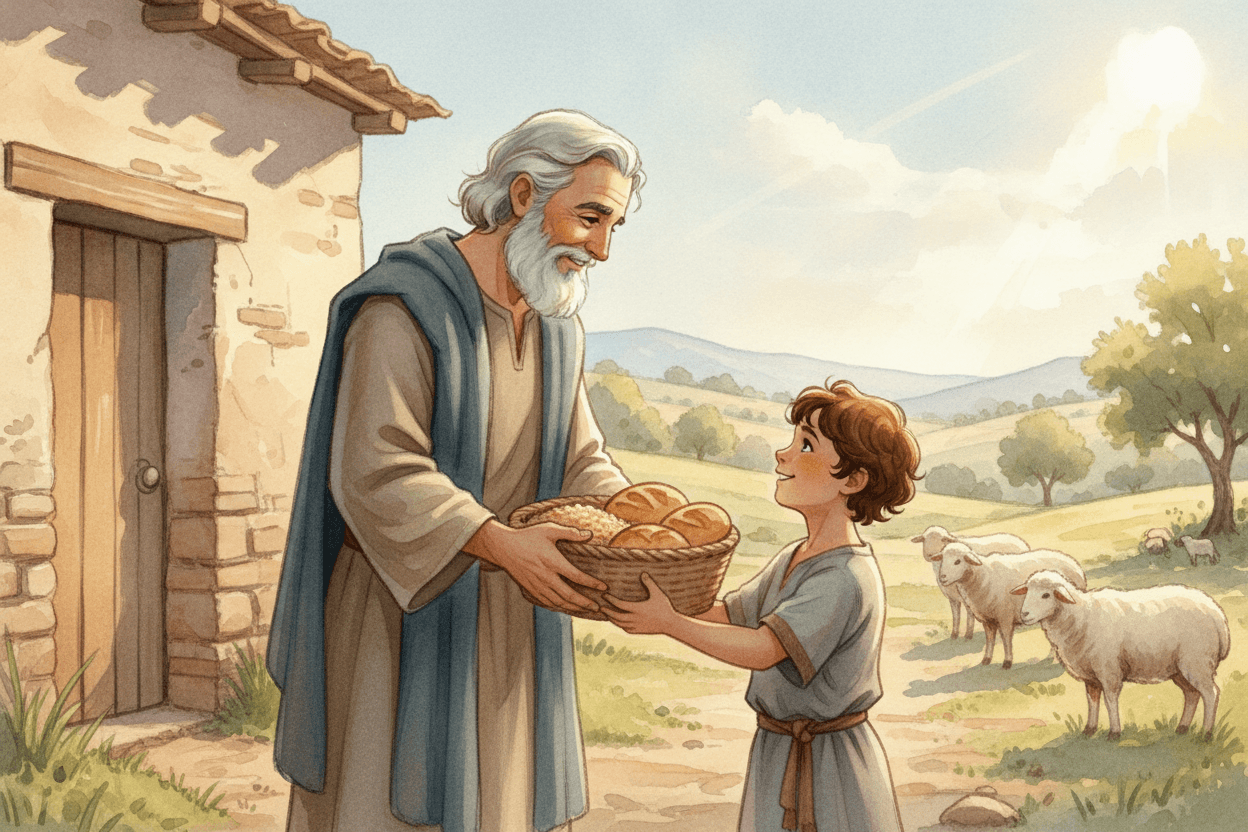
Place a loaf of bread, a dinner roll, or even a box of crackers in your child’s hands. Ask them to carry it across the room and deliver it to another family member. It seems almost too ordinary to matter—and that is precisely the point. Before David stood before Goliath, he completed a simple errand for his father.
Read 1 Samuel 17:12–20 together, paying attention to the details. David was caring for sheep when Jesse told him to bring food to his brothers at the battle camp. Jesse said, “Take this ephah of roasted grain and these ten loaves for your brothers and bring them quickly to your brothers in the camp.” David did not know that this assignment would place him at the center of Israel’s crisis. He simply listened, made sure the sheep were cared for, gathered the provisions, and went as his father directed.
Help your children learn 1 Samuel 17:17 as the memory verse. For ages six to nine, movement makes the words easier to retain: hold up pretend grain, count ten imaginary loaves, point toward the “camp,” and walk quickly across the room. Repeat the verse two or three times. Then ask what might have happened if David had complained that carrying food was unimportant. Scripture invites us to notice that God’s larger purposes often begin within duties that look small.
Here’s how I’d teach this without turning obedience into mere rule-following: David’s action joined listening, responsibility, and love. He did not abandon his sheep carelessly in order to chase excitement. He left the flock with a keeper and then served his family. Children can do the same when they feed a pet, put away shoes, bring a diaper for a younger sibling, or set napkins on the table. The size of the task does not determine the amount of love offered to God through it.
Ask each person, “What small job can you do with love this week?” Keep the answers concrete and age-appropriate. A child might choose to clear one plate after dinner, pack a school bag without repeated reminders, or help a sibling find something. Parents can choose a task too. This shared practice reflects the Church’s teaching that the home is a primary place of formation in faith; as the Catechism reminds us in CCC 2226, parents teach faith not only through instruction but through the daily witness of Christian life.
Finish by placing the bread or household item near your family Bible. Pray: “Lord God, give us willing hearts. Help us listen, serve our family, and complete small tasks with love. Like David, may we be faithful in ordinary duties and ready when you call us to something more. Amen.” During the week, quietly notice the chosen acts of service. A simple “You served with love today” connects the child’s action back to Scripture without making service into a performance.
Jesse said to his son David: "Take this ephah of roasted grain and these ten loaves for your brothers and bring them quickly to your brothers in the camp."
Night 3: Take Off the Wrong Armor
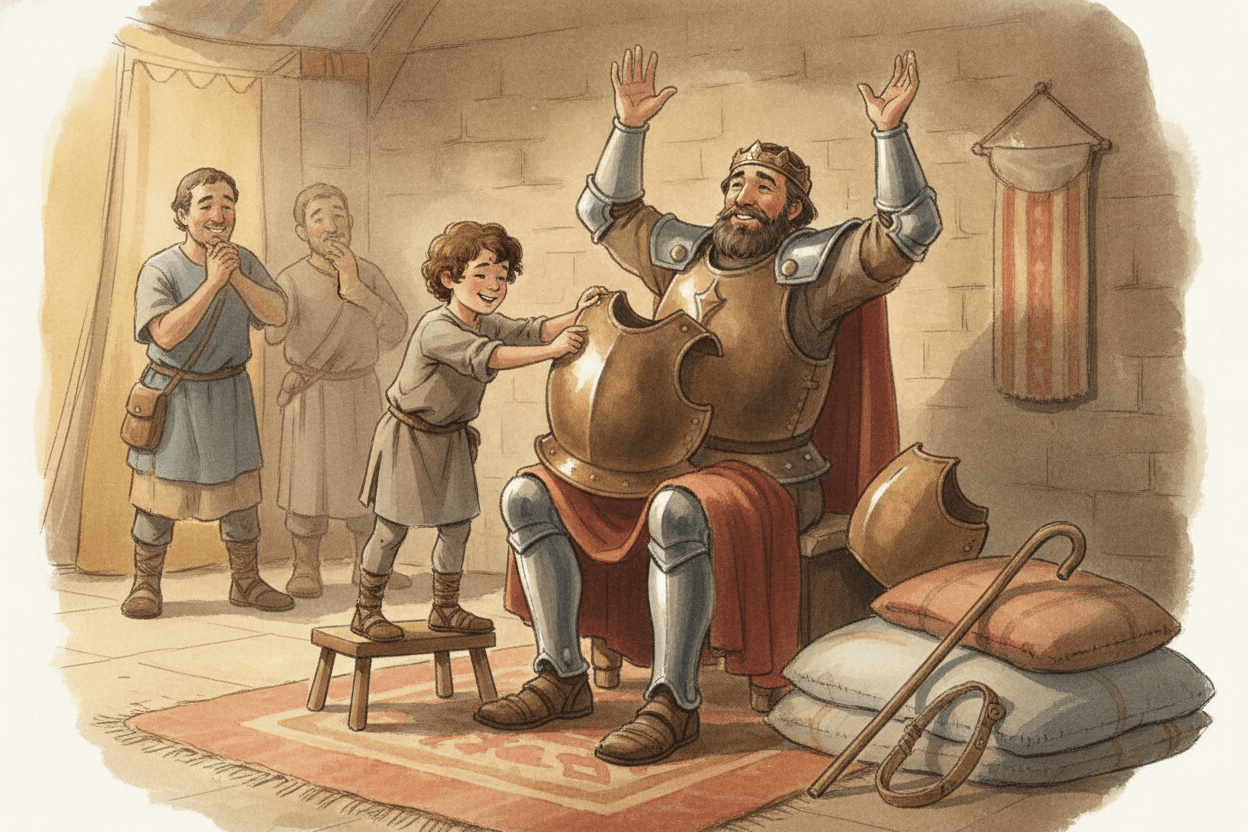
Set an oversized coat on the floor beside a pair of adult shoes. After reading 1 Samuel 17:32–40 aloud, invite each child to put them on and walk across the room. The sleeves may cover their hands; the shoes may slip off with every step. Let them laugh, but then ask what would happen if they had to complete an important task dressed that way. This concrete experience helps children understand David’s problem: Saul’s armor was impressive, but it prevented David from moving as he needed to move.
Return to verse 39 and have everyone repeat David’s honest words: “I cannot go in these.” David was not refusing help out of pride. He recognized that Saul’s equipment did not fit the way God had prepared him. David knew a shepherd’s staff, a sling, and stones. Those ordinary tools looked weak beside a soldier’s armor, yet David had practiced with them while protecting his father’s flock. His humility allowed him to admit both what he could not use and what he could use well.
Scripture invites us to teach humility more carefully than simply saying, “Do not brag.” Humility is truthfulness before God. It means neither exaggerating our abilities nor denying the gifts God has actually given us. As the Catechism reminds us, every person receives gifts suited to his or her place in God’s plan, and these gifts are meant to serve others (see CCC 2003). David did not pretend to be Saul. He received his own experience and abilities as gifts that could be offered to God.
Ask, “What gifts has God given you to do what is right?” Children may name obvious abilities such as reading, running, drawing, or singing. Help them also notice quieter strengths: listening patiently, remembering to pray, including a lonely classmate, apologizing first, or telling the truth when it is difficult. Catholic children do best when we respect their intelligence, so clarify that a gift does not make someone better than another person. Different gifts carry different responsibilities, and every good gift must be practiced and directed toward love.
Here’s how I’d teach this at home: write each child’s name on a paper shield, then add two or three gifts the family has noticed in that child. Avoid empty praise; be specific. “You notice when your brother needs help” teaches more than “You are amazing.” End by placing the shields near your prayer space and praying: “Lord, thank you for the gifts you have given each of us. Help us refuse what does not fit your call and use our real strengths to choose what is good. Give us David’s humility and trust. Amen.”
David girded himself with Saul’s sword over the armor. He walked with difficulty, however, since he had never worn armor before. He said to Saul, "I cannot go in these, because I have never used them before." So he took them off.
Night 4: Gather Five Reminders of Grace
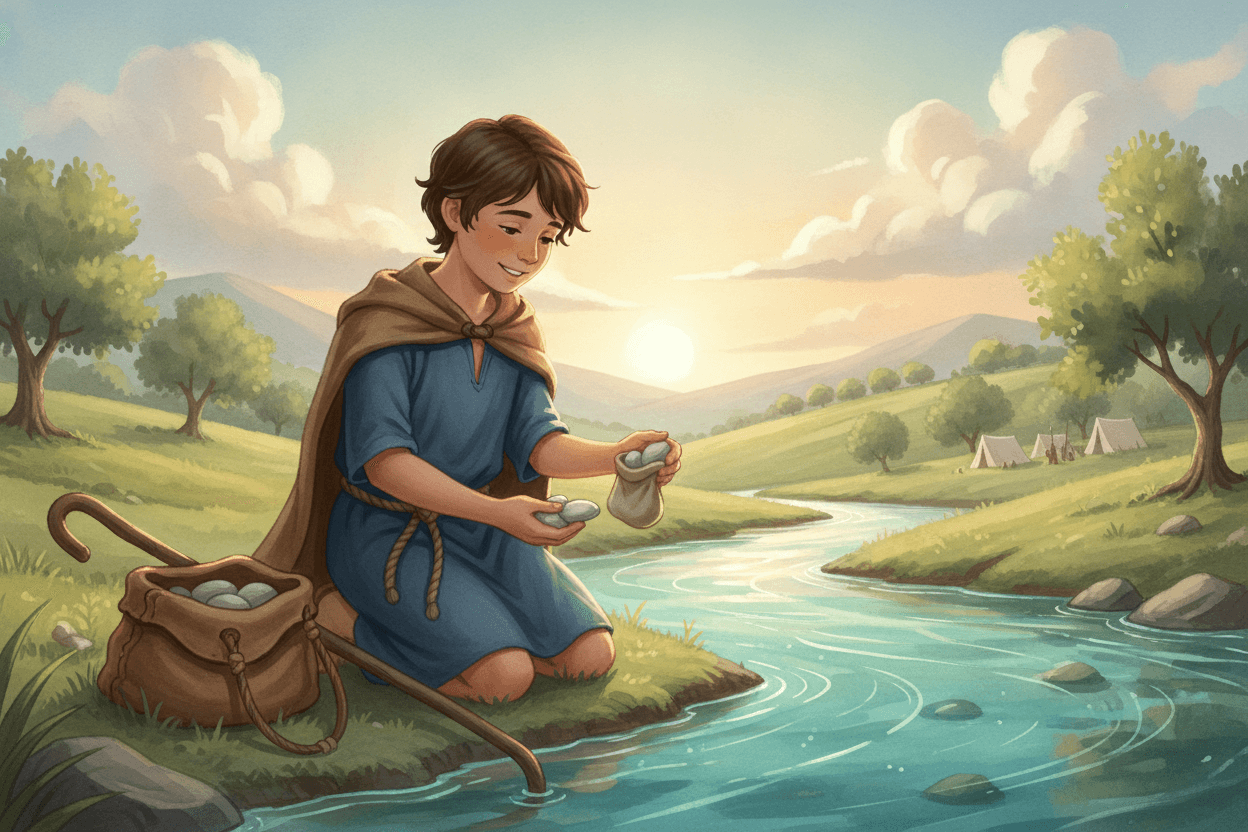
Set five smooth stones on the table before you open the Bible. Children ages six to nine will usually reach for them at once, which is exactly why this scene stays in their memory. Read 1 Samuel 17:40–47 slowly, allowing them to notice David’s staff, shepherd’s bag, sling, and stones. Then repeat the short memory line together: “David selected five smooth stones.” David approached Goliath with ordinary objects he already knew how to use, but his confidence rested in the living God, not in the objects themselves.
Give each child five stones and washable markers. Paper circles work just as well, especially for younger children or when you are gathered around a clean dining table. Label the five pieces prayer, Scripture, the sacraments, courage, and kindness. Here’s how I’d teach this: explain plainly that the Bible does not say David’s stones represented these five things. This is a family mnemonic—a memory aid inspired by the concrete detail in the story—not a literal interpretation of the verse. Catholic children can understand that distinction when we state it clearly.
Take one reminder at a time. Prayer teaches us to turn toward God. Scripture lets us hear the Word God has given his people. The sacraments communicate the grace Christ entrusted to his Church; as the Catechism reminds us, they are effective signs of grace instituted by Christ and entrusted to the Church (CCC 1131). Courage helps us act rightly even when we feel afraid, while kindness gives that courage a loving direction. These five are not interchangeable or equal in precisely the same way: the sacraments have a unique place in Catholic life, while courage and kindness describe virtues we practice with God’s help.
Place the labeled stones in a small bag and invite each child to draw one. Ask for a concrete example: “When could prayer help at school?” “What truth from Scripture do you want to remember?” “How does receiving Jesus in the Eucharist strengthen us?” “When might courage mean telling the truth?” “Who needs kindness tomorrow?” Scripture invites us to see that David did not carry a magical solution. In verses 45–47, he identifies the Lord as the source of deliverance. The stones were real tools; victory came through God’s power.
Finish with one open question: “Which reminder will help you trust God tomorrow?” Let each child answer without correcting or expanding the response too quickly. Place the chosen stone beside a backpack, lunchbox, or family prayer space for the next morning. Then pray: “Lord God, David trusted you when he faced Goliath. Teach us to pray, listen to your Word, receive your grace in the sacraments, act with courage, and show kindness. Help us remember that every good gift comes from you. Amen.”
Then, staff in hand, David selected five smooth stones from the wadi and put them in the pocket of his shepherd’s bag. With his sling also in hand, he approached the Philistine.
Night 5: Give God the Victory
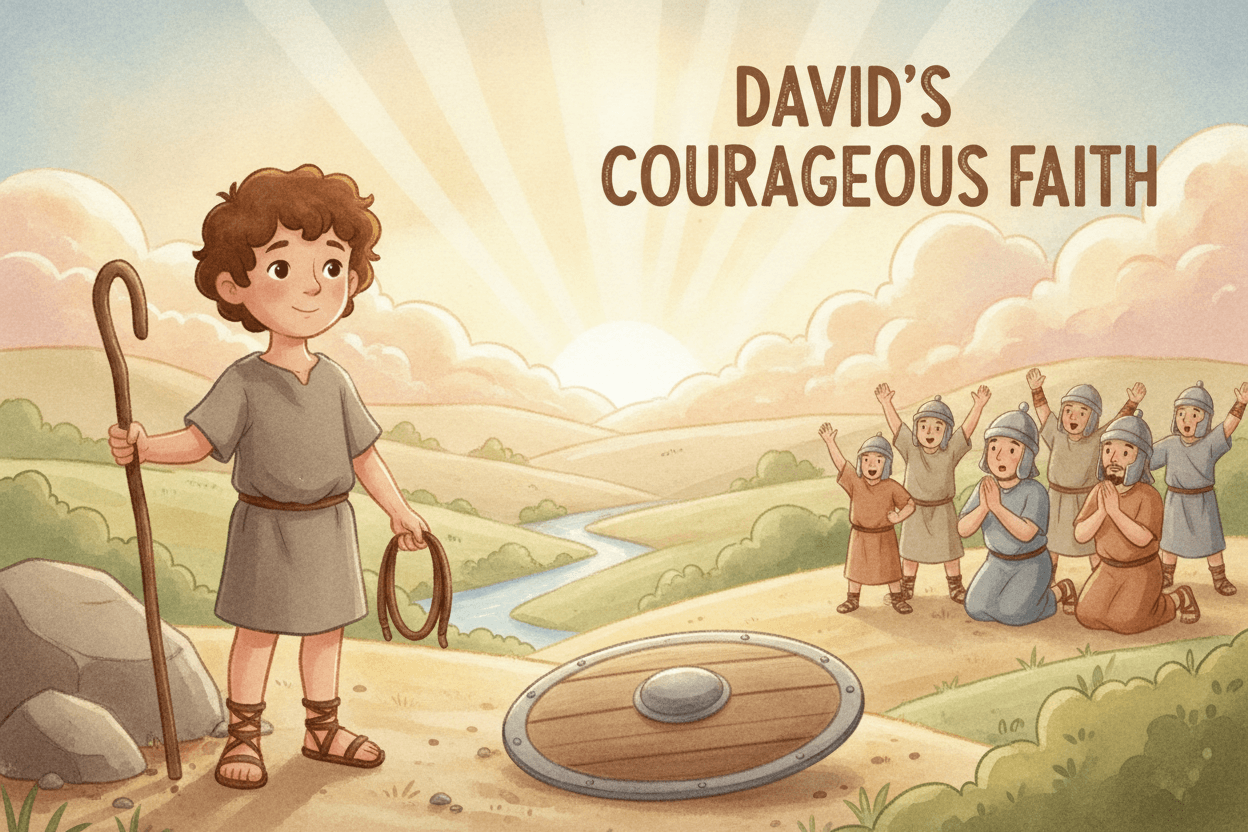
The stone leaves David’s sling, and the noisy battlefield suddenly changes. Before children rush to celebrate the young hero’s aim, pause and read 1 Samuel 17:45–50 aloud. David had practiced with a sling while guarding sheep, so his skill mattered. Yet he did not stride toward Goliath boasting about his talent. He announced that the battle belonged to the Lord. Scripture invites us to hold both truths together: David acted courageously with the ability he had developed, and God was the source of the victory.
Teach the opening words of verse 50: “David prevailed over the Philistine with sling and stone.” Have your child repeat the line while making a gentle slinging motion with an empty hand. Then ask who is missing from that short phrase. The answer is important: David did not prevail because God replaced his effort, nor did David’s effort make God unnecessary. God’s grace enabled David to act with trust and courage. As the Catechism reminds us, God gives his creatures the dignity of cooperating in his work (CCC 306).
Here’s how I’d teach this around the kitchen table: name several victories that do not earn applause. A child admits breaking something instead of blaming a sibling. Another refuses to join classmates who are mocking someone. A nervous student asks an adult for help. These choices require practiced virtues—honesty, courage, prudence, and kindness—just as David needed practiced skill. God’s help does not usually make the good choice effortless; grace strengthens us to make it.
Ask, “Where have you seen God help you tell the truth, resist pressure, or choose what is good?” Give children time to think, and do not supply an answer too quickly. If they cannot identify a moment, offer one from your own week. Catholic kids can understand that God’s victory is not the same as always getting the result we wanted. David won a dramatic battle, but faithful people also face disappointment, consequences, and suffering. We thank God because he remains present and gives us grace to choose the good, even when the outcome is difficult.
Finish with thanksgiving rather than a request for easy success: “Lord God, thank you for staying with us when doing what is right is hard. Thank you for the abilities you have given each person in our family. Help us practice what is good, use our gifts wisely, and remember that every true victory comes through your grace. Amen.” If time permits, let each family member add one brief sentence beginning, “God, thank you for helping me…” That final act places the credit where David placed it—not in the stone, the sling, or himself, but in the Lord.
David prevailed over the Philistine with sling and stone; he struck the Philistine mortally, and did it without a sword in his hand.
Put the Five-Night Devotional Into Practice This Week
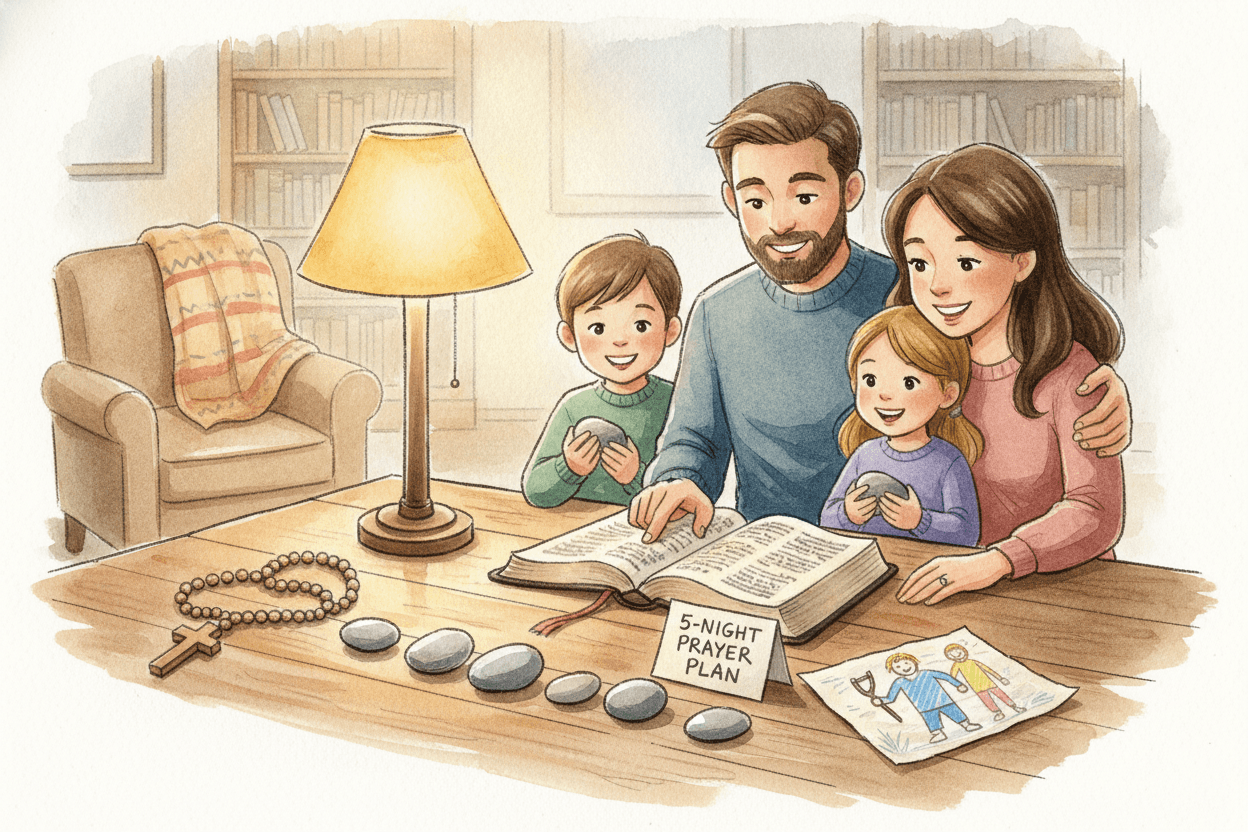
On Monday evening, place a Bible, five smooth stones, and a small candle on the kitchen table before anyone sits down. The setting does not need to be elaborate. Choose five evenings when your family can protect ten minutes—even if one night happens beside a half-cleared dinner table or just before soccer practice. Let the stones remain visible all week. For children ages six to nine, concrete objects help hold the sequence of the story in memory: the giant, the errand, the armor, the stones, and the victory.
Follow the same four-part rhythm each evening: read, remember, discuss, and pray. First, read the selected verses from 1 Samuel 17 directly from the Bible. Next, repeat one short verse or key line together. Then ask one open question, such as, “What do you notice about David here?” or “When might you need to trust God this week?” Finally, offer a brief prayer connected to the lesson. Ten attentive minutes are better than thirty restless ones. Consistency helps children know what to expect and gives the Word of God room to settle into family life.
Resist turning the conversation into a quiz. Your child does not need to recall every name, measurement, or plot detail to participate well. If an answer wanders, listen for the thought underneath it and guide the child back to the passage: “Let’s see what Scripture says.” Catholic children do best when we respect their intelligence while giving them patient direction. Here’s how I’d teach this in a parish classroom: ask one sincere question, allow several seconds of silence, and accept that younger children may answer through a story from school rather than formal religious language.
This simple repetition follows the pattern God gives Israel in Deuteronomy 6:6–7. Faith is handed on during ordinary household moments—at home, away, at bedtime, and upon rising. As the Catechism reminds us, parents have the first responsibility for the education of their children in faith, prayer, virtue, and Christian living (CCC 2221–2226). Family catechesis does not require parents to imitate a theology lecture. It asks them to let Scripture, the sacraments, forgiveness, and prayer become familiar parts of the home.
At the end of the fifth evening, invite each child to choose one stone and name the lesson it will represent during the coming week. Keep the stones near the family Bible, and return to them when someone faces a hard choice. You can also revisit 1 Samuel 17 with the related David and Goliath comic. Ask your children which details the artist emphasized and which words from Scripture they would place in the largest speech bubble. That comparison keeps the comic connected to its biblical source while giving visual learners another way to remember what they have heard.
Take to heart these words which I command you today. Keep repeating them to your children. Recite them when you are at home and when you are away, when you lie down and when you get up.
Frequently asked questions
How do I do a David and Goliath family devotional with young children?
Read a short section of 1 Samuel 17, add one hands-on activity, discuss a simple question, and close with prayer. Keep each session to about ten minutes so children ages 6–9 can stay engaged.
What does David and Goliath teach kids about courage?
Biblical courage does not mean pretending a frightening problem is small. It means remembering that no problem is greater than God and trusting his presence even when we still feel afraid.
How can I help my child talk about fears during family prayer?
Invite your child to draw or name a fear, and listen without dismissing or immediately correcting it. Ask what fear can make us forget about God, then place the drawing near a Bible or crucifix and pray together while allowing the child to keep details private.
What hands-on activities help kids remember the story of David and Goliath?
Children can draw a giant, hold five smooth stones, carry bread across the room, or try walking in an oversized coat and adult shoes. These concrete experiences help them remember themes such as fear, faithful service, and relying on what God has prepared them to do.
How does David's bread delivery teach children about obedience?
David reached the battlefield because he faithfully completed an ordinary errand for his father while making sure the sheep were cared for. His example shows that obedience can combine listening, responsibility, and love rather than mere rule-following.
How can children serve God through everyday chores?
Help each child choose one specific task, such as feeding a pet, clearing a plate, packing a school bag, or helping a sibling. Quietly recognize the act by saying, “You served with love today,” connecting ordinary family duties to faith without turning service into a performance.
Sources: biblegateway.com · pewresearch.org · barna.com · barna.com · barna.com · pewresearch.org · vatican.va · usccb.org
Scripture quotations in this article use the NABRE translation.