Elijah and the Ravens:Trusting God When Supplies Feel Short
When resources feel scarce, Elijah’s story at the Wadi Cherith helps families name their worries and notice God’s faithful provision. Explore how trust grows through daily dependence, patient listenin

The grocery total is higher than expected, the calendar is crowded, and a child notices the worry on your face. Elijah’s days at the Wadi Cherith give families a truthful place to begin: God sees real needs, provides in real ways, and asks us to keep listening when we cannot yet see the whole plan.
When the Pantry, Budget, or Calendar Feels Thin

The grocery cart is fuller than the number at the bottom of the screen should allow. Or the calendar has three school commitments, a work deadline, a parish event, and no clear space for dinner together. Sometimes the shortage is not food or money but patience: a parent reaches the end of a long day with very little energy left to give. Children notice these moments. They hear the careful conversations, see a parent put something back on the shelf, and recognize when everyone is moving too fast.
We need not pretend that faith makes these pressures simple. A family may need a tighter budget, help from relatives or a parish pantry, a difficult conversation about spending, or a real adjustment to the schedule. God’s providence does not excuse us from planning, working, asking for help, or sharing what we have wisely. As the Catechism teaches, God’s care is not distant or abstract; it is concrete and immediate (CCC 303). He often provides through ordinary means: a meal offered by a neighbor, steady work, prudent choices, and the generosity of the Christian community.
That is why Elijah’s story belongs in a family conversation about supplies that feel short. First Kings 17 begins in a drought, not in an easy season. Elijah has announced that there will be no dew or rain, and then the Lord directs him away to the Wadi Cherith. He has water from the wadi, but his food arrives in a most unexpected way: ravens bring bread and meat in the morning and again in the evening. Scripture invites us to notice both parts of the account: Elijah receives a command, and he responds by going where the Lord sends him. His trust is not passive waiting; it is obedience in the next faithful step.
Here’s how I’d teach this to children: begin with a plain question, “What can feel too small in our home this week?” Let them name money, groceries, time, sleep, or a parent’s attention without correcting the answer. Then tell them that Elijah lived through a real drought, and that God knew exactly where he was. The point is not that God will send birds to stock our kitchen. The point is that no family concern is too ordinary for prayer, and no child is invisible to the Father’s care. We can ask God for what we need, make a sensible plan, receive help gratefully, and look for one way to share even when our own supply feels limited.
The word of the LORD came to Elijah: “Leave here, go east and hide in the Wadi Cherith, east of the Jordan. You shall drink of the wadi, and I have commanded ravens to feed you there.” So he left and did as the LORD had commanded. He left and remained by the Wadi Cherith, east of the Jordan. Ravens brought him bread and meat in the morning, and bread and meat in the evening, and he drank from the wadi.
Read the Story Closely: God Meets Elijah at the Wadi

A child may hear that ravens brought Elijah food and picture a cheerful bird dropping a sandwich at his feet. Scripture asks us to look more carefully. The story begins with a drought: no dew, no rain, and therefore no ordinary certainty about crops, water, or food (1 Kings 17:1). This is not a pretend problem. Elijah is living through a real crisis, and God does not deny that the land is dry.
Then the Lord gives Elijah a remarkably specific instruction. He is to leave, go east, hide by the Wadi Cherith, and drink from its stream. God also tells him that ravens have been commanded to feed him. Elijah does not receive a map of the next year, an explanation of every hardship, or a storehouse filled for months ahead. He receives the next faithful step. He goes where God sends him, remains there, drinks from the wadi, and waits for the food God has promised.
The ravens bring bread and meat in the morning and bread and meat in the evening. That detail matters. God’s care is not vague encouragement; it is concrete. Elijah eats twice each day. Yet the provision is daily, not a guarantee that he will never again face need. In fact, the wadi itself will later dry up. Here is how I’d teach this to children: God did not give Elijah everything for his whole future at once. He gave him what was needed for that day, and then called him to keep listening.
This is a sturdy lesson for a family when the grocery budget, the school schedule, or a parent’s energy feels short. Trust in God is not pretending there is no drought. It is telling the truth about the need, doing the responsible thing in front of us, and asking God to provide through the means he chooses: a paycheck, careful planning, a meal shared by a neighbor, parish assistance, rest, or the help of relatives. As the Catechism teaches, God’s providence is concrete and immediate, extending even to the small events of our lives (CCC 303). His care does not cancel our responsibility; it gives us reason to act without despair.
Try reading the passage aloud and asking children three plain questions: What was Elijah’s problem? What did God tell him to do next? What did God provide that day? Let them name a present need without forcing a quick answer: “We need enough money for groceries,” “I need help finishing my homework,” or “I need time with you.” Then pray simply: “Father, show us today’s next faithful step, and help us recognize the care you send.” Elijah’s wadi teaches us to expect neither magic nor abandonment, but the faithful provision of God.
The word of the LORD came to Elijah: “Leave here, go east and hide in the Wadi Cherith, east of the Jordan. You shall drink of the wadi, and I have commanded ravens to feed you there.” So he left and did as the LORD had commanded. He left and remained by the Wadi Cherith, east of the Jordan. Ravens brought him bread and meat in the morning, and bread and meat in the evening, and he drank from the wadi.
What Divine Providence Does—and Does Not—Promise

A child hears that God fed Elijah with ravens and may reasonably ask, “Then will God make food appear when our refrigerator is empty?” That question deserves an honest Catholic answer. The Lord’s care is real, but 1 Kings 17 is not a promise that every faithful family will receive provision in the same surprising form. Elijah lived through a drought; he had to leave home, hide by a wadi, and accept food one day at a time. God did not deny the hardship. He sustained his prophet within it.
The Church calls this divine providence. CCC 302 teaches that creation is not abandoned to chance after God makes it; he guides it wisely toward the good for which he created it. CCC 303 makes the point especially personal: God’s care is “concrete and immediate,” reaching even the small circumstances of our lives. A missed paycheck, an empty calendar, a medical diagnosis, and a child’s worry at bedtime are not beneath the Father’s notice. Nothing is too ordinary for his attention, and nothing is too painful for us to bring to him.
Providence, however, is not a prosperity message wearing Christian vocabulary. It does not mean that Christians will never face drought, bills, illness, job loss, or disappointment. It does not excuse us from making a budget, seeking work, accepting help, visiting the doctor, or sharing what we have with someone else. God often provides through ordinary channels: a neighbor’s meal, a parish pantry, wise financial counsel, a grandparent’s help, steady employment, or the generosity of the Church. These are not lesser forms of care simply because no ravens are involved.
Here’s how I’d teach this to children: God does not promise that we will get everything we want, exactly when we want it. He promises that we are known by a Father who sees our needs and calls us to trust him today. Then give them language that is both simple and truthful: “We can tell God what we need. We can do the next responsible thing. We can receive help without shame. And we can thank God for the help he sends.” This respects children’s intelligence because it does not pretend that worry disappears when we pray.
Jesus himself directs anxious hearts toward the Father’s knowledge and kingdom. When supplies feel short, a family can pray specifically, make a practical plan, and look outward for ways to give or ask for help. Trust is not passive waiting; it is faithful action without the belief that we are alone. Elijah obeyed the word he had received, drank from the wadi available to him, and received each day’s food as it came. That is a sound pattern for us as well.
So do not worry and say, ‘What are we to eat?’ or ‘What are we to drink?’ or ‘What are we to wear?’ All these things the pagans seek. Your heavenly Father knows that you need them all. But seek first the kingdom (of God) and his righteousness, and all these things will be given you besides.
God Often Sends Help Through Ordinary Means
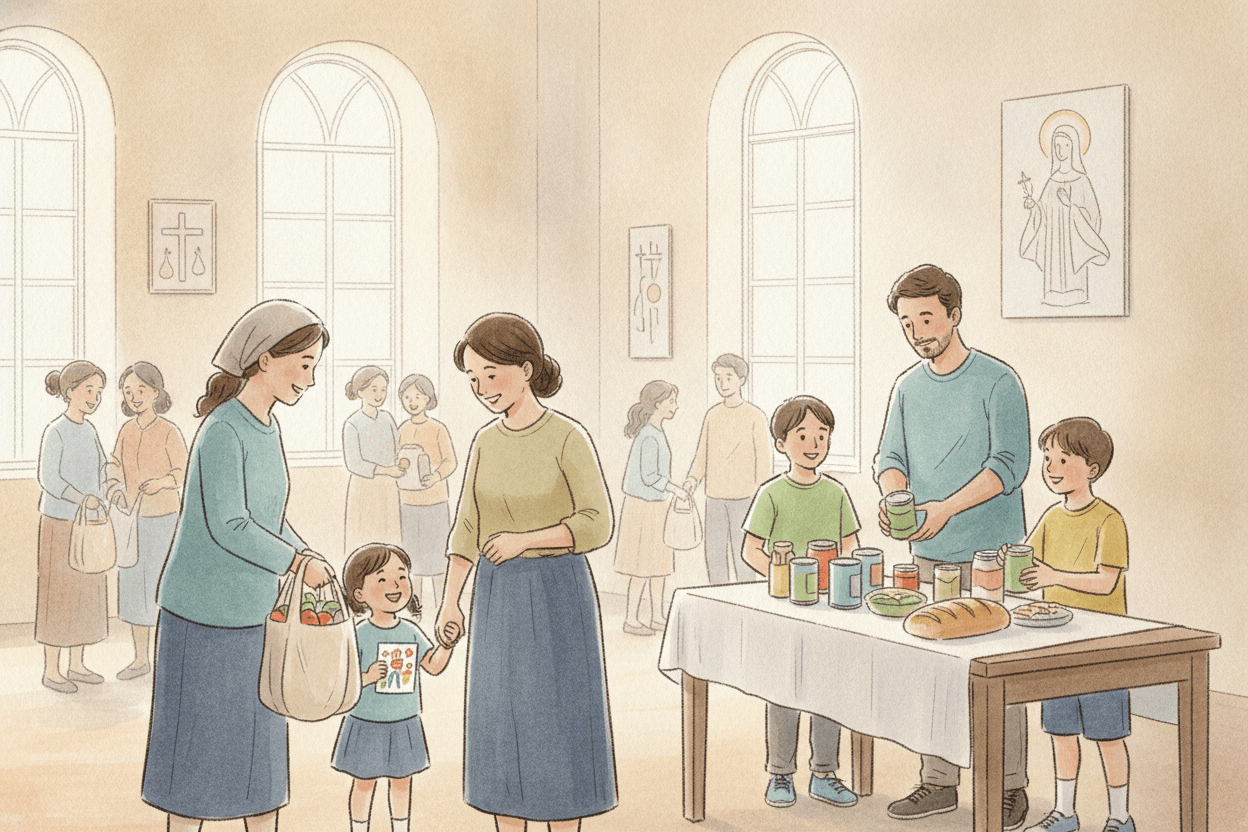
The grocery bag on the porch, the grandmother who covers an unexpected prescription, the neighbor who drops off soup after a hard week—these can look ordinary enough to miss. Yet Elijah’s food arrived through creatures no one would have chosen as caterers. God commanded ravens to feed him, and the birds brought bread and meat morning and evening (1 Kings 17:2-6). The point is not that Christian families should wait for a dramatic rescue. It is that God is free to care for his children through surprising instruments.
For most families, God’s provision comes through the steady means he has already placed before us: a parent’s honest work, a realistic budget, a meal plan, medical assistance, a relative’s advice, a parish food pantry, or a friend who notices a need. Careful planning is not opposed to trust. Saving what we can, asking questions before a major expense, and accepting practical support are responsible responses to the gifts God provides. As the Catechism reminds us, God’s providence is not distant or vague; it is concrete and immediate (CCC 303).
Here’s how I’d teach this at home: name the “ravens” God has sent this week. At dinner, each person can identify one ordinary help received—a teacher’s patience, a ride, a coupon, a bag of groceries, an extra hour of work, or someone who listened. Then ask, “Did we thank God? Did we thank the person?” Children learn to recognize providence without pretending that every problem is instantly solved. They also learn that gratitude has a human face.
Asking for help deserves a place in this lesson. Some parents fear that receiving aid means they have failed. But humility tells the truth: we are creatures who need God, and at times we need one another. A call to a parish St. Vincent de Paul conference, a conversation with a trusted relative, or an application for community assistance may be the prudent next step. Scripture invites us to bring real needs to God, not hide them behind a cheerful mask. Jesus says, “Your heavenly Father knows that you need them all” (Matthew 6:32).
There is another side to this teaching. Your family may be the ordinary means of God’s care for someone else. A child can help choose pantry items to donate, carry a meal to a new parent, add a little to a collection, or make room at the table. Even when resources are limited, generosity can be concrete: sharing time, skills, encouragement, and prayer. We do not give because we have unlimited supplies; we give because God has made us members of one body, able to receive and to serve.
Your heavenly Father knows that you need them all.
Jesus Invites Us to Bring Daily Needs to the Father

A child hears that the grocery list must wait until payday, then asks the question adults may be carrying silently: “But what are we going to do?” This is a fitting moment to place Elijah beside Jesus’ own words about ravens. The birds that brought bread and meat to Elijah at the wadi were not forgotten by God, and neither is the child who notices an empty shelf, a tense conversation about bills, or a parent rushing from one responsibility to another.
Jesus says, “Notice the ravens: they do not sow or reap; they have neither storehouse nor barn, yet God feeds them. How much more important are you than birds!” He is not teaching children that planning is pointless or that parents should ignore a budget. Nor is he scolding a worried child for having an anxious feeling. Fear often arrives before we choose it. Jesus invites us to do something with that fear: bring it to the Father who already knows our needs.
Here’s how I’d teach this at home or in a parish classroom: name one real need, one person who can help, and one faithful next step. A child might pray, “Father, help us with our food this week,” then help make a simple meal plan, write a note of thanks for a neighbor’s kindness, or place a family intention in the prayer basket. If a need is serious, the next step may include calling family, a parish ministry, or a community food pantry. Trust in God does not replace responsible action; it steadies us for it.
The Catechism teaches that God’s providence is concrete and immediate (CCC 303). That is important language for families: the Father’s care is not vague encouragement from far away. Sometimes it comes through wages, careful spending, a meal shared by a friend, medical help, or the generosity of the parish. Scripture invites us to seek God’s kingdom first, which means choosing honesty, prayer, generosity, and love even when supplies feel short. We can tell children plainly: “We may not know yet how this will work out, but we are not facing it alone. Let’s ask God for help and do the next good thing.”
Notice the ravens: they do not sow or reap; they have neither storehouse nor barn, yet God feeds them. How much more important are you than birds!
How I’d Teach Elijah and the Ravens to Children Ages 6–9

At the kitchen table, give each child a small paper raven before anyone begins explaining the story. I have found that children ages 6–9 listen more carefully when their hands have a simple task and the question is concrete: “What would you want to carry to Elijah if he were hungry by the stream?” Then open the Bible, not a retelling, and read 1 Kings 17:2–6 aloud from the NABRE. Let the children hear that Elijah did not invent the plan; “he left and did as the LORD had commanded.” The ravens brought food, and the wadi gave water—specific help for a real need during a drought.
Pause for wondering rather than rushing to a lesson. Ask, “What might Elijah have felt when God told him to hide by a stream?” “Would you have been surprised to see ravens bringing breakfast and supper?” “Who helps our family when things are hard?” Their answers may name parents, grandparents, a neighbor, a teacher, a food pantry, parish friends, or a doctor. Receive those answers seriously. Scripture invites us to see that God’s care is not vague. The Catechism teaches that providence is concrete and immediate, extending from small things to great events (CCC 303). Children can understand this without pretending that every hard situation has an easy ending.
Next, have each child write or draw one need on one side of the paper raven: food, help with homework, a sick relative, peace after an argument, enough time together, or courage for a worry. On the other side, have them name one gift they received today. Take turns “delivering” the ravens to a basket in the center of the table. An adult can pray simply: “Father, you know what we need. Thank you for the help you give us through people, work, and our parish. Teach us to ask, to receive, and to share.” Here’s how I’d teach this point: God fed Elijah in an unusual way, but he often cares for us through ordinary means and through people who act with generosity.
When a child asks, “Do we have enough money?” parents need not offer false certainty or hand over adult anxieties. Try: “We are being careful with our money right now. The adults are working, making decisions, and praying. You do not need to solve this problem. You can help by being grateful, telling us what you need, and praying with us.” If a change is coming—fewer extras, a delayed purchase, a tighter grocery plan—say so plainly and calmly. This protects a child’s sense of safety while teaching truthful trust. End by choosing one practical response together: make a grocery list, set aside a pantry donation, write a thank-you note, or pray for a family under greater strain. Trust in God never excuses us from wise action; it steadies us to take the next faithful step.
The word of the LORD came to Elijah: “Leave here, go east and hide in the Wadi Cherith, east of the Jordan. You shall drink of the wadi, and I have commanded ravens to feed you there.” So he left and did as the LORD had commanded. He left and remained by the Wadi Cherith, east of the Jordan. Ravens brought him bread and meat in the morning, and bread and meat in the evening, and he drank from the wadi.
Try This Week: A Daily Ravens Prayer and One Act of Sharing

At the end of a long day, children often reveal the worries they carried quietly: “Will we have enough?” “What if Grandma is still sick?” “Why is Dad working late again?” This is a good moment not to rush into reassurance or pretend that every problem has a quick answer. Instead, gather the family for a brief daily practice that teaches a sturdier habit: we bring real needs to God, notice the care already given, and look outward to someone else who may need help.
For seven days, choose either breakfast or bedtime. Let each person name three things: one need they want to place before God, one provision they have already received that day, and one person who may need help. Keep it concrete. A child might say, “I need help with my spelling test; I got lunch at school; my friend Ava is sad.” A parent may name a bill, a patient neighbor, a meal shared, or the patience needed for tomorrow’s schedule. Catholic children are capable of recognizing both need and grace when we give them clear language for it.
Then pray Philippians 4:6–7 together. You might say: “Father, we bring you our needs with prayer, petition, and thanksgiving. Give us your peace in Christ Jesus, and show us what love asks of us today. Amen.” This does not turn prayer into a guarantee that circumstances will change by morning. It forms the family to make requests, give thanks, and receive God’s peace while taking the next faithful step. As the Catechism teaches, God’s providence is concrete and immediate (CCC 303); often that care comes through the ordinary people and responsibilities placed near us.
Choose one concrete response for the week. Make a simple grocery plan before shopping, and invite children to help distinguish needs from extras. Set aside a few pantry items for a parish food collection. If your family is the one under strain, contact the parish office or a St. Vincent de Paul conference; receiving help with humility can also be an act of trust. Or thank someone whose ordinary service has cared for your family: a grandparent, teacher, neighbor, delivery worker, parish volunteer, or friend who listened. Elijah received bread through ravens, but many families receive God’s care through hands that look much more familiar.
When the seven days are over, ask one question: “Where did we notice provision this week?” Record the answers in a notebook or on the refrigerator. Some answers may be small, and that is worth noticing. Scripture invites us to bring our needs honestly before the Father and to recognize his care without denying hardship. To keep the conversation going with younger children, read the Elijah and the Ravens comic together, then ask them who acted like a “raven” in their week.
Have no anxiety at all, but in everything, by prayer and petition, with thanksgiving, make your requests known to God. Then the peace of God that surpasses all understanding will guard your hearts and minds in Christ Jesus.
Frequently asked questions
How can I teach my child about Elijah and the ravens?
Explain that Elijah faced a real drought, but God told him one faithful step at a time: go to the Wadi Cherith, drink from the stream, and receive the food provided. Ask your child what feels too small or difficult at home this week, then pray together for God to show your family the next step.
Does the story of Elijah and the ravens mean God will make food appear when we need it?
No. The story is not a promise that God will provide in the same miraculous way for every family. It teaches that God sees real needs and may care for us through ordinary means, such as work, budgeting, relatives, neighbors, or parish support.
What does God’s providence mean when our family is short on money or groceries?
Divine providence means that God has not abandoned us and cares about even ordinary needs. Catholic faith also calls us to act responsibly: make a plan, seek assistance when needed, accept help gratefully, and avoid despair.
How do I talk to my children when they notice financial stress at home?
Be truthful without placing adult burdens on them. You might say, “We are making careful choices with our money, and we are asking God to help us,” then invite them to name what they need, such as groceries, time together, or help with schoolwork.
What is the ‘next faithful step’ for a family feeling overwhelmed?
Choose one concrete action instead of trying to solve the entire future at once. That could mean planning inexpensive meals, calling a parish pantry, adjusting the calendar, asking a relative for help, or making time for rest and prayer.
What Bible passage should we read about Elijah being fed by ravens?
Read 1 Kings 17:1-6, which tells how God sent Elijah to the Wadi Cherith during a drought and provided bread and meat through ravens each morning and evening. Afterward, ask what Elijah needed, what God asked him to do, and how God cared for him that day.
Sources: bible.usccb.org · bible.usccb.org · catholicculture.org · vatican.va · catholicstand.com · catholicspirit.com · missionbibleclass.org · childrensministrylessons.com · catholicism.org · workingpreacher.org
Scripture quotations in this article use the NABRE translation.