From Joseph’s Coat to Pharaoh’s Court:The Whole Story for Kids
Joseph’s coat is only the beginning. Follow kids through betrayal, the pit, prison, and Pharaoh’s court to discover how God remains present through painful detours—and how the whole story carries more
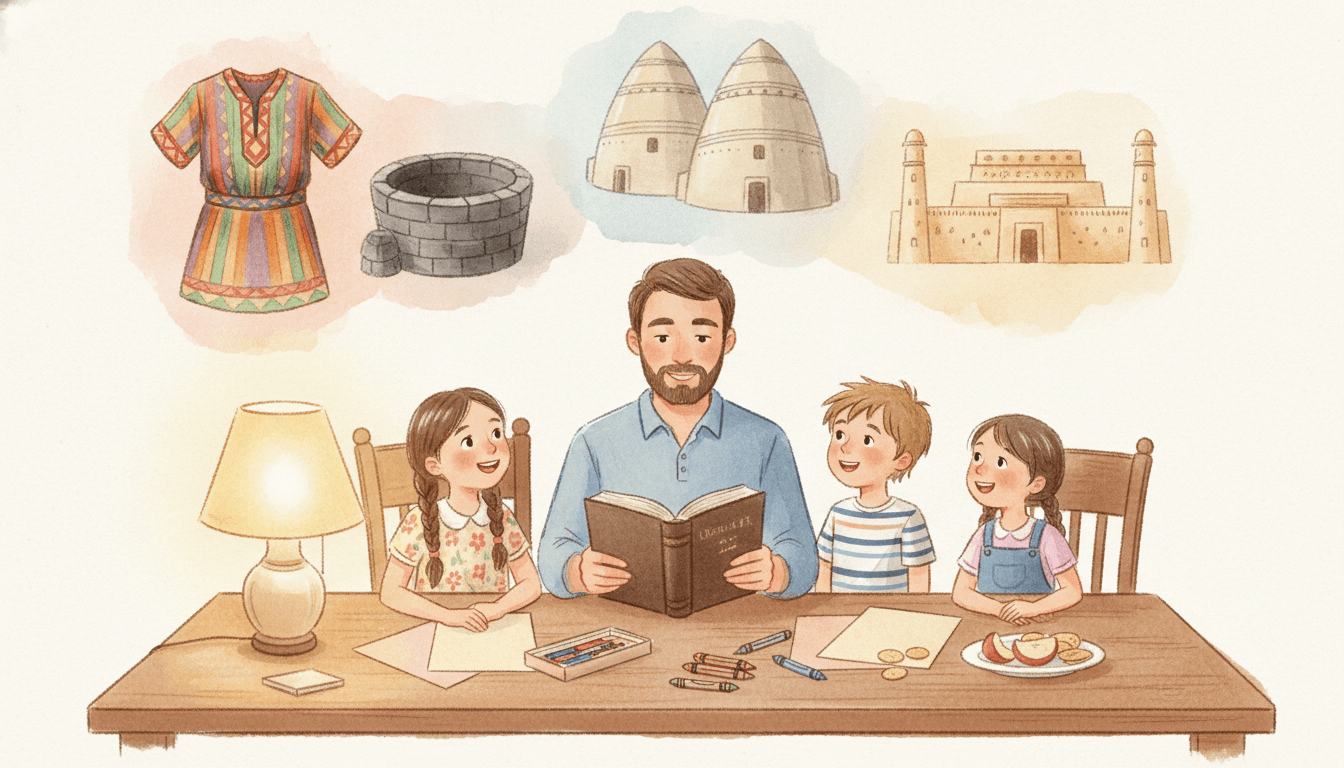
One night at our table, a child asked why Joseph’s brothers were so mean about a coat. It is a fair question—and a good reminder not to leave Joseph standing in his fancy tunic. The whole story gives kids something better than a quick lesson: a God who stays near in the pit, the prison, and the happy ending.
Don’t Leave Joseph at the Coat
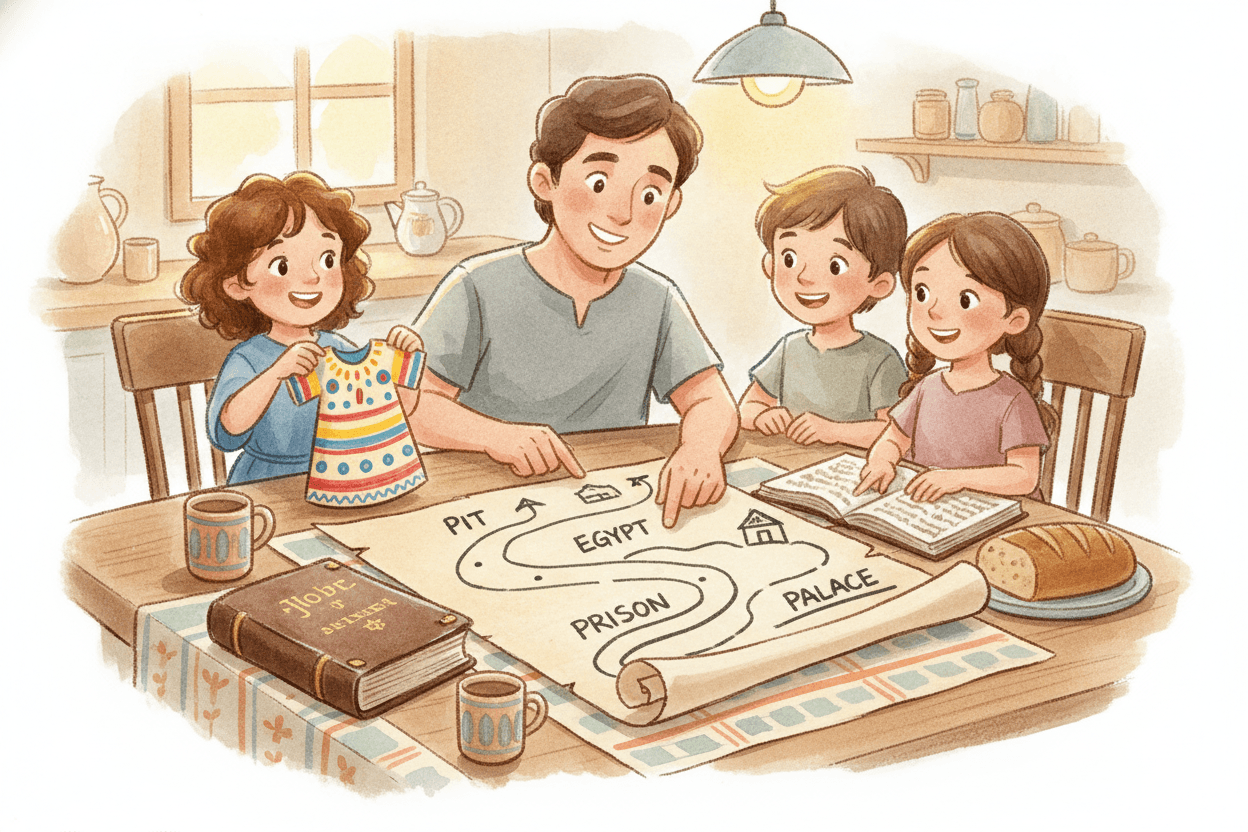
Most kids can spot Joseph’s coat from across the room. It is bright, special, and just a little unfair-looking if you are one of the brothers. That is where many retellings stop: Dad gives Joseph a fancy coat, the brothers get mad, and everybody moves on to the next Bible hero. But the coat is not the whole story. It is the first scene of a long family mess that eventually ends with hungry people being fed, brothers weeping, and forgiveness that no one could have guessed at the beginning.
When we leave Joseph at the coat, children can miss the part that matters most: Joseph did not go straight from being loved by his father to standing beside Pharaoh. There was a pit. There was slavery in Egypt. There was a false accusation and a prison. There were long years when nothing looked fair. Then Joseph helped Pharaoh understand his dreams, prepared Egypt for famine, and found himself face-to-face with the very brothers who had sold him. That road gives children something real to hold when a sibling is mean, a friendship falls apart, or they feel overlooked at home.
For children around six to nine, I would not try to read Genesis 37–50 in one heroic bedtime push. We have all attempted that sort of thing at 8:47 p.m., when somebody suddenly needs water and somebody else cannot find one sock. Tell it in short episodes over a week or two: the coat and jealousy; the pit; Joseph in Egypt; Joseph in prison; Pharaoh’s court; then the reunion. Begin each time with one question: “What do you think Joseph felt here?” Let the child answer before supplying the lesson. They may notice the brothers’ jealousy long before they can say the word providence. That is okay. Start there.
One small thing we tried was ending each episode with a simple sentence: “God had not left Joseph.” Not because every hard thing immediately became easy, but because God was still at work when Joseph could not see the ending. Later, when Joseph forgives his brothers, children can see that God brought good from a terrible wrong without calling the wrong thing good. And when the whole story is familiar, you can gently point ahead: Joseph suffered, was rejected, and became a source of life for his family; Jesus suffered, was rejected, and saves us all. Here’s what landed at our table: the Bible stories are not disconnected little lessons. They belong together, and our own messy family stories belong under God’s care too.
Israel loved Joseph best of all his sons, for he was the child of his old age; and he had made him a long ornamented tunic. When his brothers saw that their father loved him best of all his brothers, they hated him so much that they could no longer speak to him peacefully.
Tell It in Six Kid-Sized Stops
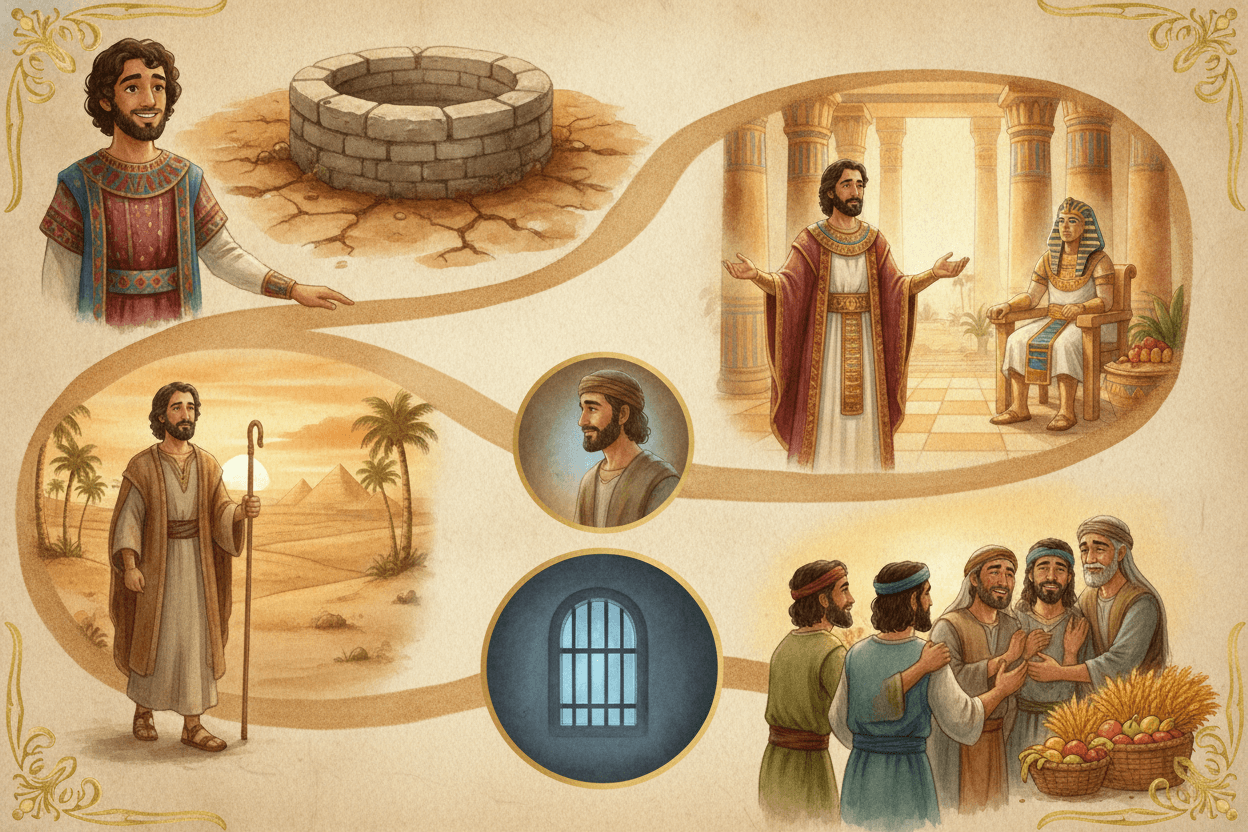
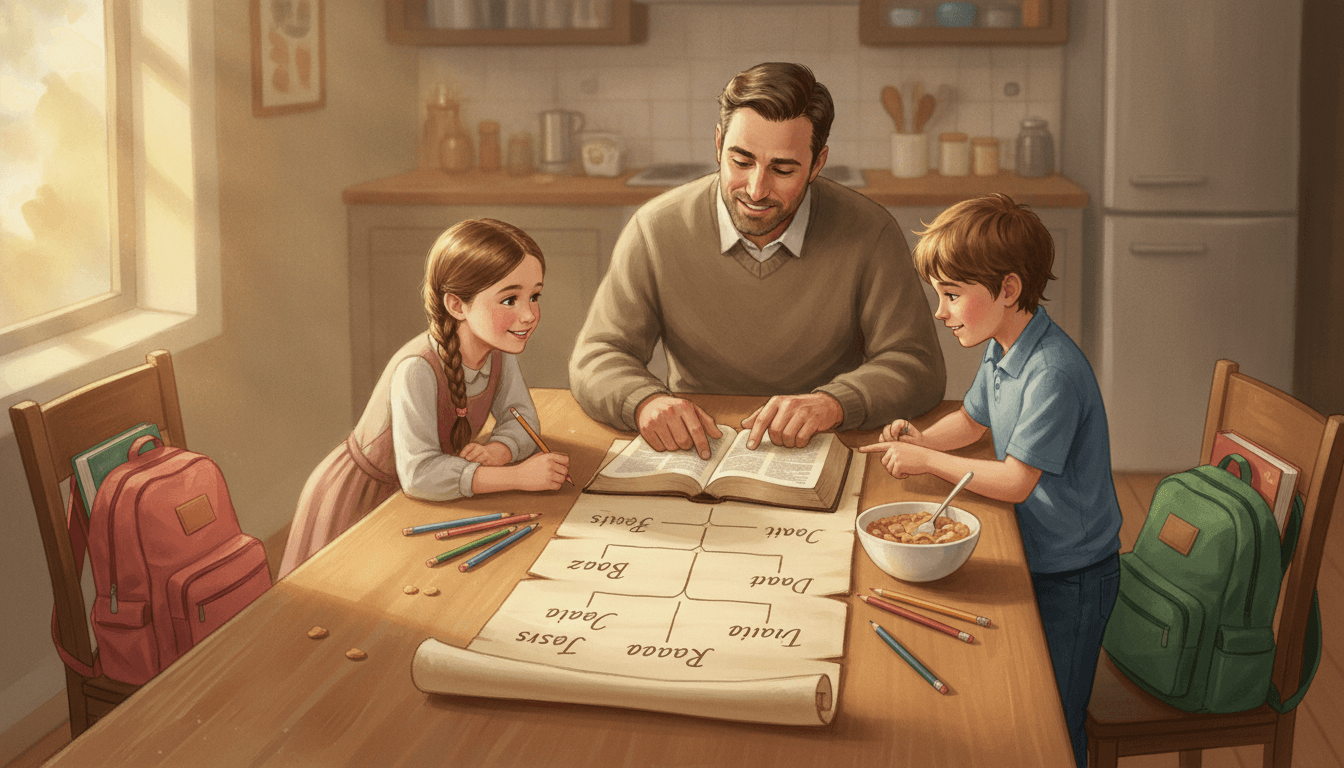
Last Tuesday, a child at our table asked, “Wait, Joseph got the coat, then he was suddenly in Egypt?” Fair question. We adults can do that to Bible stories: skip from the colorful picture-book part to the happy ending before anyone has had time to feel the hard middle. Try telling Joseph’s story over six short sittings instead. Five or ten minutes is enough. End each time with one question, even if the answer comes between bites of cereal and somebody is wearing one sock.
First stop: the coat. Tell how Jacob loved Joseph and gave him a special tunic, while his brothers grew jealous. Kids know the sting of someone else getting the bigger cookie, the first turn, or the gift that seems better than theirs. Ask, “What can jealousy make us want to do?” Do not make Joseph sound perfect, either. He was loved in a way his brothers noticed, and the family had a real problem brewing.
Second stop: the pit. Joseph’s brothers stripped off his coat, threw him into an empty cistern, and sold him away. Keep it honest: what they did was cruel and wrong. You do not need to linger on frightening details. The feeling here is fear, especially the fear of being left out or wondering whether anyone will help. Ask, “What could Joseph have been thinking when he was alone?” Let silence be an acceptable answer.
Third stop: Egypt. Joseph became a servant in Potiphar’s house, far from home, but God did not leave him. This is a good place to talk about being new: a new classroom, a team, a babysitter’s house, or the first night away from family. Joseph did not choose Egypt, yet he kept doing what was right there. Ask, “When have you had to be brave in a place you did not want to be?”
Fourth stop: prison. Joseph was punished even though he had done the right thing. Children understand unfairness with remarkable speed, usually before 7:15 in the morning. Name it plainly: sometimes bad things happen, and we cannot see why. God was still with Joseph, even in prison. Ask, “What do you do when something feels unfair?” You can add your own answer: pray, tell the truth, ask for help, and keep choosing what is good.
Fifth stop: Pharaoh’s court. Joseph explained Pharaoh’s dreams and wisely prepared Egypt for a famine. He did not take credit for himself; he said God would give the answer. The feeling children may recognize is nervousness before a big moment, like speaking in class or trying something new. Ask, “What gift has God given you that could help someone else?” Then tell the reunion: Joseph’s hungry brothers came to Egypt, and Joseph chose forgiveness instead of revenge. He did not call evil good; he trusted God could bring good from it. Ask, “Is there someone you need help forgiving?”
So when Joseph came to his brothers, they stripped him of his tunic, the long ornamented tunic that he had on; then they took him and threw him into the cistern. It was empty; there was no water in it.
Let Kids Name the Hard Feelings
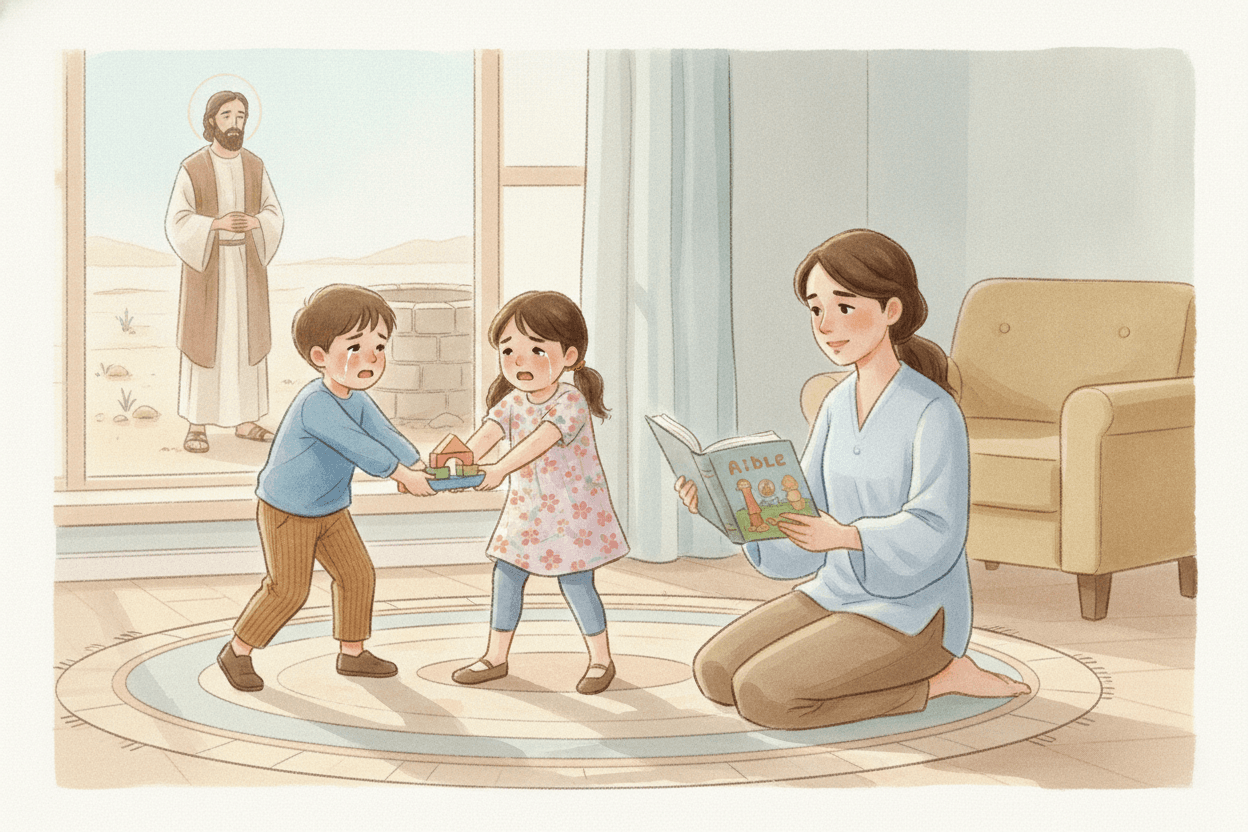
The argument started over the blue cup. One child had used it yesterday, which apparently made it his forever. The other child folded his arms, announced that nobody ever lets him have anything, and then the blue cup became less important than the hurt underneath it. At our table, that is often where a Bible story earns its place: not as a lesson pasted onto the problem, but as words for what the kids already feel.
Joseph gives children those words. His brothers were jealous. They felt overlooked by their father. They were angry at Joseph, and they did something seriously wrong when they threw him into the pit and sold him. Say that plainly. We do not need to soften their sin into “they made a bad choice.” They chose cruelty. Kids know the difference between being annoyed because your brother got the bigger cookie and deciding to hurt someone because you are angry. Joseph’s story lets them name both the feeling and the choice: “I feel left out.” “I am jealous.” “That was unfair.” “I want to get even.”
It also makes room for the child who feels like Joseph. Maybe she did not get picked for the game. Maybe his sister got praise for a drawing while he heard nothing. Maybe a friend said something mean at recess. Joseph was far from home, treated unfairly, and later put in prison. None of that meant God had abandoned him. Genesis says, “The LORD was with Joseph, and he enjoyed great success and stayed in the house of his master the Egyptian.” That does not mean Joseph was happy every minute or that hard things were secretly fine. It means God was present in the hard place. That is a steadier message than telling a sad child, “Don’t worry.”
One small thing we tried was pausing after a sibling fight and asking two questions: “Which part of Joseph’s story feels like this?” and “What can we do with this feeling without hurting somebody?” The answers can be very small. Take a breath. Give back the toy. Ask for a turn. Tell Mom, “I am mad,” instead of shoving. Later, when everyone is calmer, remind them that Joseph eventually chose forgiveness, but forgiveness did not pretend the harm never happened. Children need permission to tell the truth about what hurt them. Then they can begin to see that God stays near, even when the cookie is smaller, the turn feels too short, or the day goes badly.
The LORD was with Joseph, and he enjoyed great success and stayed in the house of his master the Egyptian. His master saw that the LORD was with him and that the LORD made everything he did successful.
In Egypt and Prison, God Does Not Forget Joseph
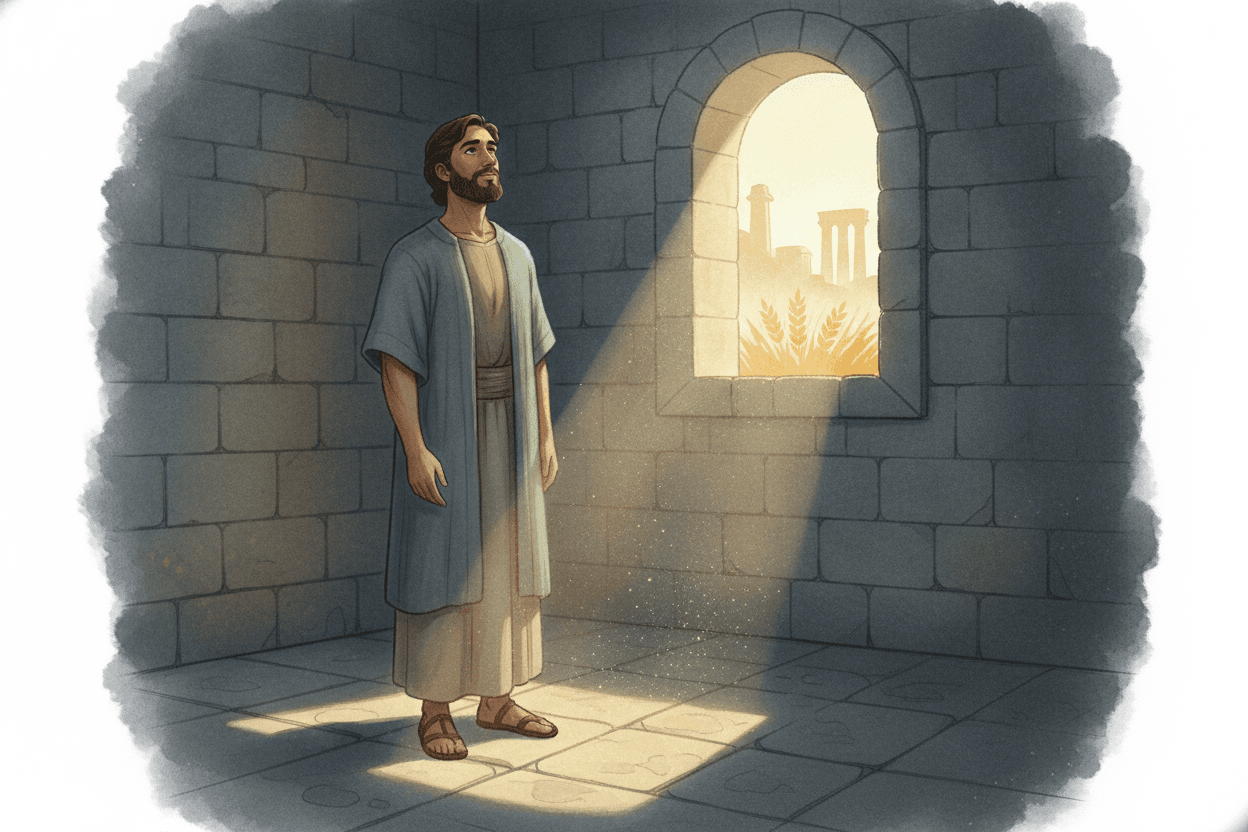
The toy jail door would not stay shut, which felt about right for telling this part of Joseph’s story at our table. One child wanted Joseph to escape immediately. Another said, “That is not fair!” Exactly. Joseph had done the right thing in Egypt. He worked hard in Potiphar’s house. Then he was blamed for something he did not do and put in prison. We do not need to tidy that up for children. It was wrong, and Joseph’s life was hard.
This is a good place to slow down. Ask, “What do you think Joseph felt when the prison door closed?” Kids may say mad, scared, lonely, or confused. Let those answers sit for a minute. Joseph did not get a quick reward for being faithful. He served well in Egypt, and then he suffered anyway. Children know that kind of disappointment: the sibling who gets away with it, the friend who excludes them, the effort that does not get noticed.
But Joseph was not alone in either place. God was with him in Potiphar’s house, and God was with him in prison. That does not mean Joseph liked every day there. It means the hard place was not empty of God. One small thing we tried was to name a child-sized hard place at bedtime—a tough spelling test, a disagreement, a worry about tomorrow—and pray simply: “God, be with us here.” Not fix it instantly. Be with us here.
Later, when Pharaoh asked Joseph to explain a dream, Joseph did not puff himself up or act like he had all the answers. He said, “It is not I; God will give Pharaoh the right answer.” That is a steady kind of faith. Joseph had lived through the pit, slavery, and prison. He still knew that God was God. The answer to Pharaoh’s dream would open a new door, but Joseph could not see that door back when he was sitting in prison.
For children, the point is not “Be good and everything will work out by Thursday.” (Parents know Thursday can be surprisingly long.) The point is that faithfulness matters, and God does not forget his children when life is unfair. You can ask this week, “What is one hard place where we need to remember God is with us?” Then listen. The child in front of you may be carrying more than you knew.
Pharaoh said to Joseph, “I had a dream, but there is no one to interpret it. But I heard it said of you that for you to hear a dream is to interpret it.” Joseph answered Pharaoh: “It is not I; God will give Pharaoh the right answer.”
Pharaoh’s Court Shows What Trust Can Look Like
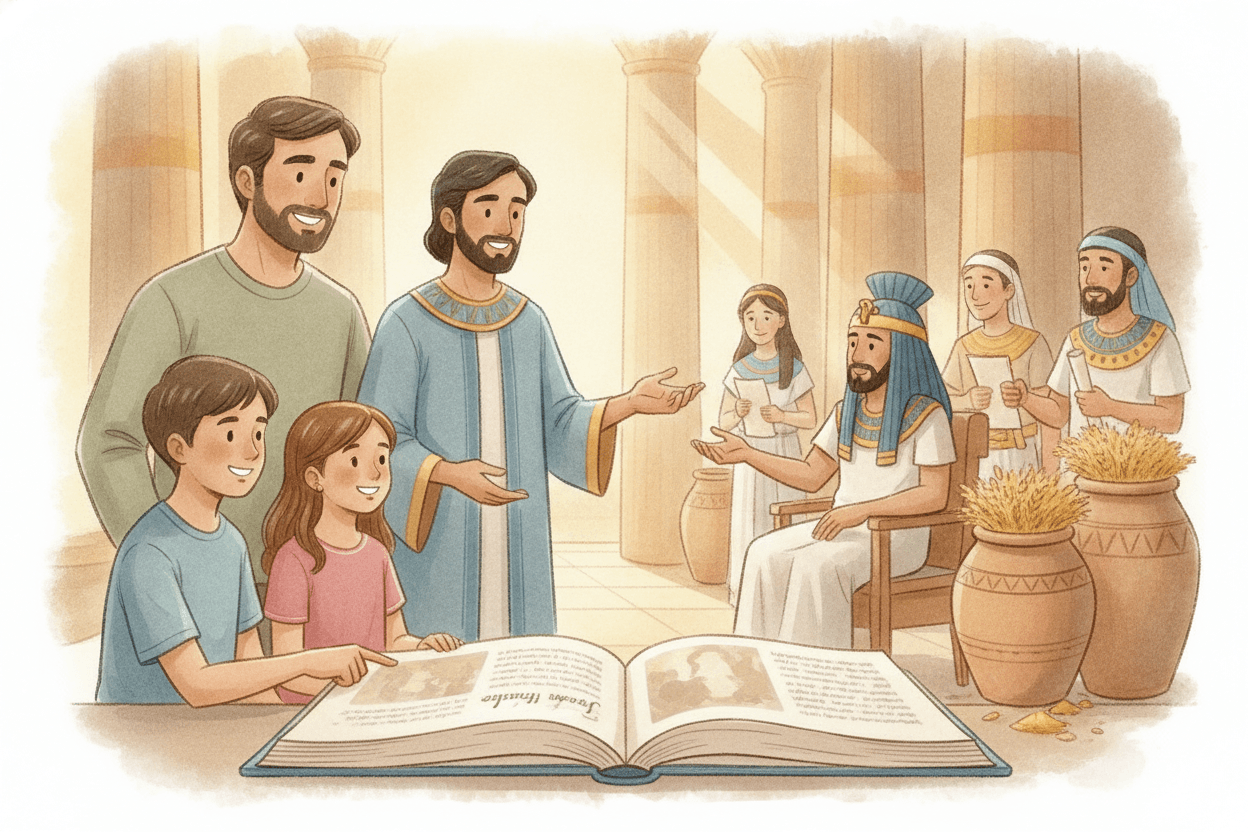
The morning rush can make a child feel like the whole world is ending because the blue cup is in the dishwasher. Then somebody finds a clean cup, shoes get tied, and we keep moving. Joseph’s life was not a small-morning problem, of course. He had been sold, enslaved, and imprisoned. But when Pharaoh needed help, Joseph did not let his painful past keep him from doing the faithful thing in front of him.
Pharaoh had troubling dreams about seven healthy cows followed by seven thin ones, and seven good heads of grain swallowed up by seven withered ones. No one in the royal court could explain them. Joseph could have walked in thinking, Finally, people will see how smart I am. Instead, when Pharaoh praised his ability, Joseph pointed somewhere else. He told Pharaoh that the answer would come from God. That is humility kids can spot: Joseph had a gift, but he did not pretend he made it all by himself.
God showed Joseph that Egypt would have seven years of abundant crops followed by seven years of terrible famine. Joseph did not stop with the interpretation. He offered a practical plan: appoint leaders, collect food during the good years, and store it for the hard years ahead. Pharaoh recognized Joseph’s wisdom and put him in charge. The brother in the pit became the ruler who helped prepare a whole country to survive. That is a big turn in the story, but it did not happen because Joseph chased a fancy title. He kept serving God where he was placed.
Here’s what landed with our kids: courage is not always standing in front of a king. Sometimes it is telling the truth when you made the mess. Sometimes it is finishing the math page, helping a younger sibling, or trying again after a bad soccer practice. Joseph did the next job in front of him—first as a servant, then as a prisoner, then as a leader. He trusted that God was with him in each place.
One small thing we tried was asking, “What is your next faithful job today?” Keep it concrete. Put away the backpack. Speak kindly to your brother. Say sorry without adding “but he started it.” Then remind your child that being good at something is not a reason to brag. It is a chance to serve. Joseph’s wisdom fed hungry people, including, before long, the very family that had hurt him.
Pharaoh said to Joseph, “I had a dream, but there is no one to interpret it. But I heard it said of you that for you to hear a dream is to interpret it.” Joseph answered Pharaoh: “It is not I; God will give Pharaoh the right answer.”
The Reunion Teaches Forgiveness Without Pretending
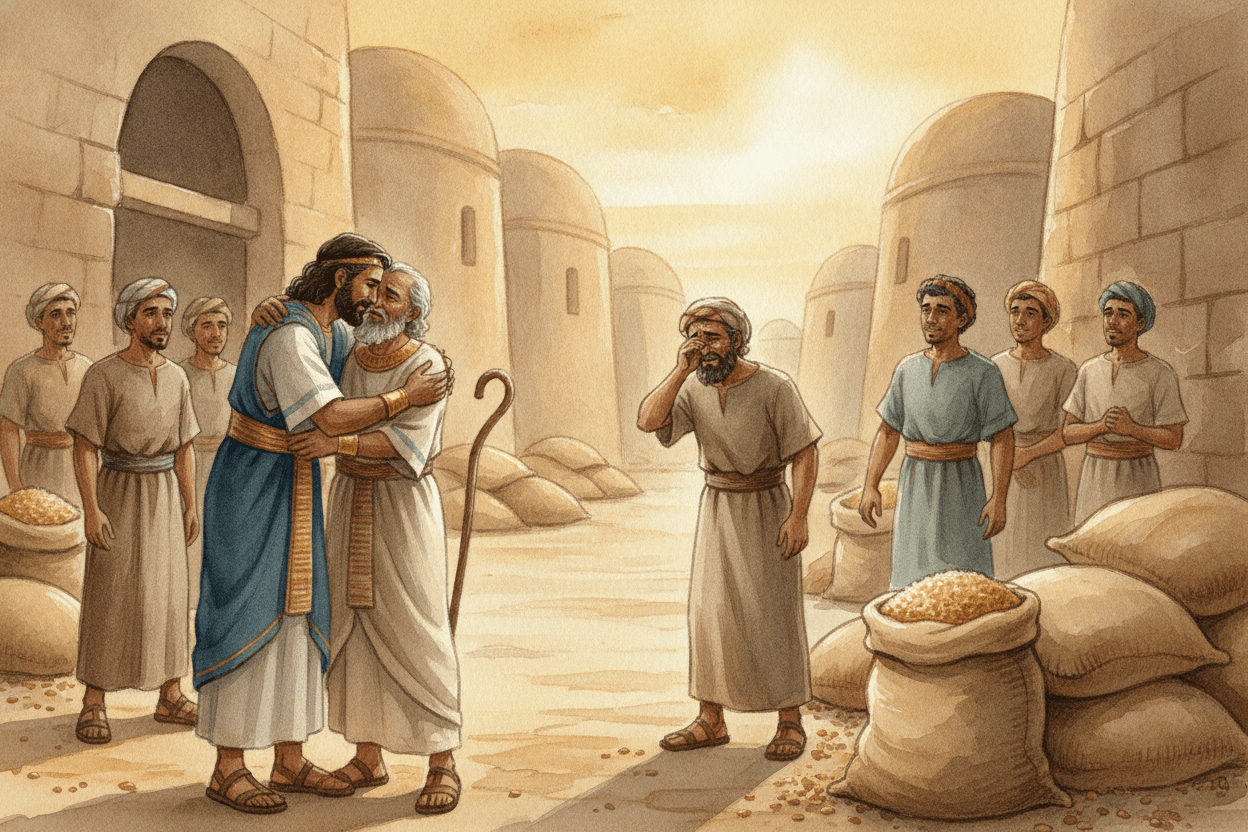
A child can understand a crumpled apology better than a long speech. One of my kids once knocked over another kid’s block tower, then stood there with both hands behind his back, waiting to see what would happen next. Nobody needed a lecture on reconciliation. The room already felt it: somebody had been hurt, somebody was sorry, and the next choice mattered.
That is why Joseph’s reunion with his brothers lands so deeply. Years after they sold him and lied about what happened, Joseph sees them in Egypt. He recognizes them before they recognize him. He weeps. He does not pretend the pit was fine, or that being sold away from his father did not wound him. But when the moment comes, Joseph chooses mercy. He tells his frightened brothers not to be afraid and sees that God has been at work even through a terrible wrong.
For kids, keep this part plain: forgiveness does not mean saying the bad thing was good. It does not erase consequences. If a brother breaks a toy on purpose, he still helps clean up, apologizes, and may lose the privilege of playing with it for a while. And forgiveness never means a child has to stay close to someone who is unsafe or keeps hurting them. A child should tell a trusted grown-up right away. Safety comes first. Mercy is not pretending everything is normal.
One small thing we tried was giving our kids a sentence to use when they were still upset: “God, this hurt. Help me not to hurt them back.” That is a real beginning. Sometimes forgiveness happens quickly. Sometimes it takes many prayers, many talks, and a little space. Joseph had years between the harm done to him and the reunion. Kids do not need to force a cheerful face before their hearts are ready. They can bring the anger, sadness, and confusion to God.
Here’s what landed at our table: we can refuse to pass a hurt along. Joseph’s brothers expected revenge. Instead, Joseph trusted that God could bring good without calling their sin good. After a hard sibling moment this week, ask, “What happened? What needs to be made right? How can we choose not to pass this hurt along?” Then let your child hear the words they most need: “You can tell the truth. You can be sorry. And, with God’s help, you can forgive.”
But Joseph replied to them: “Do not fear. Can I take the place of God? Even though you meant harm to me, God meant it for good, to achieve this present end, the survival of many people.”
Try a Joseph Story Week at Home
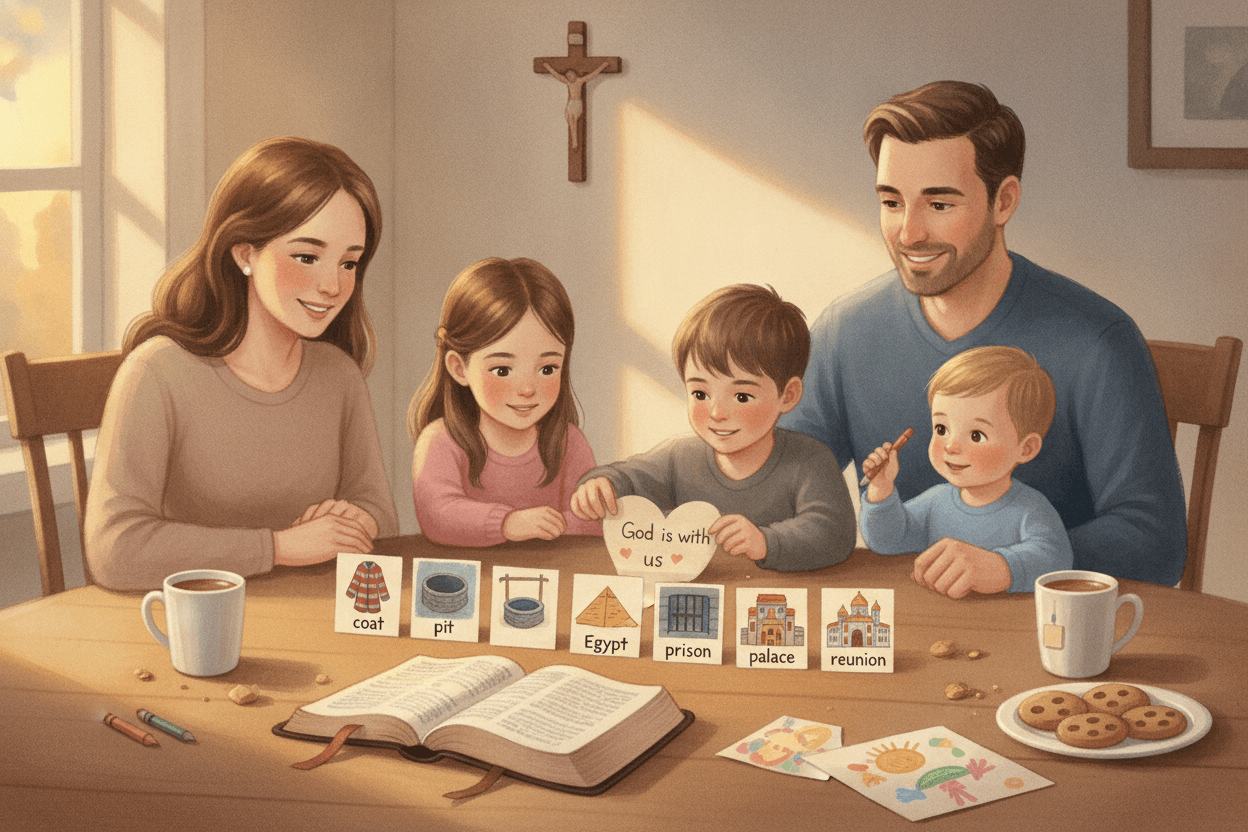
Last Tuesday, one child wanted the blue cup because the other child had it. Within thirty seconds, the cup was apparently proof of a great injustice. That is why Joseph works so well at our table. Kids do not need much help finding jealousy, unfairness, fear, or the wish to get even. They need help seeing that God is still present when those feelings show up.
A Joseph Story Week does not need craft supplies, a color printer, or a heroic bedtime routine. Read a short passage after dinner, while lunches are being packed, or before bed. Keep it moving. Let the story do its work. One small thing we tried was giving each child one job: one holds the Bible or comic, one picks the feeling question, and one says the prayer. This prevented exactly zero arguments, but it gave everyone a place at the table.
Day 1: read about Joseph’s special coat and his brothers’ jealousy (Genesis 37:3–4). Ask, “When have you felt left out or jealous?” Pray, “God, help us be glad when good things happen to others.” Day 2: read about the pit and Joseph being taken away (Genesis 37:23–24). Ask, “What would Joseph have felt in that pit?” Pray, “God, stay with us when we feel scared.” Day 3: read about Joseph in Egypt and notice that God was with him (Genesis 39:2–3). Ask, “What helps you remember God is near on a hard day?” Pray, “God, be with us wherever we go.”
Day 4: tell the prison part in a few simple sentences. Joseph had done the right thing, yet he was treated badly. Ask, “Have you ever thought, ‘That is not fair’?” Pray, “God, stay with us when life feels unfair.” Day 5: read Joseph before Pharaoh (Genesis 41:15–16). Joseph does not brag; he says God will give the answer. Ask, “Who can we thank when something goes well?” Pray, “God, help us trust you and give you thanks.”
Day 6: read the reunion, when Joseph’s brothers come to Egypt and Joseph chooses mercy (Genesis 45:4–5). Ask, “Is forgiving the same as saying a hurt did not matter?” Let them answer. Then say Genesis 50:20 in kid-sized words: “You meant to hurt me, but God brought good from it.” God did not call the brothers’ sin good. He brought life out of what they meant for harm. Gently connect Joseph to Jesus: both suffered unjustly, and both brought life to others. Then keep going together with the related Joseph’s Coat comic. A six-day habit may feel small, but small is often where family faith gets its start.
Even though you meant harm to me, God meant it for good, to achieve this present end, the survival of many people.
Frequently asked questions
How can I tell Joseph's story to kids without skipping the hard parts?
Tell it in short episodes rather than jumping from the coat to Pharaoh's court. Include the pit, slavery, prison, and reunion in age-appropriate language, naming the brothers' actions as wrong without dwelling on frightening details. This helps children see that God was with Joseph through the long middle, not only at the happy ending.
How many days should we spend telling Joseph's story to children?
Try six brief sittings over one or two weeks: the coat, the pit, Egypt, prison, Pharaoh's court, and the reunion. Five to ten minutes at a meal or bedtime is enough. End each part with a simple question about what Joseph may have felt.
What questions can I ask my child while reading about Joseph?
Ask questions connected to each scene, such as, “What can jealousy make us want to do?” or “What could Joseph have been thinking when he was alone?” For the prison and reunion, ask what they do when life feels unfair or whether there is someone they need help forgiving. Let their answers come before offering a lesson.
What does Joseph's story teach children about unfairness?
Joseph did many things right and still experienced cruelty, separation, and false punishment. Parents can say plainly that hard and unfair things happen, while also repeating that God had not left Joseph. Encourage practical responses: pray, tell the truth, ask for help, and keep choosing what is good.
How do I explain Joseph forgiving his brothers without excusing what they did?
Make clear that selling Joseph and hurting him were cruel and sinful. Joseph's forgiveness did not mean the evil was good or did not matter; it meant he trusted God to bring good even from a terrible wrong. This gives children a way to think about forgiveness without pretending hurt is unimportant.
How does Joseph's story connect to Jesus for Catholic children?
After children know the full story, point out that Joseph was rejected and suffered, yet became a source of life for his family during famine. Jesus also suffered and was rejected, but He saves the whole world. The connection helps children see the Bible as one story of God's care rather than separate moral lessons.
Sources: biblegateway.com · bible.usccb.org · vatican.va · vatican.va · barna.com · onehope.net · pewresearch.org · barna.com · wordonfire.org · catholic.com
Scripture quotations in this article use the NABRE translation.