How to Teach Kids About Baptism at Home
Learn how to teach kids about Baptism through everyday moments, from making the Sign of the Cross to sharing family stories. Simple conversations about water, belonging, and Jesus can make this sacram
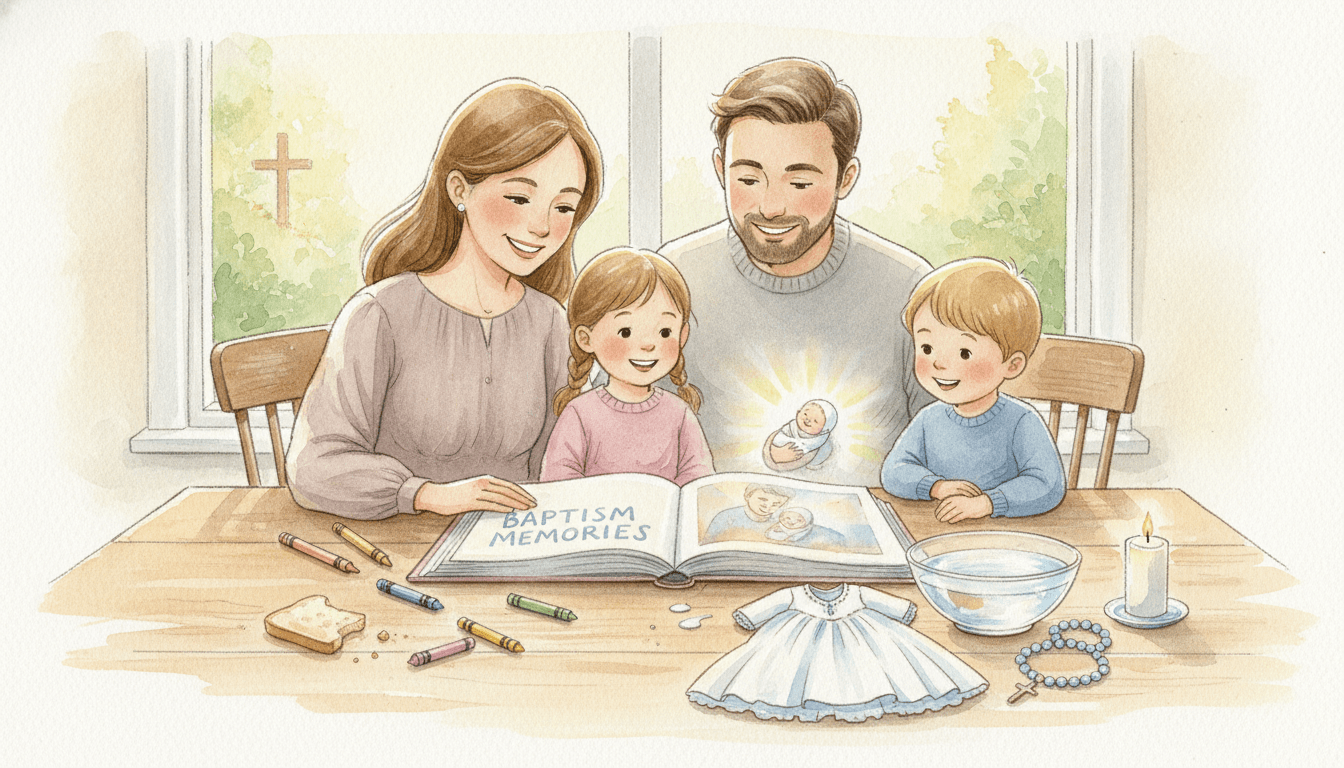
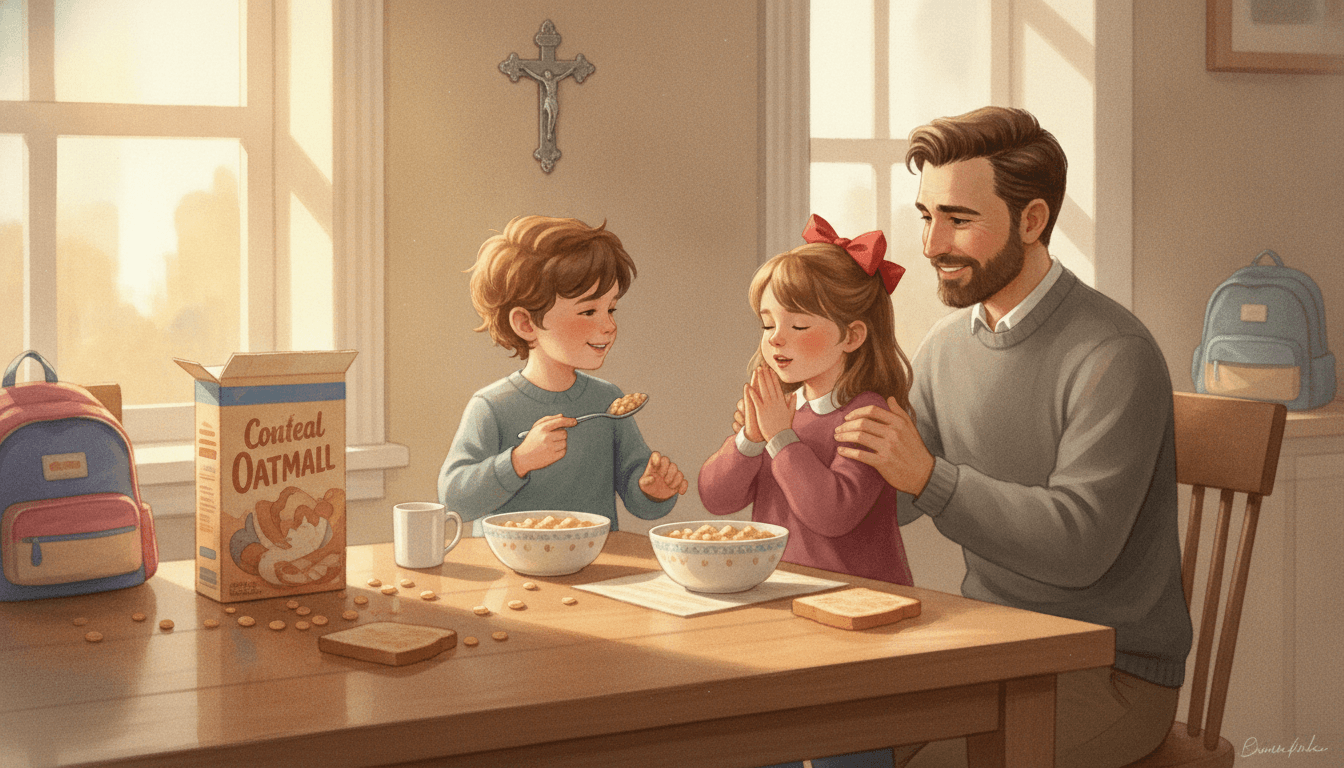
The other morning, a child at our table made the Sign of the Cross with holy water and asked, “Why do we do the water part?” It is a big question in a very small moment—and a good place to begin teaching kids about Baptism: with water, family stories, and the simple truth that Jesus calls them his own.
Start With the Question Kids Are Already Asking
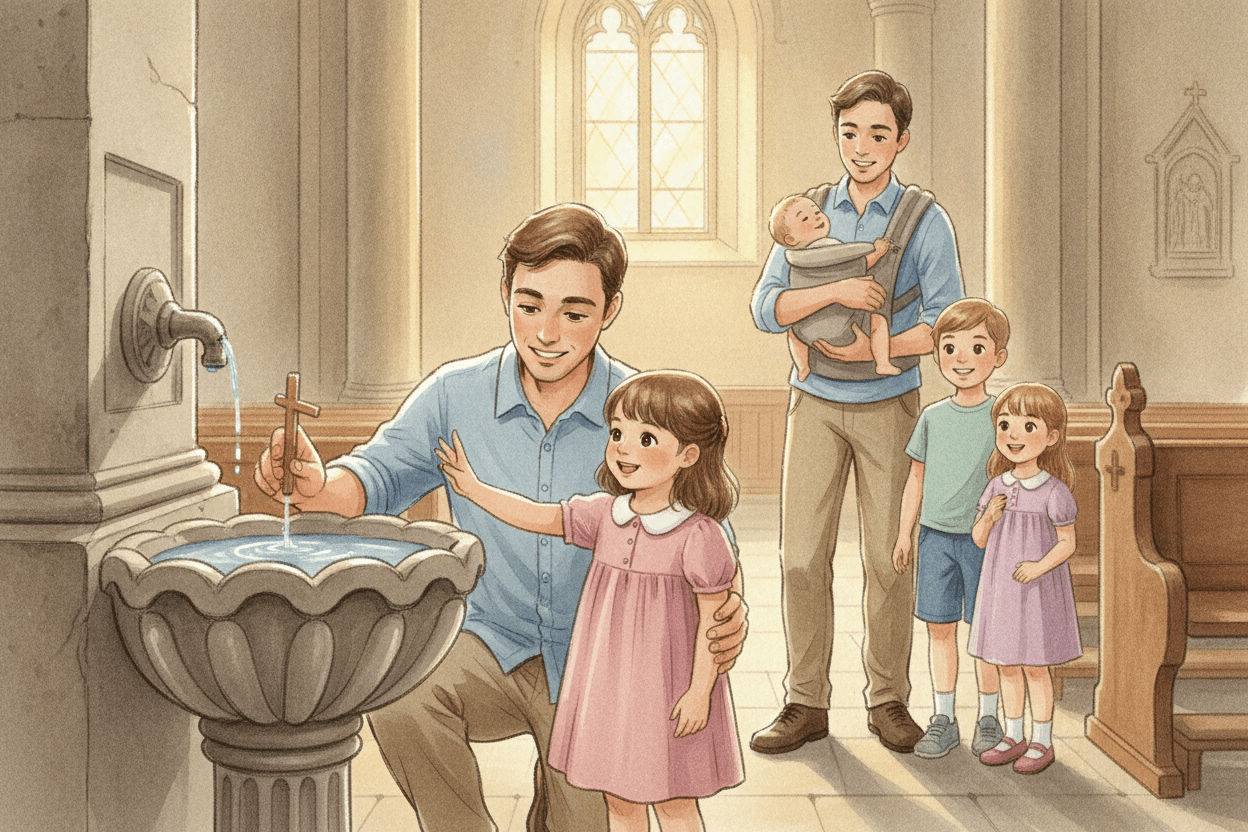
The question usually arrives sideways. A child spots a baptism photo on the refrigerator, notices a tiny white outfit in a keepsake box, or watches someone dip fingers into the holy-water font before Mass. Then comes: “What happened when I was a baby?” You do not need to pull out a long explanation while dinner is burning and somebody has misplaced one shoe again. Start with the child in front of you.
Try this: “Baptism is the day God welcomed you into Jesus’ family and gave you new life. It was a gift from God.” For a young child, that is plenty to hold onto. If they ask more, add that water was poured over their head and the priest or deacon said the names of the Father, the Son, and the Holy Spirit. God is not handing out a prize for good behavior. Baptism is given before a child can earn anything, which is exactly the point.
Pope Francis called Baptism “the basis of the whole Christian life.” That sounds big, but children understand beginnings. A birthday marks the day they entered their family. Baptism marks the day they were welcomed into the Church, the big family that follows Jesus. Parents and godparents stood with them then, and they still have a job now: helping that child learn to pray, love, forgive, and keep coming back to Jesus.
Jesus Himself made room for children: “Let the children come to me, and do not prevent them; for the kingdom of heaven belongs to such as these.” When your child asks about Baptism, hear it as an open door, not a test you might fail. A simple, honest answer is often where faith begins to feel like it belongs to them, not just to the grown-ups.
One small thing we tried was keeping the answer short the first time, then returning to it during ordinary moments. At our table, you might say, “You belong to Jesus’ family,” before a child heads to school or after they have had a rough day with a sibling. Later, pull out the baptism photos and let them point at the candle, the water, and the people gathered around. Here’s what landed: Baptism was not merely something that happened long ago. It is God’s gift, and it tells them who they are today.
“Let the children come to me, and do not prevent them; for the kingdom of heaven belongs to such as these.”
Use Water to Explain a Gift We Can See
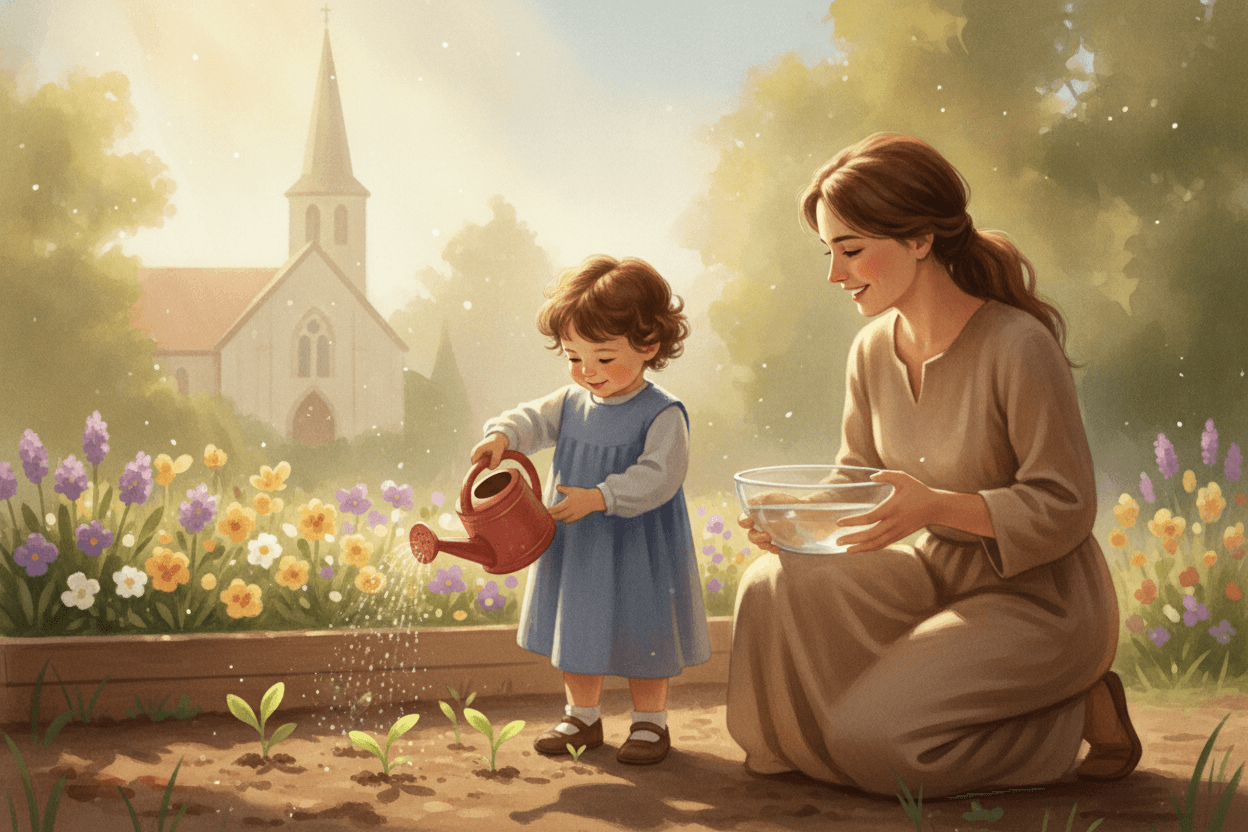
Last week, one of our kids came in from the yard with hands that looked like they had been gardening since 1987. A quick turn at the sink made perfect sense to him: water gets the dirt off. That ordinary little scene gives parents a good place to begin. Kids already know water. It washes sticky fingers, cools a hot face, fills a thirsty cup, and keeps the tomato plants from giving up in July.
Try saying it simply: “In Baptism, God uses water to show us something we cannot see.” The water points to God washing away sin and giving us new life through the Holy Spirit. We do not need to pile on big words for a preschooler. “Jesus makes us clean inside and brings us into his family” is a strong start. For an older child, add that Baptism is not only about washing away what is wrong; it is also a new beginning. God gives us grace to grow in love, goodness, prayer, and holiness.
Jesus himself connected water and the Spirit when he said, “Amen, amen, I say to you, no one can enter the kingdom of God without being born of water and Spirit.” You can explain that being “born of water and Spirit” means God gives us a new kind of life. We still have the same laugh, the same favorite cereal, and probably the same reluctance to clean our room. But through Baptism, we belong to Christ in a new way.
One small thing we tried was keeping the conversation close to real water. While washing hands, ask, “What does water do?” Let your child answer: It cleans. It helps things grow. It makes us feel fresh. Then say, “That is why water is such a good sign in Baptism.” You can also visit the church font or pause at the holy-water font when you arrive for Mass. Help your child make the Sign of the Cross and remind them, “This helps us remember our Baptism.”
A bowl of water at the kitchen table can be a teaching tool, too. Let children rinse a toy or water a plant while you talk. But be clear, especially if they are eager helpers: playing with water at home is not Baptism. Baptism is the Church’s sacrament, celebrated with water and the words naming the Father, the Son, and the Holy Spirit. At our table, that distinction actually helped. The water activity made the sign easier to understand; the real sacrament stayed wonderfully bigger than our little demonstration.
“Amen, amen, I say to you, no one can enter the kingdom of God without being born of water and Spirit.”
Tell the Baptism Story Through Its Signs
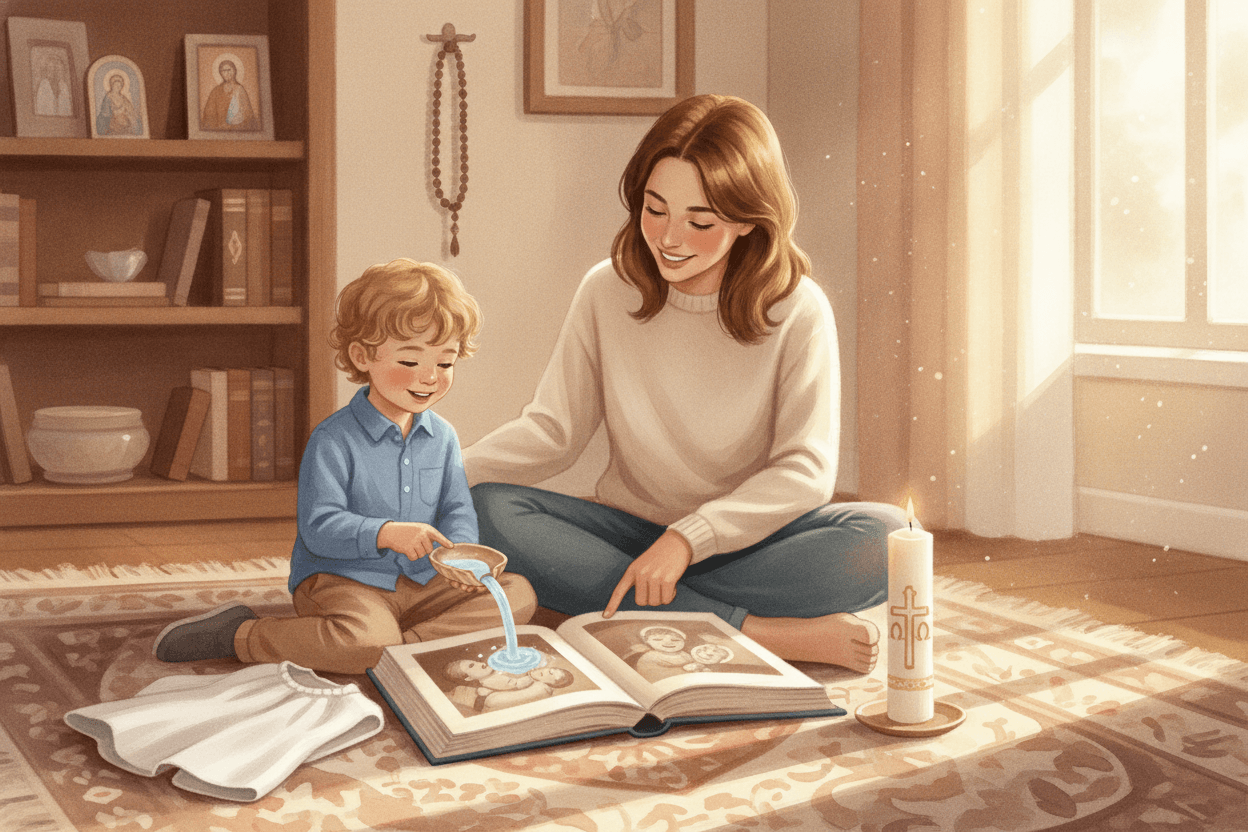
The baptism photo came out one afternoon when we were looking for a picture of Grandma. Within thirty seconds, the kids had skipped Grandma entirely and were pointing at the baby in a long white gown. “Why is he wearing a dress?” Fair question. Baptism pictures are full of things children notice right away: a big bowl, water, a candle, grown-ups standing close, and usually one baby who looks less than thrilled about the whole arrangement.
Start by letting your child be the picture detective. Ask, “Can you find the water? Can you find the person who baptized the baby? Who is holding the candle?” Name what they see. The large bowl or basin is the baptismal font. The priest or deacon is there to celebrate Baptism. Your child’s parents are there because they promised to raise that child in the Catholic faith. Godparents are there too, not as extra gift-buyers—though birthday presents are welcome—but as people who promise to help the child know and follow Jesus.
Then tell the central part simply: “The priest poured water over you and said your name. He baptized you in the name of the Father, and of the Son, and of the Holy Spirit.” Kids do not need a long explanation of the Trinity before they can know this much: there is one God, and God is Father, Son, and Holy Spirit. Jesus gave his followers these words: “Go, therefore, and make disciples of all nations, baptizing them in the name of the Father, and of the Son, and of the holy Spirit.” Those are not magic words. They tell us who God is and whose family we have been welcomed into.
The white garment gives you another easy place to pause. Say, “This white cloth showed that you put on Christ. Jesus gives us a clean, new life with him.” For a little child, that may sound like getting a fresh shirt after a spaghetti disaster. That is okay. The point is not to force a grown-up answer. It is to connect the sign to something they can hold: white means a fresh start and a life meant to reflect Jesus’ goodness. The candle points the same direction. Its flame reminds us that Jesus is our light, and that we are called to live as his people.
Do not overlook the crowd in the photo. At our table, this was the part that landed with our kids. “Look how many people came,” we said. “You were not baptized alone.” Baptism brings us into the Church, the big family of people who follow Jesus around the world. This week, pull out the photos, label the people and signs together, and let your child make the Sign of the Cross slowly: “Father, Son, Holy Spirit.” A small conversation beside a cluttered kitchen counter can make an old photograph feel like a family story they belong in.
“Go, therefore, and make disciples of all nations, baptizing them in the name of the Father, and of the Son, and of the holy Spirit.”
Make “New Life in Jesus” Concrete
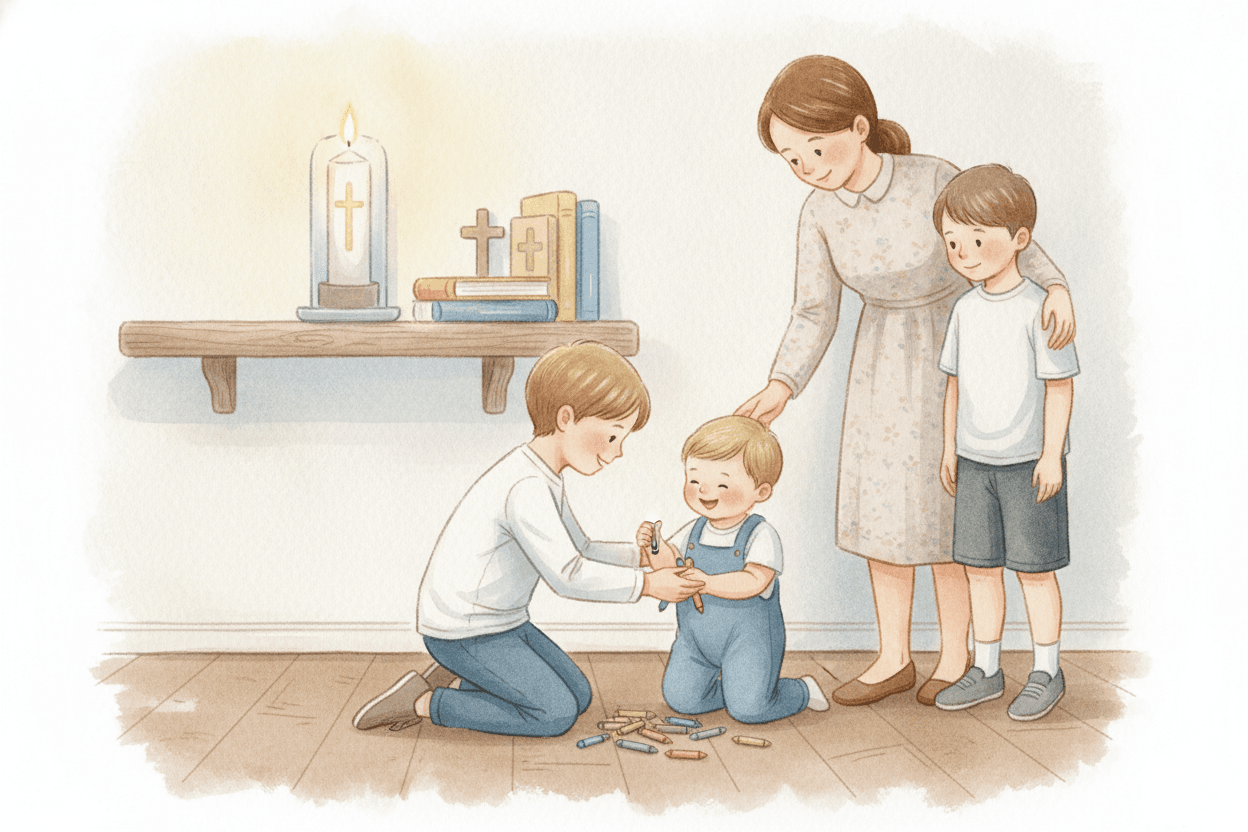
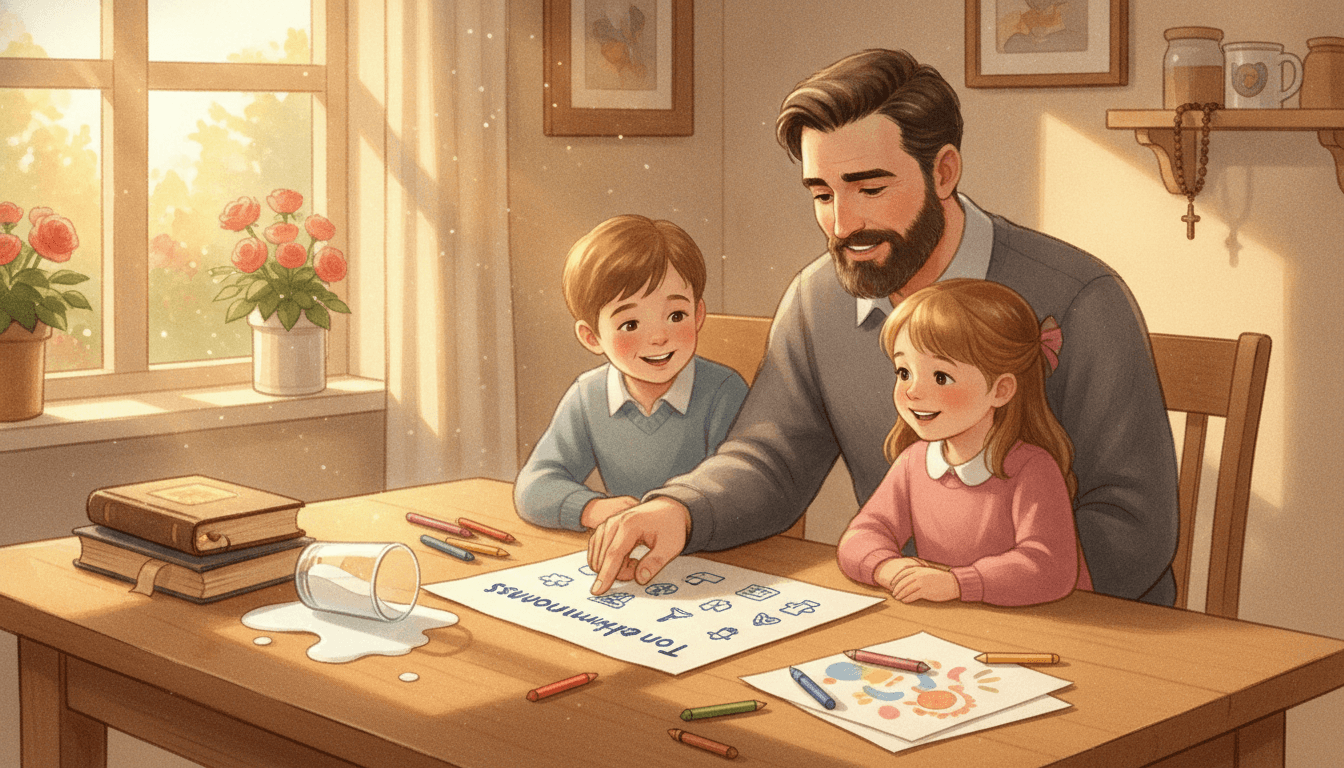
The milk had barely hit the floor when one child blamed the other, the other cried, and I had the familiar urge to ask why everyone could not simply be careful for five minutes. Then came the cleanup, the apology, and a lopsided hug. That is not a polished faith lesson. But it is a good place to talk about new life in Jesus. Baptism does not mean a child suddenly becomes neat, cheerful, or incapable of knocking over a cup. Thank God. It means your child belongs to Jesus, and Jesus gives grace to help him or her grow.
For little kids, I keep the words simple: “In Baptism, Jesus made you part of his family. He is with you and helps you love like him.” Then I name examples they recognize. Jesus helps us tell the truth when we are tempted to hide. He helps us say sorry after we hurt someone. He helps us pray when we are scared at bedtime. He helps us share the good marker, even when it is, apparently, the only blue marker that has ever existed. These are small things, but they are where goodness becomes real to a child.
One small thing we tried was connecting Baptism to the moments after a bad choice. Instead of saying, “You are being bad,” try, “You belong to Jesus. What can we do now?” A child can clean up, ask forgiveness, offer forgiveness, and try again. That is not earning God’s love. God loved them first. It is learning to live as someone who is loved. Parents need that sentence too, especially on the long afternoons when nobody naps and dinner is still an hour away.
You might make a short family prayer part of the routine this week: “Jesus, thank you that I belong to you. Help me love, pray, forgive, and do what is good today.” Keep it brief enough for a wiggly child to remember. If you have baptism photos nearby, point to your child and say, “That day, God gave you a new life with Jesus.” Here’s what landed in our house: new life is not a gold star for perfect behavior. It is God’s gift, received in Baptism, that keeps calling us back to love after we have spilled the milk, made the mess, or needed mercy before lunch.
“We were indeed buried with him through baptism into death, so that, just as Christ was raised from the dead by the glory of the Father, we too might live in newness of life.”
Show Them They Belong to a Bigger Family
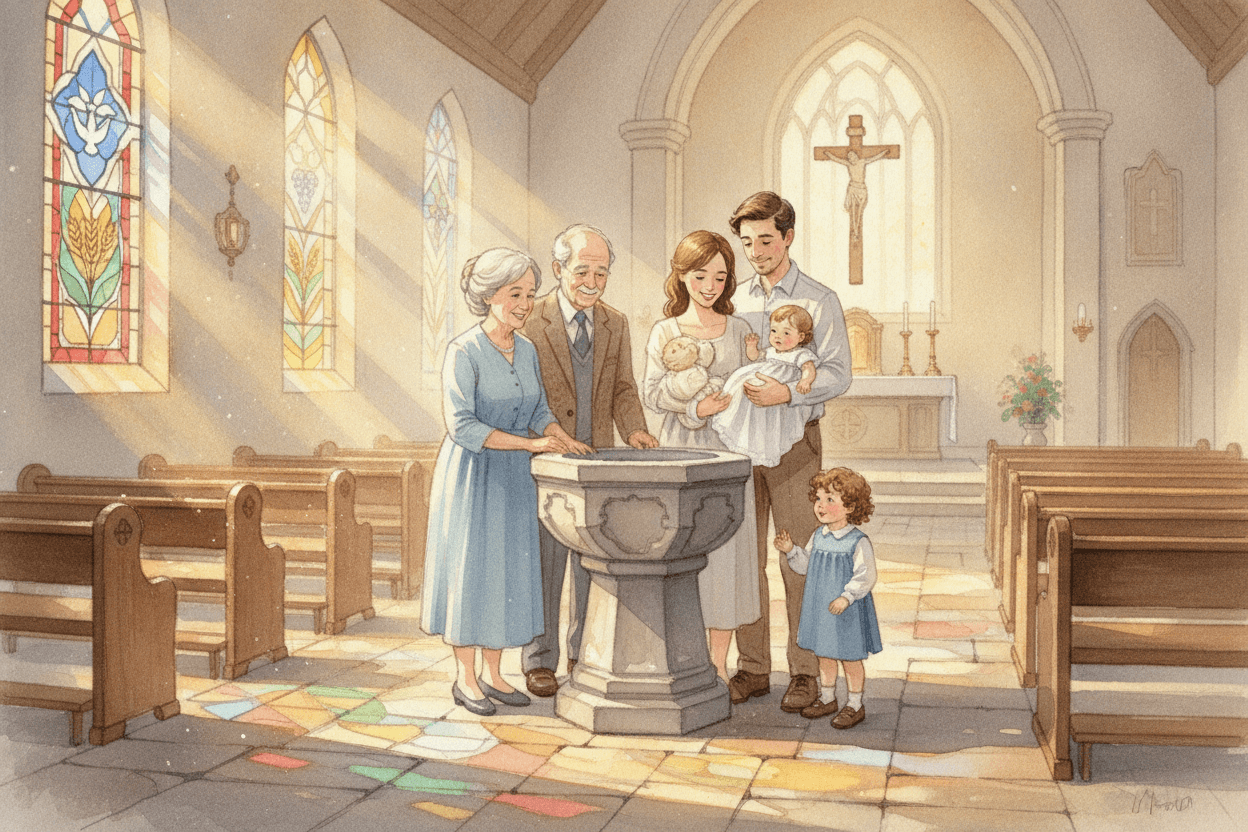
The first time we pointed out our children’s godparents in a baptism photo, one of them asked, “So are they like our extra parents?” Honestly, that is not a bad place to begin. We told them, “They are not replacing Mom and Dad. They are on your team.” Kids understand teams. They know who shows up, cheers, teaches the rules, and helps when somebody forgets what to do—which, in our house, happens before breakfast.
Baptism makes a child part of the Church, the big family of people who follow Jesus. That family includes the people sitting near us at Sunday Mass, but it is much bigger than our parish or classroom. It includes Catholics in other towns, other countries, and every kind of family. It includes saints we know by name and plenty of faithful people we will never meet. When kids hear “Church,” they may picture one building. Gently widen the picture: “This is our parish family, and it is part of Jesus’ family all over the world.”
Parents have the first job of helping a baptized child grow in faith. Godparents have a real supporting role. They pray, encourage, and help the child learn to love Jesus and live as part of the Church. Keep this practical. Ask your child’s godparents to send a birthday card with a short prayer, light a candle on the baptism anniversary, or join you for Mass once in a while. The goal is not to create a perfect faith program. It is to help your child see that faith has familiar faces attached to it.
One small thing we tried was a quiet church visit on an ordinary weekday. No big lesson plan. We walked in, lowered our voices, and let the kids look around. Start at the baptismal font: “This is where people are baptized into the Church.” Then notice the holy-water fonts near the doors. Let your child dip a finger in the water and make the Sign of the Cross, if they are ready. Point out the sanctuary and say, “This is where our parish gathers for Mass.” A five-minute visit can make the building feel less like a place they are dragged into on Sunday and more like a family home they belong in.
If you have baptism pictures, pull them out afterward. Name the people who came. Find the priest or deacon, the parents, the godparents, and the gathered congregation. Here’s what landed with our kids: Baptism was not a private family photo shoot with unusually fancy clothes. The Church was there because the Church welcomed them. And now, little by little, they are learning how to be part of that family too.
Try a Baptism Anniversary Tradition This Week
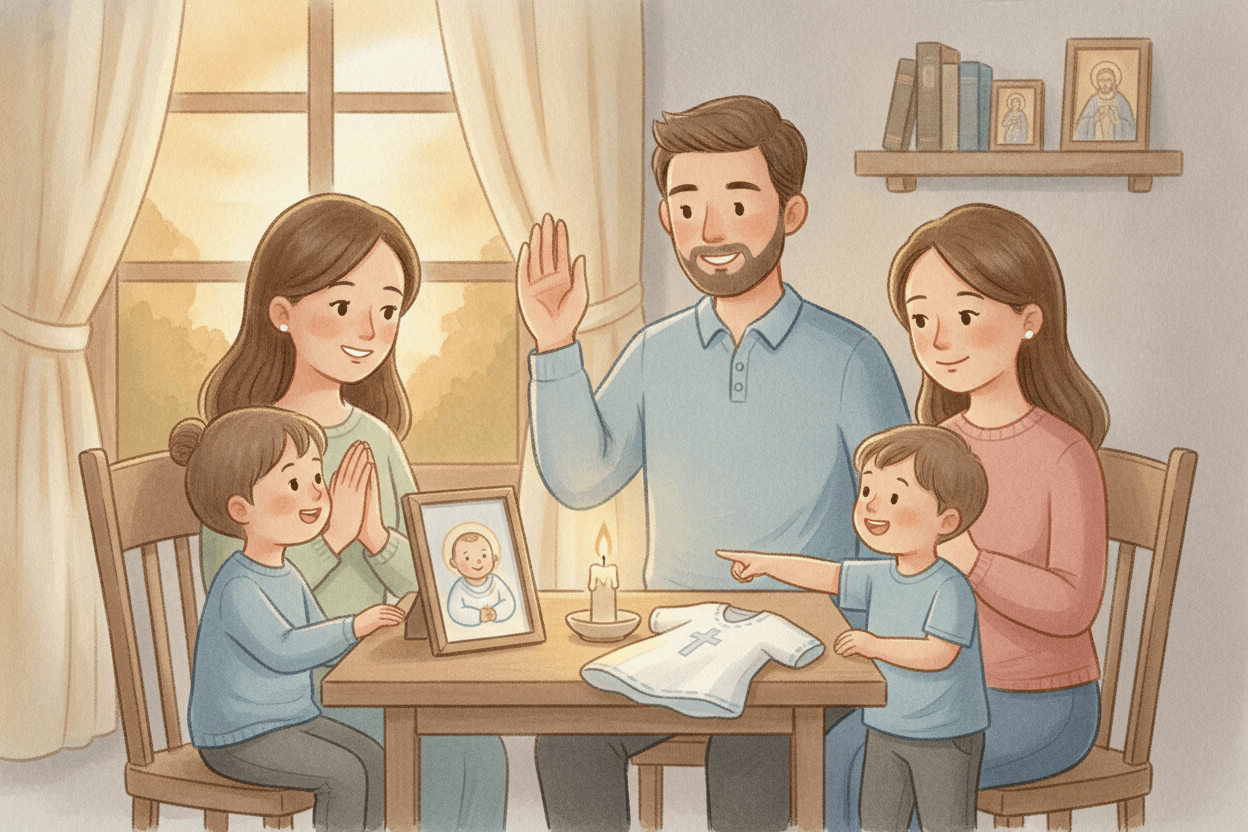
Last year, we found one of our kids’ baptism photos tucked behind a stack of school papers. There was the tiny white outfit, a proud godparent, and grandparents looking much more rested than we felt at the time. The kids crowded around the table and asked who everyone was. That little photo did more teaching than a long speech could have done.
A baptism anniversary gives your family a simple day to remember: God gave you a gift before you could earn it, explain it, or hold your own bottle. Find each child’s baptism date and put it on the family calendar. A phone reminder works too. When the day comes, pull out the photos, baptismal garment, or candle if you have them. If you do not have any of those things, that is okay. Say the date out loud and tell your child where the Baptism happened and who stood with your family.
Keep the celebration small enough that you will actually repeat it. Light a candle with adult help. Let your child hold the baptism photo or touch the white garment. Then make the Sign of the Cross together and pray, “Thank you, God, for making you your child in Baptism.” You might add one specific prayer: “Help you grow kind,” or “Help you remember Jesus is with you at school.” Cake is optional, but no one at our table has complained when it appeared.
This is not a pretend Baptism at home. The sacrament was celebrated with water and the words spoken in the name of the Father, the Son, and the Holy Spirit. Your anniversary tradition is simply a way of remembering what God did and helping your child grow into that gift. Children understand more than we think when we give them real objects, a few clear words, and the chance to ask their wonderfully unexpected questions.
Here’s one small thing we tried this week: before bedtime, use holy water at home, or stop by the holy-water font when you are at church. Help your child make the Sign of the Cross and say, “I belong to Jesus.” It takes about ten seconds. On a loud, crumb-covered evening, that may be all you manage. It is still a good beginning.
“Let the children come to me, and do not prevent them; for the kingdom of heaven belongs to such as these.”
Frequently asked questions
How do I explain Baptism to a young child?
Start with one simple sentence: “Baptism is the day God welcomed you into Jesus’ family and gave you new life.” If your child asks for more, explain that the priest or deacon poured water and baptized them in the name of the Father, Son, and Holy Spirit. Emphasize that it is God’s gift, not something a child earns.
Why is water used in Catholic Baptism?
Water is a sign of what God does in Baptism: he washes away sin and gives new life through the Holy Spirit. Connect it to everyday experiences by asking what water does when children wash their hands or water a plant. For little ones, “Jesus makes us clean inside and brings us into his family” is enough.
How can I use holy water to teach my child about Baptism?
When entering church, help your child dip their fingers in holy water and make the Sign of the Cross. Tell them, “This helps us remember our Baptism.” You can also visit the baptismal font together and point out that Baptism itself is a sacrament celebrated by the Church, not simply a water activity.
What should I tell my child about their baptism photos?
Let your child look closely and identify the water, font, candle, priest or deacon, parents, and godparents. Explain that their parents promised to raise them in the Catholic faith, while godparents promised to help them know and follow Jesus. Tell them that the water was poured as their name was spoken with the names of the Father, Son, and Holy Spirit.
What do godparents do after a child is baptized?
Godparents are meant to help a child grow in faith, not just attend the ceremony or give gifts. They can pray for the child, encourage them to go to Mass, talk about Jesus, and model forgiveness and love. Parents remain the primary teachers of faith, but godparents are important helpers.
Can I do a Baptism lesson with water at home?
Yes, a simple activity such as rinsing a toy, washing hands, or watering a plant can help children understand why water is a meaningful sign. Use it to talk about cleansing, life, and growth. Be clear that the activity is not Baptism itself; Baptism is the Church’s sacrament celebrated with water and the Trinitarian words.
Sources: usccb.org · vatican.va · vatican.va · vatican.va · vatican.va · vatican.va · vatican.va
Scripture quotations in this article use the NABRE translation.