How to Talk to Kids About the Holy Spirit
Help children understand the Holy Spirit through everyday examples, simple language, and honest questions. This guide explores who he is, how he works, and practical ways families can notice his prese

“Is the Holy Spirit like a ghost?” one of my kids asked while we cleared cereal bowls from the table. Fair question. The Holy Spirit can feel hard to explain, but we do not need a fog machine or a theology degree: we can start with who he is, notice his work, and give our children simple words for asking his help.
Start Here: The Holy Spirit Is Someone, Not Something
The question came from the back seat on the way home from Mass: “Is the Holy Spirit a ghost?” Fair question. We had just said his name in the Sign of the Cross, and our youngest had heard words like Spirit and holy but had no picture to hold onto. I told him, “The Holy Spirit is God, the third Person of the Trinity, with the Father and the Son.” That is a good first sentence for our kids because it is plain, true, and gives them solid ground.
Children often hear “spirit” and imagine something spooky, invisible, or made up. So it helps to say what the Holy Spirit is not. He is not a ghost, a magical power we can call up when we want a good grade or a parking spot, or a vague happy feeling in our chest. He is someone. He knows us, loves us, teaches us, and helps us follow Jesus. The Catechism puts it clearly: “The Holy Spirit is thus revealed as another divine person with Jesus and the Father.” We do not have to make him less mysterious, but we do want to make sure our children know he is not less personal.
At our table, I might ask, “Can someone be real even if we cannot see him?” We can feel the wind move the leaves without seeing the wind itself. That image can help, as long as we add the important part: the Holy Spirit is not merely like wind or energy. He is God. Jesus called him the Advocate, and said, “The Advocate, the holy Spirit that the Father will send in my name—he will teach you everything and remind you of all that I told you.” A force does not teach. A good feeling does not remind us of Jesus’ words when we are tempted to be unkind to a sibling before breakfast.
One small thing we tried was using ordinary moments to name his help. Before a hard conversation, a test, a soccer game, or an apology, pause for ten seconds and pray: “Holy Spirit, help me know what is true, choose what is good, and follow Jesus today. Give me wisdom, courage, and a loving heart. Amen.” Then keep the conversation honest. Not every strong feeling is the Holy Spirit. His guidance will not pull us away from Scripture, truth, love, or what the Church teaches. For a child, that may sound simple: the Spirit will not tell you to lie, be cruel, or put yourself first. He helps us become more like Jesus, even when the kitchen is loud and somebody has spilled milk again.
The Advocate, the holy Spirit that the Father will send in my name—he will teach you everything and remind you of all that I told you.
Use Pictures Kids Can Hold Onto—Without Shrinking God
The other morning, one of my kids held his hand over the air vent and announced, “The wind is hiding.” Fair point. We could not see the air moving, but we could feel it on our fingers and hear the little paper on the table scoot across the floor. That is often the easiest place to begin with children: the Holy Spirit works in ways we cannot see, yet his work is real. He gives life, helps us pray, strengthens us to choose what is good, and moves us toward Jesus.
Jesus used this picture too: “The wind blows where it wills, and you can hear the sound it makes, but you do not know where it comes from or where it goes; so it is with everyone who is born of the Spirit.” Wind and breath help a child grasp invisible, life-giving action. But I try to add one important sentence right away: the Holy Spirit is not wind, air, or an invisible power floating around. He is God—the third Person of the Trinity—who knows us, loves us, and acts in our lives.
Then we can bring out the other pictures, one at a time. Fire recalls Pentecost: the frightened disciples received courage to speak about Jesus. Water points to new life and Baptism. Oil brings children back to Baptism and, later, Confirmation, when the Spirit marks and strengthens us for the work God gives us. A seal makes a good kid-sized comparison too. Just as a name written inside a lunch box says, “This belongs to our family,” God places his seal on us and gives the Spirit in our hearts. The dove reminds us of the Spirit coming upon Jesus at his Baptism. None of these pictures is a photograph of the Holy Spirit. They are signs that help us notice what he does.
At our table, I have found it helps to tie each image to an ordinary moment. A child is nervous about apologizing to a friend? Ask for the courage of Pentecost fire. Someone is taking a deep breath before a hard conversation? Remember that God is close, even when we cannot see him. Putting lotion on dry hands can become a quick reminder of anointing and being set apart for God. The goal is not to turn every snack into a religion class—everyone needs to eat their crackers in peace—but to give children handles for a truth that is bigger than they are.
One small thing we tried was a simple question at bedtime: “Which picture of the Holy Spirit do you need tomorrow—wind, fire, water, oil, a seal, or a dove?” Their answers can be wonderfully direct: courage for a test, peace after an argument, help being kind to a sibling. Then pray together: “Holy Spirit, help me know what is true, choose what is good, and follow Jesus today. Give me wisdom, courage, and a loving heart. Amen.” The pictures give children words. The prayer reminds them they are speaking to Someone.
The wind blows where it wills, and you can hear the sound it makes, but you do not know where it comes from or where it goes; so it is with everyone who is born of the Spirit.
Tell the Pentecost Story When Courage Is the Question
Last week, one of the kids stood at the kitchen counter, very interested in a snack and not at all interested in answering my question. A cup had spilled, someone had blamed a sibling, and the real story was slowly coming out. “It is hard to tell the truth when you think you will get in trouble,” I said. That is a small-kid version of a big question: Where do we get courage when doing the right thing feels scary?
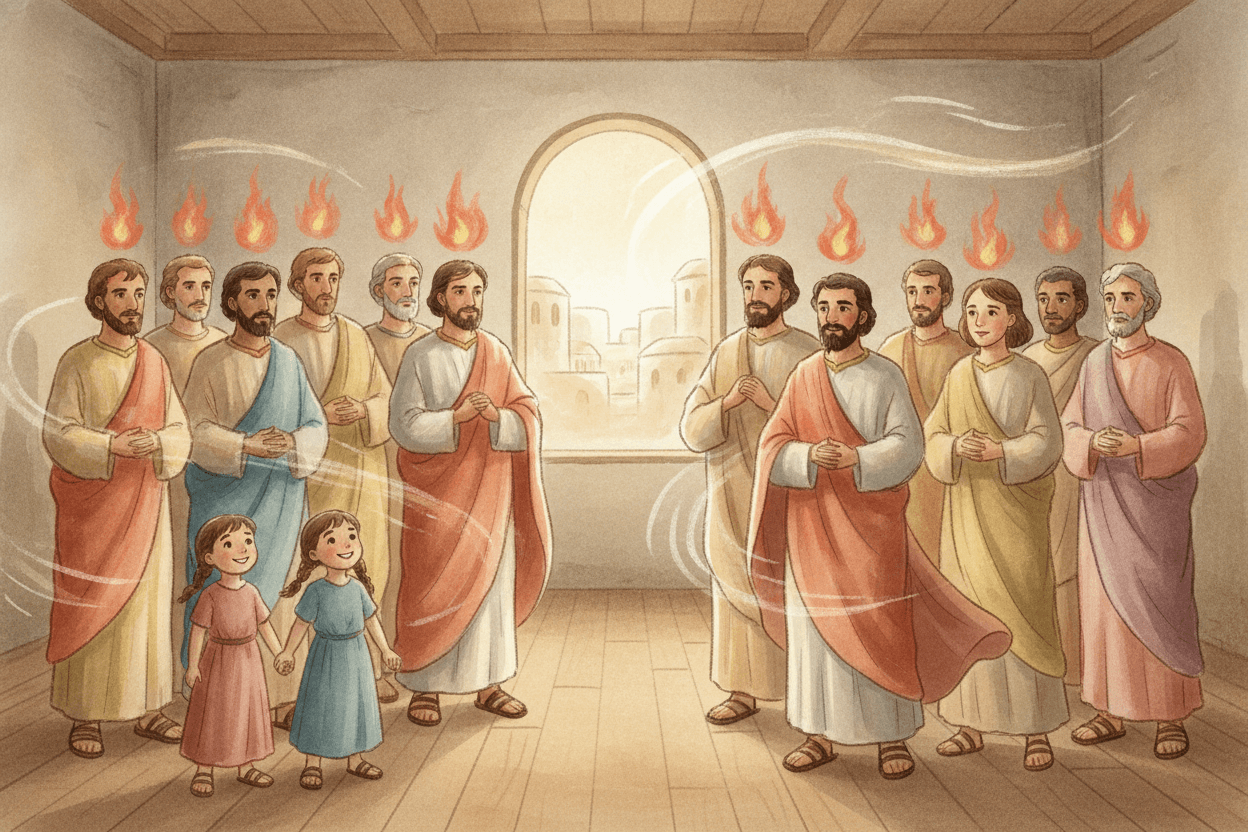
This is a good moment to tell the Pentecost story. Jesus’ disciples had been afraid. Then, as they were gathered together, the Holy Spirit came with the sound of a strong wind and tongues like fire. The fire was not a party trick. It showed God acting in them. The same disciples who had been hiding became ready to speak about Jesus. For a child, I would say it plainly: “The Holy Spirit did not make them loud for no reason. He helped them do what was right, even when it was hard.”
Then bring the story down to the place your child knows. Courage might mean telling the truth about the spilled cup. It might mean sitting with the child who is alone at lunch. It might mean saying, “I was wrong,” after being unkind to a brother or sister. It might mean refusing to join in when friends make fun of someone. Ask, “When have you needed courage to do what was right?” Let the silence sit for a minute. Kids often answer after they have finished inspecting the ceiling, the floor, and every crumb within reach.
One small thing we tried was a short prayer before school or before a hard conversation: “Holy Spirit, help me know what is true, choose what is good, and follow Jesus today. Give me wisdom, courage, and a loving heart. Amen.” Do not promise your child that courage means they will never feel nervous. Pentecost does not teach that. Courage means we can obey God while our stomach still feels wiggly. And when they do choose truth, kindness, or honesty, name it: “That took courage. The Holy Spirit helps us do things like that.”
When the time for Pentecost was fulfilled, they were all in one place together. And suddenly there came from the sky a noise like a strong driving wind, and it filled the entire house in which they were. Then there appeared to them tongues as of fire, which parted and came to rest on each one of them. And they were all filled with the holy Spirit and began to speak in different tongues, as the Spirit enabled them to proclaim.
Point to Baptism, Confirmation, and the Help We Receive Now

After Mass one Sunday, my child noticed the little bottle of oil near the baptismal font and asked why the priest used “the shiny stuff.” Fair question. Kids notice the things adults hurry past: water, a candle, a white garment, oil on a forehead. Those signs give us a simple way to talk about what God is doing. At Baptism, the Church anoints us with sacred chrism, fragrant oil, as a sign that we belong to Jesus. We are not getting a magic mark. We are being welcomed into Christ’s family and given the Holy Spirit’s life.
Confirmation uses chrism too. I tell kids to think of it as God strengthening a promise already begun. The Holy Spirit marks us as Christ’s own, gives us help to live as his disciples, and sends us out to serve. That may sound big, because it is big. But serving can look very small on a Tuesday: telling the truth when a lie would be easier, including the lonely kid, helping with dishes without turning it into a labor negotiation. The Spirit gives courage for the next right thing.
Saint Paul wrote, “But the one who gives us security with you in Christ and who anointed us is God; he has also put his seal upon us and given the Spirit in our hearts as a first installment.” That word seal can help. A seal says, “This belongs here.” In our house, lunch containers get names because otherwise someone comes home with a container full of mysterious crackers. God’s seal is far more than a name label, of course. It means we belong to Christ, and he does not leave us to figure out Christian life alone.
One small thing we tried was asking at bedtime, “Where might the Holy Spirit have helped you today?” The answer was sometimes serious. Sometimes it was, “I did not yell at my brother... much.” Both can open a real conversation. Help children look for the Spirit in ordinary faithful habits: listening to Scripture at Mass, receiving the sacraments, praying when they are worried, apologizing, giving away time or kindness. The Spirit is at work in the Church, but he is not limited to dramatic moments. Ask for help plainly: “Holy Spirit, help me know what is true, choose what is good, and follow Jesus today. Give me wisdom, courage, and a loving heart. Amen.”
But the one who gives us security with you in Christ and who anointed us is God; he has also put his seal upon us and given the Spirit in our hearts as a first installment.
Help Kids Discern: Not Every Feeling Is a Message
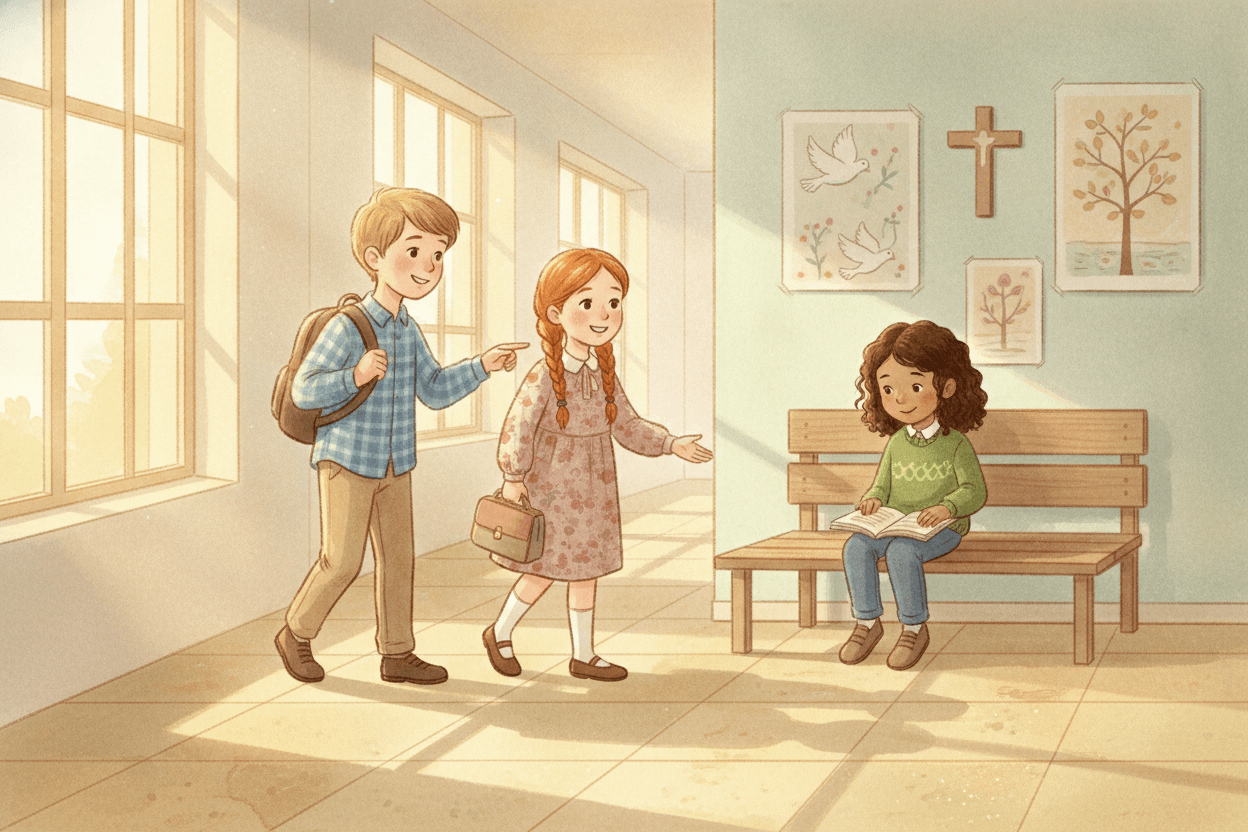
One afternoon, a child at our table announced, “I feel like the Holy Spirit wants me to tell my brother he is annoying.” The brother did not disagree with the first part. Still, we had to slow down. Feelings are real. Thoughts can matter. But not every strong feeling is God giving us instructions. Sometimes we are tired. Sometimes we are embarrassed. Sometimes someone took the last cookie and our soul suddenly has opinions.
A simple guardrail helps: the Holy Spirit will not lead us to lie, hurt someone, show off, or refuse love. He is the Spirit of truth, and he does not contradict Scripture or what the Church teaches. So when a child says, “I think God is telling me…” try asking a few calm questions: Does this choice tell the truth? Is it loving? Would it harm someone? Does it fit what Jesus teaches? Those questions do not make children afraid of hearing God. They help them learn to listen wisely.
Saint Paul gives families something practical to watch for over time: “In contrast, the fruit of the Spirit is love, joy, peace, patience, kindness, generosity, faithfulness, gentleness, self-control. Against such there is no law.” A nudge from the Holy Spirit may not make us comfortable—doing the right thing can be hard—but it will move us toward these fruits. A child who wants to apologize after snapping at a friend may need courage. A child who wants to hide a mistake probably needs help choosing truth instead.
One small thing we tried was making this a bedtime question: “What feeling showed up strongly today, and what would love do with it?” For older kids, name a real situation: joining in with gossip, cheating on homework, leaving out the new kid, or speaking up when something is unfair. Then ask which fruit is needed most. Patience? Kindness? Self-control? We can finish with a short prayer: “Holy Spirit, help me know what is true, choose what is good, and follow Jesus today. Give me wisdom, courage, and a loving heart. Amen.” That is not a magic test for every decision. It is a steady habit of bringing our noisy hearts to God.
In contrast, the fruit of the Spirit is love, joy, peace, patience, kindness, generosity, faithfulness, gentleness, self-control. Against such there is no law.
Try a Five-Minute Holy Spirit Conversation This Week
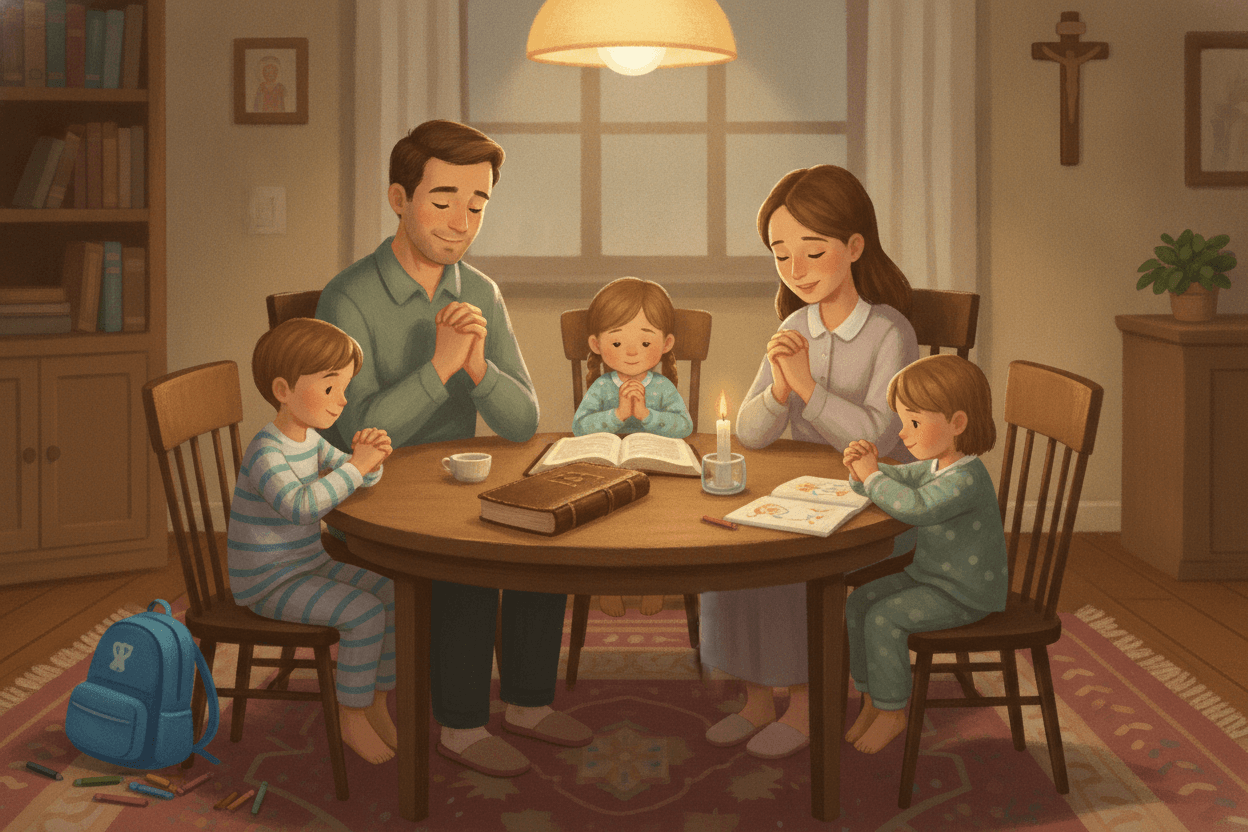
The cereal was getting soggy, one child was looking for a missing shoe, and somebody had strong opinions about whose turn it was to pick the breakfast song. That was not a perfect family-faith moment. It was, however, a good moment for a two-minute question: “What do you think the Holy Spirit helps us do when we are upset?” The answers may be funny. They may be very honest. Both are useful.
Keep this small. Pick one symbol for the week: wind, fire, water, or oil. If you choose wind, stand by an open window or take the conversation outside. Let the kids notice what wind does. We cannot grab it, but we can see leaves move and feel it on our faces. Then say plainly: the Holy Spirit is not wind or a feeling. He is God, close to us and at work even when we cannot see him.
Read one short verse, then stop. Jesus says, “The Advocate, the holy Spirit that the Father will send in my name—he will teach you everything and remind you of all that I told you.” Ask, “When have you needed courage to do what was right?” For a child, that may mean telling the truth about a broken crayon. For an older kid, it may mean refusing to join in when someone is being mocked. Do not rush to fix the answer. Listen first.
You can also name the seven gifts of the Holy Spirit: wisdom, understanding, counsel, fortitude, knowledge, piety, and fear of the Lord. No flash cards required. No quiz at the end. Just connect one gift to the day in front of them. “Fortitude is courage when something is hard.” “Counsel can help us know the good choice.” “Wisdom helps us see what matters most.” Here’s what landed in our house: kids remember a gift better when it has a job to do.
Before everyone runs off, ask one more question: “How could the Holy Spirit help you use a gift to serve someone today?” Maybe a child is good at drawing, noticing lonely people, carrying groceries, or making a little sibling laugh. The Spirit does not only help with church answers. He helps us love real people in ordinary places.
Close with the same prayer each time. Repetition is not boring to children; it becomes a handle they can reach for later. Pray: “Holy Spirit, help me know what is true, choose what is good, and follow Jesus today. Give me wisdom, courage, and a loving heart. Amen.” Five minutes is enough. A few crumbs on the table are allowed.
The Advocate, the holy Spirit that the Father will send in my name—he will teach you everything and remind you of all that I told you.
Frequently asked questions
How do I explain the Holy Spirit to my child without making him sound spooky?
Start simply: the Holy Spirit is God, the third Person of the Trinity, together with the Father and the Son. Explain that he is not a ghost, magic, or just a feeling; he knows and loves us, teaches us, and helps us follow Jesus.
Is the Holy Spirit like wind or air?
Wind is a helpful picture because children can notice its effects without seeing it. But clarify that the Holy Spirit is not wind or an invisible energy—he is a divine Person who acts in our lives and draws us toward Jesus.
What symbols of the Holy Spirit can I teach my kids?
Use one image at a time: wind and breath point to unseen, life-giving action; fire recalls courage at Pentecost; water points to Baptism and new life. Oil, a seal, and a dove also help children remember the Spirit’s strengthening presence and his coming upon Jesus at Baptism.
How can I help my child recognize the Holy Spirit's guidance?
Teach them that the Spirit's help will lead toward truth, love, Scripture, and what the Church teaches. He will not lead them to lie, be cruel, or selfish; instead, he helps them choose kindness, honesty, courage, and forgiveness.
What is a simple prayer to the Holy Spirit for children?
Pause before a test, apology, hard conversation, or other difficult moment and pray together: “Holy Spirit, help me know what is true, choose what is good, and follow Jesus today. Give me wisdom, courage, and a loving heart. Amen.” This gives children concrete words to ask God for help.
How do I connect Pentecost to a child's everyday problems?
Tell children that the disciples were afraid before the Holy Spirit came at Pentecost, and then received courage to speak about Jesus. Connect that courage to telling the truth, apologizing, including someone who is left out, or doing the right thing when it feels scary.
Sources: vatican.va · vatican.va · vatican.va · vatican.va · vatican.va · usccb.org · ccc.usccb.org · vatican.va
Scripture quotations in this article use the NABRE translation.