Helping Kids Face School Giants With David’s Courage
When school fears feel giant-sized, David’s story helps children name what scares them and take the next faithful step. Discover practical ways to nurture courage rooted in God’s steady presence.
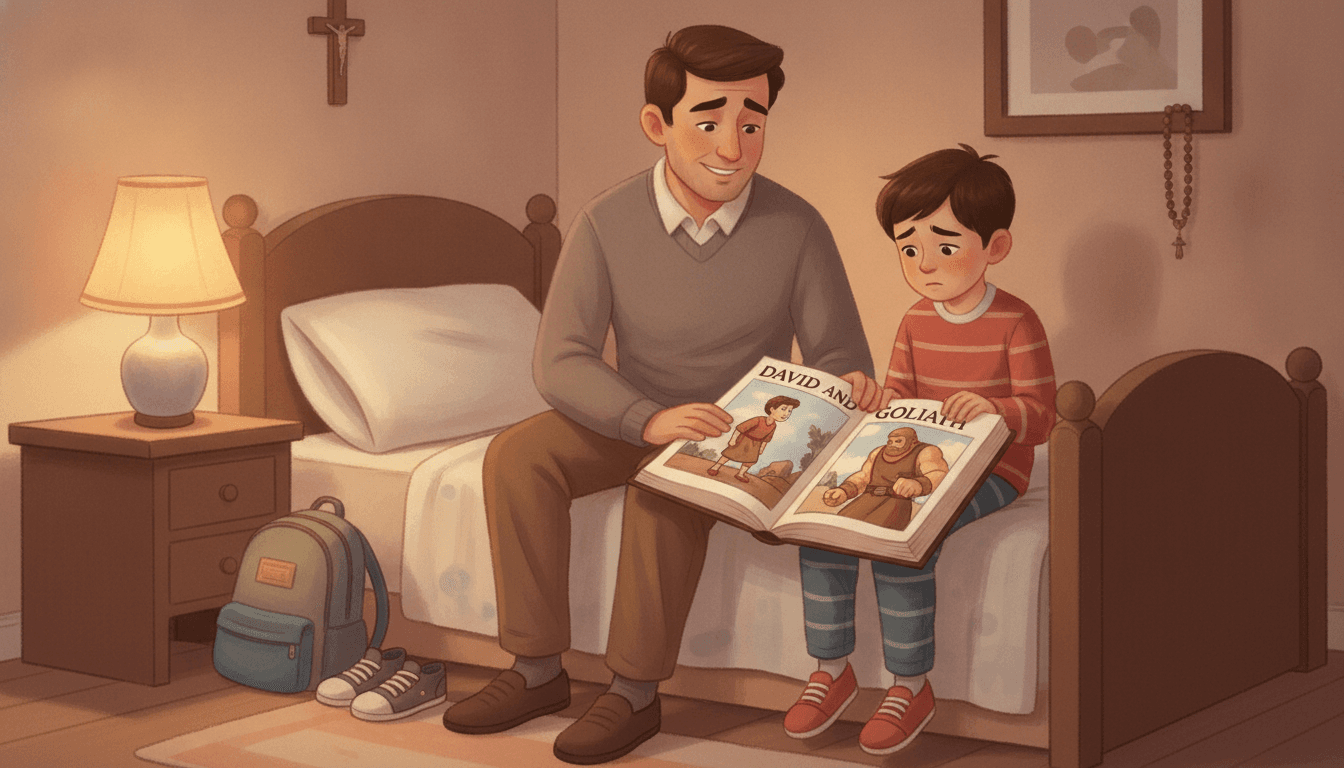
At bedtime, your child finally whispers what has been hiding beneath the stomachaches: “I don’t want to go to school tomorrow.” Whether the giant is a demanding teacher, an unkind classmate, or fear of failing, David’s story gives families something deeper than “just be brave”—courage rooted in the presence of God.
First, Help Your Child Name the Giant
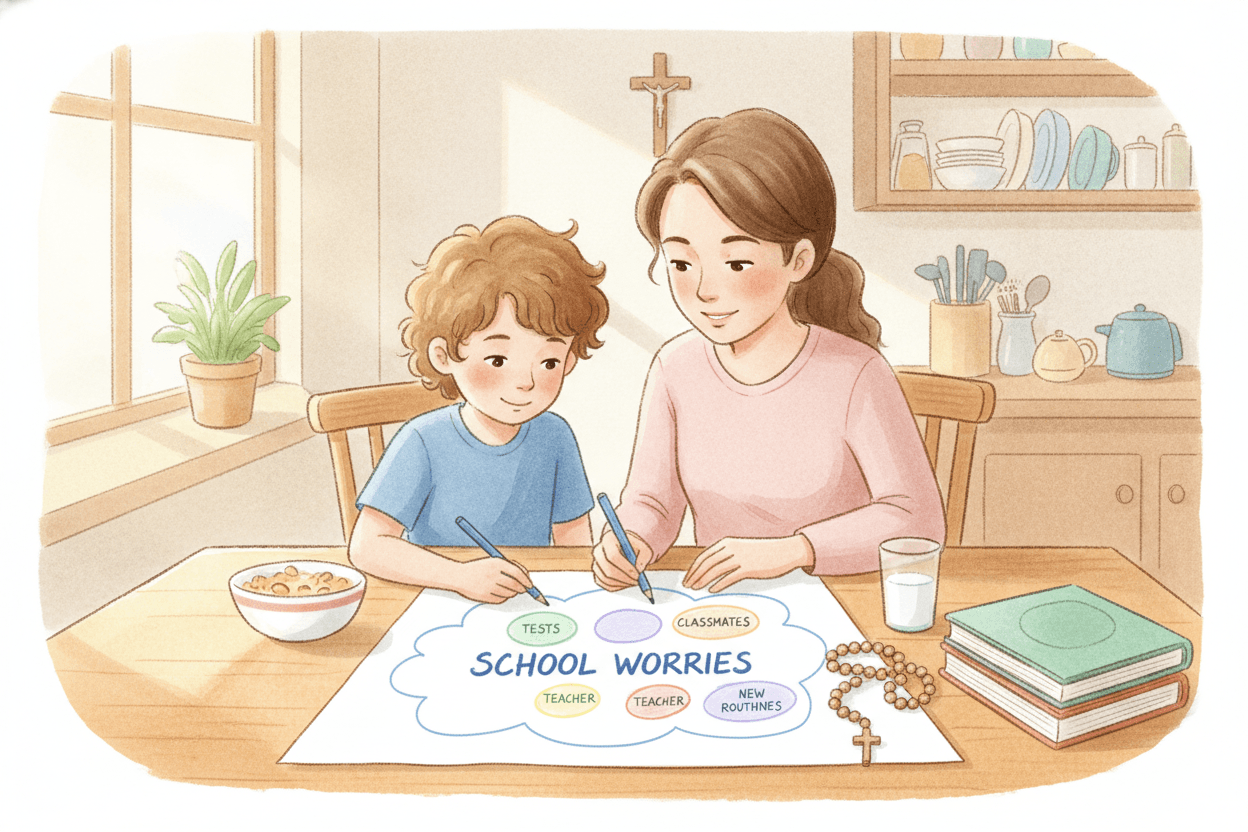
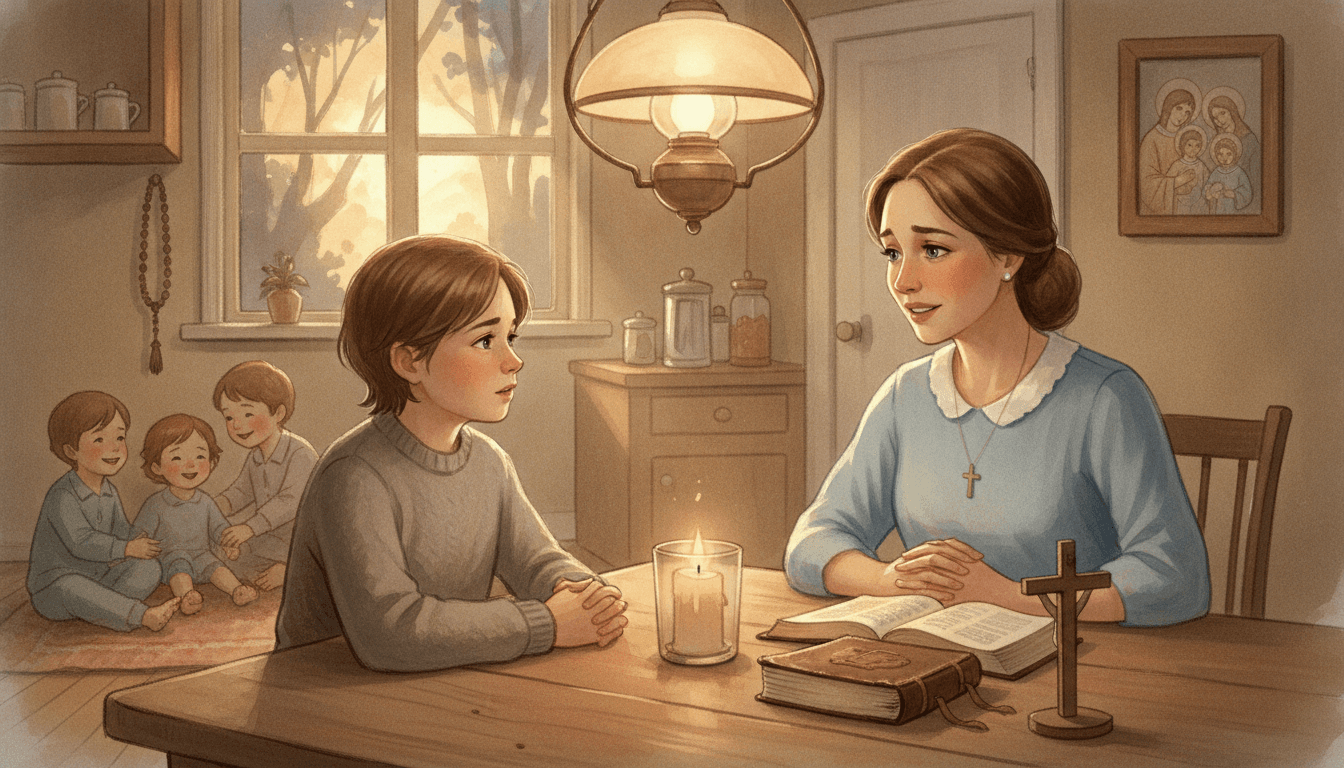
The backpack is packed, the uniform is laid out, and then your child says, “I don’t want to go tomorrow.” That sentence can tempt a parent toward quick reassurance: “You’ll be fine.” It can also stir our own fear until we begin imagining every possible disaster. A better first response is calm attention. Sit beside your child and ask, “What feels hardest about tomorrow?” Then give the answer room to come. Naming the giant does not make it larger; it helps both parent and child see what is actually standing in the way.
David did not face a vague sense of doom. The threat had a name, a voice, and a particular way of frightening Israel. Our children’s school giants also become more manageable when described clearly. Is the fear about a spelling test, getting lost between classrooms, eating alone, disappointing a teacher, or facing a classmate who has been cruel? Try questions such as, “When do you notice the worried feeling most?” “What do you think might happen?” and “Has this happened before, or are you afraid it could happen?” Avoid turning the conversation into an interrogation. One thoughtful question followed by patient listening often tells us more than ten rapid questions.
It is important neither to dismiss nor exaggerate what a child reports. Ordinary nervousness belongs to human life, especially before a new class, presentation, tryout, or change in routine. As the Catechism reminds us, our emotions are natural parts of human experience; they can alert us to something important, but they do not by themselves determine what is true or what we should do (CCC 1763-1768). We can say, “I believe that this feels scary,” without agreeing that the feared outcome is certain. That distinction respects a child’s intelligence and teaches emotional honesty.
Some concerns require more than encouragement at home. Repeated insults, threats, exclusion, physical aggression, sexual harassment, online targeting, or fear of a specific person should be documented and brought promptly to appropriate school staff. Persistent anxiety also deserves attention when it regularly disrupts sleep, causes frequent stomachaches or headaches, leads to ongoing school refusal, or interferes with ordinary family and classroom life. If a child mentions self-harm, abuse, or an immediate safety threat, seek urgent professional help and follow local safeguarding procedures. Courage never means asking a child to endure danger silently.
Here’s how I’d teach this at home: draw a simple shield on paper and write the child’s specific concern in the center. Around it, add three headings: “What I know,” “What I’m afraid might happen,” and “Who can help.” A younger child may dictate while a parent writes; an older child can complete it privately and choose what to discuss. Finish with a brief prayer asking God for truth, courage, and wise helpers. Before children can face a giant, they need to know that their parents will look at it with them—steadily, honestly, and without taking the sling out of their hands.
David’s Courage Was Trust, Not Bravado
A child stands at the classroom door with one hand still gripping a parent’s sleeve. The spelling test, the lunchroom, or the classmate who has been unkind may feel enormous. At that moment, courage does not usually look like a bold speech. It may look like entering the room, asking the teacher for help, or sitting beside one trustworthy friend. That distinction matters when we teach David’s encounter with Goliath. David was courageous, but he was not pretending that the giant was small.
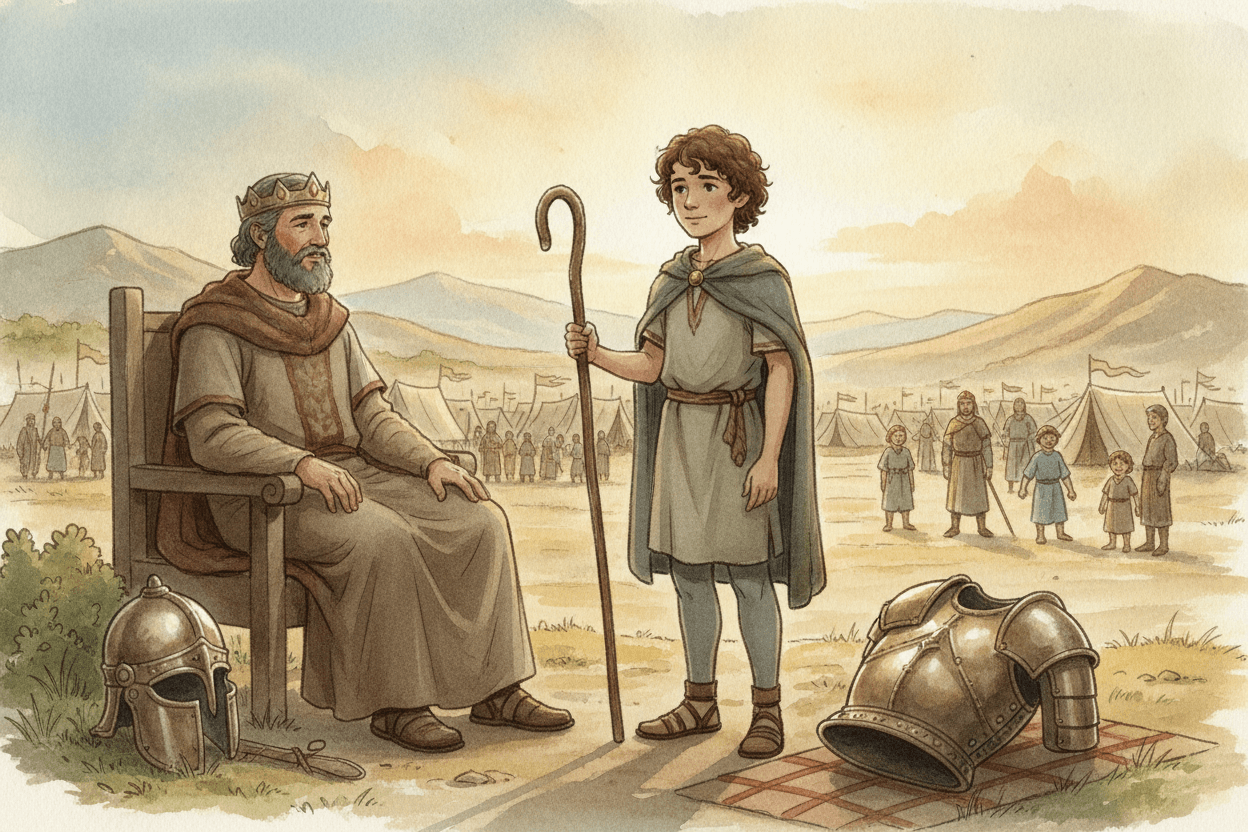
Read 1 Samuel 17:32–47 slowly with your child. David sees the danger clearly. He listens as Saul explains the imbalance between an experienced warrior and a young shepherd. Yet David also remembers how God sustained him when he protected his father’s flock from wild animals. His confidence rests on God’s past faithfulness, not on an inflated opinion of his own ability. Scripture invites us to notice that David’s memory becomes part of his courage: because God has been faithful before, David can take the next faithful step now.
David also refuses Saul’s armor because it does not fit him. This is more than an interesting detail. He does not imitate another person’s way of facing fear. Children need permission to do the same. One student may speak directly to a teacher; another may need to write a note first. One child may pray aloud before school; another may quietly trace the Sign of the Cross in the car. Here’s how I’d teach this: ask, “What is your stone and sling—the honest, fitting step you can take today?” The answer should be concrete and within the child’s responsibility.
We should also guard against turning David’s victory into a promise that faithful children will quickly overcome every difficulty. Some learning struggles require months of patient work. Bullying requires adult intervention, not simply greater confidence from the child being targeted. Anxiety may call for support from parents, teachers, counselors, or medical professionals. Trust in God does not remove these ordinary means of help. Catholic teaching understands providence as God’s wise care working through creation and through our responsible actions (CCC 302–308). Seeking help can itself be an act of trust.
As the Catechism reminds us, fortitude enables a person to remain firm in difficulties and to pursue the good despite fear (CCC 1808). That is a better measure of courage than whether a child feels fearless or wins immediately. After reading the passage, help your child recall one time God provided help through a person, a new skill, an answered prayer, or unexpected perseverance. Then choose one next right step and pray for the grace to take it. David’s example teaches children neither swagger nor self-reliance, but steady action rooted in the conviction that they do not face their giants alone.
What Catholic Tradition Teaches About Courage
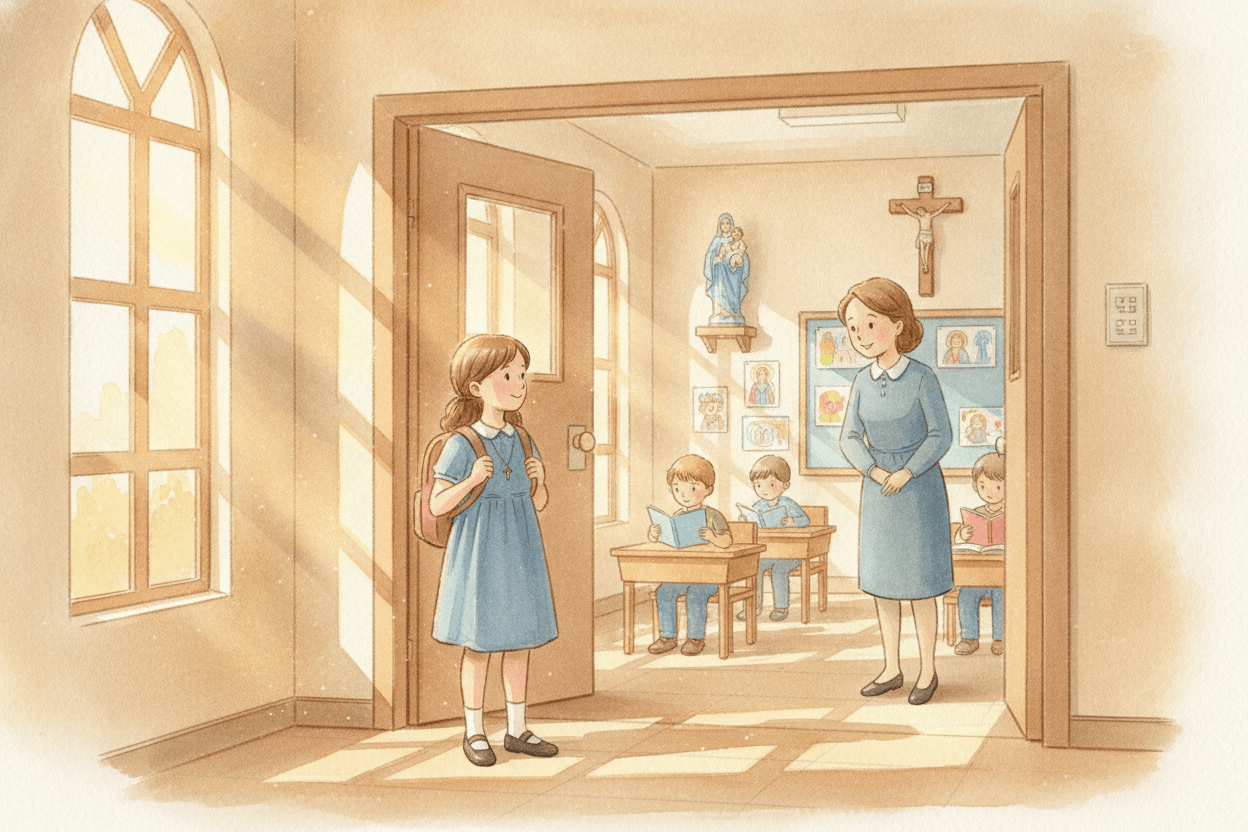
A seven-year-old stands near the classroom door, backpack still on, and whispers, “I don’t want to go in.” That child may already know what the right choice is—enter the room, tell the teacher what happened yesterday, or sit beside a classmate who feels alone. The problem is not a lack of knowledge. The child needs enough steadiness to do the good thing while fear is tugging in the other direction. Catholic Tradition gives that steadiness a name: fortitude.
The Catechism teaches that fortitude is the moral virtue that gives us “firmness in difficulties and constancy in the pursuit of the good” (CCC 1808). For children ages six to nine, I explain it this way: courage does not mean that your stomach never hurts, your hands never shake, or you never wish the problem would disappear. Courage means choosing what is good with God’s help, even when you feel afraid. David did not become courageous by pretending Goliath was small. He faced a real danger while trusting that God had not abandoned him.
As the Catechism reminds us, fortitude also helps a person resist temptation, overcome obstacles, and remain faithful when doing what is right costs something. A child may need fortitude to admit breaking a classroom rule, refuse to join cruel teasing, try again after a poor grade, or enter school after being excluded by friends. These choices may appear ordinary beside David’s battle, but they train the same moral strength: staying with the good rather than surrendering to fear, shame, or pressure.
Fortitude must work together with prudence. A child should never hear the story of David and conclude, “I have to fight every giant by myself.” If the school problem involves bullying, threats, unsafe touching, repeated humiliation, or fear of being harmed, the courageous choice is to seek protection. Teach children to tell a parent, teacher, school counselor, or principal clearly and promptly. Asking for help is not cowardice. Prudence recognizes danger and chooses suitable means to protect what is good, including the dignity and safety of the child.
Here’s how I’d teach this at home or in a parish classroom. Draw two columns labeled “What I Feel” and “What I Can Choose.” A child might write, “I feel scared that they will laugh,” and then, “I can tell my teacher and stay near a safe friend.” Another might say, “I feel embarrassed about my mistake,” followed by, “I can tell the truth and apologize.” End with a short prayer such as, “God, help me know the good, choose the good, and ask for help when I need it.” This respects a child’s intelligence: feelings give important information, but they do not have to make the final decision.
Conversation Scripts for Three School Fears
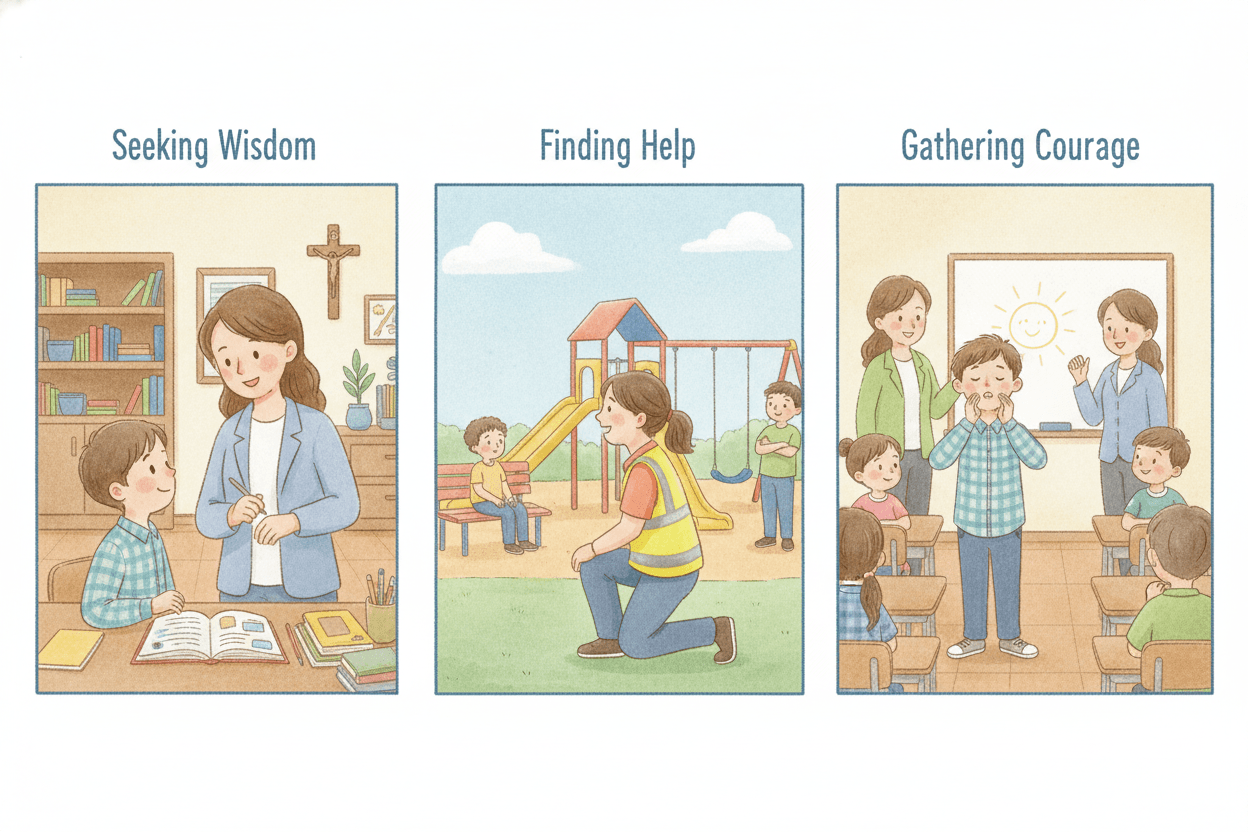
The backpack lands hard by the door, and your child says, “My teacher hates me.” This is not the moment for a lecture, a correction, or an immediate email to the school. It is the moment to listen carefully. Children often speak in conclusions before they can explain the events underneath them. Here’s how I’d teach this at home: acknowledge the feeling, gather the facts, identify what belongs to the child’s control, choose one safe action, and then place that action in God’s care. That pattern respects both the child’s emotions and intelligence.
For a tough teacher, a parent might say: “It sounds as though you felt embarrassed and worried in class. Tell me exactly what happened, starting just before the teacher spoke to you.” After listening, continue: “You cannot control your teacher’s tone, but you can control whether you complete the work, ask a clear question, and speak respectfully. What would feel like a safe next step—asking after class, writing down your question, or having me help you request a meeting?” Then add: “God is present with you in that classroom. We can ask him for courage and wisdom, and I will help you decide whether an adult needs to step in.” This last sentence matters: prayer does not replace appropriate parental action.
For a mean classmate, try: “Being mocked or excluded hurts. I am glad you told me.” Then ask for specifics rather than labels: “What words were used? Where did it happen? Who was nearby? Has this happened before?” Help the child separate responsibility: “You are responsible for telling the truth, keeping your hands and words safe, and seeking help. You are not responsible for making this child like you.” Choose a concrete response together: move near a trusted friend, say, “Stop. That is not okay,” tell the teacher, or report repeated behavior to the counselor. Close with: “God sees what happened, and you do not have to face it alone. Telling a safe adult is an act of courage, not tattling.”
For performance anxiety before a test, presentation, audition, or game, begin with the body: “I see your hands are tight and your stomach hurts. You seem afraid of making a mistake.” Ask, “What is the part you are most worried about?” Once the fear is specific, name what can be controlled: preparation, sleep, arriving on time, breathing slowly, and asking for directions to be repeated. A useful script is: “You cannot control every question or everyone’s opinion. You can practice the first two sentences, take one slow breath before beginning, and do the next right thing.” Then pray simply together: “Lord, stay near to me. Help me use the gifts you have given me and accept that I do not have to be perfect.”
These conversations form fortitude in small, repeatable steps. As the Catechism reminds us, fortitude gives firmness in difficulties and constancy in pursuing the good (CCC 1808). David did not pretend the giant was harmless; he faced a real danger while remembering who God was and what faithful action required. Our children need the same balance. We neither dismiss the fear nor let fear make every decision. We listen, discern what is true, involve responsible adults when needed, and help the child take one safe step with God.
Pack Five Practical Stones for the School Day

On a Monday morning, a child may stand at the school door with a spelling test ahead, a difficult classmate nearby, and a stomach already tied in knots. That is the moment when courage needs to become concrete. In 1 Samuel 17:40, David selects five smooth stones before facing Goliath. We need not turn every stone into a complicated symbol. Instead, we can use the number five as a simple memory device: five faithful responses a child can carry into the school day.
The first stone is a one-sentence prayer: “Jesus, you are with me; show me the next good step.” A child can pray it while walking into class, waiting to give a presentation, or deciding what to do when someone is unkind. The second stone is one remembered truth from Scripture. Keep it brief and accurate: God remains with his people in danger, as Psalm 23 teaches; Jesus welcomes children, as we read in Matthew 19:14; or God gave David courage for the task before him in 1 Samuel 17. Children do not need a large collection of verses at first. They need one truth they can remember when fear becomes loud.
The third stone is one calming breath. Teach the child to breathe in slowly, pause, and breathe out slowly while praying the one-sentence prayer. This is not a substitute for grace or trust in God. It simply helps the body settle enough for the child to choose wisely. The fourth stone is one manageable action: open the worksheet, ask the teacher to repeat the directions, move to a safer seat, say “Please stop,” or begin with the easiest question. Courage usually appears as the next good action, not as the sudden disappearance of fear.
The fifth stone is one trusted adult to contact. Before a hard school day, help your child name that person: a teacher, counselor, aide, coach, school nurse, or parent. Be specific about when to seek help. Teasing that continues, threats, unsafe touch, exclusion that becomes targeted, or fear that keeps a child from participating should not be carried alone. Asking for assistance is not cowardice. As the Catechism reminds us, fortitude enables a person to remain firm in difficulties and pursue what is good (CCC 1808). Sometimes the courageous act is speaking clearly to an adult who can intervene.
Here’s how I’d teach this in a parish classroom or at the kitchen table: make a pocket card together. On the front, write, “My Five Stones.” On the back, list: “1. Pray: Jesus, you are with me; show me the next good step. 2. Remember: God is with me. 3. Breathe slowly. 4. Take one good step. 5. Tell my trusted adult: ______.” Let the child fill in the adult’s name and keep the card in a backpack pocket or pencil case. Practice using it during an ordinary moment, not only during a crisis. Rehearsal respects a child’s intelligence and builds a habit: pray, remember, steady the body, act, and seek help.
Make a Family Courage Plan This Week
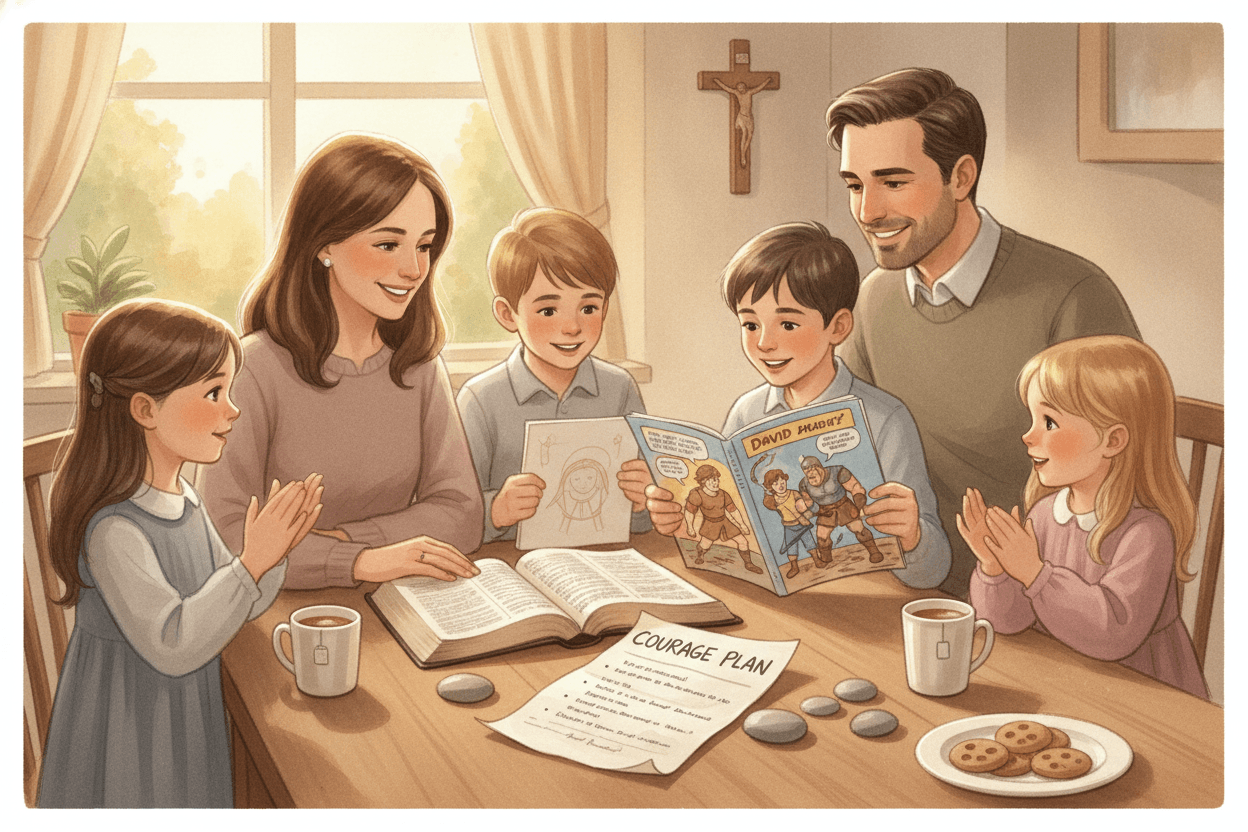
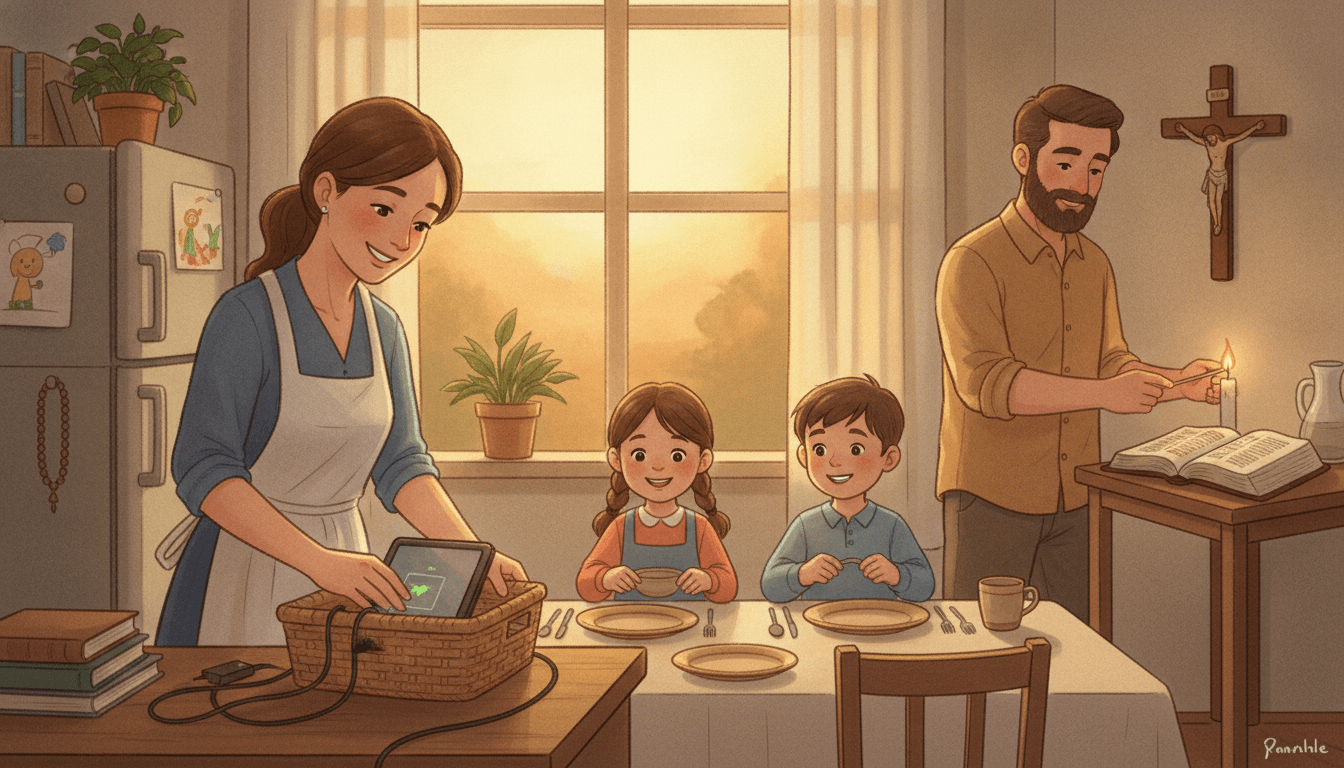
On Sunday evening, place seven small stones or paper circles on the kitchen table. Let them stand for seven days of practicing courage—not seven chances to perform perfectly. Explain that David’s courage in 1 Samuel 17 grew from his trust in God and from habits formed long before he faced Goliath. Your family plan follows that same pattern: listen to God’s word, prepare wisely, ask for help, and take the next faithful step.
Day one: read 1 Samuel 17 together. With younger children, pause to explain unfamiliar details; with older children, ask what David noticed that the frightened soldiers missed. Day two: invite each family member, including parents, to name one current “giant.” It might be a difficult class, lunchtime loneliness, a bully, a test, or the fear of asking a teacher for help. No one has to disclose private details in front of siblings. A child may write or draw the answer instead.
Day three: choose one short line from Scripture that the child can remember during the school day. Read it directly from your family Bible, copy it onto a card, and place it in a lunchbox or backpack. Day four: rehearse one conversation with a trusted adult. Here’s how I’d teach this: the parent plays the teacher, counselor, coach, or principal, and the child practices saying, “Something has been happening at school, and I need your help.” Repeat until the words feel familiar, but do not demand a polished performance.
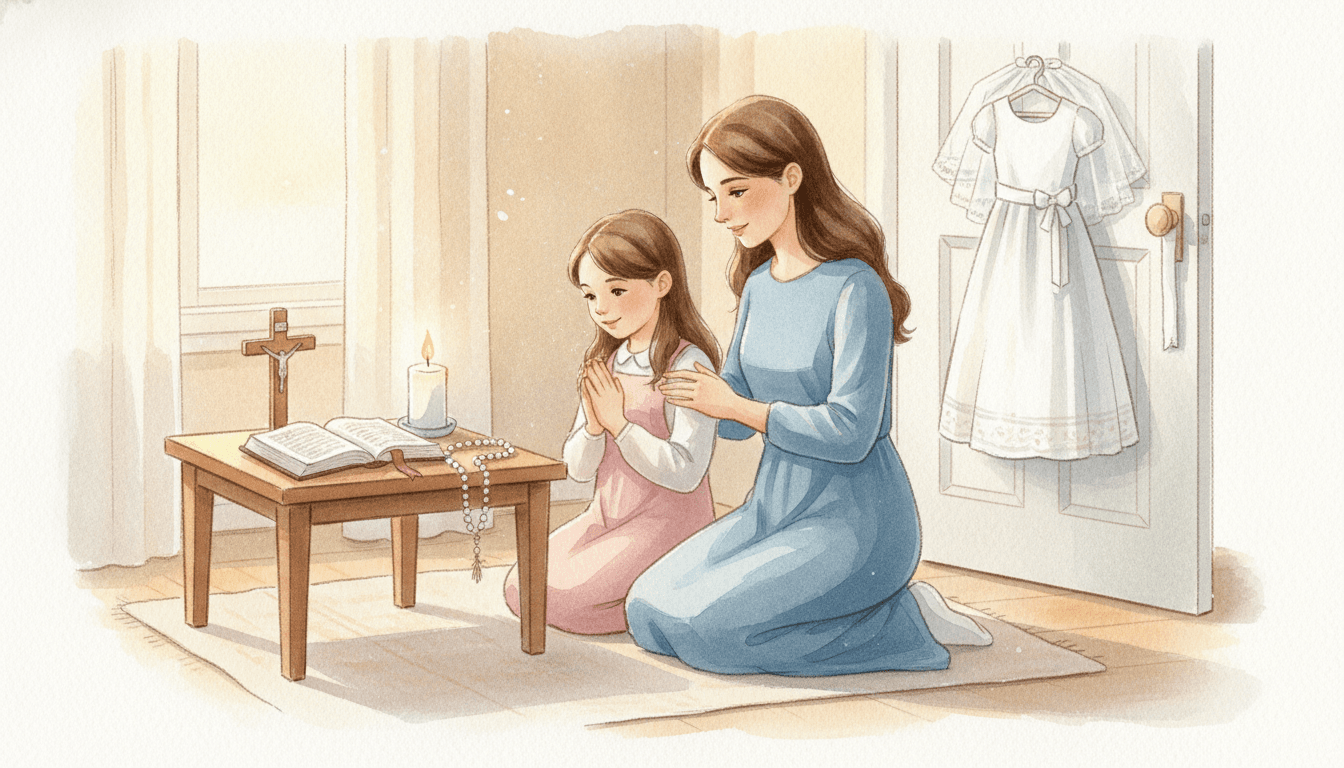
Day five: pray briefly before school. Keep the prayer concrete: ask the Holy Spirit for wisdom, fortitude, and the courage to speak truthfully. As the Catechism reminds us, fortitude helps a person remain firm in difficulties and steadfast in pursuing the good (CCC 1808). That does not mean a frightened child must handle the problem alone. Seeking protection and wise adult assistance can itself be an act of courage.
Day six: use the David and Goliath comic to reinforce the lesson. Ask your child to point out what David did before, during, and after the confrontation. Notice his preparation, his confidence in God, and his refusal to copy Saul’s equipment. Then ask, “What support fits you?” One child may need a note for the teacher; another may need a friend to walk with her; another may need regular meetings with the school counselor.
Day seven: review the week without turning it into a success test. Ask, “What helped even a little?” “What still feels hard?” and “What should we try next?” Courage often grows through repeated, supported attempts. If your child shows repeated distress, refuses school, experiences persistent physical symptoms linked to school, or reports threats of harm to self or others, contact the school and an appropriate medical or mental-health professional promptly. The family courage plan supports children; it never replaces needed protection or professional care.
Frequently asked questions
How do I help my child who says they are scared to go to school?
Begin by listening calmly and asking what feels hardest about tomorrow. Help your child name the specific fear, separate what is known from what might happen, and choose one manageable next step, such as speaking to a teacher or sitting with a trusted friend.
How can I use the story of David and Goliath to teach my child courage?
Read 1 Samuel 17:32–47 and point out that David recognized the danger but trusted God’s past faithfulness. Ask your child to identify a fitting “stone and sling”—one concrete action they can take without pretending the problem is small.
What should I say instead of telling my anxious child, “You’ll be fine”?
Try, “I believe this feels scary, and we can look at it together.” Ask one gentle question, such as “What do you think might happen?” and listen before offering reassurance or solutions.
When should I contact the school about my child’s fear?
Contact appropriate school staff promptly if your child reports repeated insults, threats, exclusion, physical aggression, sexual harassment, online targeting, or fear of a particular person. Document specific incidents, and seek urgent help if there is abuse, self-harm, or an immediate safety threat.
When does school anxiety require professional help?
Consider additional support when anxiety repeatedly disrupts sleep, causes frequent headaches or stomachaches, leads to ongoing school refusal, or interferes with family and classroom life. A counselor, pediatrician, or other qualified professional can work alongside parents and school staff.
What is a simple Catholic activity for helping a child face school fears?
Draw a shield and place the specific concern in the center. Around it, write “What I know,” “What I’m afraid might happen,” and “Who can help,” then finish with a short prayer for truth, courage, and wise helpers.
Sources: bible.usccb.org · usccb.org · biblicalcounseling.com · parentingforfaith.brf.org.uk · teachingcatholickids.com · uscatholic.org · ministryspark.com · cefonline.com · trulywendymomica.com · vts.edu
Scripture quotations in this article use the NABRE translation.