Helping Kids Love Sunday Mass:A Parent’s Guide
Discover practical steps for preparing children before Mass, guiding them through distractions, and building joyful routines afterward. With patience, prayer, and realistic expectations, parents can h
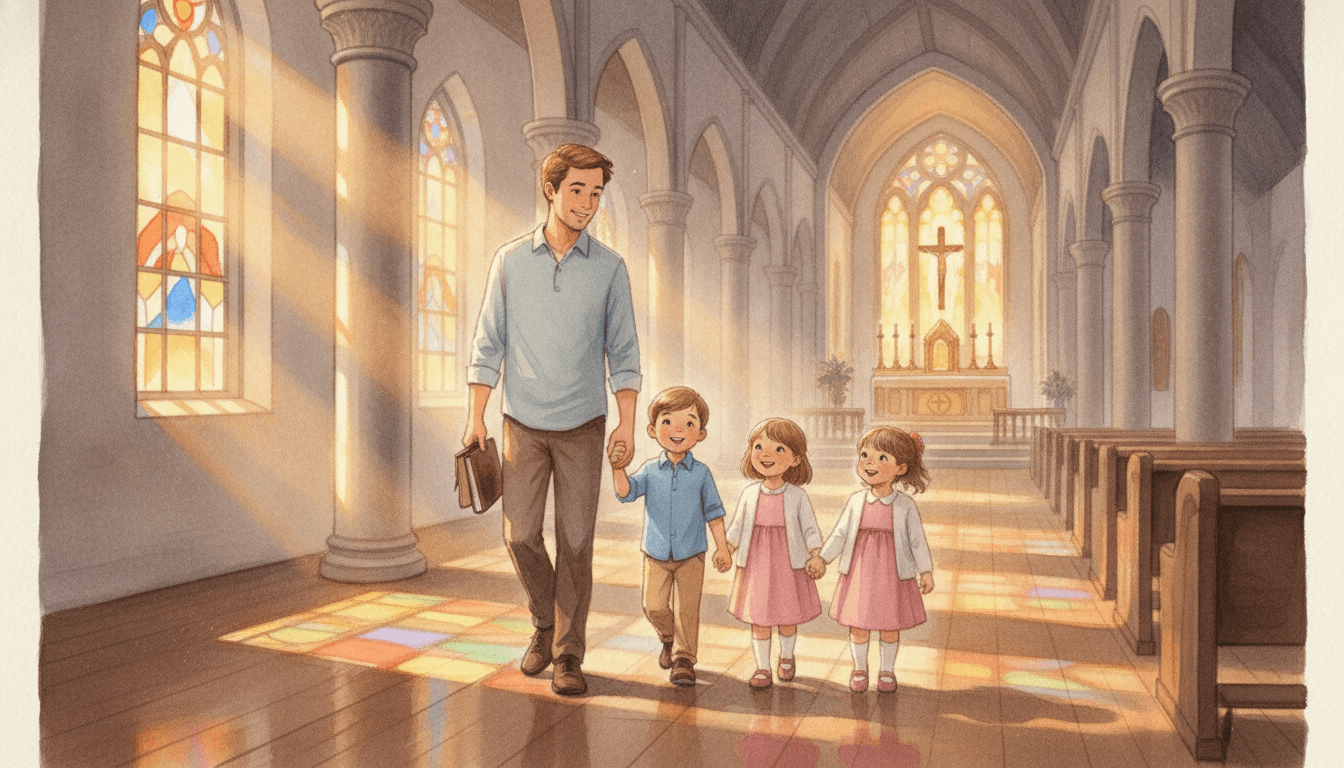
The Sunday you spend half the opening hymn settling a child can feel like an endurance test. Yet Jesus’ words are clear: “Let the children come to me” (Matthew 19:14); with steady preparation and realistic expectations, Mass can become a familiar family meeting with the Lord.
Begin With the Goal: Your Child Is Coming to Meet Jesus
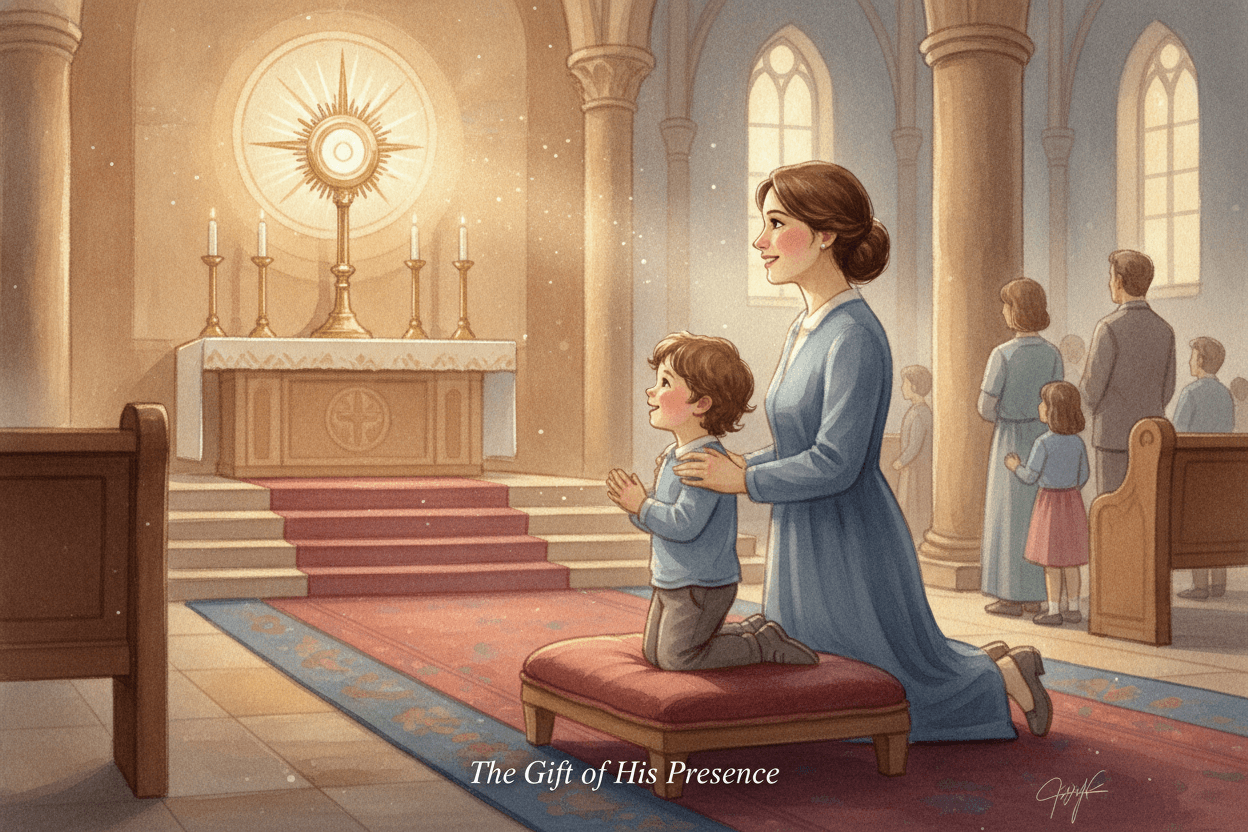
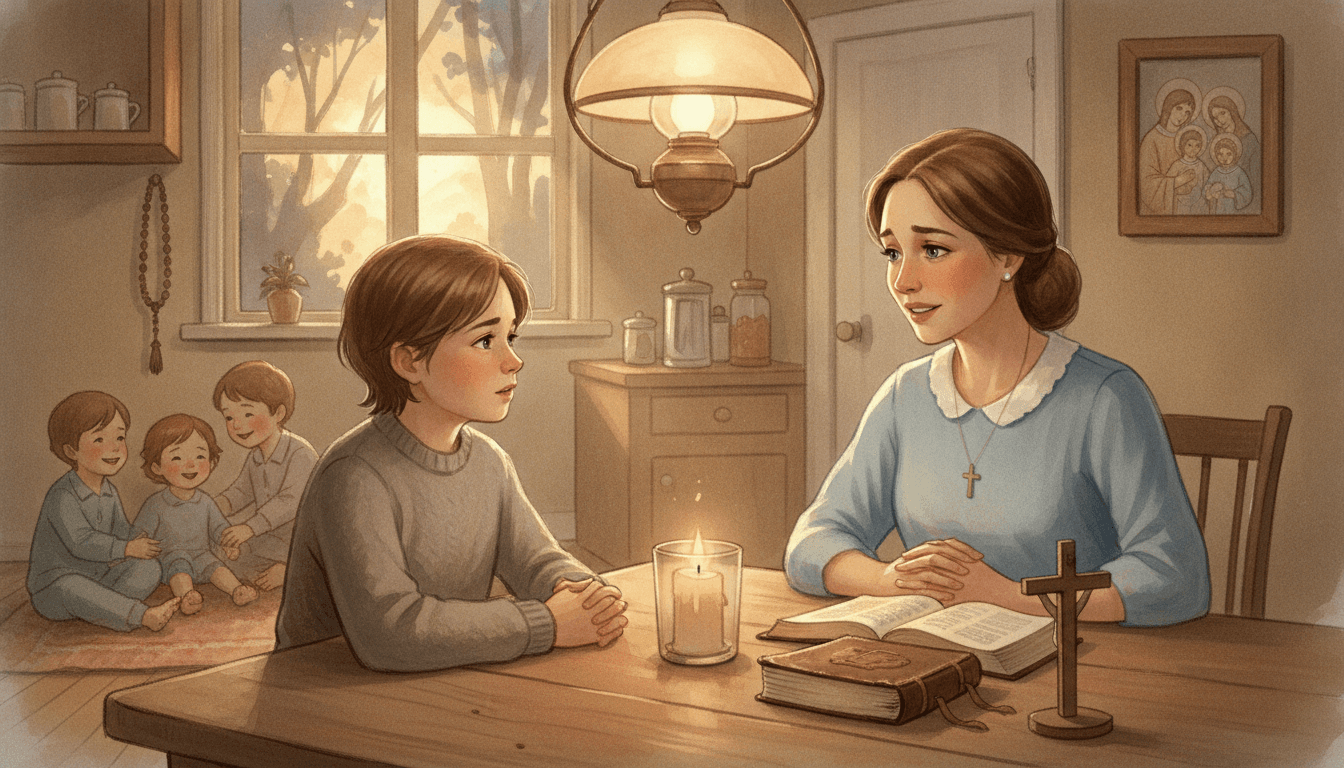
A toddler drops a hymnbook, a preschooler whispers too loudly during the Gospel, and an older child asks when Mass will be over. In that moment, it is easy to make the goal simple: get everyone through the hour without a scene. But Sunday Mass is not a weekly test of family manners. Your child is coming to meet Jesus Christ—present in the gathered Church, in his proclaimed Word, and most especially in the Eucharist. Calm behavior matters because it serves attention and reverence; it is not the final purpose.
Jesus gives parents the right starting point: “Let the children come to me, and do not prevent them; for the kingdom of heaven belongs to such as these.” Notice that he does not say, “Bring them only once they can sit perfectly still.” He receives children and calls adults to make room for them. Scripture invites us to see even an imperfect Sunday as part of a long education in belonging: this is our family’s worship, these are our people, and this is the Lord who gathers and feeds us.
Here is the first step: before you ask a child to be quiet, tell him why he is there. A simple sentence before leaving home can shape the whole morning: “We are going to Mass so Jesus can meet us, teach us in his Word, and feed us in Holy Communion.” A baptized child who has not yet received Communion can still adore, listen, sing, pray, and learn to desire the Eucharistic Lord. This respects a child’s intelligence. We do not need to reduce Mass to rules or entertainment; we can name, in age-appropriate words, what the Church is actually doing.
As the Catechism reminds us, parents are the primary educators of their children (CCC 2223). That responsibility is lived less through one impressive lesson than through ordinary, repeated habits: going on Sunday, preparing without drama, praying the responses your child can learn, and returning after a difficult week. Pew Research Center reported that 81% of Catholic parents in a 2019 survey had teens who also identified as Catholic. Statistics do not guarantee faith, but they do confirm what parish catechists see: parents’ steady practices carry lasting weight.
So measure progress differently. Perhaps your three-year-old learns to make the Sign of the Cross with care. Perhaps your seven-year-old notices the Gospel procession, or your teenager begins to listen for one phrase in the homily. These are signs of interior participation growing over time. When correction is needed, offer it calmly and briefly; when a child must step out, return when possible. The aim is neither noise for its own sake nor rigid silence. It is to form a heart that recognizes Sunday Mass as a real appointment with the living Lord.
but Jesus said, “Let the children come to me, and do not prevent them; for the kingdom of heaven belongs to such as these.”
Set Up Sunday on Saturday and Sunday Morning
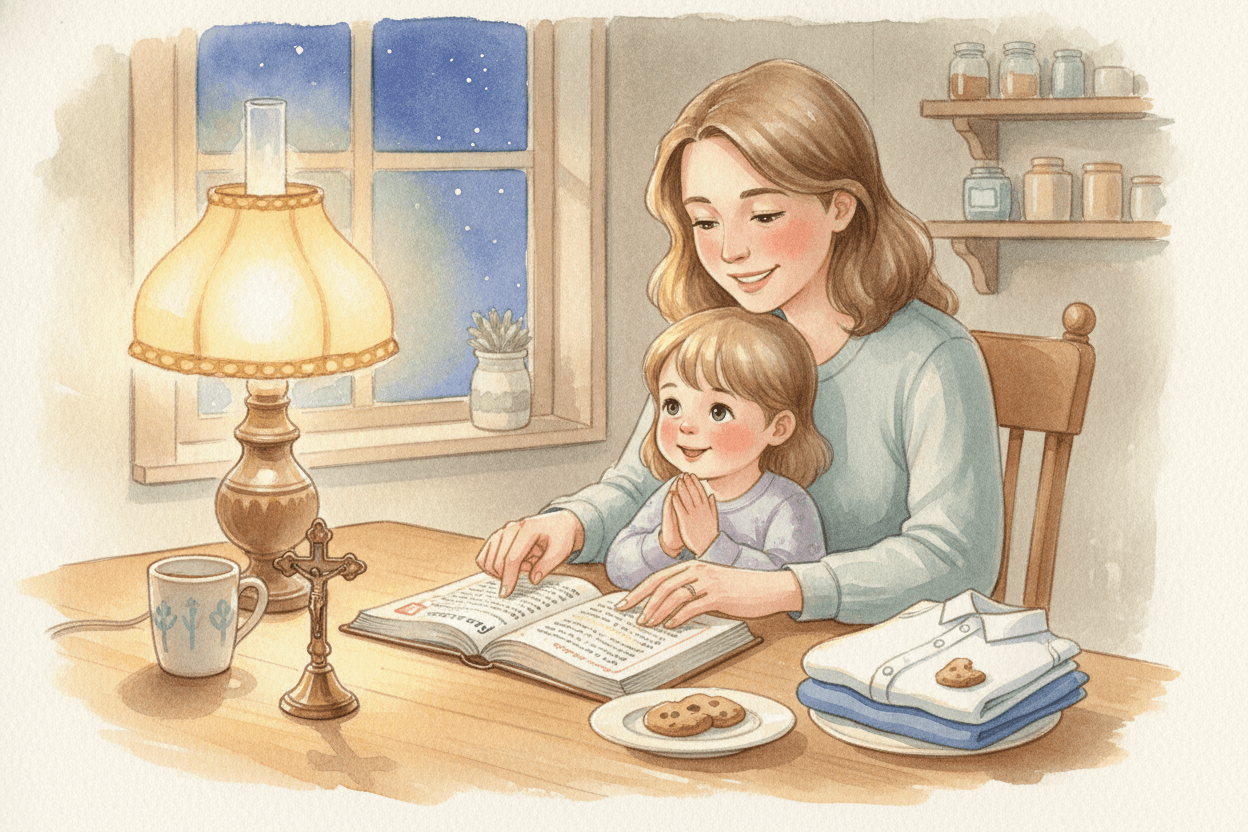
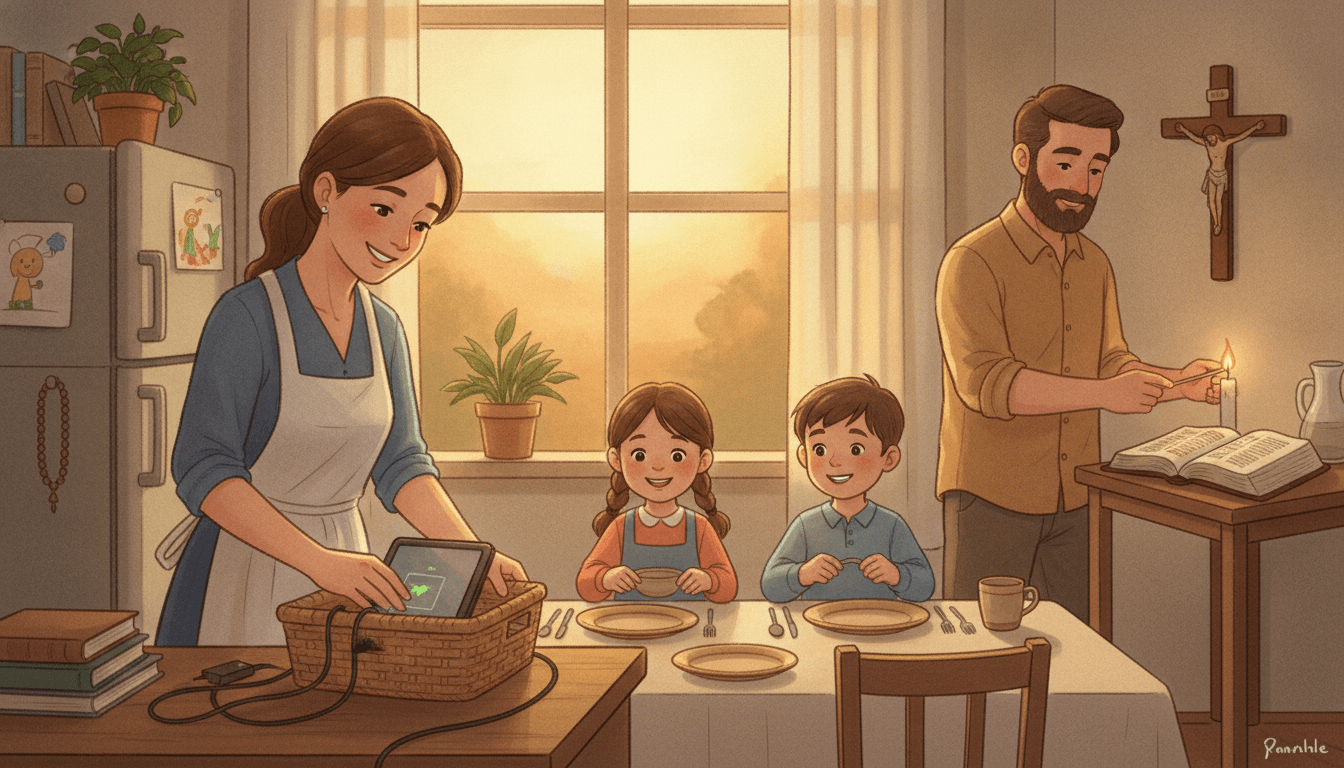
Saturday evening often decides whether Sunday begins peacefully or with everyone searching for shoes ten minutes before departure. In my years of parish formation, I have seen that children settle into Mass more readily when the family has already made a few ordinary decisions: clothes are chosen, bedtime is protected, and the morning has a familiar order. This is not about producing a perfectly silent child. It is about making room for attention. As the Catechism reminds us, parents are the primary educators in the faith, including by teaching prayer and forming habits that order daily life toward God (CCC 2223).
Begin with church clothes the night before. Let a young child make a limited choice—“the blue sweater or the gray one?”—rather than opening a full negotiation on Sunday morning. Then protect sleep as best you can. A tired preschooler has less capacity to listen, sit, sing, or recover from a disappointment. Before leaving, offer a filling breakfast or snack and water. Hunger can sound very much like restlessness in a pew. These preparations are humble, but they teach children that Sunday Mass matters enough for the household to prepare for it.
Next, pack one small Mass bag, and keep its contents focused on the liturgy. A board book about the Mass, a child-friendly missal, a soft religious image card, or a small notebook for an older child is usually enough. Avoid turning the bag into an entertainment kit. Here’s how I’d teach this to a child: “This book helps you watch for Jesus at Mass.” At church, the same book can help you notice the entrance procession, the Gospel, the altar, and the elevation of the Host. Familiar objects used for a clear purpose become quiet supports for participation.
Before the family gets in the car, take two minutes with the coming Sunday Gospel. Read it from the USCCB readings, or read a few verses if your children are very young. Give one simple sentence they can carry into church: “Today we will hear Jesus tell us to trust him,” or “Listen for what Jesus says about loving our neighbor.” Then name one thing they will see: “Watch for Father lifting the Host,” or “When we hear the Gospel, we stand because Jesus speaks to us.” Children do not need a lecture; they need one true point of attention.
Finally, pray briefly at the door or in the car: “Jesus, we are coming to meet you. Help us listen, pray, and love you today.” Scripture invites us to bring children toward Christ, not to hold them back until they can manage every moment flawlessly. If the morning is imperfect, go anyway. Consistent presence, patient correction, and small explanations over many Sundays form more than a single smooth Mass ever could.
but Jesus said, “Let the children come to me, and do not prevent them; for the kingdom of heaven belongs to such as these.”
Teach the Mass in Small, Repeatable Pieces
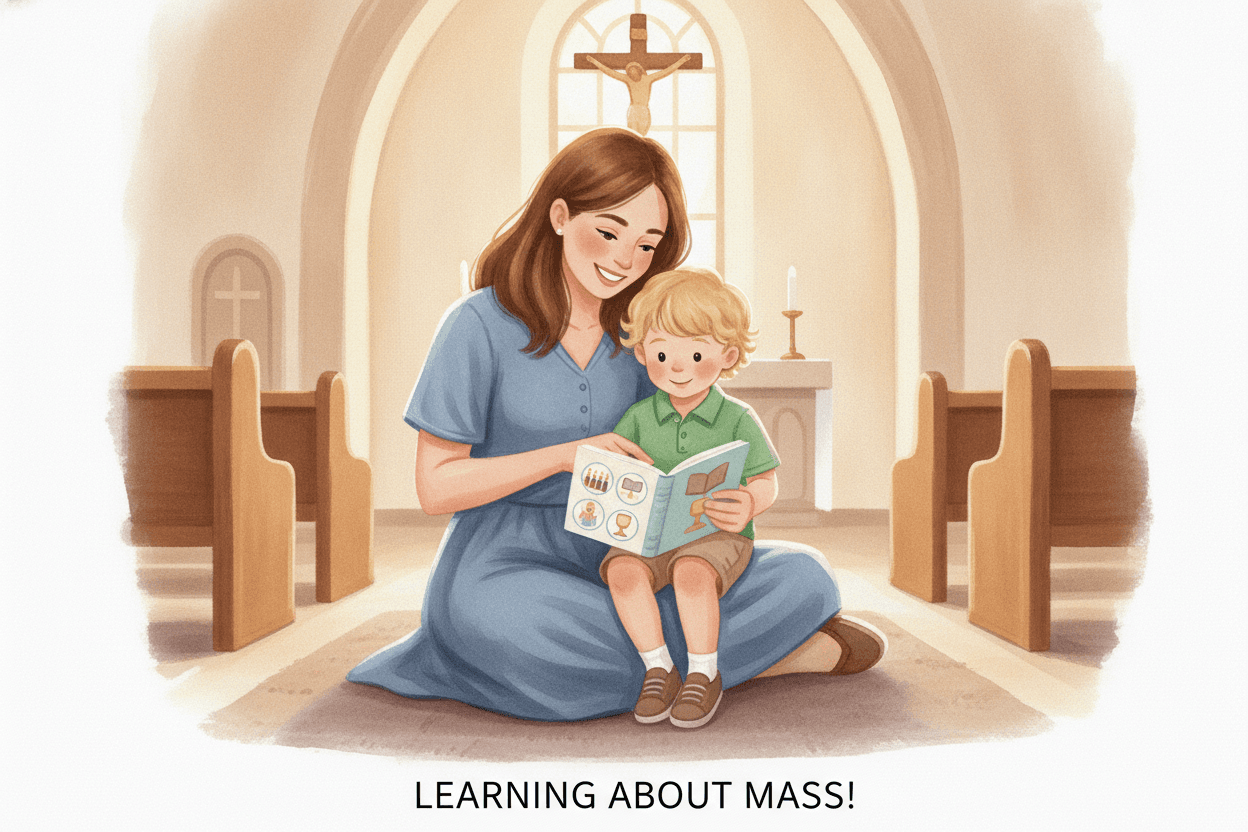
A four-year-old who knows when to make the Sign of the Cross has already begun to learn the grammar of the Mass. She may not yet grasp every word, but she recognizes: we stand now, we listen now, we kneel now. Children learn the liturgy the same way they learn a beloved family routine—through small actions repeated faithfully over many Sundays. Do not attempt one long lesson in the pew. Choose one or two moments each week, name what is happening, and return to them patiently.
Begin with the entrance procession and the Sign of the Cross. Whisper, “Father and the other ministers are coming in. We are gathering as God’s family to pray.” When you bless yourself, say, “We begin in the name of the Father, and of the Son, and of the Holy Spirit. God is one God in three Persons.” Keep the language clear and brief. Before Mass at home, a child can practice the response, “And with your spirit,” or simply learn to stand and sing the opening hymn with the family.
During the readings, teach the difference between listening to God’s word and listening to an ordinary story. “Now we hear words from the Bible. God speaks to his people.” At the Gospel, explain why everyone stands: “We stand to welcome Jesus’ words.” Help a child make the small crosses on forehead, lips, and heart, with a simple meaning: “May God’s word be in my mind, on my lips, and in my heart.” Scripture invites us to take children seriously as receivers of Christ’s own welcome, not merely as observers who must be kept occupied.
At the offertory, point to the bread and wine being brought forward: “We give these gifts to God, and we give him our love and our work too.” At the consecration, lower your voice further: “Jesus makes himself present for us.” For a young child, that sentence is enough; repetition will give it depth over time. Invite reverence by your own posture—kneeling, looking toward the altar, and praying rather than scanning the room. A picture missal may help a child locate these moments, but unrelated toys teach attention away from the action that matters.
When people process for Communion, explain, “They are going to receive Jesus in Holy Communion.” If your child has not yet received First Communion, teach a reverent posture for a blessing or remaining in the pew; avoid making this a moment of exclusion. At the dismissal, say, “Mass is ending, but now we go to love and serve the Lord at home.” These short explanations form real participation, not mere quiet behavior. As the Catechism reminds us, parents are the primary educators in faith and prayer (CCC 2223). Your steady presence, week after week, is the lesson your child will remember.
but Jesus said, “Let the children come to me, and do not prevent them; for the kingdom of heaven belongs to such as these.”
Choose a Pew That Helps Them See and Belong
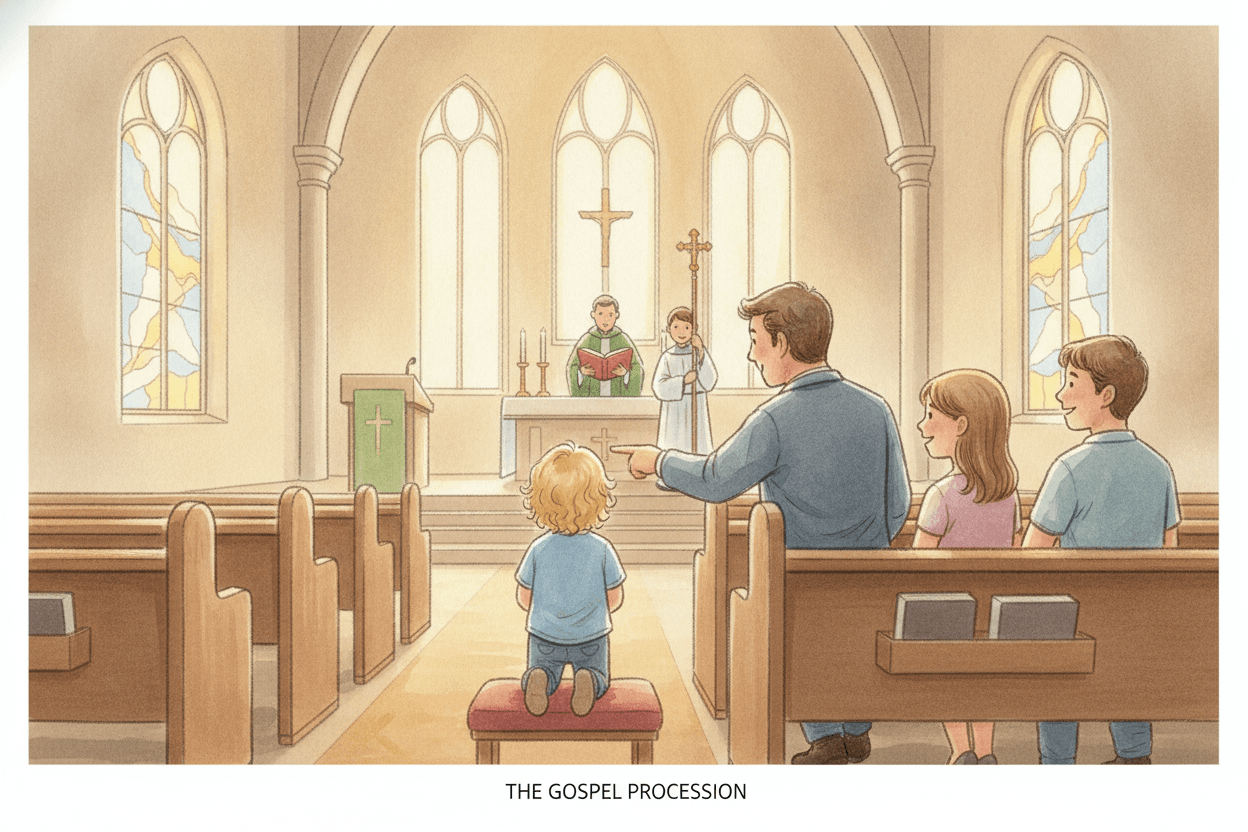
A four-year-old who can see the entrance procession often has something real to watch before he has the words to understand it. He notices the cross leading the way, the candles, the priest, and the people standing. From a pew with a clear view, Mass is not a set of adult sounds happening somewhere beyond a forest of shoulders; it has visible actions he can begin to recognize week after week.
Choose your place with your children’s sightlines in mind. When possible, sit where they can see the altar and the ambo, as well as the procession at the beginning and the crucifix. If your parish’s baptismal font is visible, point it out before Mass or on the way in: “That is where people are baptized into God’s family.” Preschoolers learn through concrete things they can see, name, and revisit. The same altar, candle, book, and font become familiar signs that carry meaning over time.
Here’s how I’d teach this in the pew: use a few quiet sentences, then let the liturgy speak for itself. As the reader approaches the ambo, whisper, “We are listening to God’s Word.” Before the Gospel, say, “The priest is reading Jesus’ words in the Gospel.” When the gifts are carried forward, a parent might say, “The bread and wine are being brought to the altar.” At the elevation, even a simple, reverent “Jesus is here” gives a child a true point of attention. Avoid turning every moment into commentary. One brief explanation connected to what the child can see is usually enough.
A small picture missal can help, particularly for a toddler or preschooler who needs a quiet way to follow the action. Open it only at key moments: the entrance procession, the Gospel, the preparation of the gifts, and the Eucharistic Prayer. Then invite small acts of belonging: stand when the family stands, fold hands for a moment, join a familiar response, offer a sign of peace, or place a coin in the collection basket. These are not performances of good behavior. They are early practices of conscious participation in the Church’s worship.
Scripture invites us to resist treating children as interruptions to be managed at the edge of parish life. Jesus says, “Let the children come to me, and do not prevent them; for the kingdom of heaven belongs to such as these.” Parents are their children’s primary educators in faith (CCC 2223), and a wisely chosen pew is one ordinary way to carry out that responsibility. Some Sundays will still require a hallway break or a reset. Return when you can. With patient repetition, children learn not merely where to sit, but that they have a place among the people gathered around the Lord.
but Jesus said, “Let the children come to me, and do not prevent them; for the kingdom of heaven belongs to such as these.”
Give Little Children Real Ways to Participate
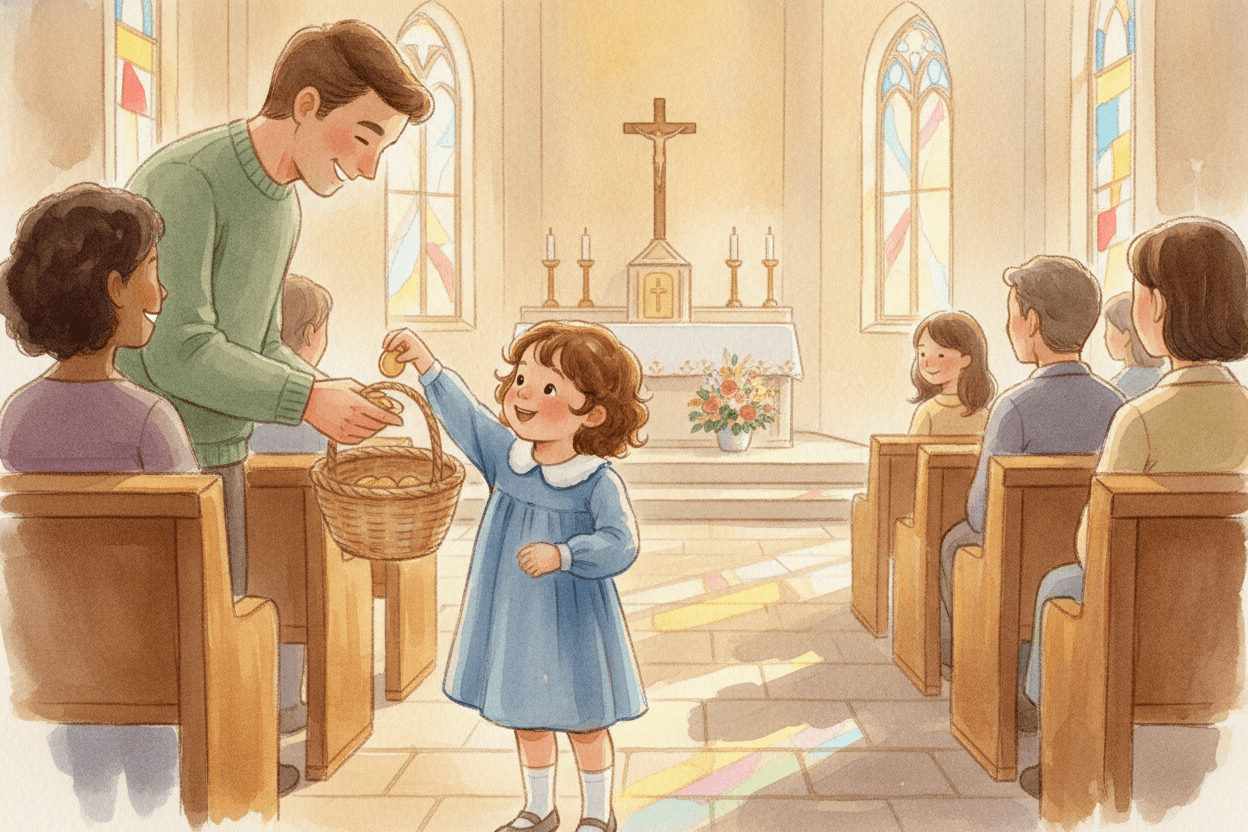
A three-year-old who stretches up to put a coin in the collection basket has not “made it through” Mass; she has taken her small place in the worshipping Church. That distinction matters. Children are not spectators waiting to become useful parishioners someday. They are baptized members of Christ’s Body, and their participation can begin with gestures and words suited to their age. Jesus’ instruction, “Let the children come to me,” is especially concrete on Sunday: we bring them near, and we teach them how to answer his invitation.
Start with one action your child can reliably do. At the holy water font, guide his hand for the Sign of the Cross and say the words slowly together. In the pew, help a toddler stand, sit, and kneel when the assembly does; if kneeling is not yet safe or manageable, he can stand quietly beside you. Before the opening prayer, offer a simple cue: “Hands together—we are speaking to God.” These bodily actions are not performance. Human beings pray with bodies as well as voices, and repeated reverent gestures give a child a framework for attention.
Then choose a few spoken responses to practice at home during the week. Many preschoolers can learn “Amen,” especially after hearing it at family prayer. They can join the Alleluia before the Gospel when it is sung, and, over time, listen for and sing the Great Amen at the end of the Eucharistic Prayer. Here’s how I’d teach this in a parish classroom: name one response, explain in one sentence what it means, and practice it twice—not twenty times. “Amen means, ‘Yes, I believe.’” A child who recognizes even one response has a reason to listen for it.
Offer participation that connects your child to the people around her. Let her place the family’s offering in the basket, with a quiet reminder that we give because everything we have comes from God. At the sign of peace, teach a simple, appropriate greeting—“Peace be with you”—to family members or those immediately nearby, following the customs of your parish. Invite her to sing a familiar refrain, even if she only manages a few words. These modest acts teach belonging without turning the pew into a lesson room.
The goal is not outward compliance—a perfectly folded pair of hands can coexist with a faraway heart. Rather, small responses help form internal participation: a child gradually learns that the procession, prayers, Gospel, offering, and Eucharistic Prayer are actions in which the whole Church is involved. As the Catechism reminds us, parents are the primary educators of their children in the faith (CCC 2223). Patiently helping a child say “Amen,” kneel with assistance, or offer a coin is part of that work. If she misses a response, simply model it and continue. Consistency, not correction at every moment, is what makes these practices familiar and prayerful.
but Jesus said, “Let the children come to me, and do not prevent them; for the kingdom of heaven belongs to such as these.”
Handle Wiggles With Mercy and Clear Boundaries
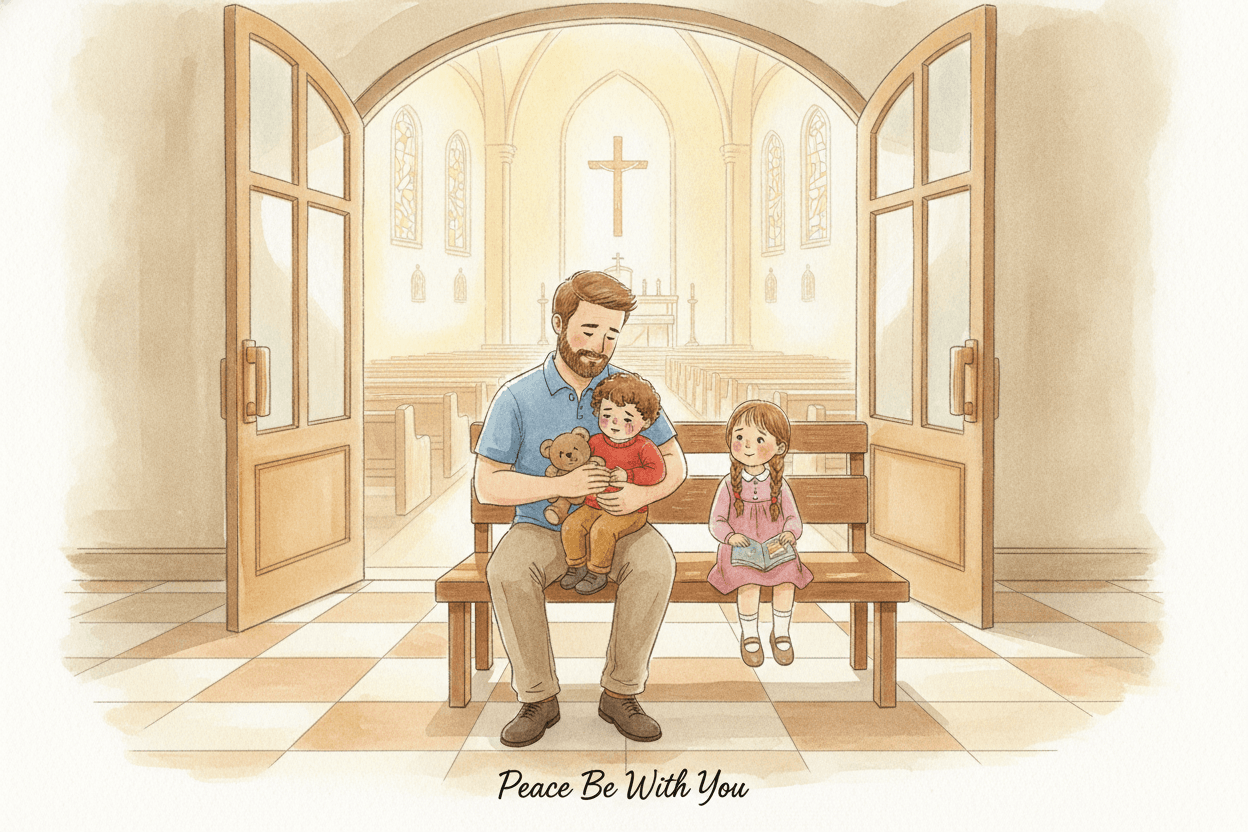
The toddler who drops a hymnbook during the Eucharistic Prayer is not ruining Mass, even if every head near you seems to turn. Nor is a parent failing because a child needs to be carried to the back for a minute. The task is neither to demand adult stillness from a small child nor to surrender the expectation that church is different from the playroom. It is to teach, patiently and repeatedly, that we are present to the Lord and to his people.
Jesus’ words set the tone: children are not an interruption to be managed away from him. At the same time, parents are called to form them. CCC 2223 names parents as the primary educators of their children and speaks plainly of teaching them to order material and instinctual impulses toward interior and spiritual goods. For a young child, that formation begins with very small expectations: a quiet voice, feet near the pew, hands occupied with a Mass book rather than a noisy toy, and a return to attention when Mama or Dad gives a signal. These are not merely rules for appearances; they make room for the child to notice and join the prayer of the Church.
Here’s how I’d teach this: make a calm three-part plan before you need it. First, offer one quiet reminder at the child’s level: “We use our whisper voice now. Jesus is here.” A hand on the shoulder, a finger to the lips, or an invitation to look at the altar often works better than a string of corrections. Second, if the behavior is truly disruptive or escalating, step outside briefly for a reset. Keep it simple: “Your body needs to be calm. We will take a breath, then go back in.” Do not turn the vestibule into a reward with snacks, games, or a long conversation. Third, return warmly and matter-of-factly as soon as the child is ready. The return matters. It teaches that leaving was a pause for learning, not an exile from worship.
Over years of Sundays, children learn by being brought in, not by waiting until they can perform perfectly. Some weeks they will kneel reverently; other weeks you will spend much of the homily settling a squirming preschooler. Receive both moments without shame. After Mass, name one thing they did well—“You folded your hands for the Our Father”—and give one concrete practice for next time. Patient accompaniment, clear limits, and a steady return to the pew tell children something lasting: they belong in the Church, and they are capable of learning how to pray with her.
but Jesus said, “Let the children come to me, and do not prevent them; for the kingdom of heaven belongs to such as these.”
This Week: Build a Simple Before-and-After Mass Rhythm
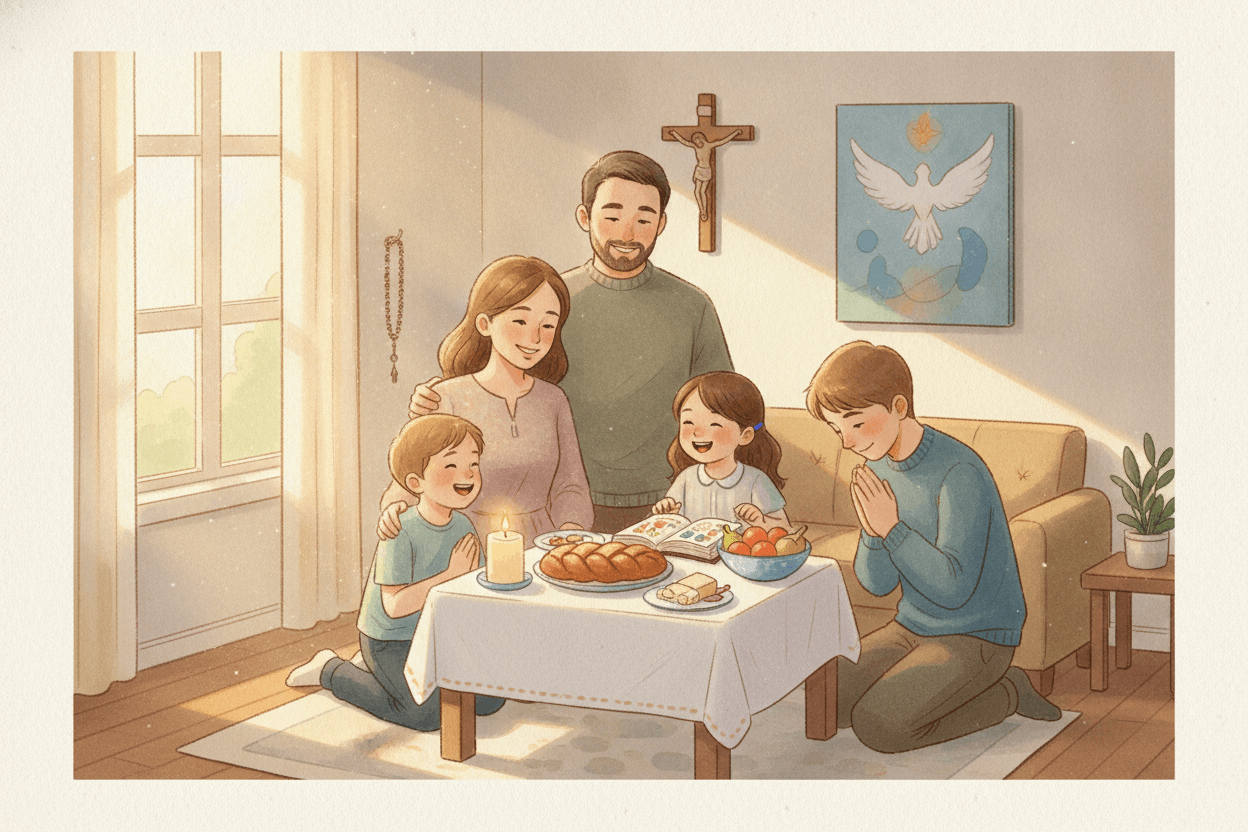
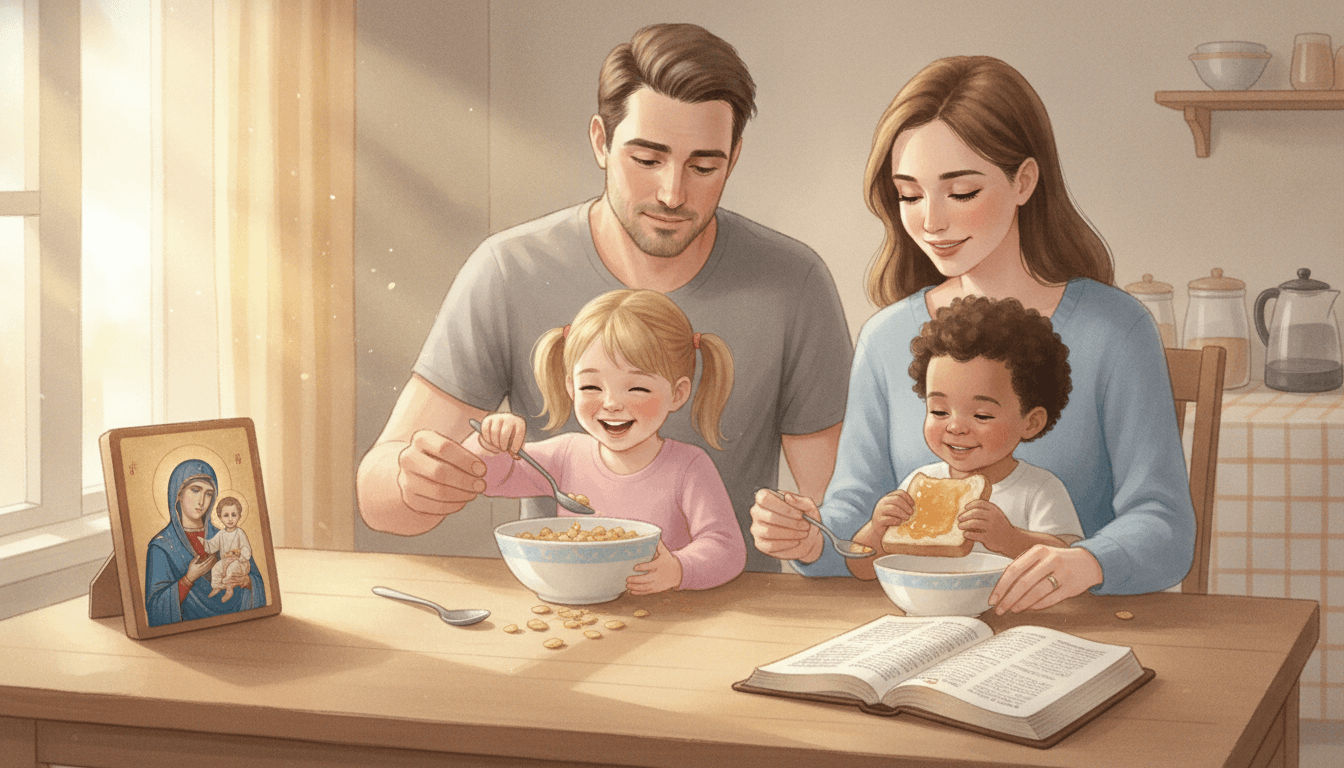
The most useful question after Mass is often not, “Were you good?” but, “What did you notice?” A child who can say, “Father lifted up the host,” or “Everyone sang loudly,” has begun to attend to the liturgy from the inside. That attention grows through a small rhythm before and after Sunday, not through a long lecture in the car or a stack of activities that makes Mass feel like another assignment.
Scripture gives parents confidence for this work. Jesus says, “Let the children come to me, and do not prevent them; for the kingdom of heaven belongs to such as these.” Children are not visitors at Mass while adults do the real worship. They are members of the baptized family, learning—gradually and according to their age—to join the Church’s prayer. The Catechism names parents as the primary educators in the faith (CCC 2223), which includes giving children words, habits, and patient guidance for Sunday worship.
Start before Mass with only one point of focus. On Saturday, read the coming Sunday’s Gospel from the USCCB readings, or tell it simply in your own words. Ask one concrete question: “What did Jesus do?” “Who needed help?” or “What do you think we will hear at Mass?” On Sunday, name one thing the child can watch for: the Gospel procession, the priest raising the host, the ringing of bells, or the congregation’s “Amen.” Here’s how I’d teach this to a preschooler: “Today, watch for the Gospel book. We stand because Jesus speaks to us in the Gospel.” Then let that be enough.
During Mass, offer brief whispered help when it serves the liturgy: “We are asking God to forgive us,” “Listen—this is the Gospel,” or “Jesus comes to us in the Eucharist.” The USCCB encourages parents to pray frequently with their children, especially with them at the Sunday Eucharist. That counsel matters because children need more than external quiet; they need help understanding what is happening. A picture missal may support that attention, but it should point them back toward the altar, ambo, prayers, and people around them. After Mass, praise one specific effort before correcting anything: “You made the sign of the cross carefully,” or “You listened when the Gospel was read.” Then ask, “What did you notice?” Receive even a small answer seriously.
Try this seven-day starter plan. Saturday: read or summarize Sunday’s Gospel in two minutes. Sunday before entering church: name one thing your child can watch for. During Mass: give one short explanation only if it helps them follow. After Mass: praise one specific effort and ask, “What did you notice?” On one weekday evening, return to their answer with a short prayer, light a candle during family prayer, or choose one small act of charity connected to the Gospel—sharing a snack, writing a kind note, helping without being asked. In this way, Sunday is not an isolated obligation; the Eucharist begins to shape the ordinary life of your home.
but Jesus said, “Let the children come to me, and do not prevent them; for the kingdom of heaven belongs to such as these.”
Frequently asked questions
How can I help my child understand why we go to Sunday Mass?
Tell your child simply before leaving: “We are going to Mass so Jesus can meet us, teach us in his Word, and feed us in Holy Communion.” Even children who have not received Communion can listen, sing, pray, adore Jesus, and grow in desire for the Eucharist. Keep the explanation focused on meeting the Lord, not merely behaving well.
What should I do the night before Mass to make Sunday easier with kids?
Choose church clothes, protect bedtime, and prepare a simple breakfast or snack ahead of time. Give young children limited choices, such as choosing between two outfits, so Sunday does not become a long negotiation. A calmer routine helps children arrive with more capacity to listen and participate.
What can I bring to Mass to keep my child engaged without distracting them?
Pack one small, liturgy-focused Mass bag with items such as a board book about Mass, a child-friendly missal, a religious image card, or a small notebook for an older child. Use these items to help your child notice the procession, Gospel, altar, and Eucharistic Prayer. Avoid filling the bag with toys or activities that make Mass feel like entertainment time.
How do I prepare my children for the Sunday readings?
Read a few verses of the Sunday Gospel before you leave, using the USCCB readings if helpful. Give children one short idea to listen for, such as trusting Jesus or loving a neighbor. You can also name one visible action to watch for, like standing for the Gospel or the priest elevating the Host.
What should I do if my child is noisy or has to leave Mass?
Correct briefly and calmly, remembering that the goal is to help your child attend to Jesus rather than to achieve perfect silence. If you need to step out, return when possible so your child learns that leaving is a short reset, not the end of Mass. Faithful return after difficult Sundays is part of forming a lasting sense of belonging in the Church.
How can I tell whether my child is really participating at Mass?
Look for small signs of growth rather than expecting adult-level attention. A child making the Sign of the Cross carefully, noticing the Gospel procession, learning responses, or listening for one phrase in the homily is beginning to participate. Repeated habits over many Sundays teach children that Mass is their family’s real meeting with Christ.
Sources: usccb.org · usccb.org · wordonfire.org · catholic.com · eucharisticrevival.org · foryourmarriage.org · teachingcatholickids.com · catholicmom.com · catholicmom.com · pewresearch.org
Scripture quotations in this article use the NABRE translation.