How to Talk About the Sunday Gospel With Your Child
Help your child move beyond remembering the pew crayons by turning Sunday’s Gospel into a shared conversation. With a few simple, unhurried questions, families can discover what stood out, connect it
Some Sundays, the homily ends and our kids can tell us exactly which color crayon they used in the pew—but not one thing from the Gospel. That is not a parenting failure; it is an opening. A few unhurried questions at our table can help the Sunday Gospel become a story they meet, remember, and live.
You Do Not Need to Turn Sunday Into School

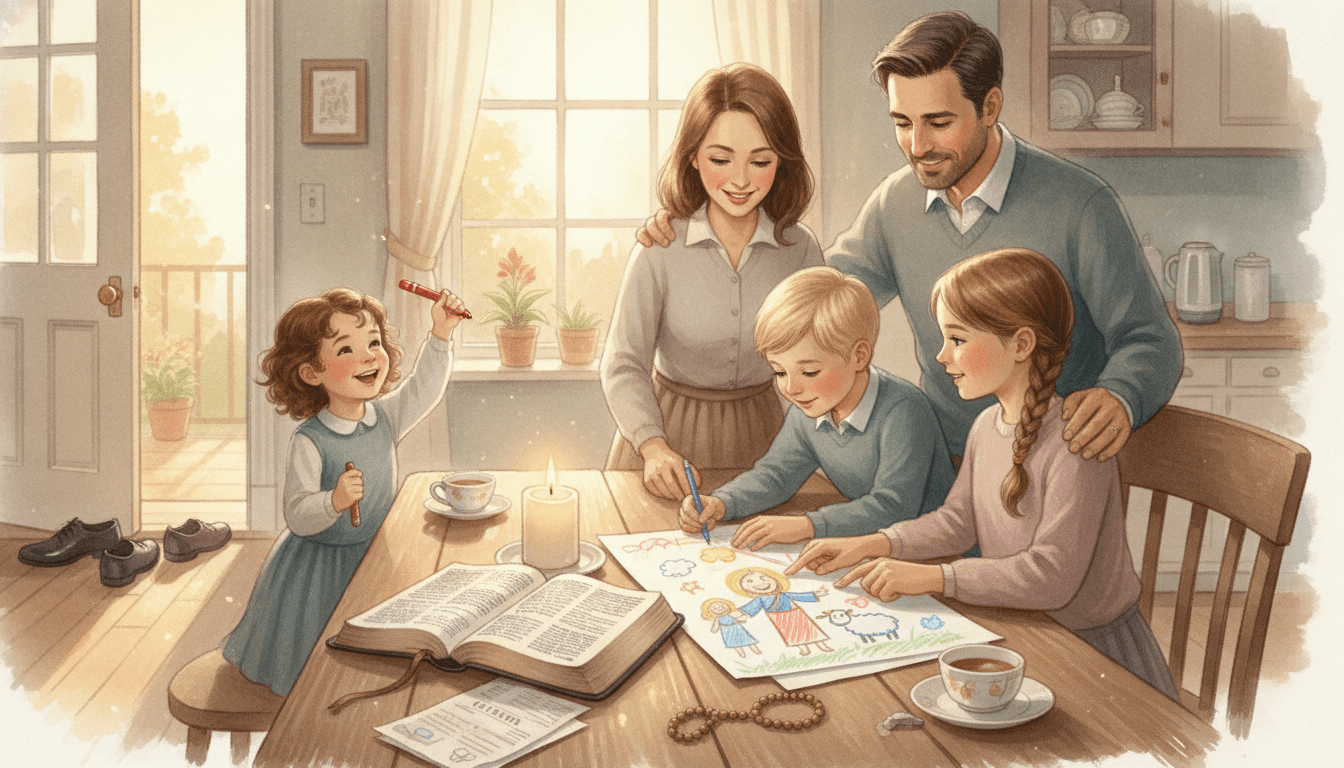
The post-Mass rush can make a parent feel like the Gospel needs a lesson plan. Coats are falling off hooks, someone is hungry before we reach the car, and the baby has found the one crayon under the pew. Then comes the quiet pressure: Did they understand anything? Do I need to sit everyone down and explain it properly? Take a breath. You do not have to turn Sunday afternoon into school for the Gospel to take root.
A short conversation can be enough. Read the Gospel again later from the NABRE, perhaps after lunch or while dinner is still on the stove. Then ask one simple question: “What did you notice?” Your six-year-old may say, “The sick man was sad,” or act out the whole scene with a fork and two napkins. That counts. Your older child may connect Jesus’ words to a problem with a friend. That counts too. At our table, a one-sentence answer is often all we get before somebody remembers a Lego emergency.
The United States Conference of Catholic Bishops puts it plainly: “Parents are catechists precisely because they are parents.” That does not mean parents must have every background detail ready or give a mini-homily between bites of pasta. It means you already have the daily closeness to help your child notice Jesus: in the car, at bedtime, during a hard moment with a sibling. Speak naturally. If your child asks something you cannot answer, it is perfectly good to say, “That is a great question. Let’s learn more about it.”
One small thing we tried was keeping the questions loose. Who was in the story? What happened? What did Jesus do? Who needed help? Then we chose one response for the week: forgive a brother, include someone at recess, help set the table without grumbling, or pray for a person who is hurting. The goal is not to cover every question or reach the final page of a worksheet. The goal is to let Christ’s words be heard and to give your child a small, real way to answer them.
Jesus says, “Let the children come to me, and do not prevent them, for the kingdom of heaven belongs to such as these.” A five-minute Gospel conversation, offered regularly and without pressure, makes room for that coming. End with a plain prayer: “Jesus, help us be patient with each other this week,” or “Jesus, help Mia welcome the new girl at school.” It may feel small. Most family faith moments do. But small, repeated moments have a way of staying with a child.
Let the children come to me, and do not prevent them, for the kingdom of heaven belongs to such as these.
Start With the Gospel They Just Heard
On Sunday afternoon, someone usually finds the parish bulletin under a couch cushion, and someone else is still wearing one dress shoe. That is a perfectly good time to open the Gospel again. Not for a lesson. Not because everyone is sitting still. Just because the family heard these same words at Mass a few hours earlier, and hearing them once more gives them a chance to settle in.
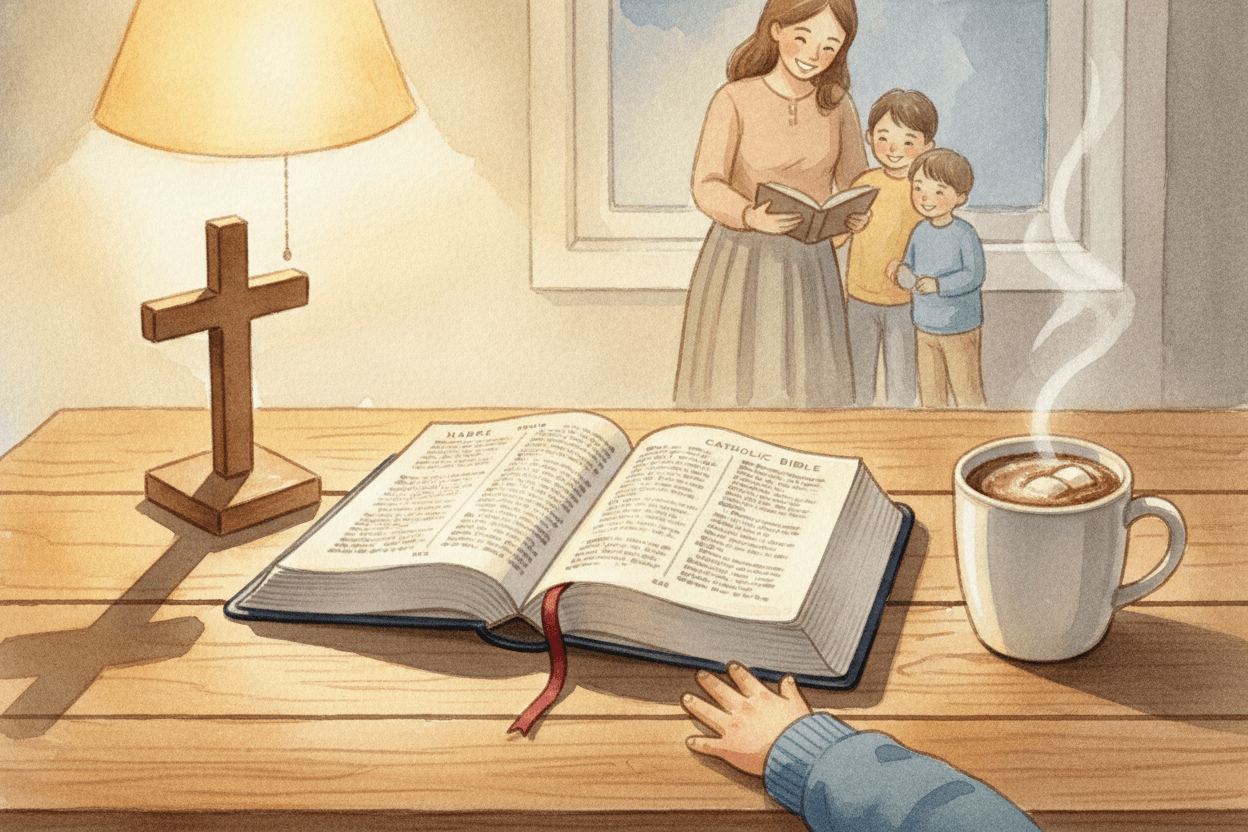
Use the Sunday Gospel from the NABRE, the translation used in the lectionary at Mass in the United States. Read it aloud slowly. Put phones aside if you can. At our table, that has sometimes meant reading while a child colors and another child asks for a snack halfway through. Fine. The point is not creating a tiny monastery in the dining room. The point is letting the words of Jesus be heard again in the ordinary life you already have.
Then ask one easy question: “What did you notice?” A younger child may name the boat, the crowd, the sick person, or the fact that Peter was scared. That counts. If words do not come, ask who was in the story, where they were, or what happened first and last. A drawing, a gesture, or a messy retelling can be a real answer. Here’s what landed for us: children often catch one detail that the adults rushed past.
You do not need to explain every line. In fact, it helps when children see that Mom or Dad is still listening too. When a hard question comes up, say, “I wonder about that too.” You might add, “Let’s ask Father after Mass,” or “Let’s look into it this week.” That kind of honesty keeps the Gospel from becoming a quiz with Dad holding the answer key. Parents are catechists precisely because they are parents, which means we can teach from the middle of real life, with real questions still open.
Before you close the book, choose one small response. Maybe Jesus’ words make your child think of a lonely classmate, a sibling they need to forgive, or Grandma, who needs prayer. Name it, then pray one sentence together: “Jesus, help me be patient with my brother tomorrow.” The disciples on the road to Emmaus said, “Were not our hearts burning within us while he spoke to us on the way and opened the scriptures to us?” We may not get a dramatic family moment every Sunday. But a few minutes with the Gospel they just heard can give Christ room to speak on the way home, at dinner, and into Monday morning.
Were not our hearts burning within us while he spoke to us on the way and opened the scriptures to us?
The Four Questions That Work for Any Sunday Gospel
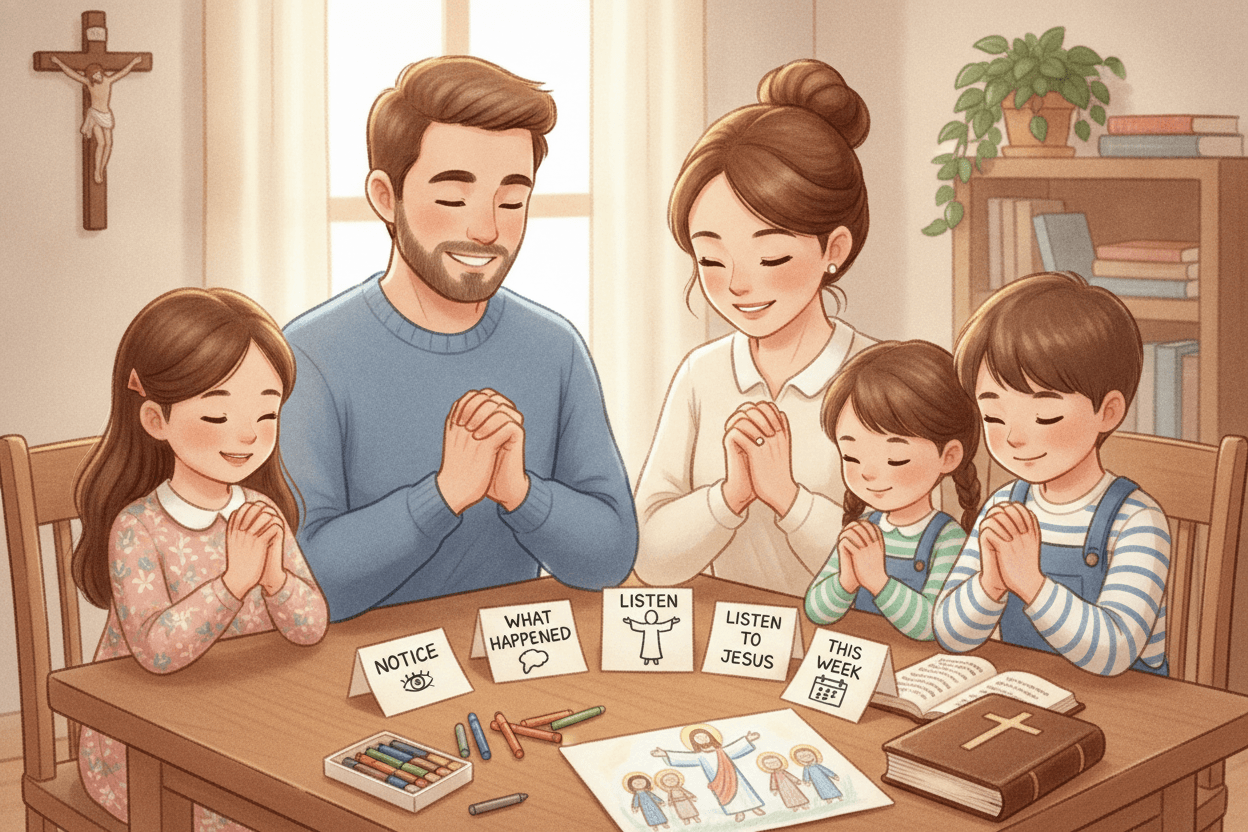
By the time we got home from Mass, one child was asking for a snack, another had one shoe missing, and I had already forgotten half the Gospel myself. So at our table, we stopped trying to have a polished discussion. We started using four simple questions. They work whether the Gospel is about a storm, a blind man, a difficult parable, or Jesus sitting down to eat with someone nobody else wanted around.
First: “What did you notice?” This is the easy on-ramp. Let them name anything: the boat, the crowd, the angry brother, the words Jesus said twice. A six-year-old may draw the scene instead of explaining it. That counts. Ask, “Who is in this story?” “Where are they?” and “What happened first, next, and last?” Do not correct every small detail right away. You are helping your child look closely before asking them to say something impressive.
Next: “What is going on here?” Now help them see the human need in the story. Was someone afraid, sick, lonely, hungry, confused, or left out? What problem did the disciples face? How might the people have felt when Jesus came near? This question keeps the Gospel from becoming a string of names and events. It puts us beside real people with real worries. Sometimes a child will make a surprising connection: “Maybe he was scared like I was at school.” That is worth pausing for.
Then ask, “What does Jesus show us?” This is not a pop quiz with one correct church answer. Wonder together. Does Jesus show that God welcomes people? Forgives? Cares for those who are hurting? Calls people to trust him? If your child asks something you cannot answer, it is completely fine to say, “That is a good question. I want to learn more too.” Parents do not need to sound like Bible experts. The USCCB says parents should speak naturally and simply about God and faith. That takes some pressure off all of us.
Finally: “What can we do this week?” Keep the answer small enough for a real Tuesday afternoon. Maybe your child chooses patience with a sibling, includes someone at recess, prays for a worried grandparent, or helps without being asked. One small thing we tried was ending with a ten-second prayer built from the answer: “Jesus, help me be kind to Noah when I am annoyed.” That is plenty. Jesus praises the childlike: “I give praise to you, Father, Lord of heaven and earth, for although you have hidden these things from the wise and the learned you have revealed them to the childlike.” We are not trying to finish a lesson. We are making room for his words to stay with us.
I give praise to you, Father, Lord of heaven and earth, for although you have hidden these things from the wise and the learned you have revealed them to the childlike.
Questions for Ages 6–9: Let Them Point, Draw, and Retell
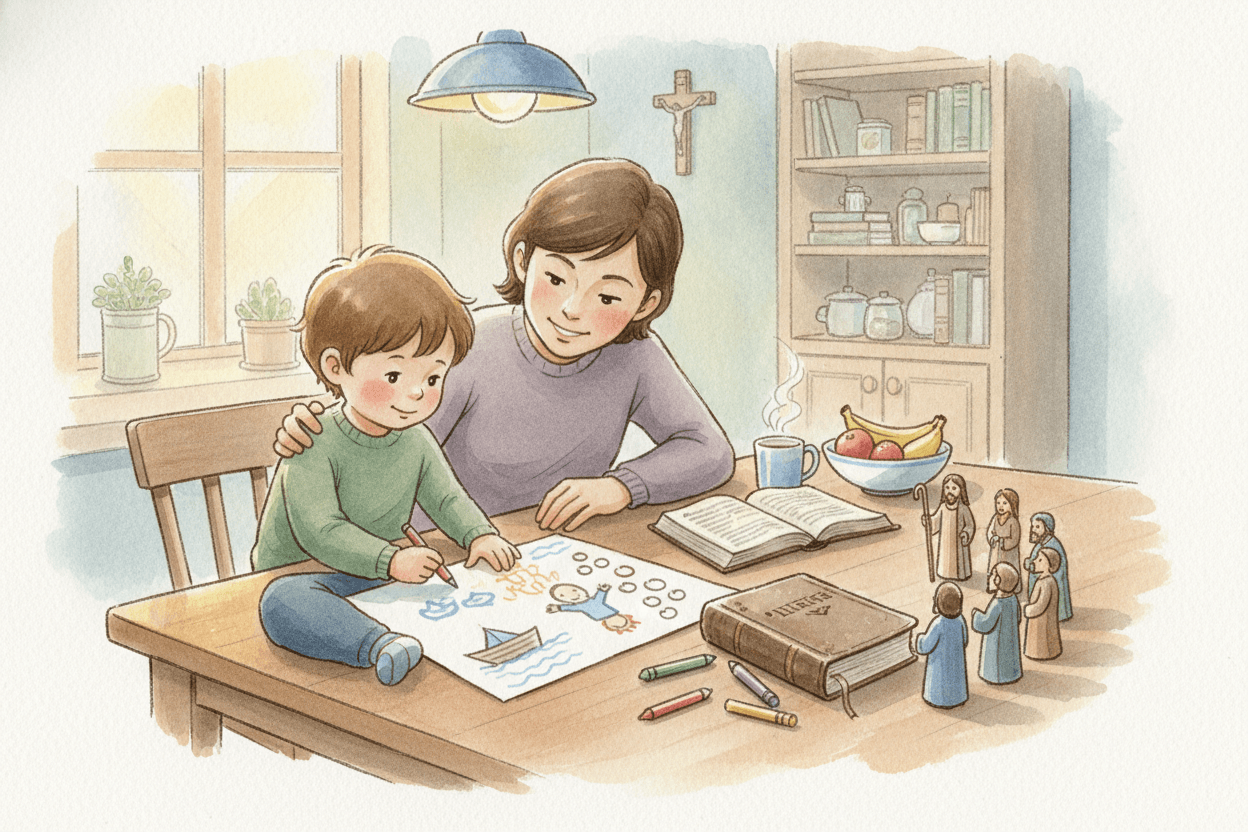
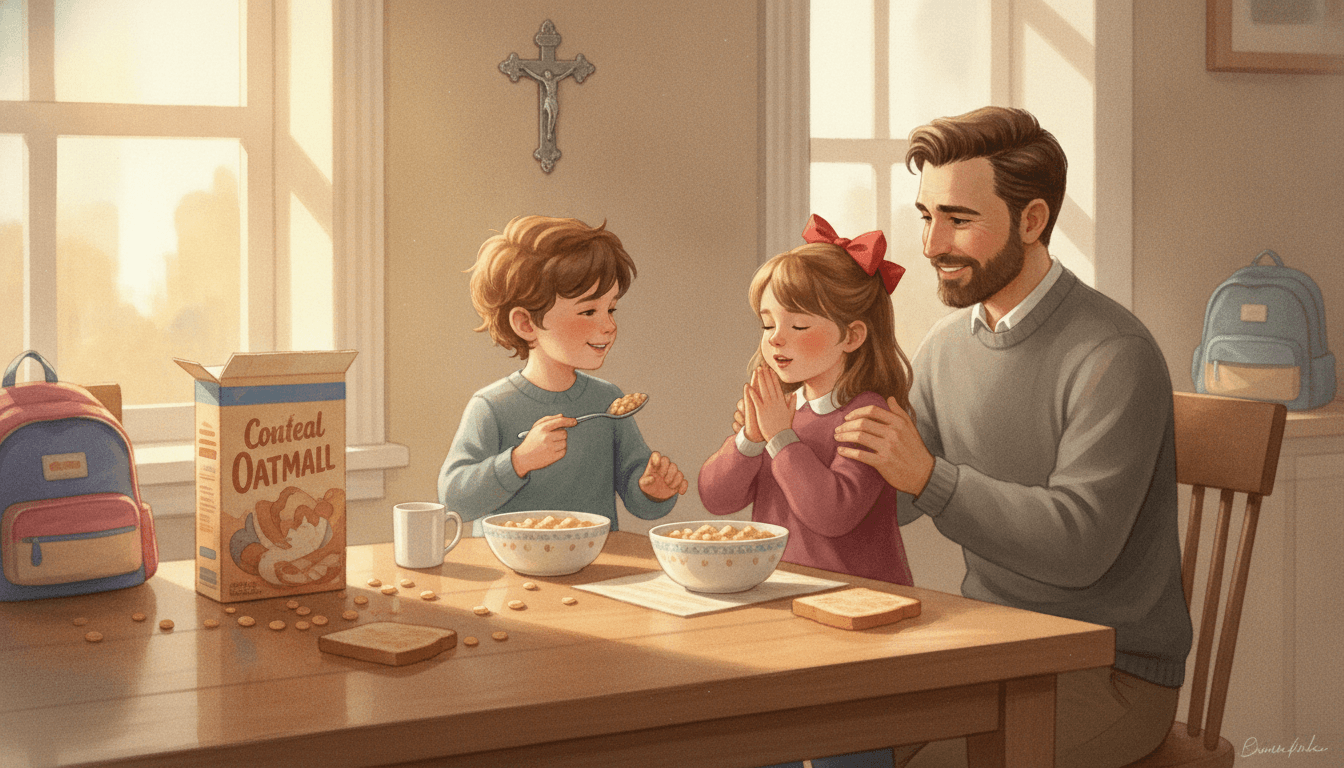
One Sunday after Mass, I asked my youngest what happened in the Gospel. He pushed his cereal spoon across the table and said, “Jesus was walking.” Then he made the spoon stop, turned it sideways, and added, “And somebody needed him.” It was not a polished retelling. It was also not wrong. He had noticed the movement, the need, and Jesus in the middle of it. For a six-, seven-, or eight-year-old, that is a real beginning.
Try giving them questions they can see in their minds: Who is in the story? Where are they? What happens first, next, and last? Is anyone worried, sick, left out, or asking for help? Then ask, “What word, action, or person stood out to you?” Keep your voice curious, not like you are checking homework. If they say, “The donkey,” or “That man was being mean,” stay with it for a minute. “What made you notice that?” is often enough.
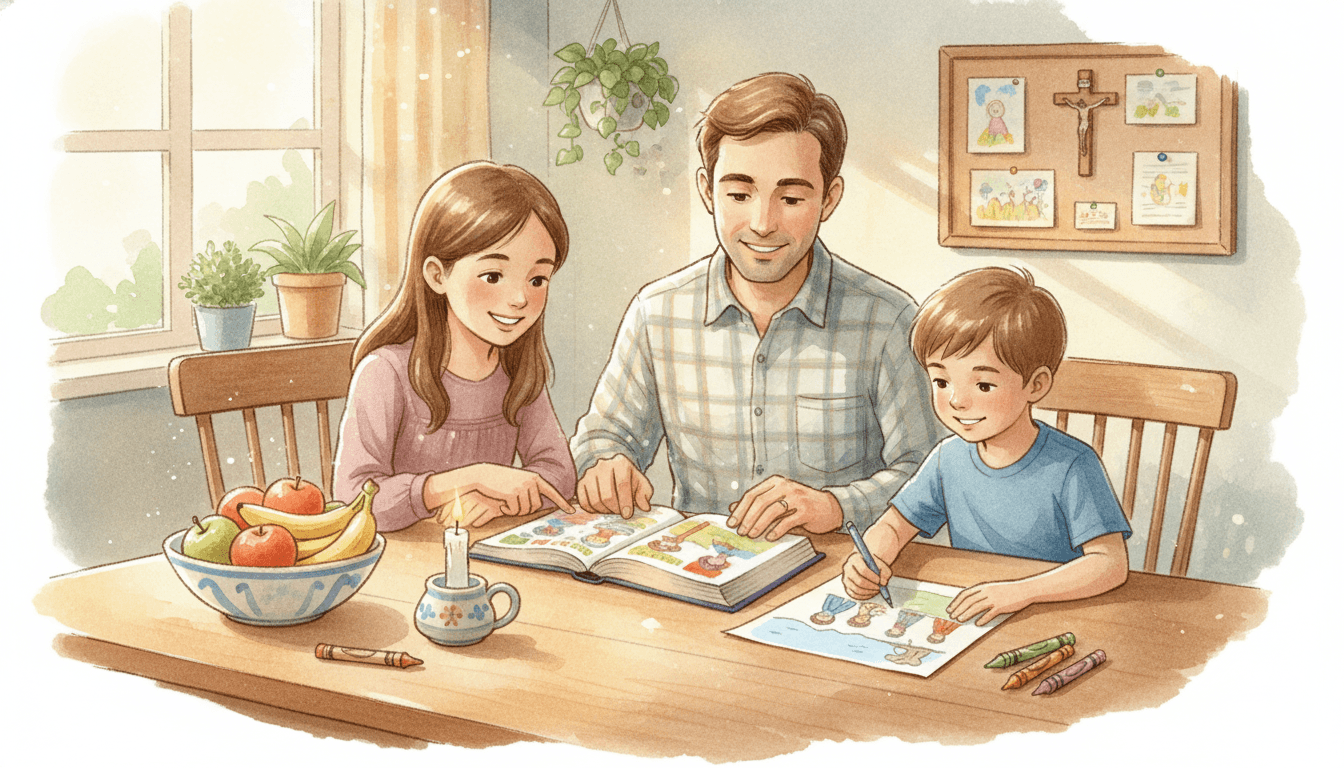
At our table, words are not always the best tool. A child can draw the boat in the storm, line up toy figures to show the crowd, or act out the scene with a stuffed animal wearing a dish towel for a cloak. One small thing we tried was asking our kids to retell the Gospel while we cleaned up lunch. They could use three sentences, their hands, or whatever was nearby. The salt shaker has played several important Bible characters in our house.
A one-sentence answer counts too. “Jesus helped him.” “They were scared.” “He said not to worry.” Those small answers show what your child heard. You do not need to pull a longer answer out of them. And if they shrug or say, “I don’t know,” let that be allowed. Silence is allowed too. You can simply say, “That’s okay. I noticed Jesus stopped for the person everyone else was ignoring.” Then leave a little room. Sometimes the thought arrives later, while shoes are being found or pajamas are going on.
Jesus himself made room for children: “Let the children come to me; do not prevent them, for the kingdom of God belongs to such as these.” Your child does not have to sound like a grown-up Bible teacher to come to him. Help them pay attention to the story in the way they can today. A pointing finger, a crayon drawing, and a small voice saying, “Jesus was kind,” may be more honest than a perfect answer ever could be.
Let the children come to me; do not prevent them, for the kingdom of God belongs to such as these.
For Preteens, Go One Layer Deeper
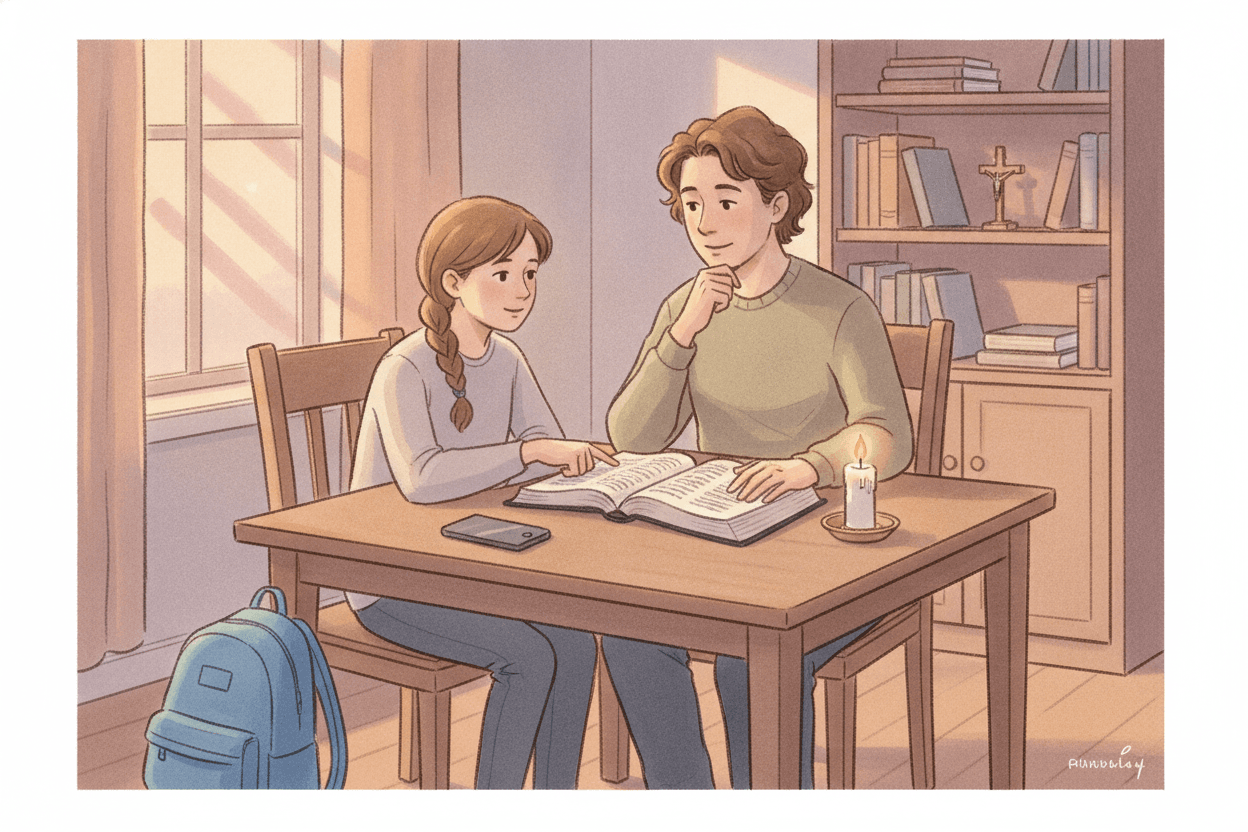
The questions change somewhere around middle school. Your child who once happily drew Jesus in the boat may now shrug and say, “I don’t know.” At our table, that usually means they have noticed more than they are saying. They are old enough to spot the unfairness in a story, wonder why someone acted that way, or ask why Jesus’ words sound hard. Don’t rush to fill the silence. A preteen’s shrug can be the beginning of a real conversation.
Keep the same simple pattern: notice the story, name the need, listen for what Jesus says, and choose a response. But give the questions a little more room. Ask, “What problem are these people facing?” “What do you think they were feeling?” “Who has the least power here?” Then try, “What assumption does Jesus challenge?” A child may notice that the disciples want to send people away, or that a respected religious person misses what a struggling person sees. Those are not small observations.
Preteens can also make connections. If Jesus welcomes someone pushed aside in this Sunday’s reading, ask whether it reminds them of another Gospel scene: Zacchaeus in the tree, the Samaritan woman at the well, or the friends who carry a paralyzed man to Jesus. You do not need a stack of notes on the counter. If you cannot remember the details, say so. “That sounds like another story Jesus was in. Let’s look for it later.” Humility teaches something important: Scripture is not a quiz where Dad has to win.
Then bring the passage into the places they actually live. “What would this look like when someone gets left out at lunch?” “What does forgiving look like in a group chat?” “When do people act one way online and another way in person?” One small thing we tried was asking each child to name one situation coming up that week—a test, a practice, a friendship problem—and then asking where Jesus’ words might meet it. Sometimes the answer was thoughtful. Sometimes it was, “I should probably stop sending that meme.” Fair enough. That is a place to begin.
There is no scorecard for this. No directly relevant, verifiable statistic was located on how often Catholic families discuss the Sunday Gospel, so there is no imagined family average you need to chase. A ten-minute conversation, an honest “I’m not sure,” and a short prayer can be enough. Jesus places real value on the childlike heart, even as our children grow and their questions become more complicated. End by praying for the concrete person or situation your child named. Let the Gospel stay close to Monday morning.
Amen, I say to you, unless you turn and become like children, you will not enter the kingdom of heaven.
This Week: Choose One Small Response and Pray It
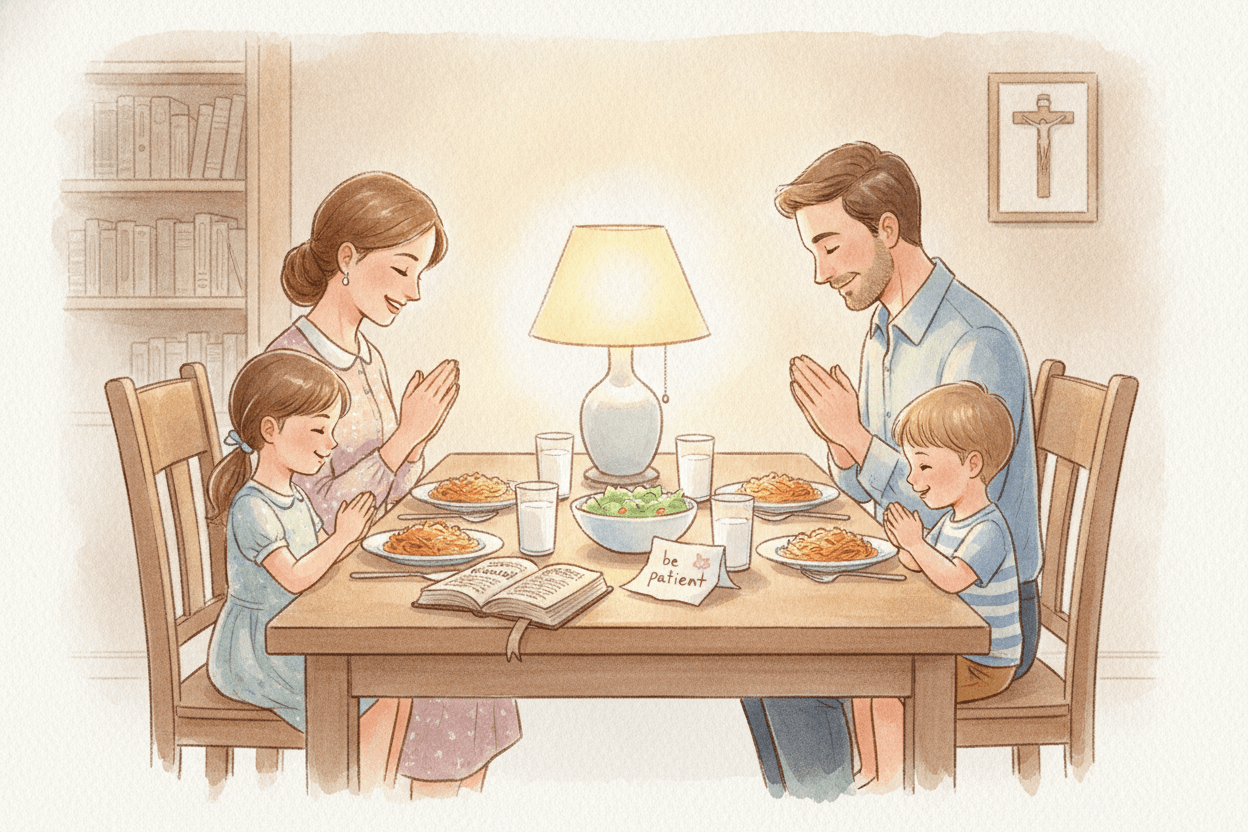
The shoes were still in a heap by the door when we tried this one Sunday afternoon. Someone wanted a snack. Someone else had already started building a blanket fort. So we did not gather everyone around the table with candles and a color-coded plan. We just recalled the Gospel from Mass and asked, “What do you remember?” One child remembered the crowd. Another remembered what Jesus did. That was enough to begin.
Try a small version of this practice this week. Read the Sunday Gospel aloud from the NABRE, or recall the part your family heard at Mass. Then ask one question from each step: What happened in the story? What problem did the people have? What does Jesus show us about God or ask people to do? What is one thing we can do this week because of it? Do not wait for everyone to have a smart answer. A shrug, a drawing, or “Jesus helped them” can be an honest starting point.
Then let each child choose one small response that has a name and a place. “I will apologize to Dad without being asked.” “I will include the kid who is alone at recess.” “I will wait patiently when my brother gets the first turn.” “I will pray for my friend who is worried about her test.” Small is good. Specific is better. The point is not to manufacture a saintly family moment before bedtime. The point is to give the Gospel somewhere to go on Monday morning.
Parents, choose something too. In our house, this matters because children notice when the grown-ups are only assigning homework. You might say, “I am going to put my phone down when you tell me about your day,” or, “I need to be more patient when we are rushing out the door.” If a child asks something you cannot answer, it is fine to say, “That is a good question. Let’s look into it.” Curiosity is not failure. It shows them that listening to Jesus is something we keep learning to do.
End with one sentence of prayer tied to what was chosen: “Jesus, help me be patient with my sister tomorrow,” or “Jesus, help us notice someone who needs a friend.” That simple habit belongs right in family life. The Catechism says, “Parents have the first responsibility for the education of their children” (CCC 2223). The USCCB encourages parents to speak “naturally and simply about God and their faith.” A brief Gospel question, one concrete response, and one honest prayer can do exactly that. As the disciples said after meeting the risen Jesus, “Were not our hearts burning within us while he spoke to us on the way and opened the scriptures to us?”
Were not our hearts burning within us while he spoke to us on the way and opened the scriptures to us?
Frequently asked questions
How can I help my child remember the Sunday Gospel after Mass?
Read the Sunday Gospel aloud again later that day, using the NABRE used at Mass in the United States. Keep it brief and ask, “What did you notice?” Even a drawing, gesture, or one-sentence answer helps the story settle in.
What questions should I ask my child about the Gospel?
Start with simple observation questions: “Who was in the story?” “What happened?” and “What did Jesus do?” Then ask who needed help or what the people may have been feeling. Let younger children retell the story in their own imperfect way before adding explanations.
Do I need to explain every difficult part of the Gospel to my child?
No. Parents do not need to turn a family conversation into a lesson or have every answer ready. If your child asks something difficult, say that it is a good question and suggest learning more together or asking your priest.
What can we do if my child will not sit still for a Gospel discussion?
Use the ordinary moments you already have: lunch, dinner prep, the car ride, or bedtime. Your child can color, eat a snack, or act out the story while you read and talk. A calm five-minute conversation is enough; the goal is regular listening, not perfect attention.
How can our family live out the Sunday Gospel during the week?
Choose one small response connected to the reading, such as forgiving a sibling, welcoming someone at school, helping without complaining, or praying for a person who is suffering. End by asking Jesus for help with that specific action. A concrete response gives children a way to connect Christ’s words to Monday morning.
What prayer can we say after reading the Sunday Gospel with children?
Keep the prayer short and connected to the family’s chosen response. For example, pray, “Jesus, help us be patient with each other this week,” or, “Jesus, help Mia welcome the new girl at school.” Simple prayers teach children that hearing Scripture leads naturally to speaking with Jesus.
Sources: vatican.va · usccb.org · usccb.org · vatican.va · vatican.va · vatican.va · vatican.va · vatican.va
Scripture quotations in this article use the NABRE translation.