Road to Emmaus for Kids:Recognizing Jesus Each Day
Help children ages 6–9 discover how Jesus meets them in ordinary worries, listens with care, and opens their eyes through Scripture. The road to Emmaus also leads naturally to recognizing Christ’s pre
Your child comes home worried about a friendship, and the instinct is to solve the problem quickly. The disciples on the road to Emmaus show a different starting point: Jesus comes near, listens, opens the Scriptures, and helps them see what was true all along. Here is how I’d teach this Easter story to children ages 6–9—and connect it clearly to the Eucharist at Sunday Mass.
Jesus Walks With Us Before We Notice Him
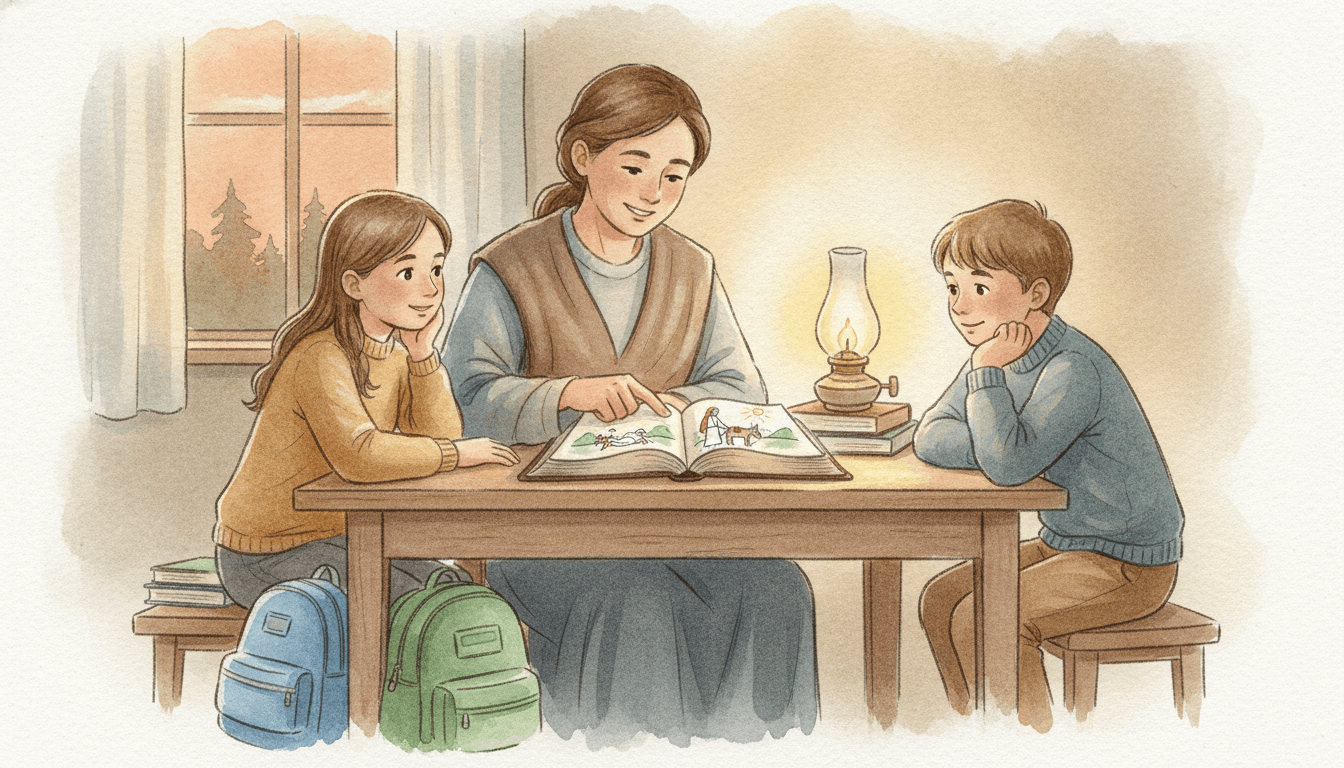
A child comes home from school, drops a backpack by the door, and says, “Nobody wanted to play with me.” Another lies awake worried about tomorrow’s spelling test or a friend who seems angry. In those moments, adults may be tempted to supply quick reassurance. But children deserve something steadier: Jesus is not absent simply because they feel sad, confused, or alone.
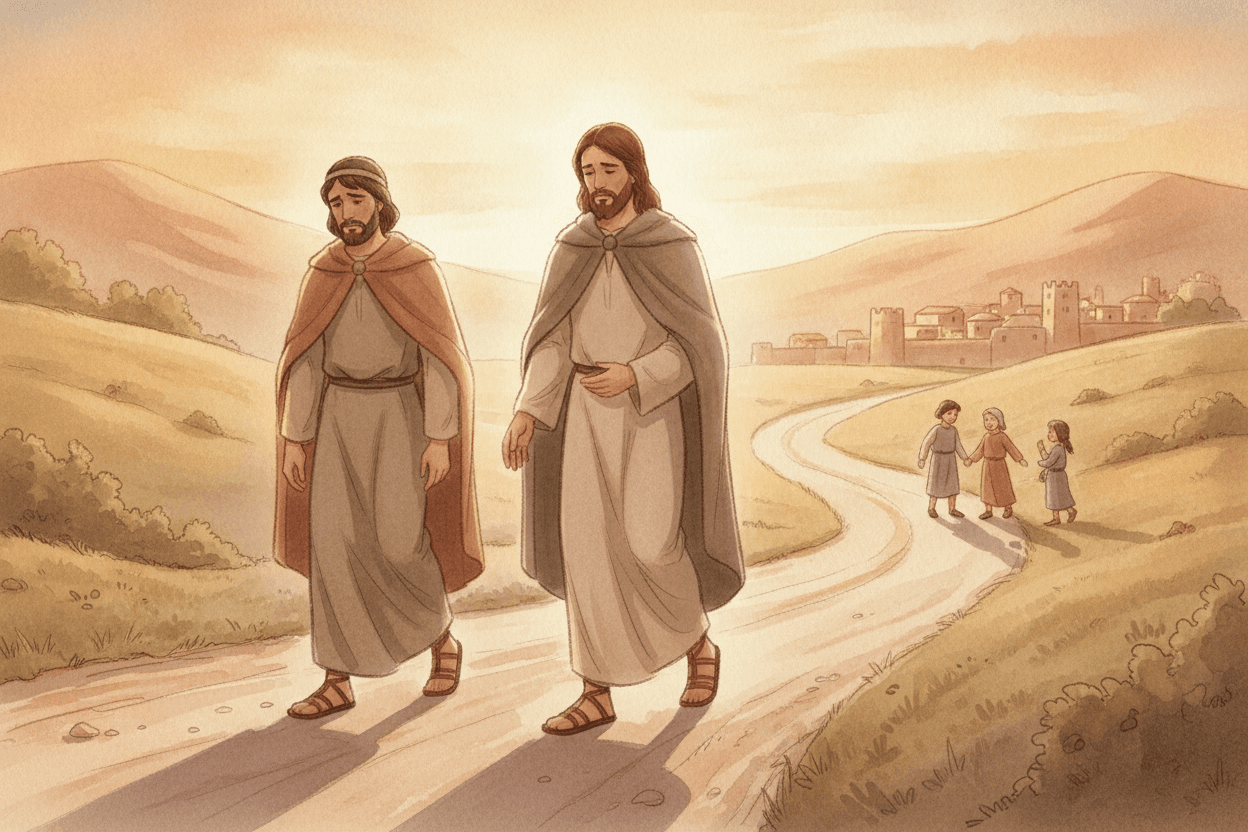
That is where the road to Emmaus begins. Two disciples are leaving Jerusalem with heavy hearts, trying to make sense of Jesus’ death and the reports that he may be alive. They are talking, debating, and likely disappointed. Then Jesus comes alongside them. They do not recognize him—not because they have failed, and not because they lack enough emotion or faith, but because “their eyes were prevented from recognizing him.” This matters for children. Faith is not the skill of producing a warm feeling on command. Jesus’ presence is real before we notice it.
Here’s how I’d teach this in a parish classroom: ask a child to picture one hard part of an ordinary day—being left out at recess, making a mistake, hearing upsetting news, or feeling nervous before a game. Then ask, “If Jesus walked with the disciples when they were confused, could he be with you in that moment too?” Let the child answer in his or her own words. The point is not to turn every disappointment into a dramatic lesson. It is to form the quiet habit of telling the truth to Jesus: “I am hurt.” “I do not understand.” “Please stay with me.”
Scripture invites us to notice the order of the story. Jesus first draws near and listens; later, he explains the Scriptures; finally, the disciples recognize him in the breaking of the bread. Parents can follow that same patient pattern. Listen before correcting. Open a short Gospel passage before offering an opinion. At bedtime, invite each child to name one difficult moment and one moment of goodness from the day, then pray simply: “Jesus, thank you for walking with us today, even when we did not notice.”
This is also a needed correction to the idea that God is present only in extraordinary experiences. The Lord meets his people in the Church’s worship most fully, and he also accompanies the baptized in the ordinary duties, questions, and losses of daily life. When parents calmly connect a child’s real concerns to Luke 24, they give more than a comforting thought. They teach a durable Christian conviction: our recognition may come slowly, but the risen Jesus has already drawn near.
Now that very day two of them were going to a village seven miles from Jerusalem called Emmaus, and they were conversing about all the things that had occurred. And it happened that while they were conversing and debating, Jesus himself drew near and walked with them, but their eyes were prevented from recognizing him.
Let Children Bring Their Real Questions to Jesus
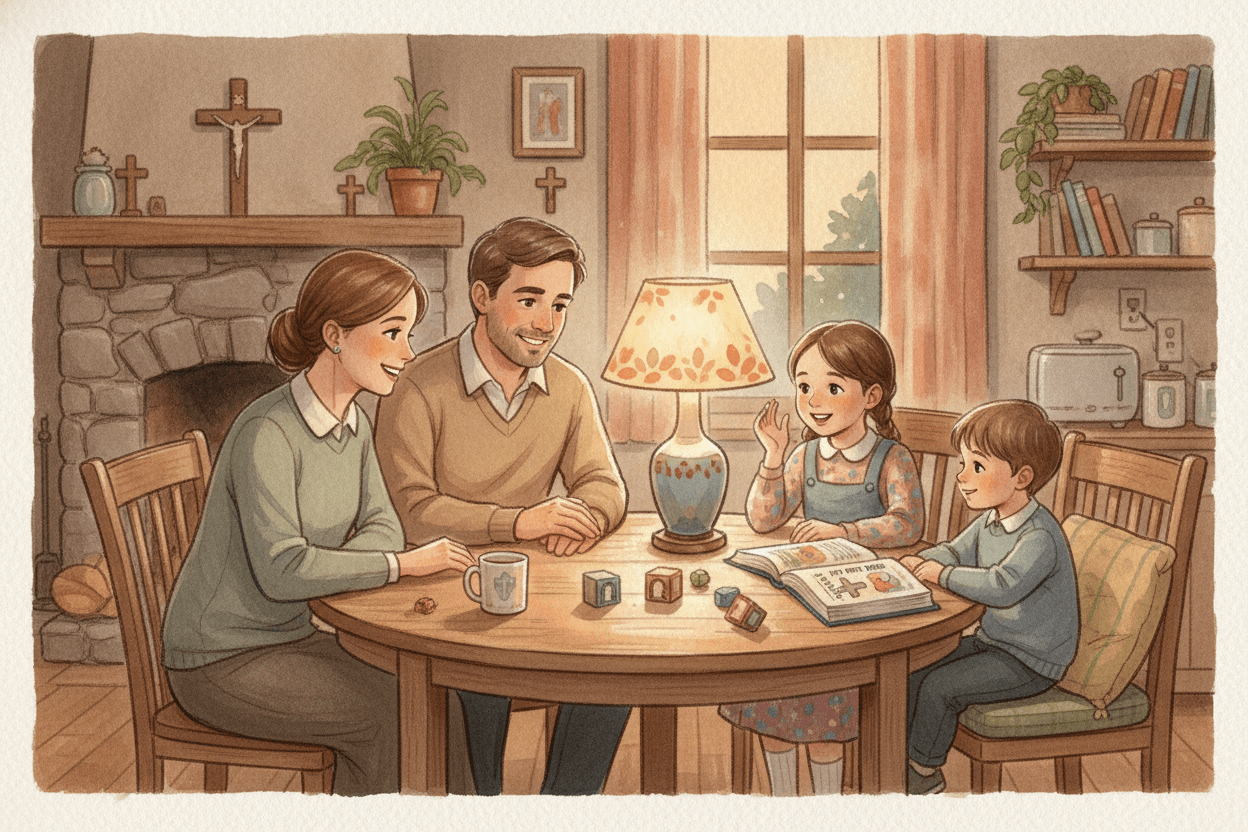
A child comes home quiet after school, drops a backpack by the door, and says, “Nothing.” It is tempting to fill that silence quickly: “You’ll be fine,” “Just pray about it,” or “Tomorrow will be better.” Yet the road to Emmaus gives parents a more patient pattern. Before the risen Jesus teaches the two disciples, he comes near as they talk over their sorrow and confusion. He does not treat their disappointment as an interruption to the lesson.
Scripture invites us to notice that Jesus walks beside people whose understanding is incomplete. The disciples are speaking about painful events, and their eyes are still unable to recognize him. That is often where children begin, too: with a friendship problem, fear over a test, anger at a sibling, or a question they worry might sound disrespectful. Catholic children do not need adults to pretend every question has an immediate, tidy answer. They need to learn that honest questions can be brought into the presence of Christ.
Here’s how I’d teach this to children ages six through nine: make a brief Emmaus conversation part of the afternoon or bedtime routine. Ask one concrete question at a time: “What was hard today?” “What made you happy?” “Where did you need help?” “Was there a time you felt left out or worried?” Then wait. If a child says, “I was scared when I had to read,” resist correcting the feeling or turning it at once into a moral. Try, “That sounds hard. Tell me what happened.” A parent’s attentive listening teaches something true about Jesus’ own way with us.
After listening, offer a small word from faith rather than a lecture. You might say, “Jesus was with you when you felt afraid, even if you did not feel brave,” and then pray simply: “Jesus, thank you for staying with us. Please help us tomorrow.” If a child asks why God allowed something difficult, it is enough to answer, “I do not know every reason, but Jesus hears that question. We can keep asking him.” This is not uncertainty disguised as catechesis; it is reverence for both the child’s intelligence and the mystery of God’s providence.
The Emmaus pattern is listen, teach, send. In family life, “send” can be very ordinary: encourage a child to apologize, invite someone into a game, ask a teacher for help, or return to a concern in prayer the next day. Later, connect this habit to Sunday Mass. There, Christ opens the Scriptures and gives himself in the Eucharist; the Catechism calls the Eucharist the memorial that makes present his Passover (CCC 1362). Children who are heard at home are better prepared to recognize that the Lord who receives their real questions also meets them at the altar.
Now that very day two of them were going to a village seven miles from Jerusalem called Emmaus, and they were conversing about all the things that had occurred. And it happened that while they were conversing and debating, Jesus himself drew near and walked with them, but their eyes were prevented from recognizing him.
Open the Scriptures, Not Just the Moral
A child who has heard the Emmaus story may quickly offer the expected answer: “Jesus was being kind because he walked with the sad men.” That is not wrong, but it is far too small. Jesus does walk with the disciples in their grief and confusion. Yet Luke shows him doing something more demanding: he teaches them to read their sorrow within God’s plan. Before they recognize him at the table, he opens the Scriptures to them. Catholic children deserve that larger vision. The Bible is not chiefly a collection of good-behavior lessons; it is the story of God saving his people in Jesus Christ.
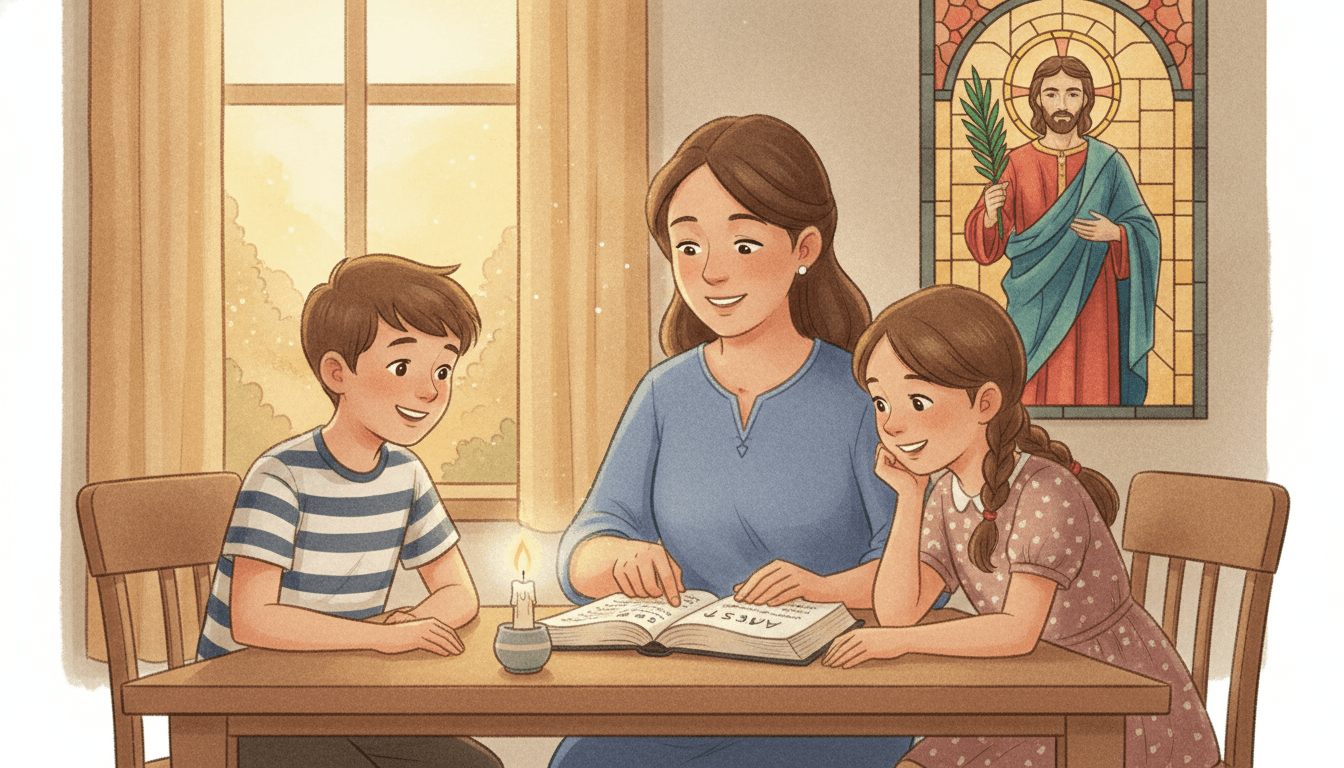
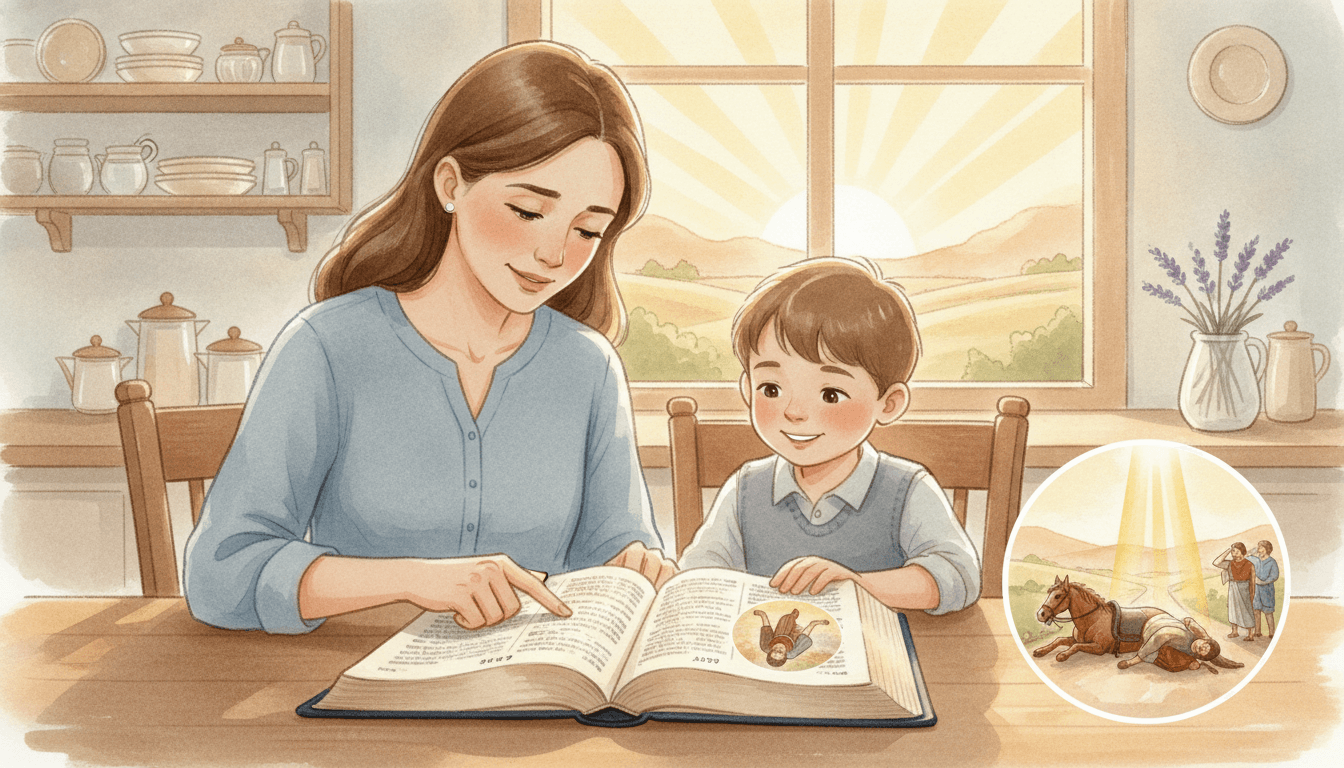
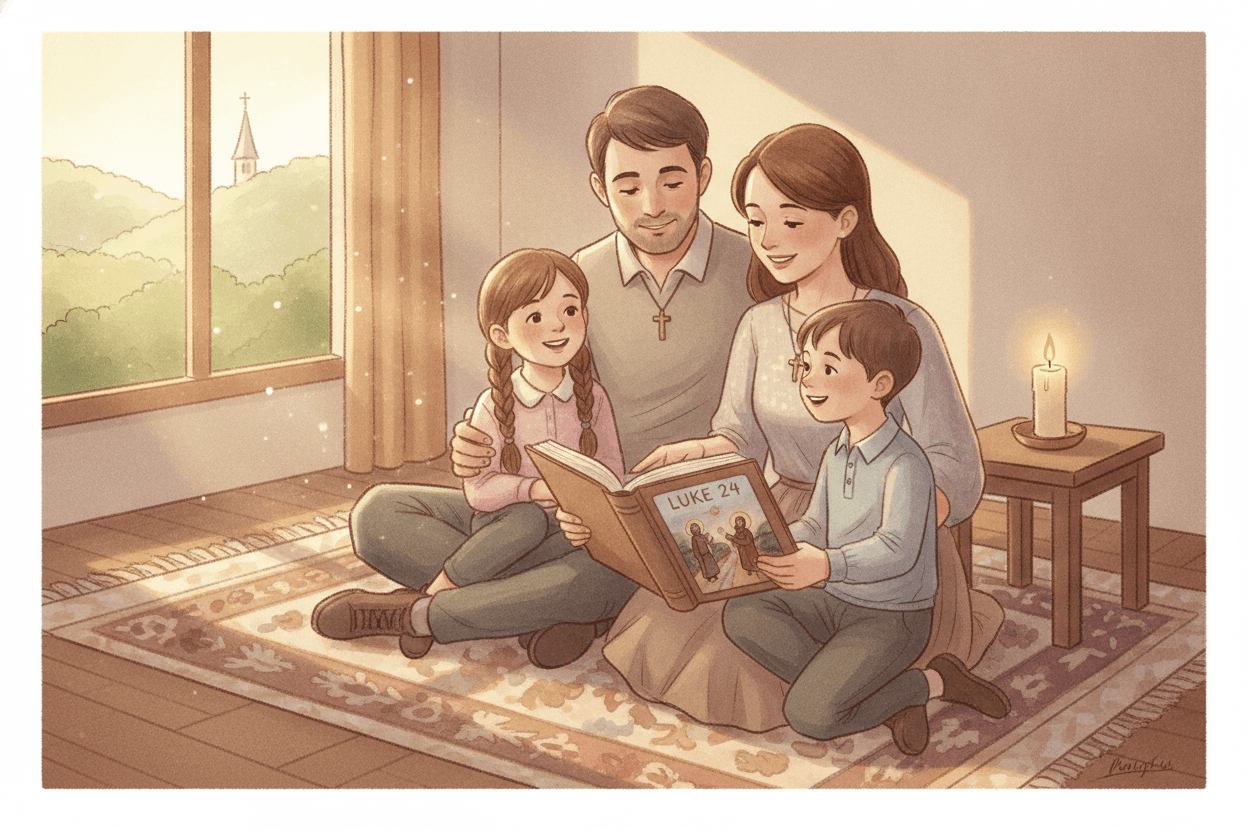
Here’s how I’d teach this at home: read Luke 24:13–15 one evening, Luke 24:16–27 the next, and Luke 24:28–35 on a third. Keep the Bible open and ask observation questions before explaining anything. “Where are the disciples going?” “What are they talking about?” “Who comes near them?” “Do they know it is Jesus?” Then ask one question that connects the passage to their real lives: “Have you ever been upset about something and not noticed who was helping you?” Let children answer plainly. They do not need a polished spiritual response. Jesus himself first listened to the disciples describe what had happened.
When you reach Jesus’ teaching in Luke 24:25–27, explain that he was showing how God had prepared his people to receive the Messiah, and why the Messiah’s suffering was not a mistake or a defeat. For a younger child, that may be enough. For an older child, point out that Jesus did not simply say, “Cheer up.” He gave them the Scriptures so they could understand reality truthfully. As the Catechism reminds us, Scripture is read in the living Tradition of the whole Church (CCC 113). Parents need not produce a long lesson. A simple sentence—“Jesus helps us see that God keeps his promises, even when we cannot yet see what he is doing”—is faithful to the passage.
Luke records the disciples’ response after Jesus had gone: “Were not our hearts burning [within us] while he spoke to us on the way and opened the scriptures to us?” A burning heart is not merely a pleasant feeling. It is the awakening that comes when Christ’s word reaches us with truth. At bedtime, ask, “What part of this story surprised you?” or “What did Jesus help the disciples understand?” Then carry the question into Sunday Mass: “Listen for the Scriptures before we come to the altar.” This keeps Emmaus from becoming “be nice to strangers” or “notice nice things.” Scripture invites us to see the risen Lord teaching his Church, preparing her for the breaking of the bread, and sending her to tell what she has seen.
Then they said to each other, "Were not our hearts burning [within us] while he spoke to us on the way and opened the scriptures to us?"
The Breaking of the Bread Means the Eucharist
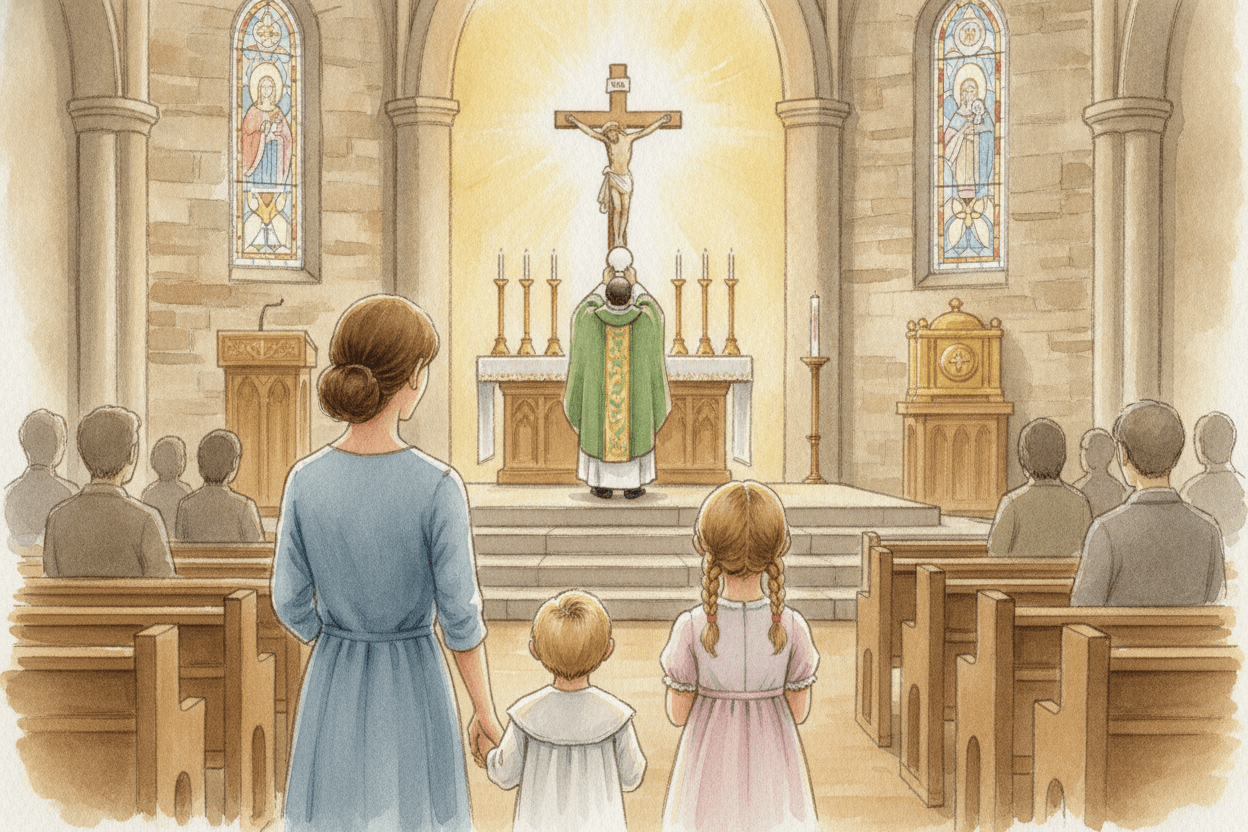
At the moment the priest lifts the host after the words of consecration, children often look up because the whole church has grown still. That is the moment to give them more than a vague instruction to “be reverent.” Tell them plainly: Jesus is here. The disciples at Emmaus knew Jesus when he took bread, said the blessing, broke it, and gave it to them. Luke is showing us an action that reaches back to the Last Supper and forward to every celebration of the Mass.
Here’s how I’d teach this to children: at the Last Supper, Jesus did not say, “This bread will help you think about me.” He said, “This is my body, which will be given for you; do this in memory of me” (Luke 22:19). At Mass, when the priest says Christ’s words over bread and wine, Jesus acts through him. What still looks like bread is no longer ordinary bread. By the power of the Holy Spirit and Christ’s word, it is truly the Body of Christ. The wine is truly his Blood. This is not pretend, and it is not merely a symbol or a religious reminder.
The Catechism gives parents steady language for this truth. The Eucharist is “the memorial of Christ’s Passover” (CCC 1322), and this memorial makes present Christ’s one sacrifice rather than repeating it (CCC 1362). A child need not master every theological term to receive the truth. You might say, “At Mass, Jesus gives himself to us. We cannot see him with our eyes as the disciples did, but he is truly present under the appearance of bread and wine.” That careful distinction respects a child’s intelligence and guards against reducing Communion to a snack, a reward, or a nice custom.
Make the connection visible on Sunday. Before Mass, remind your children: “Listen for the words Jesus spoke at the Last Supper.” During the Eucharistic Prayer, help younger children notice when they kneel and when the bells ring, if your parish uses them. After Communion, ask one concrete question: “Where did the disciples recognize Jesus?” Then answer together: “In the breaking of the bread.” The same Jesus who met confused disciples at Emmaus gives himself to his Church now. From that encounter, children can learn to notice his care in ordinary days—but the Eucharist remains the clearest place where he has promised to be with us.
And it happened that, while he was with them at table, he took bread, said the blessing, broke it, and gave it to them. With that their eyes were opened and they recognized him, but he vanished from their sight.
Help Kids Recognize the Emmaus Pattern at Mass
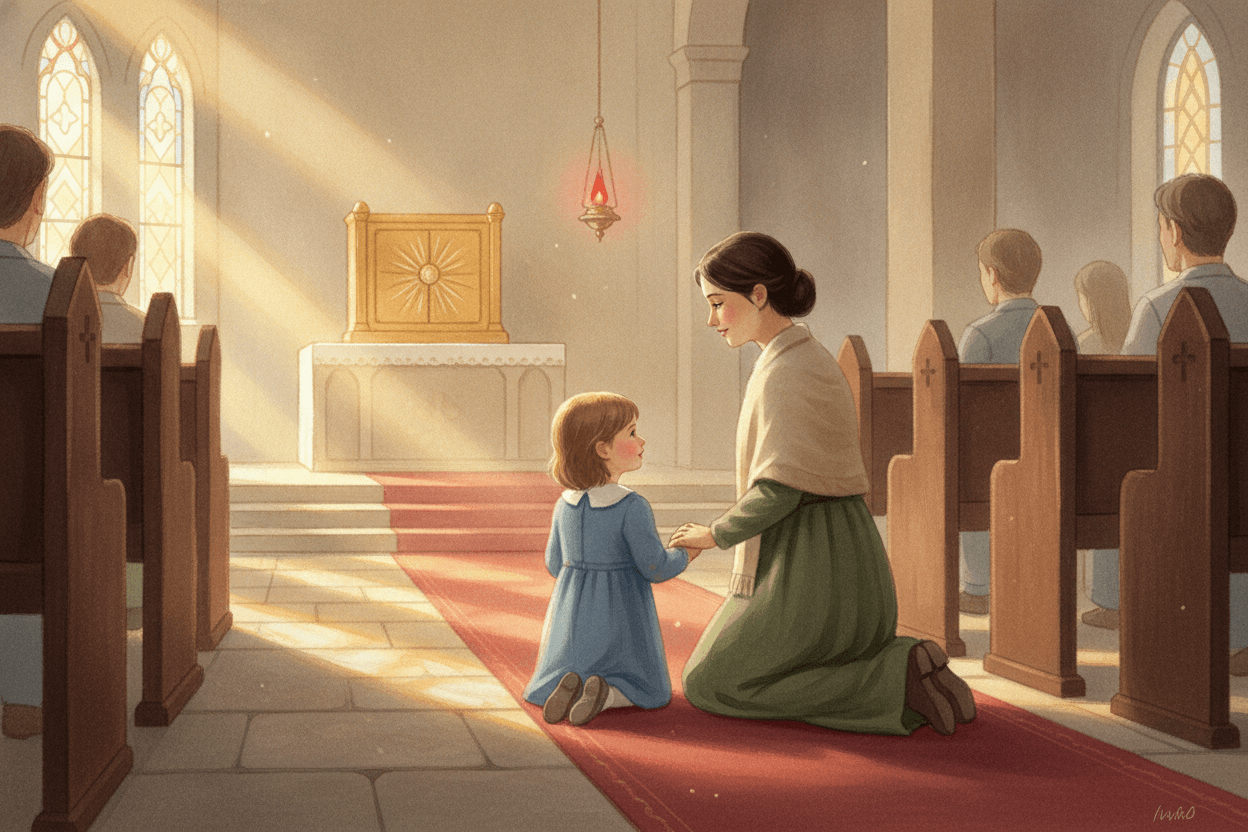
A child can follow the entrance procession with one simple question: “Where is Jesus going to meet us today?” At Mass, he gathers his people first. We stand, sing, make the Sign of the Cross, and join the congregation because we are not spectators arriving for a lesson; we are the Church assembled for worship. Before finding the pew, teach children to look toward the tabernacle. If the Blessed Sacrament is reserved there, we genuflect—touching the right knee to the floor—as an act of adoration directed to Jesus truly present. A child who cannot genuflect easily may make a reverent bow instead.
Then comes the Liturgy of the Word, the part of Mass that resembles the road to Emmaus. Jesus speaks through the Scriptures proclaimed in the Church. Here’s how I’d teach this: when the Gospel is announced, make the three small crosses—on forehead, lips, and heart—and quietly pray, “Jesus, help me know your word, speak your word, and love your word.” Encourage children to listen for one detail: a person, an action, or a sentence they can remember at lunch. Their attention need not be perfect to be real. Patient practice teaches them that the Gospel is not merely a story from long ago; it is Christ addressing his people now.
At the altar, the Emmaus pattern reaches its clearest point. Watch carefully when the priest takes the bread and cup, gives thanks, and speaks Christ’s words. At the Last Supper, Jesus said, “This is my body, which will be given for you; do this in memory of me.” The Catechism teaches that the Eucharist is the memorial of Christ’s Passover, making present his unique sacrifice (CCC 1362). So help children understand why the church grows quiet, why we kneel when we are able, and why we look toward the altar with reverence: this is not ordinary bread and wine, nor a religious play. Jesus gives himself to us under the appearances of bread and wine.
A child who has not yet received First Communion should still come forward in the Communion procession according to the parish’s customary practice, or remain prayerfully in the pew with the family. Either way, teach a spiritual communion. In simple words: “Jesus, I believe you are truly present in the Eucharist. I love you and want to be close to you. Come into my heart and help me prepare to receive you in Holy Communion.” This does not replace sacramental Communion, but it forms desire, reverence, and a clear expectation of what First Communion will mean.
Finally, Mass sends us out, just as the disciples returned from Emmaus to tell the others what they had seen. On the drive home, ask one concrete question: “What did you hear Jesus say to us today?” At bedtime, ask, “Where can we carry that word tomorrow?” Scripture first, then the Church’s worship, then daily life: this is a sound pattern for children. They learn to recognize that the Jesus who gathers them, speaks in the Gospel, and gives himself in the Eucharist also sends them to be faithful at school, generous at home, and truthful with friends.
Then he took the bread, said the blessing, broke it, and gave it to them, saying, "This is my body, which will be given for you; do this in memory of me."
This Week: Walk, Listen, Read, Go to Mass, Tell
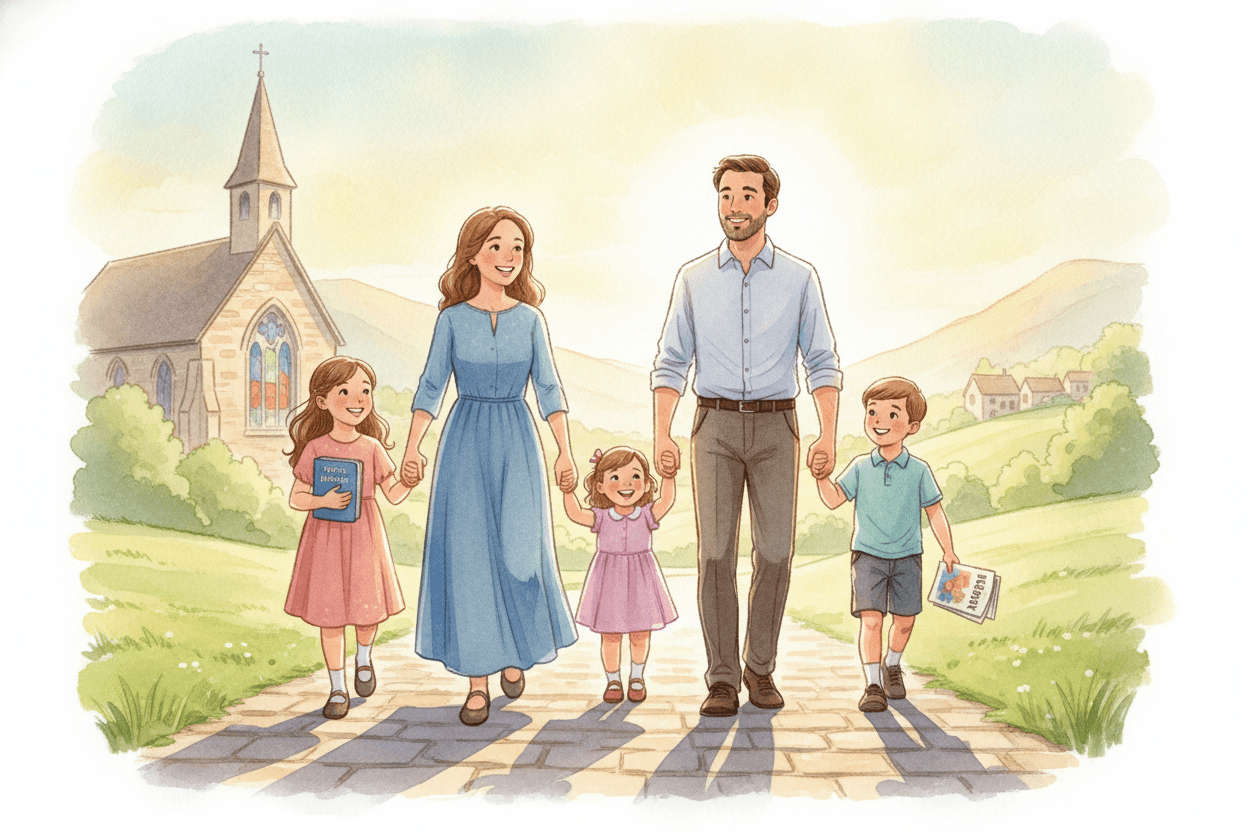
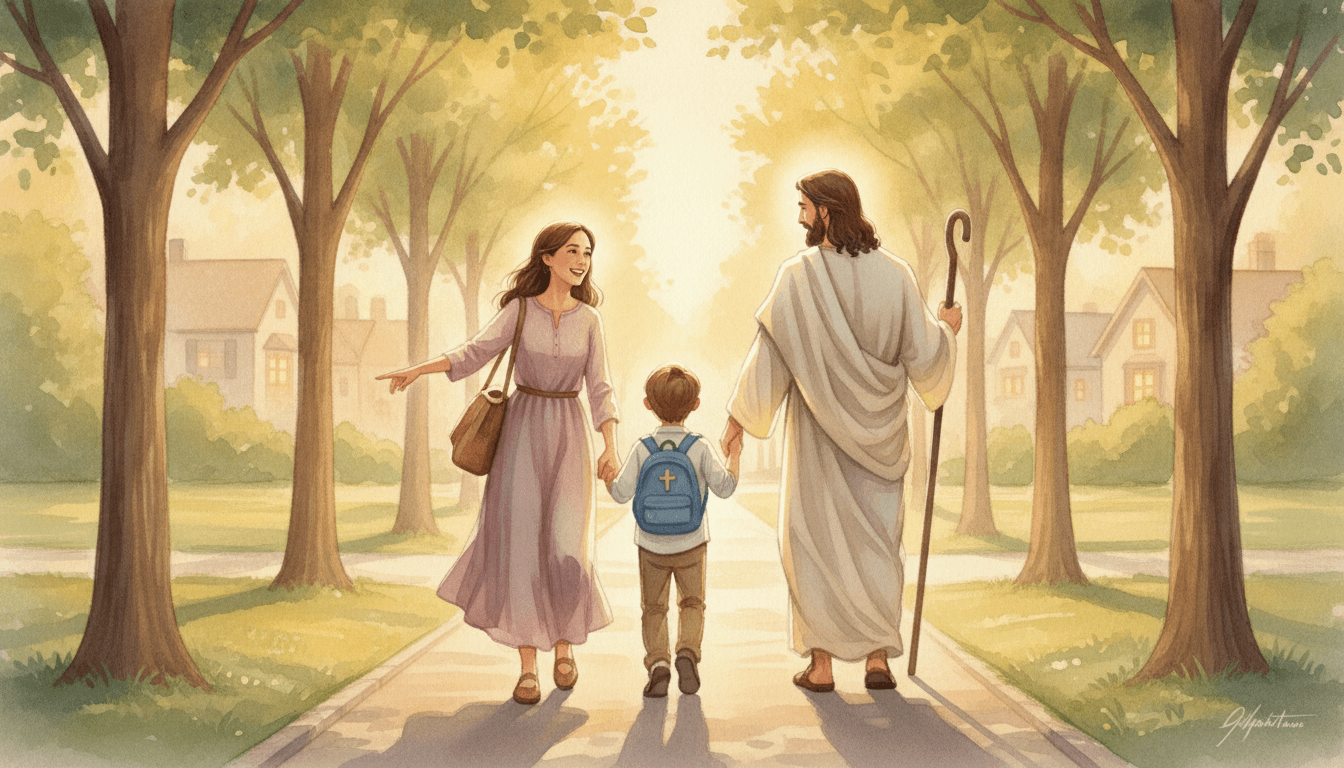
On the way home from school, begin with a ten-minute walk—not a lecture. Ask each child to name one worry, one disappointment, or one question from the day. Perhaps it is a spelling test, a friendship problem, or concern about someone who is sick. The disciples on the road to Emmaus were already talking honestly about what had happened when Jesus came near. Our children need to learn that prayer is not polished reporting; it is telling the Lord what is actually on their minds.
First, walk. Then listen. Resist the temptation to correct every statement or solve every problem immediately. A parent can say, “Thank you for telling me,” and then ask, “What do you think Jesus might want you to remember?” This is not asking children to manufacture a religious answer. It teaches them that Christ is present when they are confused, sad, grateful, or uncertain. Scripture invites us to notice that Jesus listened to the disciples’ account before he opened the Scriptures to them.
Next, read Luke 24:13–35 slowly across the week. With younger children, take a few verses at a time: the road, the conversation, Jesus explaining Scripture, the meal, and the disciples returning to Jerusalem. Keep the Bible open as the source. A BibleHeroes Road to Emmaus comic can be a helpful rereadable conversation starter—especially for a child who responds to pictures—but it should lead back to Luke’s Gospel, not replace it. Ask concrete questions: “What did the disciples not understand?” “When did they recognize Jesus?” “What would you have told the others in Jerusalem?”
On Sunday, go to Mass with one assigned detail to notice: the priest taking the bread, saying the blessing, breaking it, and giving it; the elevation after the consecration; a genuflection; or the people coming forward for Holy Communion. Tell children plainly that the breaking of bread at Emmaus points us toward the Eucharist, where Christ gives himself to us. As the Catechism teaches, the Eucharist makes present Christ’s unique sacrifice (CCC 1362). The family’s prayer rightly comes to its fullest expression when the family shares Sunday Mass together.
After Mass, or at Sunday dinner, let each person share one “Jesus moment” from the week: help received, a prayer answered in an unexpected way, a chance to forgive, a word from Scripture that stayed with them, or something noticed at Mass. End with the disciples’ own response: “So they went back and announced to the others in Jerusalem what had taken place on the road and how they had come to know him in the breaking of the bread.” Children do not need dramatic stories to tell. They need the steady habit of recognizing that Jesus has been near and speaking of him with joy.
So they went back and announced to the others in Jerusalem what had taken place on the road and how they had come to know him in the breaking of the bread.
Frequently asked questions
How can I teach my child the road to Emmaus story?
Start with a hard, ordinary moment your child understands, such as being left out, nervous about school, or upset with a sibling. Explain that Jesus came close to the disciples before they recognized him, so he can be near to us even when we feel sad or confused. Keep the focus on talking honestly to Jesus rather than trying to force a certain feeling.
What should I say when my child feels lonely or worried?
Listen first instead of rushing to solve the problem or saying, “You’ll be fine.” Try, “That sounds hard. Tell me what happened,” and let your child describe it. Then offer a short reassurance rooted in faith: “Jesus was with you when you felt afraid, even if you did not notice him.”
How do I help my child pray about a difficult day?
At bedtime or after school, ask your child to name one hard moment and one good moment from the day. Pray simply together: “Jesus, thank you for walking with us today, even when we did not notice. Please help us tomorrow.” This teaches children to bring real worries and gratitude to Christ.
What does the road to Emmaus teach children about Jesus’ presence?
It teaches that Jesus is not absent just because we do not feel him or understand what is happening. The disciples did not recognize him right away, yet he was already walking beside them. Children can learn that faith includes trusting Christ’s presence in everyday disappointments, questions, and joys.
How can I connect the Emmaus story to Sunday Mass?
Point out the pattern in Luke 24: Jesus opens the Scriptures, then the disciples recognize him in the breaking of the bread. At Mass, Christ speaks through Scripture and gives himself in the Eucharist, where his Passover is made present. Family conversations about daily struggles can help children come to Mass ready to meet the same Jesus who receives their questions.
How should I answer when my child asks why God allowed something hard?
You do not need to give a quick or tidy explanation. You can say, “I do not know every reason, but Jesus hears that question, and we can keep asking him.” Then pray together and consider one ordinary next step, such as asking for help, apologizing, or trying again tomorrow.
Sources: bible.usccb.org · usccb.org · usccb.org · usccb.org · usccb.org · pewresearch.org · pewresearch.org · pewresearch.org · pewresearch.org · catholic.com
Scripture quotations in this article use the NABRE translation.