Simple Catholic Night Prayers Kids Will Enjoy
Discover simple Catholic night prayers kids can remember and enjoy, from familiar blessings to brief thank-yous and prayers for loved ones. These gentle bedtime routines help children settle down, fee
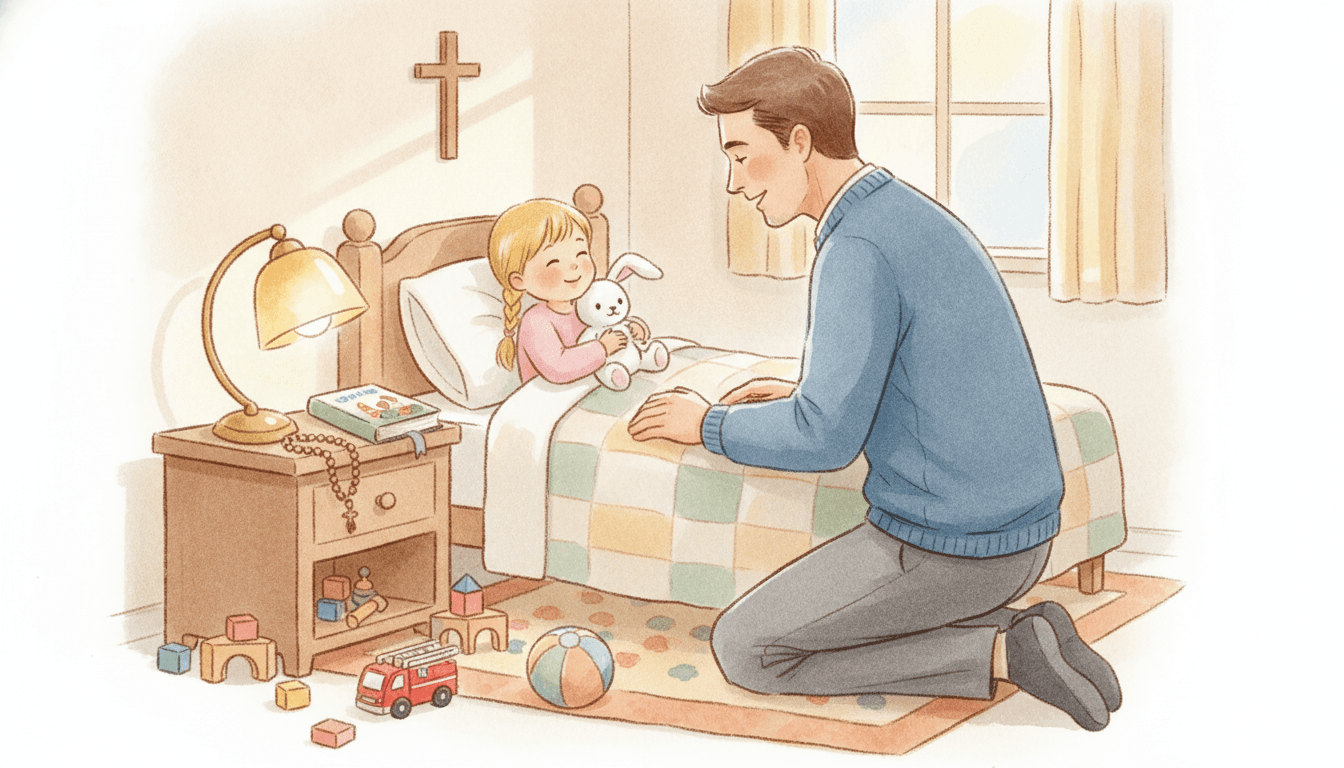
The lights are low, somebody has asked for water again, and the stuffed animals have somehow formed a committee on the bed. That is not a bad time to pray. For little kids, bedtime prayers for Catholic kids work best when they are short, familiar, and gentle enough to fit the child in front of you.
Why bedtime is a good place to begin
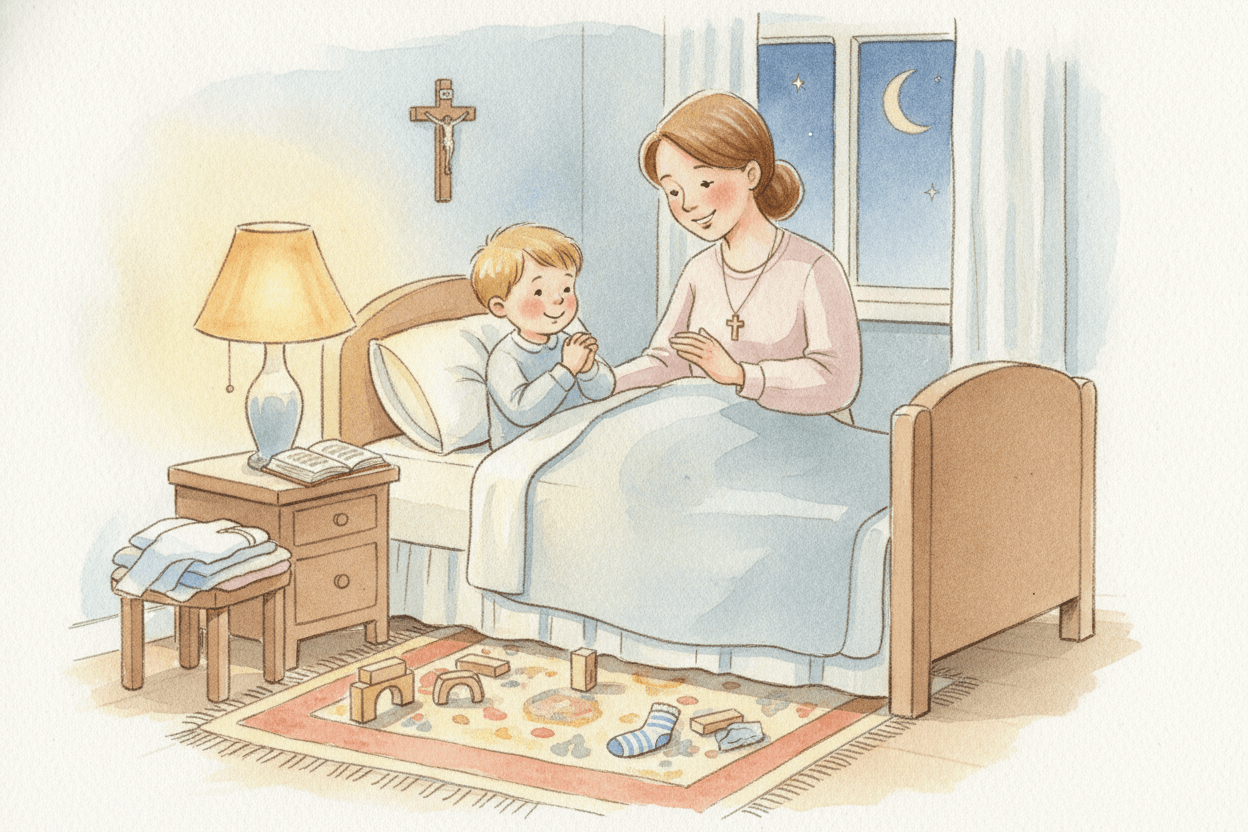
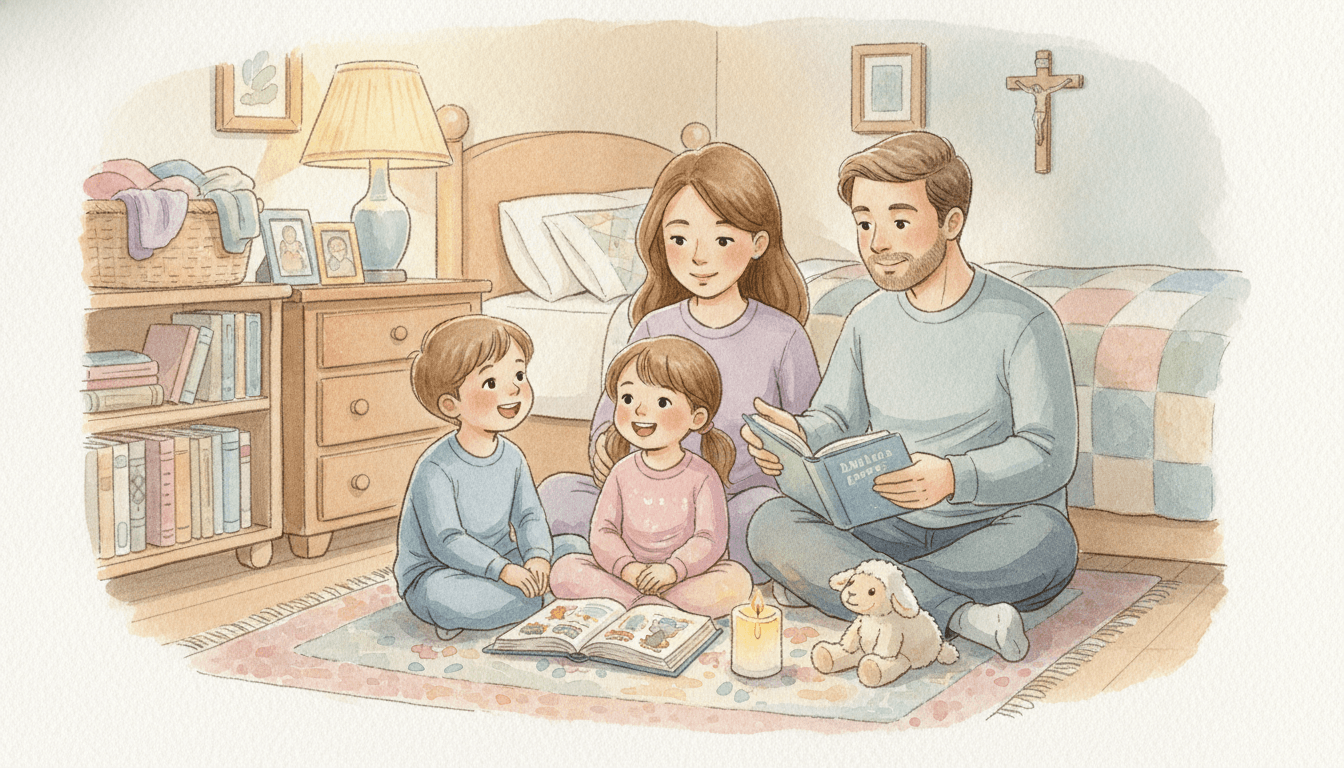
At 8:17 p.m., somebody is asking for water again, somebody else has suddenly remembered a missing stuffed animal, and the toothpaste is somehow on the mirror. That is still a perfectly good time to pray. Bedtime prayer does not need candles, a long lesson, or children sitting as still as stained-glass saints. For little kids, five calm minutes at the edge of the bed can be enough.
The relief for parents is that repetition does most of the heavy lifting. Children ages 3–5 love knowing what comes next. Pajamas, teeth, one book, one prayer, a kiss. The same simple pattern tells their busy little bodies that the day is ending and they are safe. Family-ministry guidance makes this point well: repeated prayer gives children security and familiarity, and bedtime is one of the most natural places to make it part of life. You do not have to make every night memorable. You just have to return to it.
That ordinary return matters. About 67% of U.S. parents say they pray with their children at home at least occasionally. So if you are trying to begin, you are not attempting some unusual family project. You are joining many parents who are doing their best in the middle of dishes, laundry, and one more request for the other blanket. In our house, a short prayer works better than a grand plan that lasts two nights. The child in front of you needs your calm voice more than a perfectly organized devotion.
Scripture gives this home-sized picture: “Take to heart these words which I command you today. Keep repeating them to your children. Recite them when you are at home and when you are away, when you lie down and when you get up.” Bedtime is right there in the rhythm God names. One small thing we tried was keeping the order the same: thank God for one good thing, ask Jesus to help with one hard thing, then make the Sign of the Cross and offer a blessing. That is not small in a child’s life. Over time, they learn that joy, worry, and sleep all have somewhere to go: to God.
Take to heart these words which I command you today. Keep repeating them to your children. Recite them when you are at home and when you are away, when you lie down and when you get up.
Keep the whole routine to five or ten minutes
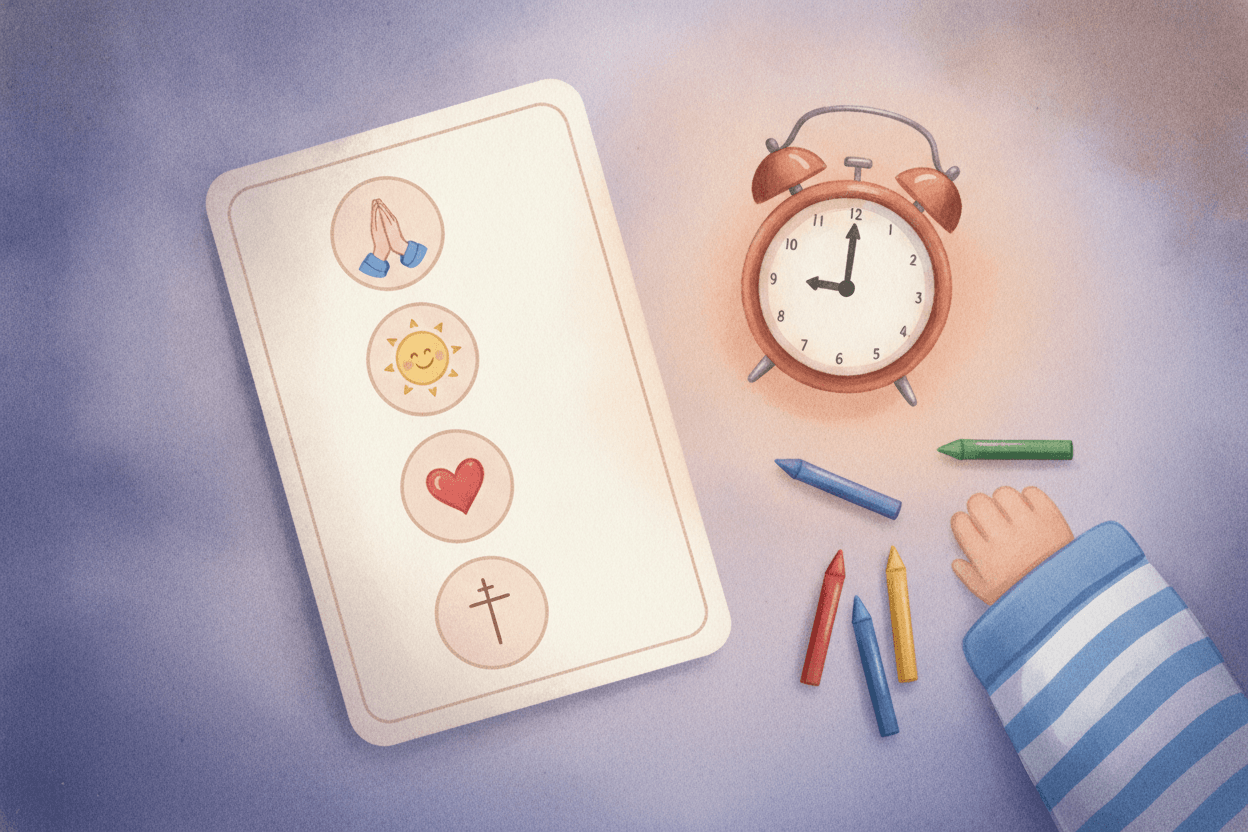
The toothbrush was already on the floor, someone had remembered they needed water for the third time, and the clock was not helping. Those are not the nights for a twenty-minute prayer plan. In our house, a short prayer that actually happens beats a thoughtful plan that stays in a parenting book. Five minutes is enough to help a child settle, speak to God, and know that the day ends in his care.
For little kids, predictability matters more than novelty. They like knowing what comes next: the same prayer, the same little questions, the same sign of the cross from Mom or Dad. That repetition is not boring to them. It is comforting. It also keeps prayer from feeling like a test. No child has to invent a profound intention after a long day of snacks, blocks, tears, and one very serious dispute over whose turn it was.
Try this five-minute version this week. First, make the Sign of the Cross and pray the Our Father together. Second, ask one simple question: “What is one thing you want to thank God for today?” Let the answer be a grandparent, a purple crayon, or macaroni and cheese. Third, ask, “What do you want Jesus to help with?” Name one intention together. Finish by tracing a small cross on your child’s forehead and saying, “God bless you and keep you safe tonight.” That is a complete prayer time.
On nights when everyone has a little more margin, use a ten-minute version. Begin with the Sign of the Cross, the Our Father, and a Hail Mary. Then let each child name one happy part of the day and one hard part. You can gently ask, “Where did you see God’s love today?” A child may say, “When my sister shared.” Or, “When Daddy fixed my truck.” Thank God for those moments, bring one worry or person to him, and end with the blessing. Add a few quiet seconds before lights out if your child can manage it. If not, no problem. Tomorrow is coming fast.
Psalm 4 gives us a simple bedtime hope: “In peace I will lie down and fall asleep, for you alone, Lord, make me secure.” The goal is not polished words or perfectly still children. The goal is a familiar little place at the end of the day where your child learns, again and again, that God hears thanks, worries, silly details, and sleepy voices. Here's what landed for us: keep the order the same for a week before changing anything. The routine will begin to carry some of the weight, even on the messy nights.
In peace I will lie down and fall asleep, for you alone, Lord, make me secure.
A simple Catholic night-prayer script to use tonight
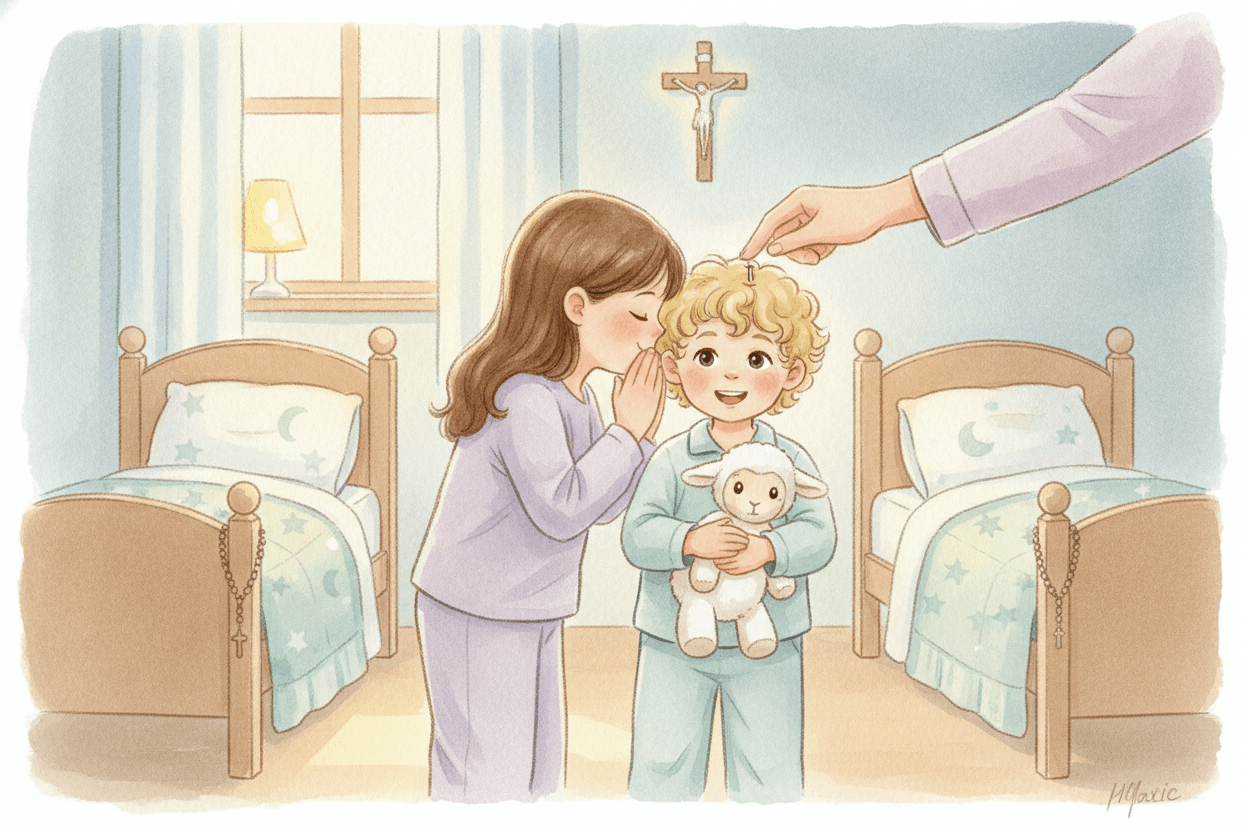
The toothbrush is on the counter, somebody has suddenly remembered a stuffed animal downstairs, and the room is one minute from turning into a wrestling match. That is not the moment for a long speech. It is the moment for a few familiar words. In our house, the best prayer is often the one we can still say when everyone is tired and Dad is doing the math on how many times he has been asked for water.
Try this tonight. Gather by the bed, make the Sign of the Cross, and say: “In the name of the Father, and of the Son, and of the Holy Spirit. Amen.” Then pray the Our Father together. If your children are still learning it, let them join on the words they know. Afterward, say: “Jesus, thank you for this day. Thank you for loving us. We want to tell you one good thing from today.” Go first if the room is quiet: “Thank you for pancakes,” or “Thank you that your brother felt better.” A child can answer with one word, point to a toy, or simply say, “Thank you, God.”
Next say: “Jesus, we give you the things that worry us. Please help ___.” Leave a little space for names and needs. A child who is shy, silly, or fully out of battery can use one of these lines: “Help my friend.” “Help Grandma.” “Help me sleep.” Or the always-honest, “I don’t know.” Then pray: “Jesus, stay with us tonight. Keep our family safe. Help us love you tomorrow. Amen.” Finish with a parent’s blessing: “May Almighty God bless you, the Father, the Son, and the Holy Spirit. Amen.” Make the Sign of the Cross again, kiss foreheads, and let the lights go out.
Do not worry if your three-year-old says, “Thank you for dinosaurs,” every night for two weeks. He is praying. Do not worry if an older child offers a rushed intention and immediately asks whether tomorrow is a school day. She is praying too. The steady shape matters more than polished words. On nights when the routine feels settled, add a Glory Be after the Our Father. As children get older, rotate in a short Act of Contrition once in a while, especially after a hard day of fighting, lying, or hurt feelings. Keep it gentle. Bedtime prayer is not a courtroom. It is a small family habit of placing the real day, including its spilled milk and sharp words, before God. Psalm 4 gives us the hope underneath it all: “In peace I will lie down and fall asleep, for you alone, Lord, make me secure.”
In peace I will lie down and fall asleep, for you alone, Lord, make me secure.
Help children pray their highs, lows, and worries
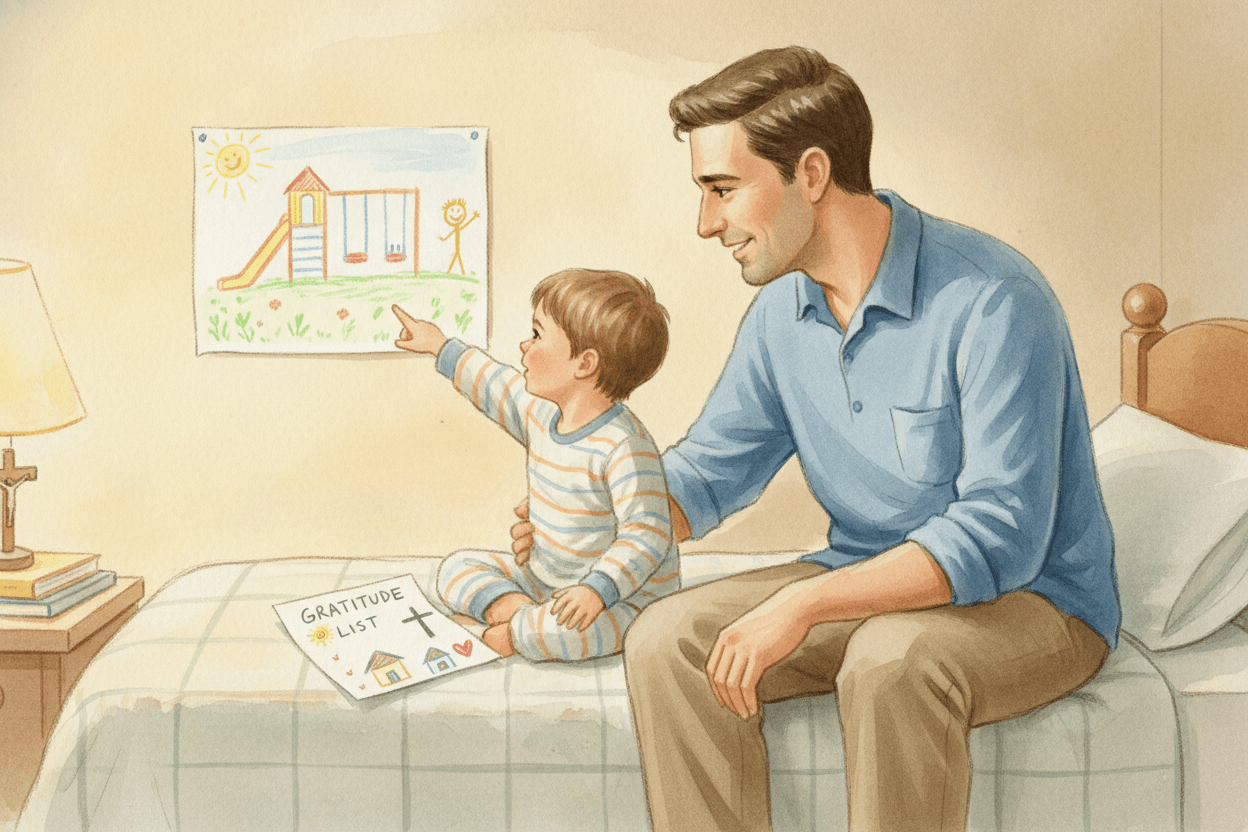
Some nights, the biggest obstacle to prayer is a stuffed dinosaur emergency. Other nights, it is the fact that somebody suddenly remembers a hard thing that happened at preschool three hours ago. We have learned not to rush past those moments. A child who says, “Nobody played with me,” or “I was scared of the dark hallway,” has just handed us a real prayer intention. Bedtime is not the time for a long lesson. It is a chance to help the kid in front of us bring his actual day to Jesus.
One small thing we tried was four simple questions after our usual night prayer: What made you happy today? What was hard today? Where did you notice love? What do you want Jesus to help with tomorrow? This is a kid-sized Daily Examen, though you do not need to call it that. Let them answer in their own words. “I got the blue cup.” “My tower fell.” “Daddy gave me a snack.” “Help me not cry at drop-off.” Those answers may sound small to us. They are not small to them.
Keep the bar low. A child can name one thing only. If your preschooler is already tucked under the blanket and says, “I’m thankful for crackers,” that counts. You might answer, “Thank you, God, for crackers. Please help us sleep peacefully.” Then make the sign of the cross and let the day end. Sr. Janet Schaeffler, OP, puts it simply in USCCB family resources: “Many families end the day in a prayer of thanks, which can take many forms, such as naming the people and events in a litany form, or keeping a family gratitude journal of gratitude prayers to God.” You do not need a journal, a perfect answer, or a child who sits still like a tiny monk. (If you have one, please tell the rest of us your secret.)
Gratitude and worries belong together. St. Paul tells us to bring “prayer and petition, with thanksgiving” to God, trusting that God’s peace will guard our hearts and minds. So after your child thanks God for the playground, help him ask for help with the nightmare, the spelling test, Grandma’s cold, or tomorrow’s separation at school. You can finish with one steady sentence: “Jesus, thank you for today. Please take care of what feels hard tomorrow.” Over time, children learn that nothing in their day is too ordinary, too silly, or too heavy to say to God.
Have no anxiety at all, but in everything, by prayer and petition, with thanksgiving, make your requests known to God. Then the peace of God that surpasses all understanding will guard your hearts and minds in Christ Jesus.
Use all three kinds of prayer—without making it complicated
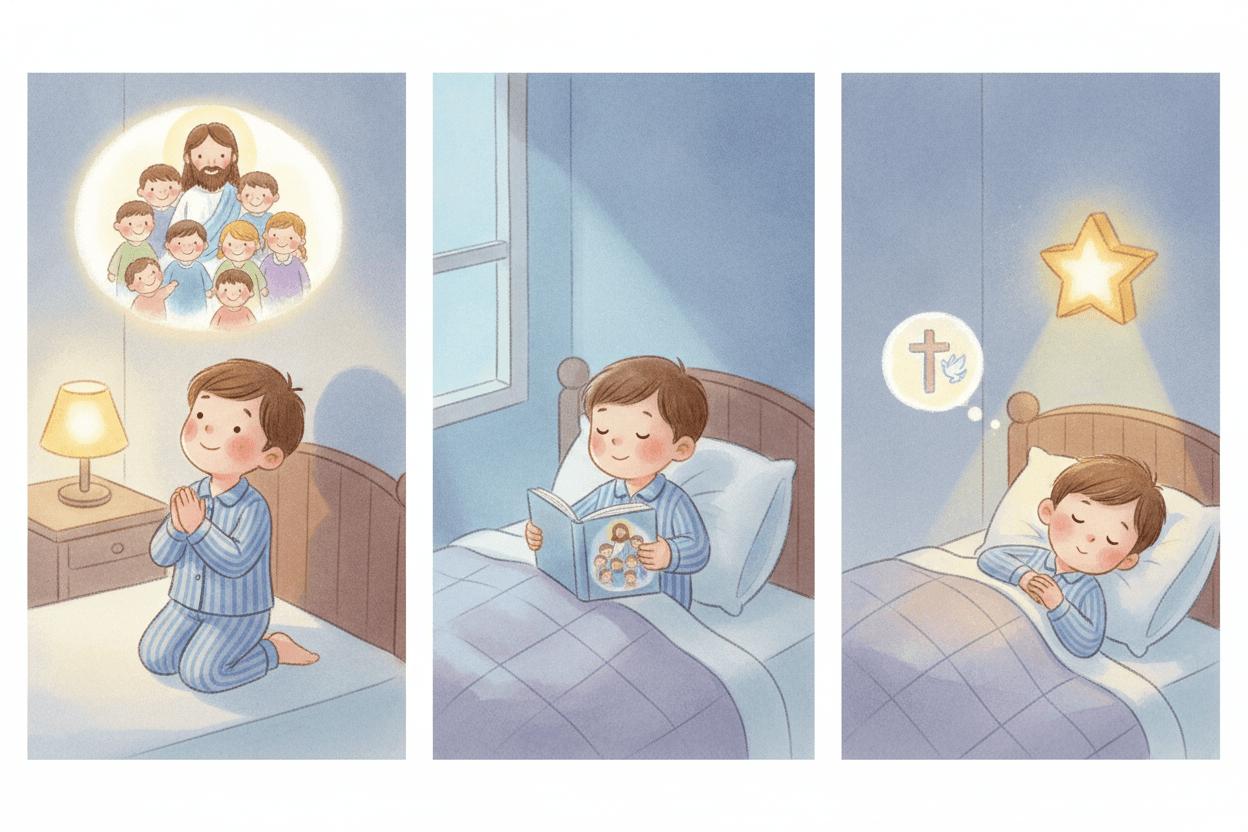
Last night, one of our kids was tucked under the covers with a stuffed animal on his head. He was supposedly a “sleeping bear.” It was not the picture-book version of prayer time. But we said the Our Father together, talked for a minute about his day, then sat still long enough to take three slow breaths. That was prayer. All of it counted.
The Catechism describes three basic ways we pray: vocal prayer, meditation, and contemplation (CCC 2721–2724). Those words can sound like a lot when you are standing in a dark hallway looking for the missing water bottle. They do not have to be complicated. For little kids, vocal prayer means using their voices. Say the Our Father, a Hail Mary, or a Glory Be. Let them join where they can. If they only remember the last line, that is a fine place to start.
Meditation means paying attention to something God has done or something that happened that day. Ask one small question: “What was your favorite part of today?” or “When did somebody show you love?” A BibleHeroes story can give you an easy starting point too. Maybe your child remembers David being brave or Jesus calming the storm. You do not need a lesson plan. Just connect the story to their actual Tuesday: “Were you a little brave when you tried the big slide?” Here’s what landed in our house: keeping the question small made room for real answers. Usually.
Then comes contemplation, which is simply being quiet with Jesus. For a preschooler, quiet might last five seconds. Honestly, sometimes that is an ambitious five seconds. Still, it counts. Invite your child to put a hand on his heart, take two or three breaths, and say, “Jesus, I am here.” Then be quiet together. No need to correct fidgeting, giggling, or an urgent report about a sock. Gently return to the quiet and let the moment be small.
Rita Burns Senseman, writing for the USCCB, says that these three modes of prayer—vocal, meditative, and contemplative—give families a framework for praying at home. A framework is exactly what tired parents need, not another thing to master. In our house, it can be as simple as: say a familiar prayer, remember one good or hard moment, sit quietly for a few breaths. Jesus said, “Let the children come to me, and do not prevent them; for the kingdom of heaven belongs to such as these.” Your child does not need to pray like an adult to come to him. They just need a little space, and you beside them.
Jesus said, “Let the children come to me, and do not prevent them; for the kingdom of heaven belongs to such as these.”
Adjust the prayer for the child you have tonight
At our table, a three-year-old once answered every bedtime question with “chicken nuggets.” Thank you, God, for chicken nuggets. Help Grandma, chicken nuggets. Amen, chicken nuggets. It was not polished, but it was prayer from the child we had that night. Bedtime is not the hour to demand a grown-up response from a tired little person. Meet the child in front of you, and keep the next small step very small.
For a three-year-old, use short echo phrases and let the body help. You say, “Thank you, God,” and she repeats it. “Help us sleep.” “Bless Daddy.” Add a gesture: hands together, a hand over the heart, or tracing a little cross on the forehead. Thirty seconds can be enough. For a four-year-old, invite one thank-you and one ask: “What is one good thing from today?” and “Who needs God’s help?” If the answer is “my blue truck” or “no one,” receive it calmly. You can supply your own answer and move on.
By five, many children can do a tiny look back over the day. Ask, “What was your high? What was hard?” Then try, “Where did you see someone be kind?” They may notice a friend sharing crayons, or they may shrug. Both are normal. Let them lead the Our Father, Hail Mary, or Glory Be once they know it. Being the prayer leader for sixty seconds feels important at that age. It also quietly teaches them that prayer belongs to them, not only to Mom or Dad.
The usual bedtime complications do not mean the routine has failed. If they giggle, smile and say, “God can hear happy kids too,” then finish one short prayer. If siblings interrupt, give each child one turn to name a thank-you, even if the turns are noisy. If you miss a night, do not make a speech about it; begin again tomorrow. When fear shows up—monsters, shadows, the mysterious creak in the hallway—name it plainly: “Jesus, help us feel safe.” A parent’s hand on a back and a calm voice often say as much as the words. “In peace I will lie down and fall asleep, for you alone, Lord, make me secure.”
And when a child says, “I don’t know what to pray,” do not turn it into a quiz. Offer choices: “Would you like to thank God for your toy, your friend, or our family?” Or pray first: “God, I was glad when we read books. Please help us sleep.” Here’s what landed in our house: the warmth of the parent mattered more than getting every word right. Children learn that prayer is a safe place because they watch us bring our own ordinary joys and worries to God, night after night.
In peace I will lie down and fall asleep, for you alone, Lord, make me secure.
Try this peaceful prayer rhythm for one week

Last Tuesday, one child wanted to pray for a scraped knee, another wanted to pray for a stuffed dinosaur, and I mostly wanted everyone to stay in bed. That was enough. Nobody needed a perfect prayer voice. Nobody needed a long list. We made the sign of the cross, said our few familiar words, and the room got quieter than it had been five minutes earlier. Not silent, exactly. There was still a question about whether dinosaurs went to heaven. But quieter.
For the next seven nights, keep the rhythm boring in the best possible way. Children like knowing what comes next, especially when the day has included spilled cereal, hard goodbyes, and one sock that has vanished without explanation. Use the same four steps every night: begin with one familiar prayer, thank God for the day, name one worry or person who needs help, and give the same short blessing. Psalm 92 puts nighttime thanksgiving in simple words: “It is good to give thanks to the Lord, to sing praise to your name, Most High, to proclaim your love at daybreak, your faithfulness in the night.”
Choose one prayer your children can learn by repetition. The Our Father works. So does a simple “Jesus, thank you for loving us. Help us to sleep in peace.” Then move around the beds and let each child offer just one thing: one gratitude or one intention. Keep the choice small enough that a tired preschooler can answer. “Thank you for my banana.” “Please help Grandma.” “Thank you for playing trucks.” If a child says, “I don’t know,” give them words to borrow. There is no prize for originality at 8:37 p.m.
Close every night with the same blessing. Make the sign of the cross on their forehead and say something like, “May God bless you, keep you safe, and give you peaceful sleep. Amen.” Those repeated words become a little handrail at the end of the day. One small thing we tried was leaving a BibleHeroes comic or an illustrated Bible scene near the bed. Not as another task. Just as an occasional prompt: “What do you notice about Jesus here?” Some nights the picture starts a real conversation. Other nights it is simply a friendly reminder that Jesus is near.
Here is the seven-night challenge: pick your one prayer tonight. Keep the same four-step order for a full week. Let every child choose one thank-you or one person to pray for. End with the same blessing each night. Put a small picture of a Bible story by the bed if it helps. Then expect real family life to interrupt the plan. You may miss Thursday because someone falls asleep in the car. You may forget Saturday because you are wiped out too. Start again Sunday. Restarting is not failing the routine. In our house, it is usually how the routine becomes real.
It is good to give thanks to the Lord, to sing praise to your name, Most High, to proclaim your love at daybreak, your faithfulness in the night.
Frequently asked questions
What is a simple Catholic bedtime prayer routine for young children?
Keep it to about five minutes: make the Sign of the Cross, pray the Our Father, thank God for one good thing, and ask Jesus for help with one concern. End by tracing a small cross on your child’s forehead and offering a simple blessing such as, “God bless you and keep you safe tonight.”
How do I get my preschooler to pray at bedtime?
Use the same short order every night so your child knows what to expect. Let them participate at their level: they can say familiar words, name a favorite thing, point to a toy, or simply listen while you pray aloud.
What should we pray when my child is too tired or restless at bedtime?
Choose a few familiar words instead of trying to complete a long prayer. Make the Sign of the Cross, say the Our Father if possible, and pray a brief line such as, “Jesus, thank you for today. Help us sleep and keep us safe tonight.”
Is it okay if my child thanks God for silly things during bedtime prayer?
Yes. A purple crayon, macaroni and cheese, or a favorite stuffed animal can be a real child-sized expression of gratitude. The purpose is to help children learn that they can bring every part of their day to God, not to make their answers sound grown-up.
What Catholic prayers should I teach my child at night?
Start with the Sign of the Cross and the Our Father, since children can gradually join in as they learn the words. On nights with more time, add a Hail Mary and a simple family blessing before sleep.
How can bedtime prayer help my child feel safe?
A repeated prayer routine helps signal that the day is ending in a calm, secure way. As children regularly thank God, share worries, and receive a blessing, they learn that God hears both their happy moments and their fears.
Sources: vatican.va · catholicculture.org · usccb.org · usccb.org · usccb.org · teachingcatholickids.com · northbrookcatholic.church · christianchronicle.org · cccatx.com · zionpsychology.wordpress.com
Scripture quotations in this article use the NABRE translation.