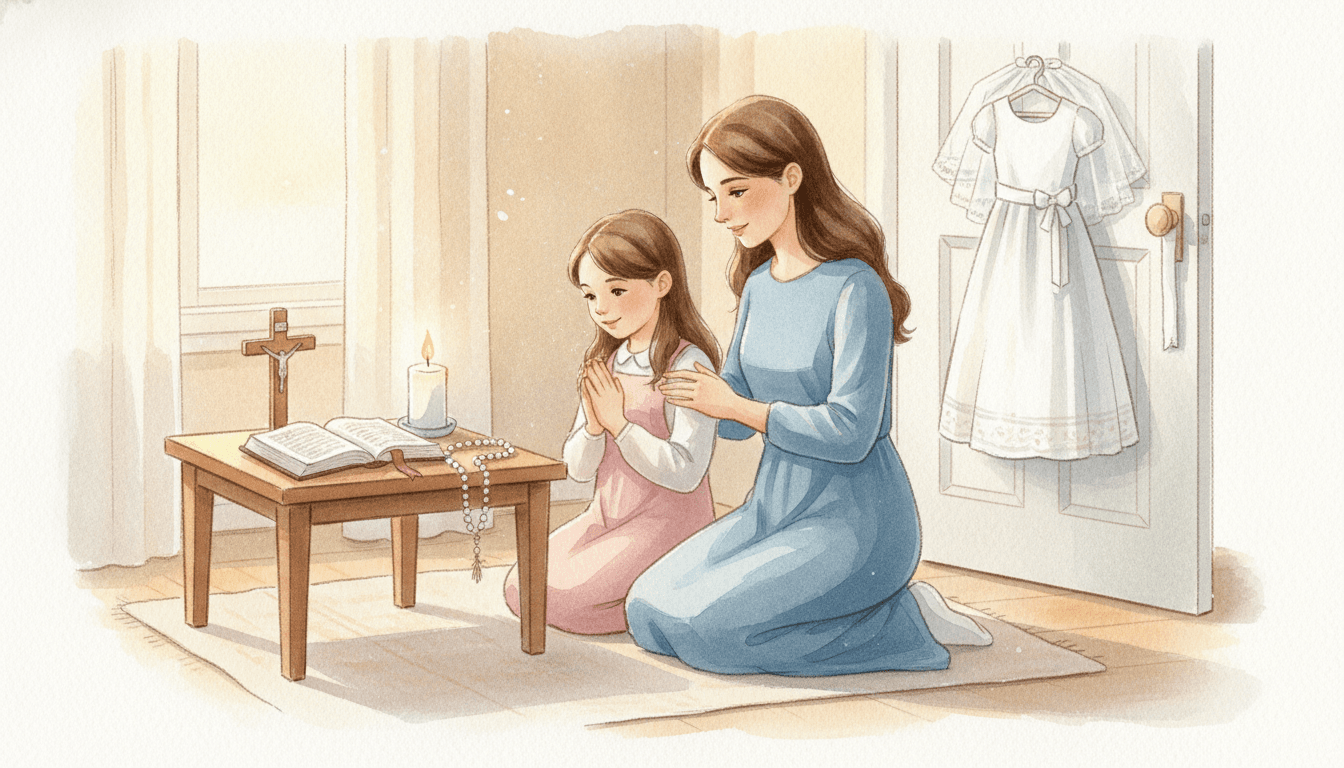
Why David Refused Saul's Armor:A Parenting Lesson on Gifts
David’s refusal of Saul’s armor offers parents a vivid lesson: children flourish when guided according to their God-given strengths, not forced into someone else’s mold. Discover how discernment can r
Have you ever watched a capable child falter because he was trying to succeed like a sibling, classmate, or friend? Before David faced Goliath, he made a quieter act of courage: he removed armor that did not fit his formation. Scripture invites us to consider whether our children need more pressure to conform—or wiser help recognizing the gifts God has already entrusted to them.
The Quiet Courage Behind David's Refusal

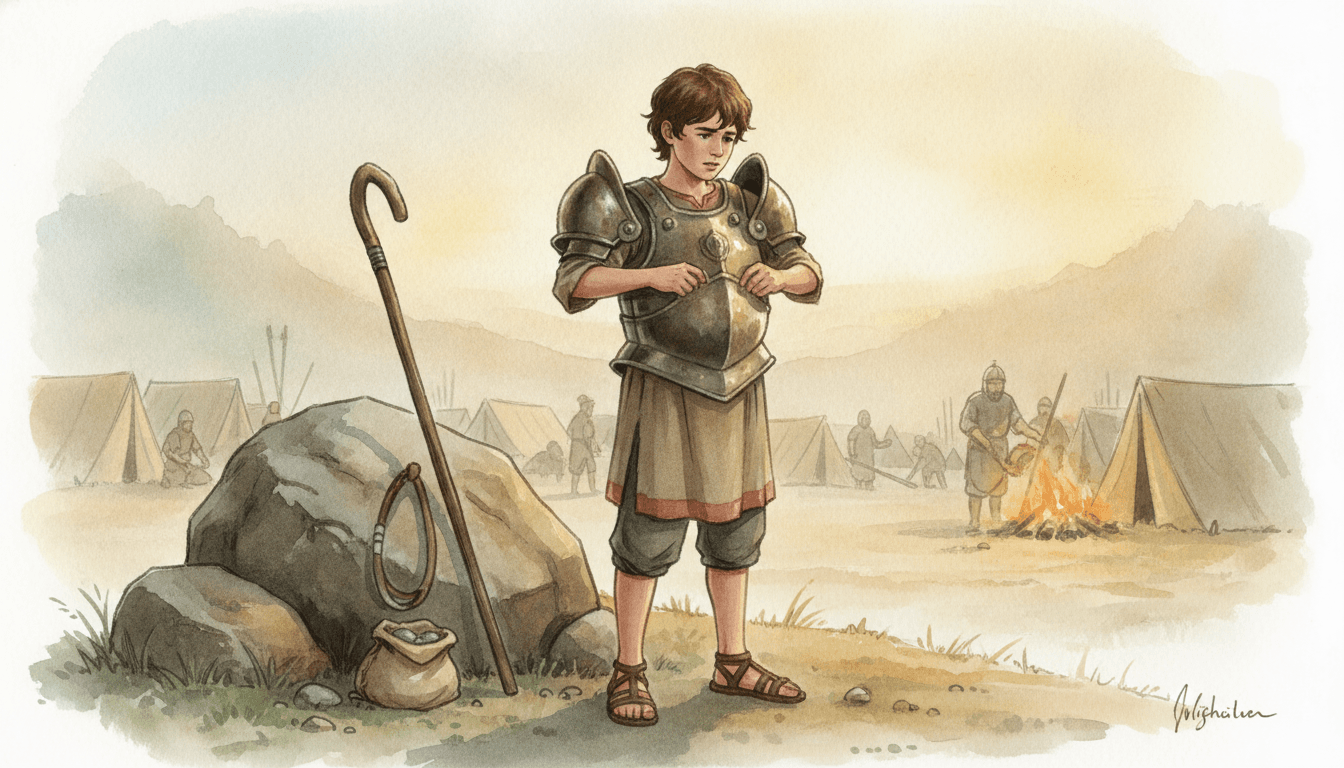
The bronze helmet settles over David’s head, the coat of mail hangs from his shoulders, and Saul’s sword is fastened over the armor. For a moment, the young shepherd looks like the kind of warrior everyone expects to face Goliath. Then he tries to walk. He cannot move freely. David removes the equipment and says plainly that he has not tested it. His courage begins not with picking up the sling, but with admitting that another man’s armor does not fit him.
David’s refusal is neither disrespect nor impulsive self-confidence. Saul is still the king, and David accepts his help long enough to test what has been offered. He does not reject preparation itself; he discerns between preparation that serves his calling and equipment that restricts him. Scripture invites us to notice the humility in that distinction. David knows what he can do, what he cannot yet do, and where his confidence truly belongs. He will later tell Goliath that he comes in the name of the Lord of hosts, so his decision is grounded in trust rather than pride.
After taking off the armor, David returns to his staff, sling, and five smooth stones. These are modest tools, but they are not shortcuts. They belong to years of ordinary fidelity in the fields: guarding sheep, watching carefully, practicing with the sling, and facing danger when no crowd was present. God’s preparation of David had already begun in hidden work. The shepherd’s gifts did not look impressive beside royal armor, yet they had been tested through responsibility and strengthened by grace.
This is where the passage speaks directly to parents. A child may struggle in the armor that fits a sibling, classmate, or admired adult. One child speaks readily; another needs time to form an answer. One serves at the altar; another notices the lonely child after Mass. One learns through books; another understands by building, drawing, singing, or asking persistent questions. Our task is not to pretend that every preference is a gift or that weaknesses require no formation. Rather, as the Catechism reminds us in its teaching on parental responsibility, we must act for the child’s true good and nurture the vocation God has given that particular child (CCC 2223).
Here’s how I’d teach this at home or in a parish classroom: read the passage slowly, then ask, “What had David already practiced?” and “Why was taking off the armor courageous?” Invite children to name one ability they are developing and one area where they still need help. Parents can praise specific effort—patient practice, careful listening, generous service—without comparing children. David did not win because he believed vaguely in himself. He acted with truthful self-knowledge, received through years of faithful work, and placed those tested gifts at God’s service.
Saul clothed David in his own armor... David said to Saul, “I cannot go in these, because I am not used to them.” So David took them off.
When Children Are Asked to Wear Borrowed Armor

At the kitchen table, one child finishes the religion worksheet in minutes while another wants to discuss every picture. A third remembers the lesson only after acting it out with toy figures. The temptation is to decide that the quickest child is the brightest, the talkative child is inattentive, or the active child is not taking faith seriously. Yet these children may simply be showing us different ways of receiving, processing, and expressing what they have learned.
Borrowed armor appears whenever a child is expected to succeed by copying someone else. It can sound like, “Your sister never needed help with math,” or, “I loved piano at your age, so you will too.” It can also enter family prayer when we assume that every child must sit still for the same length of time, speak readily during spontaneous prayer, or connect with God through the same devotion. Healthy expectations teach children to persevere, practice self-control, honor commitments, and grow beyond what is comfortable. Borrowed armor, by contrast, asks them to imitate another person’s temperament, interests, pace, or form of achievement.
Scripture invites us to see difference without turning it into rivalry. Saint Paul teaches that gifts and forms of service differ while coming from the same Lord. Giftedness, in this Christian sense, is larger than academic ability or artistic talent. It includes the child who notices when someone is left out, the child who asks precise questions about the faith, the child who works patiently with his hands, and the child whose quiet prayer is more sincere than polished. These gifts still need discipline and formation. David’s sling required practice; it was not an excuse to avoid preparation.
As the Catechism reminds us, parents have the first responsibility for the education of their children, including their moral and spiritual formation (CCC 2223). That responsibility calls for close attention. We can ask: Is this expectation helping my child grow in virtue, or merely making family life look uniform? Am I correcting laziness, or am I misreading a slower learning style? Does this child need firmer boundaries, a different explanation, more movement, additional time, or a quieter setting? Truthful acceptance does not erase weaknesses. It gives parents a sound place from which to address them.
Here’s how I’d teach this at home: name one specific strength you see, connect it to service, and give it a fitting responsibility. Tell the observant child, “You noticed Grandma was tired; please help set her place.” Invite the questioning child to look up a Scripture passage with you. Let the child who struggles to speak aloud draw an intention for the family prayer basket. Avoid labels such as “the smart one” or “the holy one,” which can become armor of another kind. Our task is not to produce identical children, but to help each child recognize the gifts God has given, submit those gifts to formation, and offer them for the good of others.
There are different forms of service but the same Lord... To each individual the manifestation of the Spirit is given for some benefit.
Christian Giftedness Is More Than Self-Esteem
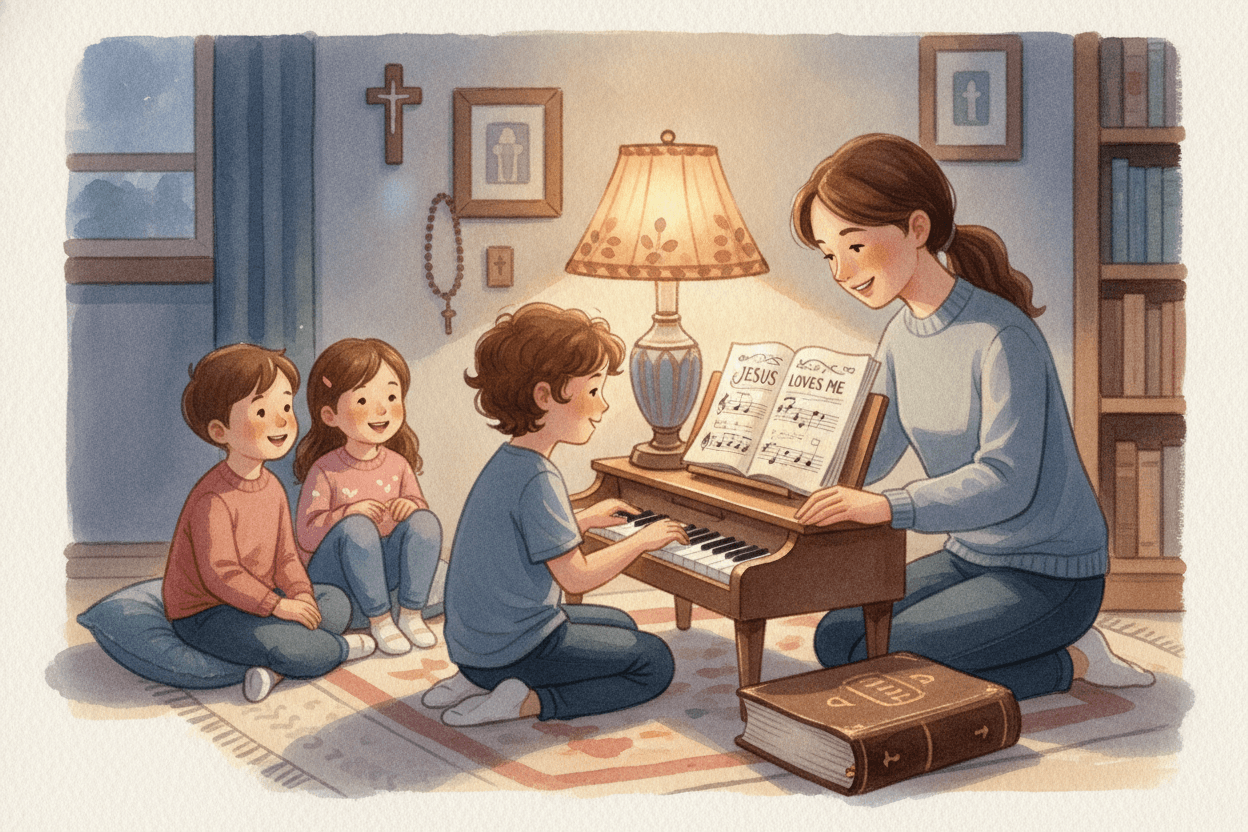
A child brings home a carefully drawn picture, and our first response may be, “You are amazing!” The praise is affectionate, but it does not yet help the child understand the gift. A more attentive response sounds different: “I see how patiently you worked on those details. You have a good eye for color. How might you use that gift for someone else?” Christian confidence grows when children learn not only that they are valued, but also that their abilities have a purpose beyond applause.
Scripture gives us the proper starting point: “For we are his handiwork, created in Christ Jesus for the good works that God has prepared in advance.” A child’s identity rests first in being created and loved by God, then called through baptism to life in Christ. Talents matter, but they are not the foundation of personal worth. A child who excels in music is not more precious than the child who struggles to keep a tune. The gifted athlete, patient listener, quick reader, and faithful helper each receive life as a gift before they accomplish anything at all.
This keeps our language about giftedness from becoming self-esteem alone. David did not refuse Saul’s armor because he needed to feel special or prove his originality. He recognized truthfully what he had and had not been prepared to do. In the same way, recognizing a child’s strengths does not mean denying sin, excusing poor behavior, or avoiding discipline. Natural ability still requires practice, humility, correction, and grace. A bright child must learn diligence; a confident child must learn charity; a talented child must learn that gifts are given for service.
As the Catechism reminds us, parents bear the first responsibility for the education of their children, creating a home marked by tenderness, forgiveness, respect, fidelity, and service (CCC 2223). That responsibility includes seeing each child accurately. We should resist assigning fixed family roles such as “the smart one,” “the difficult one,” or “the holy one.” Such labels can become another kind of borrowed armor. Instead, name particular growth: “You stayed with that task when it was hard,” or, “You noticed your brother needed help.” Specific praise teaches children to recognize grace at work without making achievement their identity.
Here’s how I’d teach this at home or in a parish classroom: ask each child to name one ability, one area that needs growth, and one way the ability could serve another person. The child who loves talking might welcome someone new. The child who enjoys order might help prepare the prayer table. The child who asks difficult questions might learn to seek answers patiently in Scripture and Church teaching. We are not trying to make children impressive. We are helping them receive themselves truthfully as God’s handiwork, then form their gifts through effort and offer them in love.
For we are his handiwork, created in Christ Jesus for the good works that God has prepared in advance.
Parents Nurture a Vocation They Do Not Own

A child pauses at the parish sign-up table while a parent points toward the choir sheet: “Your sister loved singing at Mass.” Yet the child keeps glancing at the altar-server form. Such moments may seem small, but they reveal a serious parental task. We can offer experience, encouragement, and wise limits; we cannot decide in advance the precise way God will ask a child to serve. Saul could place armor on David, but he could not make that armor David’s calling.
Scripture invites us to notice that Jesus receives children as persons who already belong to God’s kingdom: “Let the children come to me, and do not prevent them; for the kingdom of heaven belongs to such as these” (Matthew 19:14, NABRE). Parents bring children to Christ through Baptism, prayer, the sacraments, moral instruction, and the daily habits of Christian life. But bringing a child to Jesus is not the same as scripting the child’s future. Our sons and daughters come through us, but their lives answer finally to God.
The Catechism gives parents real authority and equally real limits. CCC 2221-2229 describes parents as the first educators of their children, responsible for forming them in faith, virtue, freedom, and service. The home should teach forgiveness, fidelity, prayer, self-denial, and concern for others. Parents also provide boundaries because freedom needs formation; David’s skill with a sling did not appear from wishful thinking but from ordinary work, discipline, and courage in the fields. Giftedness without character is not yet readiness for vocation.
At the same time, CCC 2230 teaches that, as children mature, they have the right and duty to choose their profession and state of life. Parents may advise them, especially when those choices affect the good of the family, but they must not treat a child’s future as parental property. The USCCB expresses this responsibility plainly: “Parents are responsible for nurturing the vocation of each child.” To nurture is to tend what God has planted. It is not to replace it with the plan that earned an older sibling praise or fulfilled a parent’s unfinished hopes.
Here’s how I’d teach this in a family or parish classroom: ask each child, “What work helps you love God and serve others well?” Then listen for particular evidence. Perhaps one child notices the lonely person, another explains difficult ideas patiently, and another works steadily without recognition. Praise the effort and virtue attached to those gifts rather than assigning a fixed label. Keep offering sacramental life, sound teaching, correction, and opportunities to serve. Like David testing Saul’s armor, children need room to discover what they can faithfully carry. A parent’s success is not measured by producing a smaller copy of oneself, but by helping a child recognize and answer the Lord’s particular call.
This discernment does not mean approving every preference or confusing desire with vocation. David’s refusal was truthful because it rested on tested ability, prior responsibility, and trust in God—not mere dislike of discomfort. Parents therefore ask careful questions, correct pride, strengthen weak areas, and seek counsel when needed. Yet they also remain humble before the mystery of a child’s life. We form, protect, and accompany; God calls.
Jesus said, “Let the children come to me, and do not prevent them; for the kingdom of heaven belongs to such as these.”
David Trusted God—and the Training of Ordinary Days
A child stands at the kitchen counter, slowly measuring flour while everyone else has finished the task. We may see spilled sugar and an afternoon schedule slipping behind. Yet something quieter may be happening: patience is growing, attention is sharpening, and the child is learning to begin again after a mistake. God often prepares his servants in ordinary places long before anyone recognizes what that preparation is for.
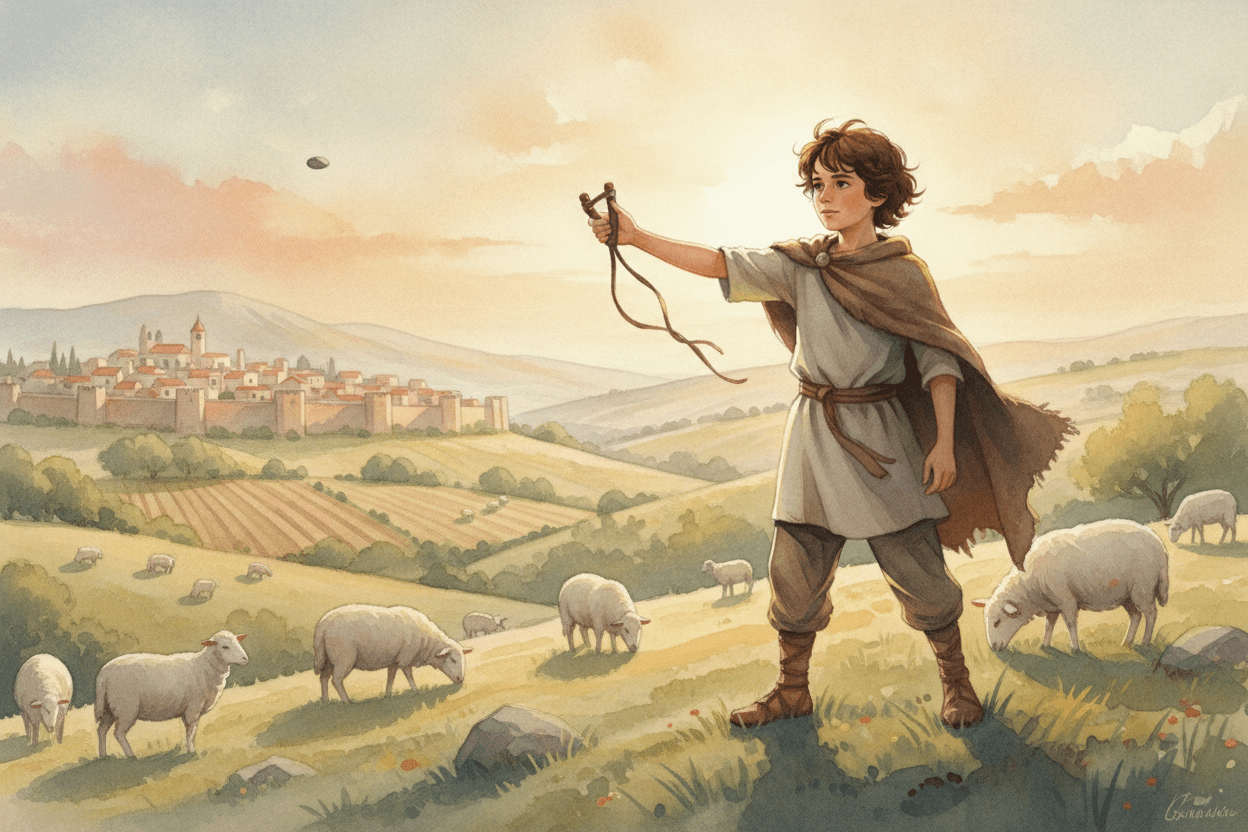
David did not approach Goliath with empty confidence. His years as a shepherd had trained him to watch carefully, act courageously, and use familiar tools with skill. When Saul’s armor restricted him, David did not reject preparation itself; he rejected equipment for which he had not been prepared. He chose what had been tested through daily responsibility. Even then, his confidence rested neither in the sling nor in his own ability. He told the Philistine that he came “in the name of the LORD of hosts.”
Scripture invites us to hold both truths together. Natural gifts matter, and faithful practice matters, but neither replaces dependence upon God. David’s shepherding formed him, while the Lord remained the source of his courage and victory. This is different from telling a child, “You can do anything if you believe in yourself.” Christian formation teaches something sturdier: receive your gifts truthfully, practice them faithfully, and entrust their purpose to God.
Parents may not immediately know which ordinary experiences are preparing a child for future service. A weekly chore can form reliability. Music practice can teach perseverance. Caring for a younger sibling can reveal tenderness and leadership. Losing a game can expose pride and then make room for humility. A quiet habit of prayer can teach a child where to turn when skill is not enough. None of these moments looks dramatic, but neither did shepherding before the battle.
As the Catechism reminds us, parents exercise their responsibility with the child’s true good in view, offering instruction and the example of faithful living (see CCC 2223). That requires attentive observation rather than constant comparison. Notice particular growth: “You stayed with that problem even when it was frustrating,” or, “You saw that your classmate was alone and included him.” Praise should name effort, virtue, and service—not merely talent or results. This helps children understand that gifts are entrusted to them for love of God and neighbor.
Here’s how I’d teach this at home or in a parish classroom: ask each child to name one ordinary activity that has taught patience, courage, kindness, or careful attention. Then ask, “How might God use that virtue to help someone else?” We do not need to predict a child’s whole vocation. We can simply honor the training already taking place and help the child recognize that small acts of fidelity are never wasted in God’s providence.
David answered the Philistine: “You come against me with sword and spear and javelin, but I come against you in the name of the LORD of hosts...”
Try a No-Borrowed-Armor Practice This Week
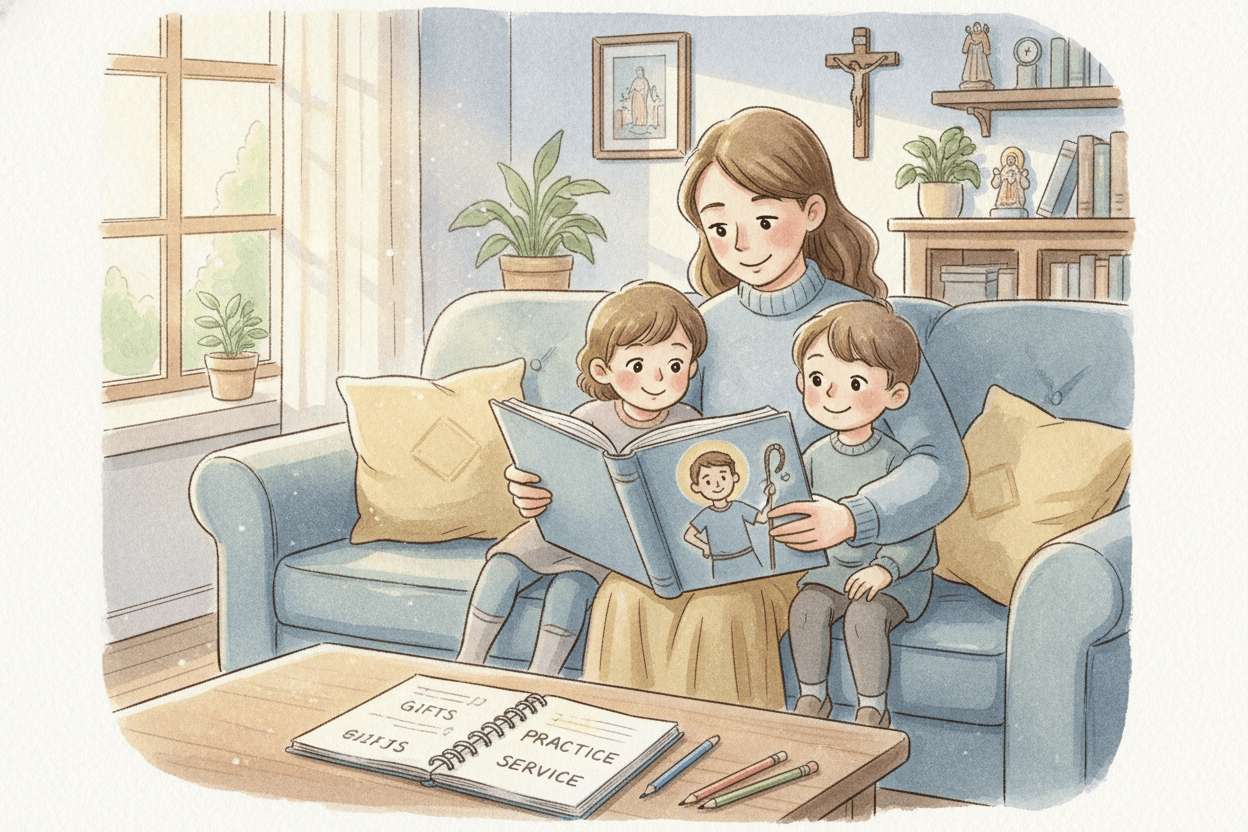
On Monday morning, notice the first comparison that rises to your lips: “Your sister never forgets her homework,” or “Why can’t you sit still like the other children?” Do not say it. Pause, take a breath, and replace comparison with observation. You might say, “You are having trouble remembering what belongs in your backpack. Let’s make a plan.” Day one is simply this: stop one comparison before it becomes borrowed armor.
On day two, name one particular gift you see in each child. Be concrete. “You notice when someone is left out,” carries more truth than “You’re so nice.” “You keep working when the answer is difficult,” teaches more than “You’re brilliant.” If you have several children, write one sentence for each of them. Giftedness includes intellectual ability, but it also includes patience, humor, craftsmanship, courage, hospitality, attentiveness, and a desire for justice.
For days three and four, change what you praise. Notice effort, fidelity, and service rather than fixed labels or public success. Thank the child who practices an instrument without applause, helps a younger sibling, asks a thoughtful question at Mass, or admits a mistake. This is not empty affirmation. It is truthful attention to grace at work in ordinary choices. As the Catechism reminds us, parents educate chiefly through the witness of their own lives and bear responsibility for their children’s human and spiritual formation (CCC 2223).
On day five, ask a quiet question: “Is there anywhere you feel as though you cannot move freely or be yourself?” A child may mention a sport, academic expectation, friendship, parish activity, or family role. Listen without immediately fixing the problem. Saul’s armor was honorable equipment, but it did not fit David’s preparation. In the same way, a good activity can still be the wrong fit for a particular child at a particular time. Discernment requires both honesty and patience.
On day six, choose one small opportunity for the child’s gift to serve someone else. A careful reader might proclaim at family prayer. A child who loves baking might make muffins for an elderly neighbor. A natural organizer could prepare supplies for a parish project. A strong storyteller might entertain a younger cousin. Christian gifts are not trophies. Scripture invites us to recognize that gifts become fruitful when they are offered for the good of others.
On day seven, read 1 Samuel 17:38-40 together. Ask, “What did David know about himself, and what did he know about God?” Then pray: “Lord, help us recognize the gifts you have given each person in our family. Give us wisdom to form them, courage to use them, and humility to offer them in service. Amen.” To continue the conversation, revisit the full David and Goliath story through the related BibleHeroes comic, inviting each child to notice how ordinary preparation, wise refusal, and trust in God belong together.
Saul clothed David in his own armor... David said to Saul, “I cannot go in these, because I am not used to them.” So David took them off.
Frequently asked questions
Why did David refuse to wear Saul’s armor?
David tested Saul’s armor but realized he could not move freely in equipment he had never used. He chose the sling and staff he had practiced with as a shepherd, trusting the abilities God had formed through years of faithful work.
What can parents learn from David taking off Saul’s armor?
Children should not be forced to succeed by copying a sibling, classmate, or parent. Parents can maintain healthy expectations while choosing methods and responsibilities suited to each child’s temperament, development, and God-given gifts.
How do I recognize my child’s God-given gifts?
Watch how your child learns, serves, solves problems, prays, and responds to other people’s needs. Name specific strengths such as careful listening, persistence, compassion, practical skill, or thoughtful questions, then provide fitting opportunities to use them in service.
How can I encourage giftedness without excusing weaknesses?
Accepting a child’s individuality does not mean avoiding discipline or difficult growth. Ask whether the child needs more practice, firmer boundaries, extra time, a different explanation, movement, or a quieter setting, and continue teaching perseverance and self-control.
How can I avoid comparing my children?
Praise concrete effort and virtue instead of assigning labels such as “the smart one” or mentioning what a sibling did more easily. Give each child responsibilities that connect personal strengths to loving service, while making clear that every gift still requires formation.
How can I teach the story of David and Goliath at home?
Read the passage slowly and ask what David had already practiced and why removing the armor required courage. Invite each child to name one developing ability and one area where help is needed, then discuss how those gifts can be placed at God’s service.
Sources: bible.usccb.org · bible.usccb.org · usccb.org · vatican.va · catholic.com · dioceseoflansing.org · biblehub.com · pewresearch.org
Scripture quotations in this article use the NABRE translation.