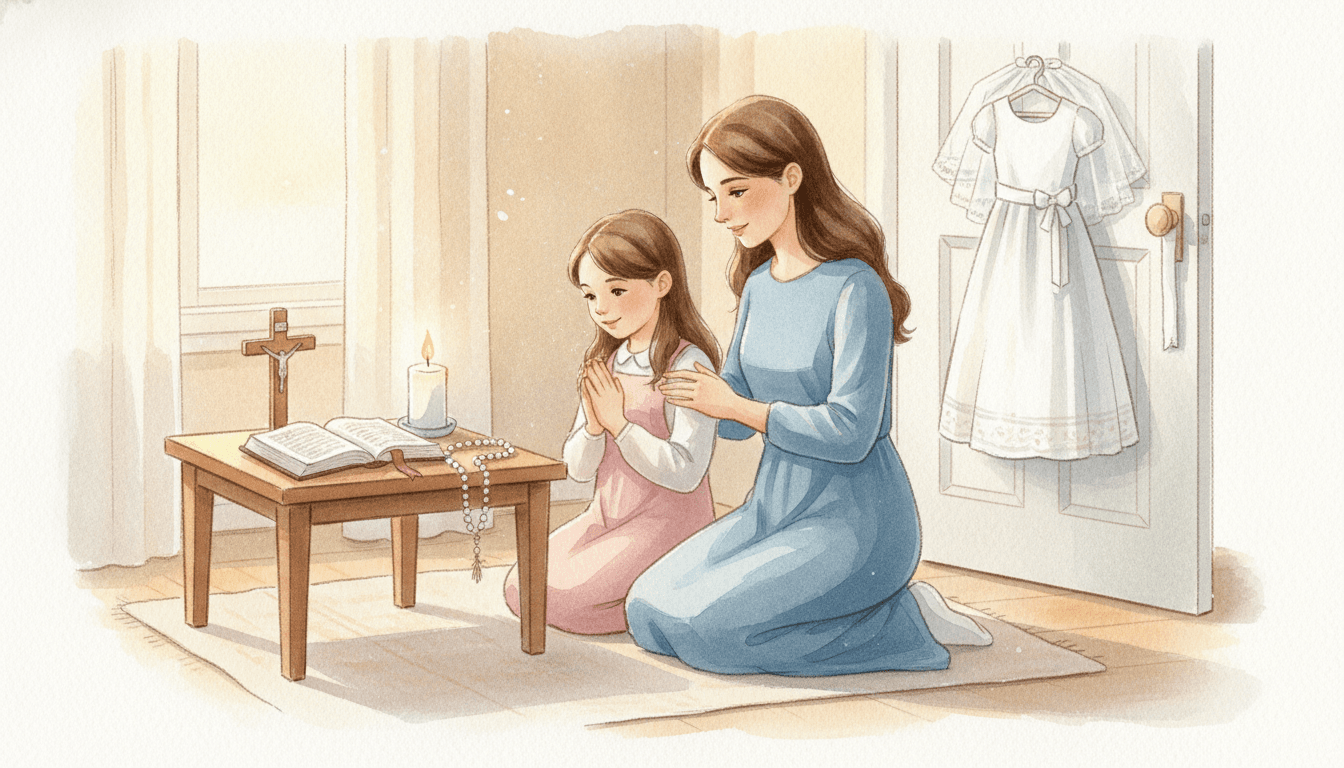
Why Mary’s Fiat Matters in the Messy Work of Parenting
Mary’s fiat offers parents a deeper vision of yes: not perfection, control, or endless energy, but trust amid interruption and uncertainty. Her example helps us recognize holiness in the ordinary, cos

The cereal is on the floor, someone has lost one shoe, and a small person needs you right when you have nothing left to give. Parenting asks for more yeses than we ever expected. Mary’s fiat shows us that a yes to God is not polished or painless; it is trust offered in the middle of a real life.
Mary’s Yes Began With a Question, Not a Perfect Plan

The baby was crying, the pasta had gone cold, and somebody had colored a blue stripe down the dog’s side. In those moments, a parent can feel like God has handed over an assignment with no instructions attached. We want the plan: what to say, what doctor to call, how to fix the friendship problem, how to make bedtime stop feeling like a tiny labor dispute. But most days, we get the next small step instead.
That is one reason Mary’s response at the Annunciation matters so much. She was not handed a neat five-year plan. Luke tells us she was “greatly troubled” by the angel’s greeting. She asked, “How can this be, since I have no relations with a man?” That is not the voice of someone pretending everything makes sense. It is the honest question of a young woman facing news that would change her body, her future, and how other people saw her.
Then Mary gave her yes. Not because every loose end had been tied up. Not because fear had vanished. She trusted the God speaking to her more than she trusted her own ability to see the whole road. Her fiat was active trust. And it became a lifelong yes: in the quiet years of raising Jesus, in the moments when others misunderstood him, and finally at the cross. Parents know something about that kind of yes. We say it again when the baby wakes at 2 a.m., when a child needs help we do not know how to give, and when love asks more of us than our schedule had planned.
This is good news for the parent carrying an unsolved problem today. You do not need a perfect plan before you pray, call for help, apologize, set a needed boundary, or bring your child to Mass again after a rough Sunday. You can ask God real questions. You can say, “How can this be?” Then, with the light you have been given, you can take the next faithful step. Faith is not acting as if hard things are easy. It is placing the hard thing in God’s hands while you keep showing up for the kid in front of you.
One small thing we tried in our house was changing our end-of-day prayer when life felt especially scrambled. Instead of making a long list of things to solve, we named one worry and said, “Lord, we do not know the whole plan. Help us say yes to what you ask tomorrow.” It is a small prayer. Still, it helps. Mary’s yes reminds us that God does not wait for parents to become calm, polished experts before he works through them. He meets us in the question, and he gives grace for the next yes.
Mary said, “Behold, I am the handmaid of the Lord. May it be done to me according to your word.” Then the angel departed from her.
What Mary’s Fiat Actually Means for Parents

The cereal was on the floor again. One child was crying because the blue cup was dirty. Another had decided socks were a personal injustice. I remember standing there with coffee going cold, feeling less like a patient Catholic dad and more like a referee who had lost control of a very small stadium. Parenting can make us think God’s will must be hiding somewhere beyond the mess. Usually, it meets us right in it.
Mary’s fiat means “let it be done.” Her words were not a shrug, as if she were saying, “Fine, whatever happens, happens.” She had asked a real question. She knew this would change everything. Her yes involved uncertainty, risk, and a future she could not map out. Yet she freely placed herself in God’s hands. As St. John Paul II wrote in Redemptoris Mater, she entrusted herself to God “without reserve.” That is active trust, not passive resignation.
For parents, this can sound like a yes to the child who woke up sick at 2 a.m., the appointment we did not expect, the hard conversation after school, or the season that looks nothing like the family life we pictured. We do not have to call those things easy or pretend we enjoy every part of them. Mary did not receive a tidy five-year plan. She received a call, then took the next faithful step. Her yes became a whole life of loving Jesus through hidden days, public confusion, and deep sorrow.
Here’s what landed for me: God is not asking me to parent some imaginary, always-grateful child in an always-orderly home. He asks me to love the actual kids at our table. Their loudness, their questions, their particular worries, their strange resistance to wearing pants when it is time to leave. Grace does not erase our children’s personalities or our limits. It helps us cooperate with God as he works in the people he has given us.
One small thing we tried was turning our rushed morning prayer into a simple sentence: “Mary, help us say yes to God today.” The kids can say it, even with toothpaste on their faces. So can I, especially when I am tempted to answer irritation with irritation. A parent’s fiat may look ordinary: apologize after snapping, pray before a difficult decision, get everyone to Mass when it would be easier to stay home, listen for two more minutes. These small yeses teach our children that faith is not about getting life perfect. It is about trusting God enough to love the person in front of us.
Mary said, “Behold, I am the handmaid of the Lord. May it be done to me according to your word.” Then the angel departed from her.
The Daily Yes Is Usually Small and Unremarkable

At our table, the grand plans usually last until somebody spills milk. One morning, a child woke up warm and miserable before dawn, another could not find a shoe, and the lunchboxes were still empty. There was no soaring music. Just a damp washcloth, a last-minute granola bar, and a whispered, “Lord, help me be kind today.” That was a yes. Not the kind anybody applauds. Still a real one.
Mary’s yes did not end when the angel left. Luke tells us that after she said yes, “Mary set out and traveled to the hill country in haste” to see Elizabeth. She moved toward the next faithful thing. Parents know that rhythm. The prayer is followed by packing the diaper bag. The decision to trust God is followed by answering the same question for the fourth time before 8 a.m. Faith has feet on it.
The daily yes can look like getting up with the sick child when you were already running on fumes. It can be apologizing after you snapped because the noise level in the house briefly reached airport-runway status. It can be holding a needed boundary without turning cold: “I love you. The answer is still no.” These moments do not make us perfect parents. They make us parents who are learning to receive mercy and give it.
It also looks like going to Mass when everyone is wearing one sock, somebody has to use the bathroom during the Gospel, and your toddler offers a loud opinion during the quietest part. Go anyway when you can. Let your children see that God is worth the effort, even when the effort is messy. Research keeps finding that children are shaped by the faith they actually see at home: prayer, forgiveness, Sunday worship, and parents who start again after a hard day.
One small thing we tried was praying one decade of the Rosary while folding laundry. Not the whole Rosary. Just one decade, with socks everywhere and a child occasionally adding a mystery that was definitely not on the list. Here’s what landed: the point was not to create a holy-looking house. It was to make a little room for God in the house we already had. A parent’s yes is often quiet, repetitive, and unseen. God sees it. And over time, the kid in front of you learns what it looks like to say yes too.
Mary said, “Behold, I am the handmaid of the Lord. May it be done to me according to your word.” Then the angel departed from her. During those days Mary set out and traveled to the hill country in haste to a town of Judah, where she entered the house of Zechariah and greeted Elizabeth.
A Faithful Yes Does Not Mean You Never Say No
Last Tuesday, one child wanted a snack, another wanted my phone, and the third wanted me to watch a cartwheel in the hallway. All at the same time. I felt that familiar pull to say yes to everybody, mostly so the room would get quieter. It did not work. It never does. Parenting can make us think faithfulness means being endlessly available, endlessly cheerful, and somehow able to meet every need before anyone has time to cry.
Mary gives us a better picture. Her yes to God was real trust, but it was not mindless agreement or self-erasure. Before her fiat, she asked a direct question. She wanted to understand what she was being asked to receive. That matters for parents. A faithful yes is not, “Sure, whatever keeps everyone happy.” It is a steady willingness to choose what God has entrusted to us, even when our children disagree loudly from the back seat.
Sometimes that means saying no to one more activity because dinner has become a drive-through event six nights a week. It means no to a screen that is making a child crankier, not calmer. It means no to a sharp tone from us, too; we can pause, apologize, and begin again rather than calling our impatience “just how family life is.” At our table, one small thing we tried was putting phones away for the first fifteen minutes of dinner. The children did not applaud the decision. But the room slowly became more human.
A parent who says no to unhealthy patterns is not withholding love. He is protecting space for love to grow. We cannot make every child happy at once, and we are not meant to. We can say, “I know you are disappointed. I still love you. The answer is no.” That is not cold. It is clear. Mary’s trust helps us remember that God’s will is not a pile of demands meant to flatten us. His priorities put people, prayer, truth, rest, and mercy back in their proper places.
And if home life feels overwhelming or unsafe, asking for help is wise, not faithless. Talk with a spouse, trusted family member, pastor, counselor, doctor, or local support service. A yes to God can include a firm no to abuse, addiction, secrecy, or carrying a burden alone. Mary did not pretend the angel’s message was simple. She brought her question to God, then took the next faithful step. Here’s what landed for me: we do not have to say yes to everything. We are trying to say yes to the good God is placing in front of us today.
But Mary said to the angel, “How can this be, since I have no relations with a man?” And the angel said to her in reply, “The holy Spirit will come upon you, and the power of the Most High will overshadow you. Therefore the child to be born will be called holy, the Son of God. And behold, Elizabeth, your relative, has also conceived a son in her old age, and this is the sixth month for her who was called barren; for nothing will be impossible for God.”
Your Children Learn From the Yes They Can See

Last Tuesday, one of the kids knocked over a full cup of water just as dinner hit the table. Nobody was hurt, but everyone was tired, and the spill somehow felt personal. I started to snap. Then I took a breath, grabbed a towel, and said, “Okay, Lord, help us.” It was not a polished family prayer. It was more like a parental distress signal. But the kids heard it.
Our children learn a great deal from the yes they can see. They notice when we pray because we are worried about Grandma’s appointment. They notice when we go back to Mass after a hard week, even when getting everyone dressed feels like organizing a small evacuation. They notice when we apologize after speaking too sharply. They notice when we bring a meal to a neighbor, make the sign of the cross before a road trip, or thank God for something ordinary at bedtime.
Mary’s yes did not stay inside one private moment with the angel. It became the shape of her life. Her words of praise came from a heart that had trusted God with something she could not fully control: “My soul proclaims the greatness of the Lord; my spirit rejoices in God my savior.” That is not the voice of someone whose life is easy. It is the voice of someone who knows God is present and good, even when the next step is not clear.
Research on faith in families points in a simple direction: parental example, support, and shared practices matter. That should not put a heavy backpack of guilt on any parent. None of us gets this right every day. It is an invitation to make faith visible in small, repeatable ways. In our house, one small thing we tried was naming one gift from God at dinner. Some nights the answers are thoughtful. Some nights somebody says, “Chicken nuggets.” Fair enough. Gratitude still got a seat at the table.
This week, let your children catch you saying yes in one ordinary place. Pray out loud for thirty seconds when a worry arrives. Go to Mass and tell them, simply, “We need Jesus.” Ask forgiveness without adding a speech about why you were really right. Thank God for the rain, the paycheck, the friend who helped, or the quiet five minutes after bedtime. A child may not remember every lesson we explain. But they remember the faith they watched their parents practice.
My soul proclaims the greatness of the Lord; my spirit rejoices in God my savior.
Try One Small Fiat This Week

The hard moment in our house usually arrives when someone has spilled milk, someone else cannot find a shoe, and I am already late. That is not when I feel like a saint. That is when I feel like a dad who would enjoy five quiet minutes and a cup of coffee that is still hot. But those are often the exact moments when a small yes is waiting for me.
Mary’s yes was not casual, and it was not based on having every detail worked out. She gave herself to God with a future she could not see. Parents do not face her unique call, of course, but we do know the feeling of being asked to love when we are tired, to stay gentle when a child is loud, or to do the right thing when nobody is clapping. A fiat can be as ordinary as getting down on the floor to help with a knotty shoe instead of barking instructions from across the room.
Here is one small thing we tried: pick one recurring hard moment this week. Maybe it is the morning rush, homework, bedtime, the drive to school, or the tenth request for water after lights-out. When it comes, pause for one breath. Then pray quietly, “Mary, help me say yes to God in this.” It will not make every child suddenly cooperative. Mine certainly did not receive the memo. But that brief pause can keep us from reacting on autopilot. It gives God a little room in the middle of the mess.
Then choose one visible act of faith your children can see this week. Make an apology when you lose your patience. Pray one decade of the Rosary at bedtime. Put Sunday Mass on the calendar and treat it like the family commitment it is. Bring cookies to a neighbor, call a lonely relative, or let your child help pack a bag for someone in need. Faith sticks when children see that we do not merely talk about trusting God; we turn toward him in the ordinary places where family life happens.
Do not aim for a dramatic family overhaul by Friday. Just make one willing response. Your children may not remember every lesson you give them, but they will notice the parent who pauses, prays, repairs, and begins again. If you want a simple way to start the conversation, read the BibleHeroes Annunciation comic together this week. Let Mary’s brave, humble answer meet the kid in front of you—and the parent God is still forming.
Mary said, “Behold, I am the handmaid of the Lord. May it be done to me according to your word.” Then the angel departed from her.
Frequently asked questions
What does Mary’s fiat mean for parents?
Mary’s fiat, meaning “let it be done,” shows that trusting God is not the same as having every answer. For parents, it can mean receiving the real demands of the day with faith and choosing the next loving action, even when life feels messy or uncertain.
How can I say yes to God when parenting feels overwhelming?
Start with one faithful step rather than trying to solve the whole situation at once. You can pray honestly, ask for help, set a needed boundary, apologize after losing patience, or simply care for the child in front of you. Mary asked God a real question before she trusted him, so honest struggle can be part of faith.
Does trusting God mean I should pretend parenting problems are easy?
No. Mary was troubled by the angel’s message and did not receive a complete plan for her future. Trusting God means placing a hard situation in his hands while still taking practical steps, such as calling a doctor, seeking counsel, or having a difficult conversation.
What are some small ways parents can live Mary’s fiat every day?
A daily yes may look ordinary: getting up with a sick child, listening patiently, bringing the family to Mass after a difficult morning, or responding calmly instead of with irritation. These repeated choices help children see that faith is lived through love, not perfection.
What is a simple prayer to Mary for stressed parents?
Try praying, “Mary, help us say yes to God today,” especially during rushed mornings or tense moments. At the end of the day, name one worry and pray, “Lord, we do not know the whole plan. Help us say yes to what you ask tomorrow.”
Sources: biblegateway.com · biblegateway.com · pewresearch.org · apa.org · pubmed.ncbi.nlm.nih.gov · apa.org · catholic.com · wordonfire.org · usccb.org · newadvent.org
Scripture quotations in this article use the NABRE translation.